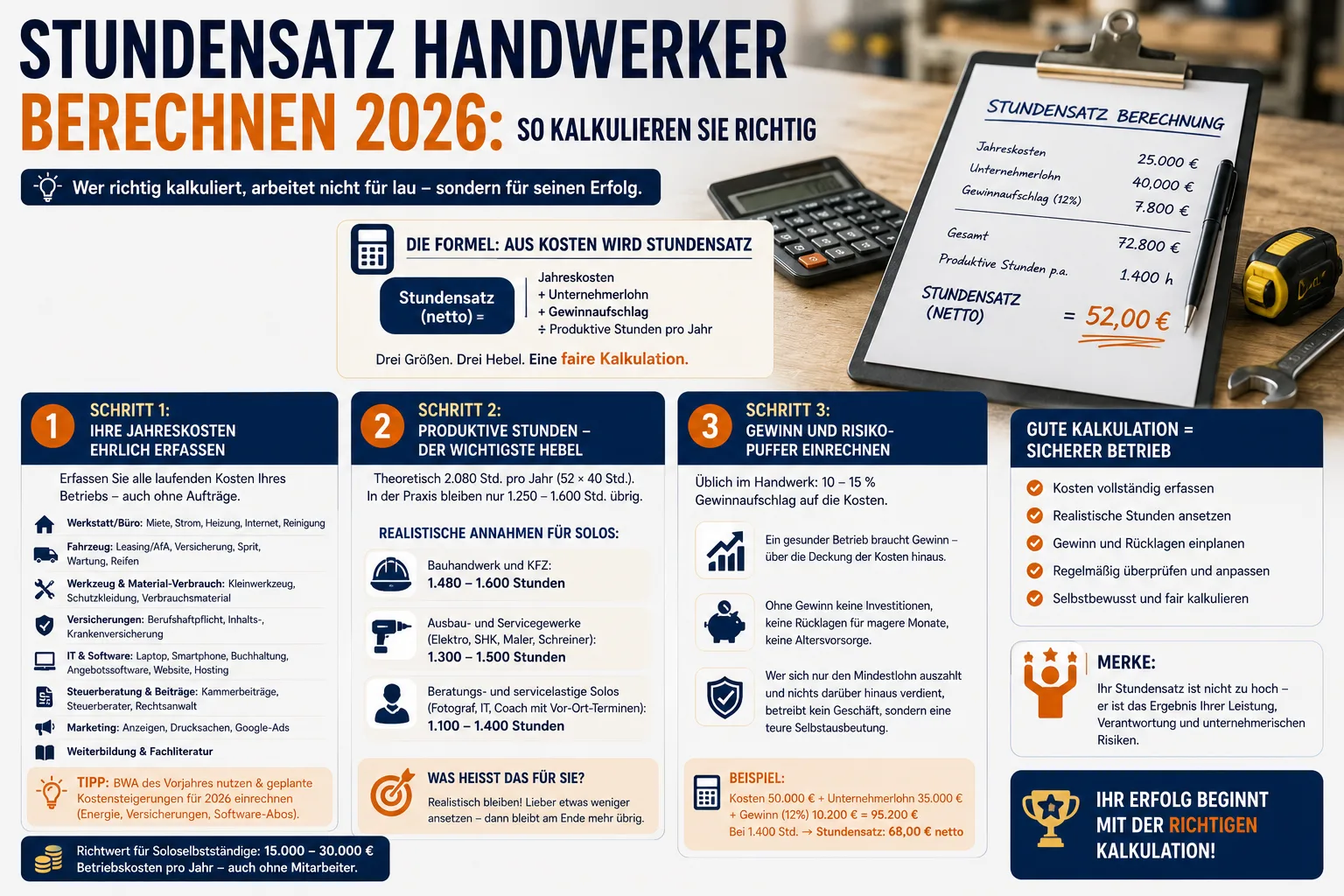
Hourly Rate for Tradespeople 2026: How to Calculate It Right
If you charge too little per hour as a painter, electrician, or carpenter, you'll be working for free by the end of the year. This practical guide shows you how to calculate your 2026 hourly rate properly — with current labour costs, realistic productive hours, and the typical mistake that costs most businesses real money.
Table of Contents
- Why the "gut-feel rate" bleeds you dry
- The formula: from costs to hourly rate
- Step 1: Capture your annual costs honestly
- Step 2: Productive hours — your most important lever
- Step 3: Add profit and risk buffer
- Worked example: solo painter
- What's new in 2026 — minimum wage, sector wages, energy
- Frequently asked questions
- Conclusion
- Sources
Why the "gut-feel rate" bleeds you dry
Many solo tradespeople just take whatever rate the local competition charges and hope it works out. The problem: your competitors may have made the same mistake, or they may be calculating with a completely different workload. Your hourly rate has to fit your costs and your reality.
The most common calculation error is in the hours: anyone calculating with 2,080 working hours per year (52 weeks × 40 hours) typically sets their rate 30 to 40 % too low. Realistically, German trades see 1,250 to 1,600 productive hours per person per year. What does that mean for you? Until you've worked through this step by step, no rate discussion with a customer is worthwhile.
The formula: from costs to hourly rate
The basic formula is simple:
Hourly rate (net) = (annual costs + owner's salary + profit margin) ÷ productive hours per year
Three numbers, three levers. Get one wrong out of optimism and you'll have a hole in your books at year-end. Let's walk through them.
Step 1: Capture your annual costs honestly
List every running cost your business has for a year — whether you have orders or not:
- Workshop/office: rent, electricity, heating, internet, cleaning
- Vehicle: lease or depreciation, insurance, fuel, maintenance, tyres
- Tools & consumables: small tools, protective clothing, materials not directly billed to clients
- Insurance: professional liability, contents, health insurance
- IT & software: laptop, phone, accounting and quoting software, website, hosting
- Tax adviser & fees: chamber dues, accountant, lawyer when needed
- Marketing: ads, printed materials, Google Ads budget
- Training & professional literature
Depending on the trade, solo operators easily reach €15,000 to €30,000 in pure operating costs per year — even without a single employee. If you have staff, add gross salary plus around 21 to 23 % employer contributions.
Tip: use last year's profit-and-loss as a starting point and add planned cost increases for 2026 (energy, insurance, software subscriptions).
Step 2: Productive hours — your most important lever
This is where most businesses lose money. In theory a full-time worker has around 2,080 hours per year (52 × 40). In practice, after holidays (25 days), public holidays (10 to 13 depending on the federal state), illness (around 12 days), training, office work, travel time, and lead-chasing, only 1,250 to 1,600 productive hours remain.
Realistic assumptions for solo tradespeople:
- Construction trades and automotive: 1,480 to 1,600 hours
- Finishing and service trades (electrical, HVAC, painting, joinery): 1,300 to 1,500 hours
- Consulting/service-heavy solos (photographer, IT, on-site coach): 1,100 to 1,400 hours
What does that mean for you? Write down your realistic hour count without fudging it. A slightly conservative number leaves more in the till at year-end.
Step 3: Add profit and risk buffer
A healthy business needs profit — over and above covering costs. In the trades, 10 to 15 % profit on costs is standard. Specialised niches can support higher figures, depending on the market.
No profit, no investment, no reserves for slow months, no retirement provision. Paying yourself only the minimum wage and nothing on top isn't running a business — it's expensive self-exploitation.
Worked example: solo painter
Anna has run her own painting business for three years. She works alone, no employees. Simplified calculation (all values are illustrative and may differ significantly in your case):
| Item | Value |
|---|---|
| Owner's salary (what Anna wants to "earn", gross) | €48,000 |
| Operating costs (workshop, vehicle, insurance, software, tools) | €22,000 |
| Total costs | €70,000 |
| Profit margin 12 % | €8,400 |
| Annual amount to recover | €78,400 |
| Realistic productive hours | 1,400 |
| Net hourly rate | €56/hr |
At 19 % VAT, that's roughly €66.60 gross for end customers. Anna sits squarely in the mid-range of typical 2026 painter rates, which industry sources put between €45 and €65 gross per hour.
If Anna had assumed 2,000 productive hours, her rate would have come out at €39 net — and after 12 stressful months she would effectively have given herself a pay cut.
How this hourly rate later appears on the invoice is more than a formality with private customers: only if the labour costs are shown separately from the material does the customer get their tax relief — see writing a tradesman's invoice to private customers.
What's new in 2026 — minimum wage, sector wages, energy
Germany's statutory minimum wage has been €13.90 per hour since 1 January 2026 and rises to €14.60 on 1 January 2027 (Federal Ministry of Labour and Social Affairs). The electrical trade has its own sectoral minimum of €14.93 since 1 January 2026; building cleaning sits at €15.00 for interior cleaning and €18.40 for glass/façade cleaning (DGB, German chambers of crafts).
For self-employed business owners, this means two things. First, your own labour costs go up as soon as you have staff — that increase belongs in your 2026 calculation. Second, market rates follow suit. If you don't pass on the wage settlement, you'll finance it from your own margin.
Energy and material prices keep rising too. Check at least once a year whether your rate still covers current costs. A €2 to €4 hourly increase every 12 to 18 months is now standard in the trades.
If you want to keep your rates and material markups properly documented, a good quote workflow helps: store your rate, set your material markup, and produce a fully calculated quote with one click. The accepted quote becomes the invoice using the same data — no double entry, no typos. For more structured dunning, see our overview of the cloud invoicing software in PepperTools Office Cloud. For local visibility tips, see Google Business Profile for tradespeople.
Frequently asked questions
What is the average hourly rate for tradespeople in 2026?
Industry data for 2026 cites €45 to €100 gross per hour depending on the trade: painters at the lower end (€45 to €65), electrical and HVAC mid-range (€55 to €90), specialists at the top. Solo operators usually run 10 to 20 % below master shops with employees.
How many productive hours should I assume per year?
For the trades, 1,250 to 1,600 hours is realistic. Once you factor in lead-chasing, travel time, and office work, you'll often land between 1,300 and 1,400. Stay slightly conservative — otherwise you'll calculate yourself poorer than you actually are.
Do I have to publish my hourly rate?
No, solo operators are not generally required to display rates. You do, however, have to disclose the rate transparently in any quote where you bill by the hour. Flat-fee quotes are fine too — but the underlying hourly rate should still sit cleanly in your back-office calculation.
When is it sensible to raise rates for existing customers?
When your costs or sectoral minimum wages have risen significantly. Announce the change in writing 4 to 8 weeks before the next job, briefly cite higher material and labour costs, and give the new rate concretely. A €2 to €4 net jump per hour is usually accepted when your work is solid.
What if competitors are clearly cheaper?
Check your own calculation first, then the market. If your numbers are clean and a competitor sits 20 % below, that competitor usually has one of three problems: undeclared work, missing reserves, or a doomed pricing model. Not every cheap supplier is a long-term competitor.
Conclusion
A properly calculated hourly rate is the foundation of every trade business. If you record your costs honestly, use realistic productive hours, and add a profit margin, you'll have money left at year-end — not just memories of a lot of work. Software that manages rates, material markups, and quotes in one place spares you the manual Excel grind and prevents calculation errors in customer quotes.
Sources
- Minimum wage rises to €13.90 on 1 January 2026 — Federal Ministry of Labour and Social Affairs — Official BMAS press release on the minimum-wage adjustment.
- Statutory minimum wage in Germany 2026 — DGB — German Trade Union Confederation overview of the 2026/2027 minimum wage.
- Sectoral minimum wages 2026 — Chamber of Crafts Halle (Saale) — Current sectoral minimum wages in the trades, including electrical and building cleaning.
- Hourly cost calculation in the trades — Haufe — Methodological guide for calculating productive annual hours.
- Minimum wage 2026 and 2027 — Deutsche Handwerks Zeitung — Background and sectoral implications of the minimum-wage rise for the trades.
Handle invoices more easily
Easy Invoice combines quotes, invoices and customer management in the cloud.
Try Easy InvoiceRead next
 Trades & Services
Timesheets in Germany: template, required entries and the seven-day rule
A German timesheet needs six entries, no more. For mini-jobbers and in eleven industries it must be filled in within seven days — and stay available for two years.
 Trades & Services
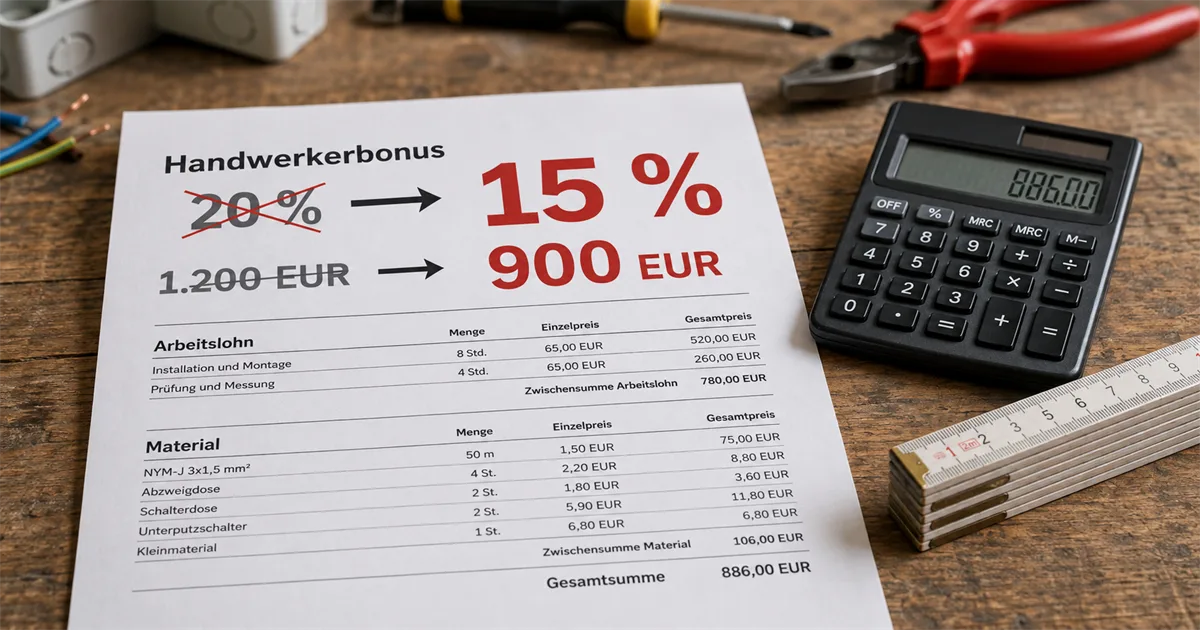
German trade tax credit set to drop to 15 percent: your customer loses up to 300 euros from 2027
In 2026, 20 percent and 1,200 euros still apply unchanged. The cut is planned for 2027 but not yet law – what your customers need to know now.
 Trades & Services
Hiring a minijob employee: what a 603-euro job really costs
A minijob employee costs more than their wages. What a 603-euro job costs per month and per hour in 2026, how many hours it covers, what the accident insurance fund charges and how you register the job.