Wero in Online Retail 2026: Fees, Plugins, Integration
A new payment wallet is pushing into the checkout: Wero, backed by European banks, is launching in German online retail. For sellers, three practical questions arise: what does it cost, are there ready-made shop plugins, and how do I integrate Wero into my shop? This article answers them – with direct links to the official pages.
What is Wero?
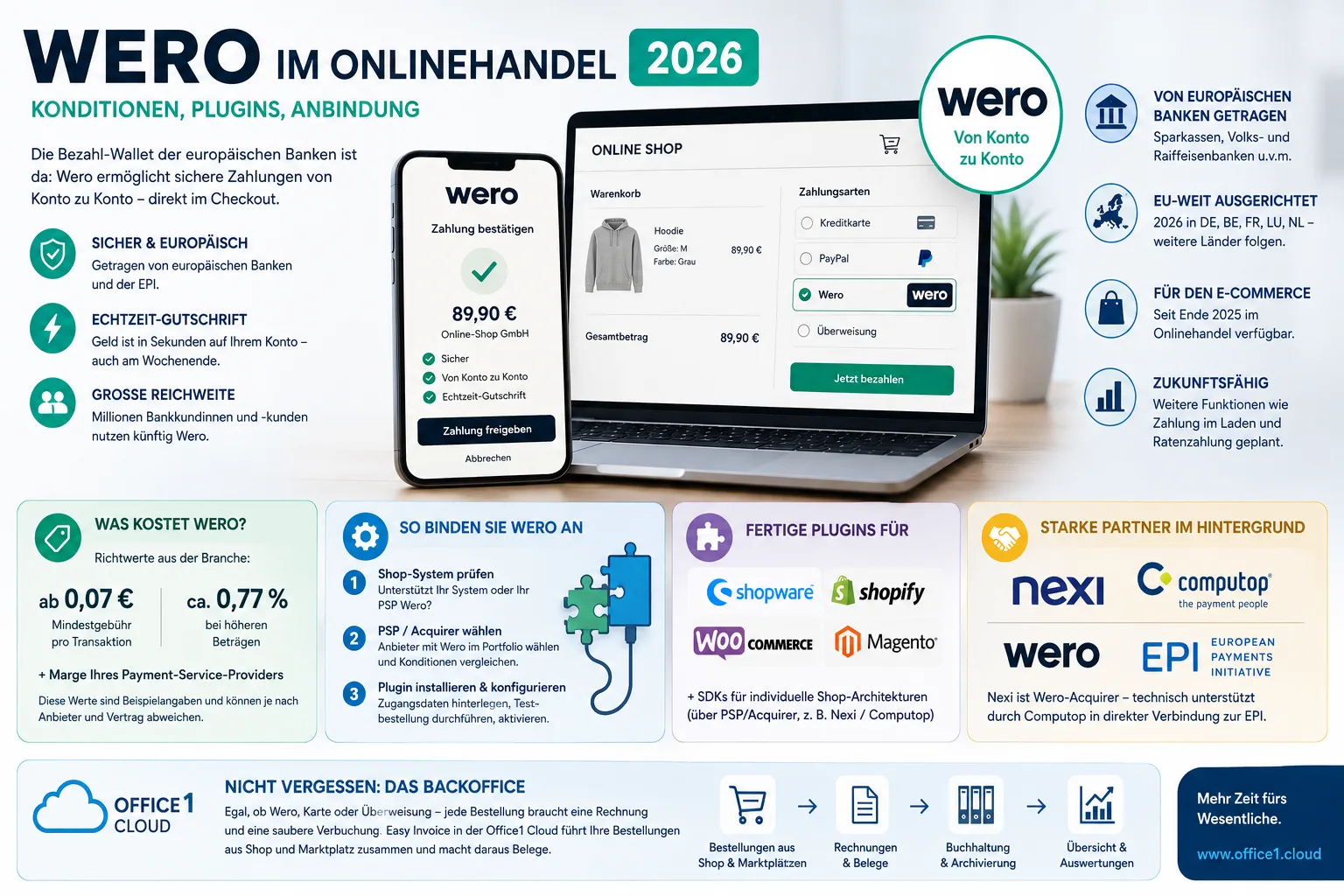
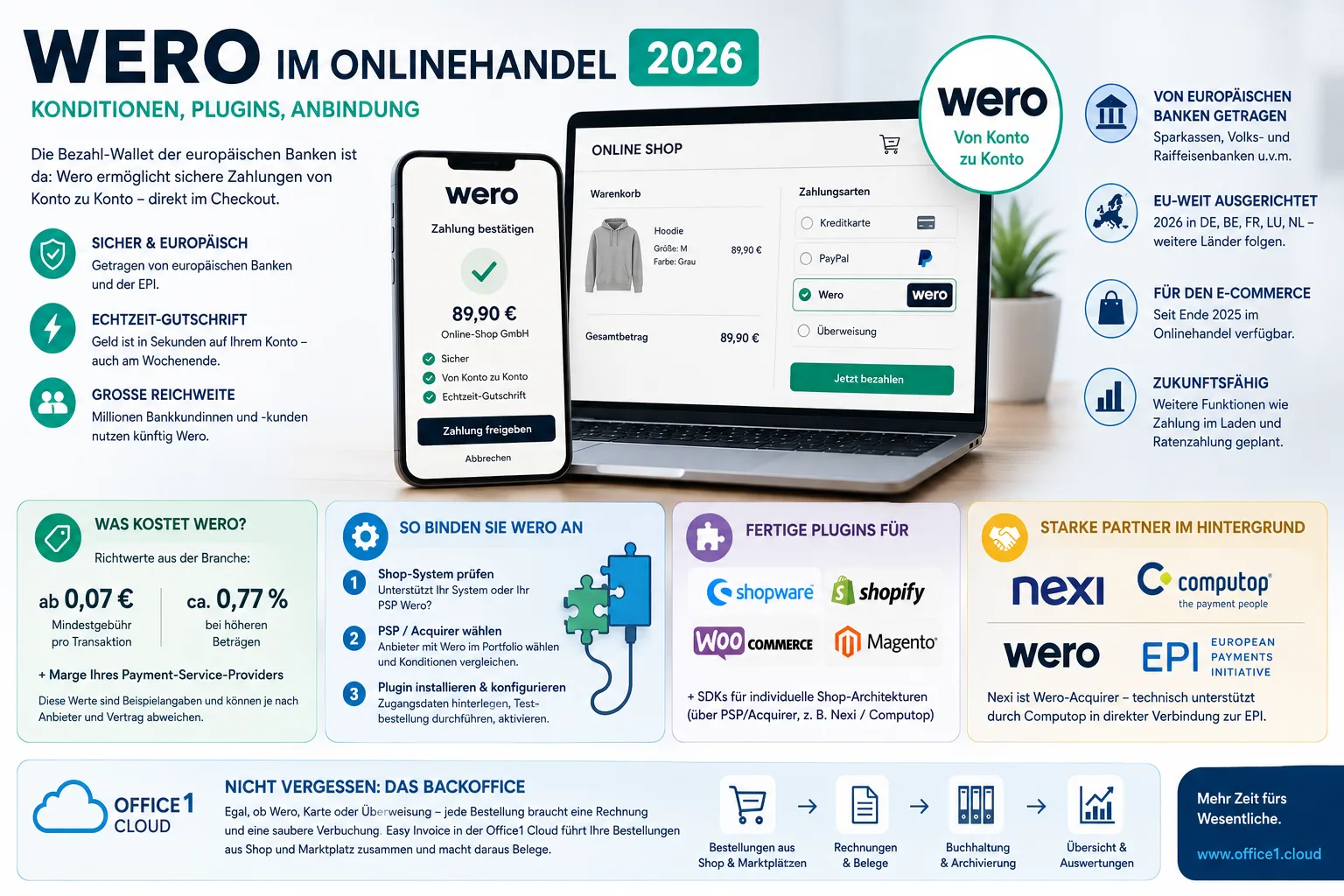
Wero is the digital wallet of the European Payments Initiative (EPI), an alliance of European banks – in Germany above all the savings banks (Sparkassen) and cooperative banks. Until now Wero was known as a service for phone-to-phone money transfers. Since late 2025 it has been moving into online retail: customers pay with it directly in the shop, and the money flows account to account. A compact overview for businesses is offered by the Munich Chamber of Commerce (IHK); the provider perspective is on the Wero merchant page.
Whether Wero pays off also depends on what the rest of your checkout costs: PayPal, Stripe, Mollie, Shopware Payments and Shopify Payments are compared with real fees in Payment providers for online shops.
What is happening right now
Wero has been live since 2024 and is now rolling out in e-commerce. The first merchants are connected, with more big names to follow; in 2026 Wero is to become available beyond Germany in Belgium, France, Luxembourg and the Netherlands, with features such as in-store payment and instalments to come later. Details on the market launch are summarised, among others, by IT-Finanzmagazin.
Payment methods decide your revenue
Why should yet another payment method interest you at all? Because it directly affects revenue. The DHL E-Commerce Trends Report shows that a considerable share of abandoned purchases is due to a missing preferred payment method – more in our article on the e-commerce trends 2026. Whoever covers their target group’s preferred payment routes loses fewer buyers just before checkout.
What does Wero cost the merchant?
There is no official flat price – the conditions run through your payment provider. As rough guide values, the industry cites a minimum fee of around 7 cents per transaction and about 0.77% for higher amounts (see for example the breakdown on demoshops.de). On top of this comes the margin of your payment service provider. These values are example figures and can vary depending on provider and contract.
A frequently cited advantage: because Wero works without card networks and their interchange fees, the costs are often set lower; in addition, credit is posted in real time – which helps cash flow even at the weekend. How else to keep your cash flow stable is covered in our article on dunning for the self-employed. The banks’ official acceptance information can be found, for example, at Sparkasse (collecting payments online – Wero).
How to integrate Wero into your shop
You don’t accept Wero directly but via a payment service provider (PSP) or acquirer that supports Wero at checkout. A central role is played by Nexi as acquirer in direct connection with EPI, technically supported by Computop – see the joint Nexi/Computop announcement and, on the German rollout, the Nexi article on Wero in e-commerce.
For the common shop systems there are already ready-made plugins or extensions – for example for Shopware, Shopify, WooCommerce and Magento – as well as SDKs for custom shop architectures (overview of the Computop shop plugins). An understandable step-by-step explanation of how Wero gets into the webshop is offered by VR Payment.
In practice, integration usually works like this:
- Check your shop system: does your system (or your PSP plugin) already support Wero? Which platforms suit which purpose is shown in our comparison of online store systems.
- Choose a PSP/acquirer: pick a provider that has Wero in its portfolio and compare the conditions.
- Install and configure the plugin: enter access credentials, run a test order, activate Wero at checkout.
What does this mean for you? If you already use a PSP, Wero is often just an additional payment method you activate – not a completely new system.
Should you offer Wero?
In favour: a potentially large user base via the banks’ customers, an EU-wide orientation, operation by European banks and real-time credit. Against: Wero is still young in online retail, and adoption is only just growing. An example: a small shop with many savings-bank and cooperative-bank customers can benefit early, because exactly those customers use Wero first. A pure niche shop with international customers, on the other hand, can wait and watch for now.
Don’t forget the back office
No matter which payment method the money comes in through – every order needs an invoice and clean bookkeeping. Office software like Easy Invoice in the Office1 Cloud brings together your orders from shop and marketplace and turns them into documents – regardless of whether the customer paid with Wero, card or bank transfer.
Frequently asked questions
What is Wero?
A digital payment wallet from the European Payments Initiative (EPI), backed by European banks. It is being extended from sending money between individuals to paying in online retail.
What does Wero cost merchants?
There is no official fixed price. Industry sources cite as a guide around 7 cents minimum fee or about 0.77% per transaction, plus the payment provider’s margin. You’ll learn the exact conditions from your PSP.
Are there shop plugins for Wero?
Yes. For systems like Shopware, Shopify, WooCommerce and Magento there are plugins or extensions, plus SDKs for custom shops – usually via the PSP/acquirer (e.g. Nexi/Computop).
Do I need Wero right now?
Not necessarily. It makes sense to observe adoption in your target group and plan Wero in as soon as your PSP offers it – especially if many of your customers are with savings or cooperative banks.
Conclusion
Wero brings a payment wallet backed by European banks into the online checkout – with transparent, often low conditions, real-time credit and ready-made plugins for the common shop systems. For small sellers it’s worth checking the conditions with your own payment provider and planning Wero in as an additional payment method. What remains important is that every order ends up cleanly in invoicing and bookkeeping – which is what the Office1 Cloud is for.
Sources
- Wero – merchant page (e-/m-commerce) — Official provider information on Wero for merchants.
- Munich Chamber of Commerce (IHK): the European payment system Wero — Overview for businesses.
- Sparkasse: collecting payments online – Wero — Acceptance information from the banks.
- Nexi & Computop: Nexi becomes Wero acquirer and Wero in German e-commerce — Acquiring and technical integration.
- VR Payment: how does Wero get into the webshop? — Integration explained.
- IT-Finanzmagazin: EPI launches Wero in German online retail — Market launch and first merchants.
Note: This article does not constitute tax, legal or financial advice. The fees mentioned are example values and can vary depending on provider and contract.
Handle invoices more easily
Easy Invoice combines quotes, invoices and customer management in the cloud.
Try Easy InvoiceRead next
 E-Commerce & Marketplaces
New eBay Terms of Service from 15 September 2026: What Sellers Should Check Now
New eBay terms apply from 15 September. Four things change, and one of them can cost you your account.
 E-Commerce & Marketplaces
Creating invoices for Shopify
Shopify sends order confirmations – not invoices. How to get from a Shopify order to a finished invoice in five steps, with your own number, correct tax details and automatic sending.
 E-Commerce & Marketplaces
eBay vehicle parts: free returns mandatory since 28 September – what it costs you
New parts over 10 euros at a fixed price: since 28 September you have to take them back free of charge for 30 days and adjust your withdrawal policy. Which returns are not covered, what the rule costs and what to check now.