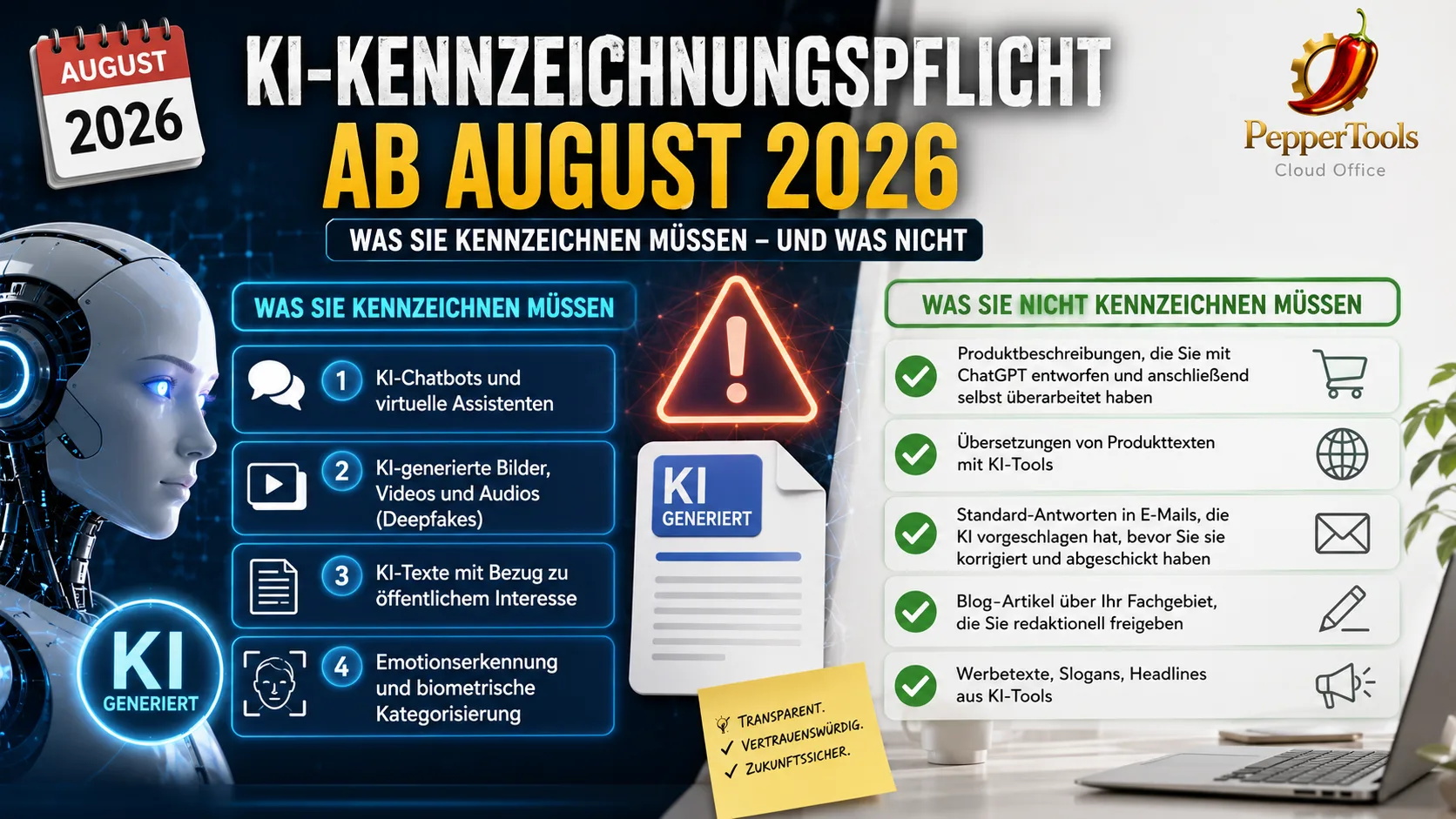
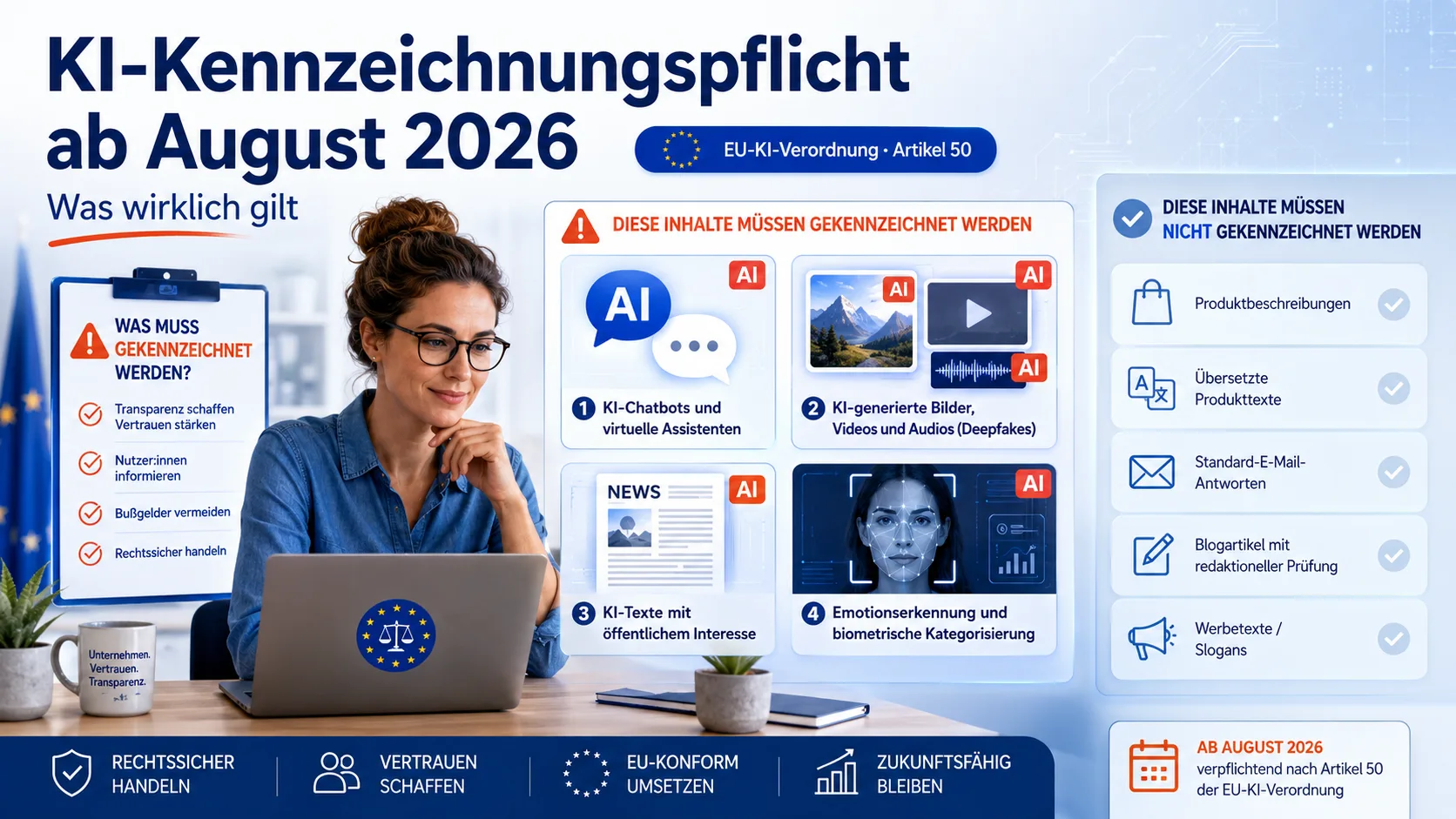
EU AI Labeling Rules from August 2026: What Really Applies
From 2 August 2026, many AI-generated outputs must be visibly labeled — but not all of them. On 8 May 2026, the European Commission finally clarified what exactly falls under Article 50 of the AI Act. Here is what you as a self-employed person or small business owner really need to do — and what you don't.
Table of contents
- What is this about?
- What you must label
- What you do not have to label
- How labeling looks in practice
- Real-world example: Mueller Photo Studio
- What violations cost
- Frequently asked questions
- Conclusion
- Sources
What is this about?
The EU Artificial Intelligence Regulation (AI Act, Regulation (EU) 2024/1689) entered into force in August 2024 and is being phased in step by step. On 2 August 2026, Article 50 applies — the part that regulates transparency obligations for AI systems. Translated: when you use AI, your customers must in many cases be made aware that an AI system is involved.
On 8 May 2026, the European Commission published a draft of interpretive guidelines and opened a public consultation that ran until 3 June 2026. The guidelines are non-binding, but they are the first official document that walks through the scope of Article 50 in practice. In Germany, the Bundesnetzagentur will act as the national market surveillance authority — the federal cabinet adopted the implementation bill on 11 February 2026.
For self-employed people and small businesses, this means: anyone running an AI chatbot, using AI-generated images in advertising, or working with synthetic voices should use the next few weeks to put the obligations in place.
What you must label
Four areas matter most for you.
1. AI chatbots and virtual assistants
If you run an AI chatbot on your website, in your online shop, or on a WhatsApp channel, the user must be told on first contact that they are talking to an AI system. A short greeting is enough: "Hello, I am the AI assistant of company XY. For more complex questions I will pass you on to a colleague." The notice must be clear, unambiguous, and appear as soon as the interaction starts.
Exception: if it is obvious from context that no human is involved (because the system calls itself a "chatbot," for instance), the notice may be skipped. In practice, all authorities recommend explicit labeling — better safe than sorry.
2. AI-generated images, videos and audio (deepfakes)
If you use images, videos, or audio for advertising, social media posts, or your website that were created or edited with tools like Midjourney, DALL·E, Sora, or ElevenLabs, the disclosure obligation for so-called deepfakes applies. This includes:
- AI-generated product photos with realistic-looking people
- AI voiceover for advertising videos with an artificially created voice
- AI avatars in training or explainer videos
A short note such as "AI-generated image" or "created with AI" is enough. For purely artistic or satirical works, the labeling may be more discreet, as long as the work itself is not compromised.
3. AI texts on matters of public interest
Texts only trigger mandatory labeling when they inform the public about matters of public interest — such as news, political commentary, or socially relevant articles. Classic product descriptions, advertising copy, or blog posts for your business explicitly do not fall under this obligation, provided that you take editorial responsibility for what is published.
4. Emotion recognition and biometric categorisation
If you use AI that analyses emotions or biometric characteristics (for example in a recruitment tool or customer analytics), you have to inform the people concerned — and comply with the GDPR. For most small businesses this is not relevant, but if you buy tools with "sentiment analysis," check whether they contain such functions.
What you do not have to label
Let's clear up a misconception that floats around many forums. You do not have to label the following as AI-generated:
- Product descriptions that you drafted with ChatGPT and then reworked yourself
- Translations of product texts with AI tools
- Standard responses in emails that AI suggested before you corrected and sent them
- Blog articles about your field of expertise that you approve editorially
- Advertising copy, slogans, headlines from AI tools
The condition: you take editorial responsibility and the text does not concern public interest. For the clean working approach in detail, see our practical guide on AI product descriptions on the PepperTools blog.
How labeling looks in practice
The regulation does not prescribe an exact wording — but it does demand that the information is clear, unambiguous, and accessible. Tested phrasings:
- For chatbots: "You are chatting with an AI assistant. Would you like to switch to a human colleague?"
- For images: caption "Stock-style image, created with AI" or a watermark at the bottom.
- For videos: an intro frame "This video contains AI-generated content."
- For audio: a note in the intro or description "Voiceover created with AI."
In addition, Article 50(2) requires providers of generative AI systems (the tool makers themselves, not you as a user) to embed a machine-readable marker in their outputs — such as invisible watermarks. That is the tool vendor's responsibility, not yours. You only use the outputs.
Real-world example: Mueller Photo Studio
Anja Mueller runs a small photo studio in Leipzig, mostly shoots job-application and family portraits, and has been using AI tools since early 2026. Here is how she implements the rules:
- Website chatbot: a simple AI tool answers initial questions about prices and appointments. The greeting now says: "Hello, I am the AI assistant of Foto Mueller. I help with standard questions — for special wishes I pass you on to Anja."
- Mood boards with Midjourney: Anja uses AI images to show clients style directions. Every image gets the caption "Style example — created with AI."
- Newsletter texts with ChatGPT: she drafts with AI, edits, and sends. No labeling needed here, because she takes editorial responsibility.
- Instagram reel with AI voice: when she publishes a reel with a synthetic voiceover, she adds "Voiceover: AI" to the description.
Total effort: about two hours of setup — after that, the topic runs in the background.
What violations cost
The fines under the AI Act are substantial: up to 15 million euros or 3 percent of global annual turnover (whichever is higher). For small and medium businesses, however, the regulation explicitly states that fines must be proportionate — a solo self-employed person will not face the maximum amount. The Bundesnetzagentur is setting up a "Coordination and Competence Centre for the AI Act" (KoKIVO) to coordinate enforcement.
More important than the headline penalty: if you want to earn customer trust, clear labeling already puts you on the safe side. What does that mean for you? Better to add a chatbot notice and a few image captions today than to scramble later.
Frequently asked questions
Does the labeling obligation also apply to ChatGPT-drafted customer email replies?
No — as long as you read, adjust, and approve the email before sending it, that counts as editorial control and is not subject to labeling.
Do I have to label AI-generated logos or graphics on my website?
Generally no, unless they are deepfakes featuring real-looking people. An abstract logo or an AI-generated symbolic image without recognisable people does not fall under the obligation. For realistic depictions of people, you should label.
What about AI features already built into tools — for example automatic reply suggestions in my email client?
As long as you as a human decide whether to send or adjust the suggestion, editorial control applies and no labeling is required.
Do I need a special AI notice in my online shop's terms and conditions?
A separate clause in T&Cs is not legally required — what matters is that the notice appears where the customer meets the AI (e.g. the chatbot). For an advertising campaign with AI images, the label at the image itself is enough.
Who enforces this in Germany?
The Bundesnetzagentur handles market surveillance. You can also file a complaint there if you are affected, for example as a customer of an opaque chatbot.
Conclusion
The AI labeling obligation from 2 August 2026 sounds more complicated than it really is for most self-employed people. The core obligations cover chatbots, AI images with people, and AI audio/video. If you use ChatGPT for product texts or email drafts and keep editorial control, no extra labeling is needed. With one to two hours of setup, you have the topic covered — and earn additional customer trust at the same time. Organised customer communication, invoicing, and quoting also helps your compliance life: the PepperTools invoicing and quoting features keep records clean and auditable.
Sources
- European Commission — Draft Guidelines on Article 50 of the AI Act (8 May 2026) — Official interpretive guidelines.
- European Commission — Consultation on the Guidelines (until 3 June 2026) — Public consultation.
- Article 50 AI Act — full text — Wording of the transparency obligations.
- German Bundestag — Implementation of the EU AI Regulation (March 2026) — National implementation in Germany.
- Bundesnetzagentur — AI market surveillance — Competent national authority.
- Federal Ministry for Digital and State Modernisation — AI Act Implementation Act — Status of the national implementing law.
--- More guides on obligations and deadlines for small businesses are available at office1.cloud.
Disclaimer: This article does not constitute tax or legal advice. For your individual case, please consult a lawyer.
Handle invoices more easily
Easy Invoice combines quotes, invoices and customer management in the cloud.
Try Easy InvoiceRead next
 Taxes & Law
Zusammenfassende Meldung (ZM): deadline, ELSTER and who must file
Anyone who supplies goods or invoices services without German VAT to business customers in other EU countries reports these sales to the German Federal Central Tax Office. Here you can find out who has to report, by when, what goes into the report and what happens if it is missing.
 Taxes & Law
USt-IdNr.: how to apply, how to check and when you need one
The USt-IdNr. (EU VAT ID) is a second number alongside the Steuernummer, meant for business with companies in other EU countries. You apply for it free of charge at the German Federal Central Tax Office and check your customer's number there too; here is how both work and how to find out whether you need one at all.
 Taxes & Law
Low-value assets in Germany (GWG) 2026: €800 limit, net or gross
The GWG limit in Germany is €800 net in 2026, also under the small business scheme. Which purchases you deduct at once, when the pooled item pays off and how to book it.