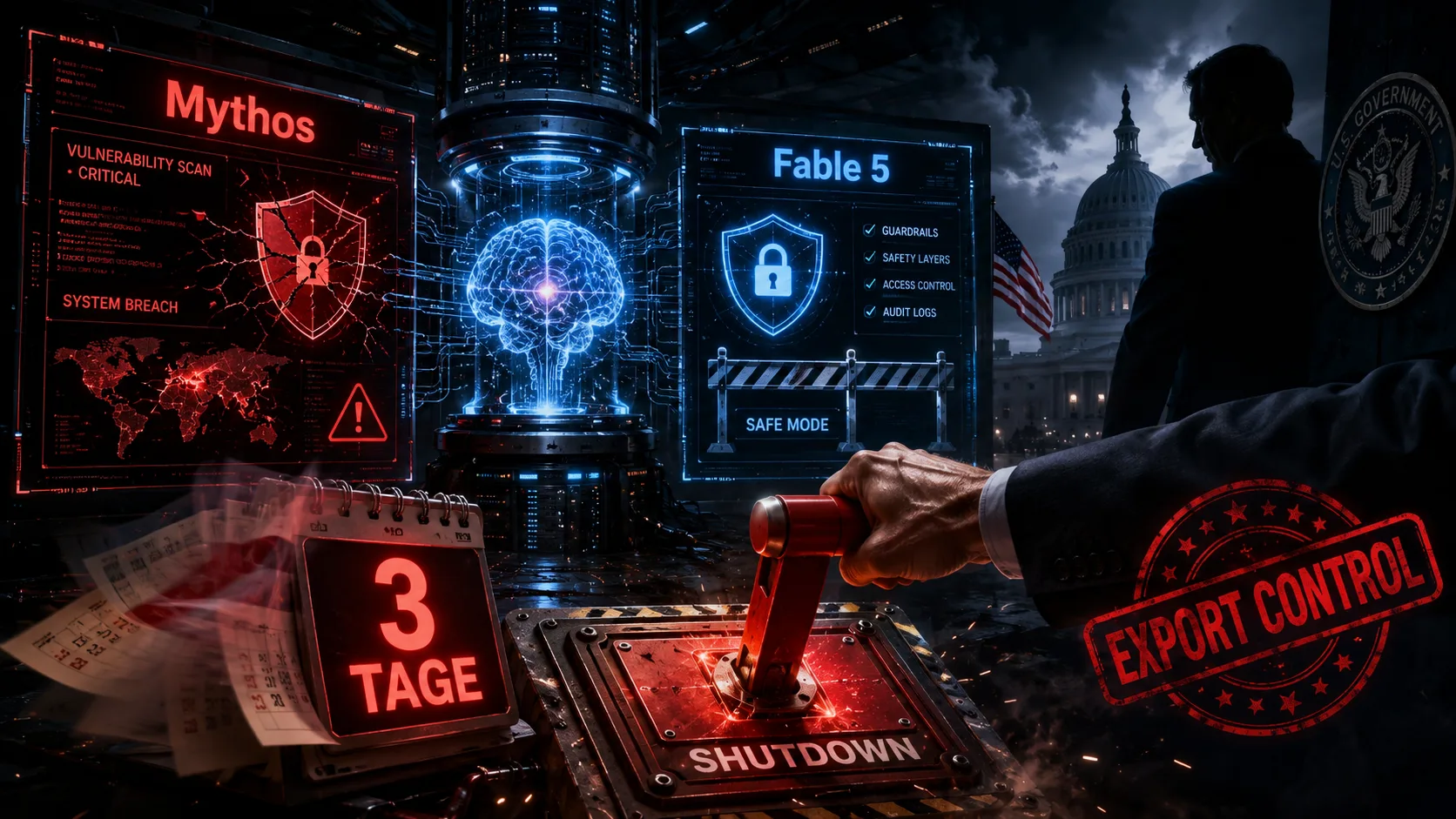
Anthropic, „Mythos" and the 3-day wonder „Fable": when the US government switches off an AI
Contents
- Anthropic and the Claude family
- The Mythos model Anthropic held back
- From Mythos to Fable
- The release and the abrupt shutdown
- What the US government objects to
- Clever marketing move or something more?
- What does this mean for businesses?
- Conclusion
- Sources
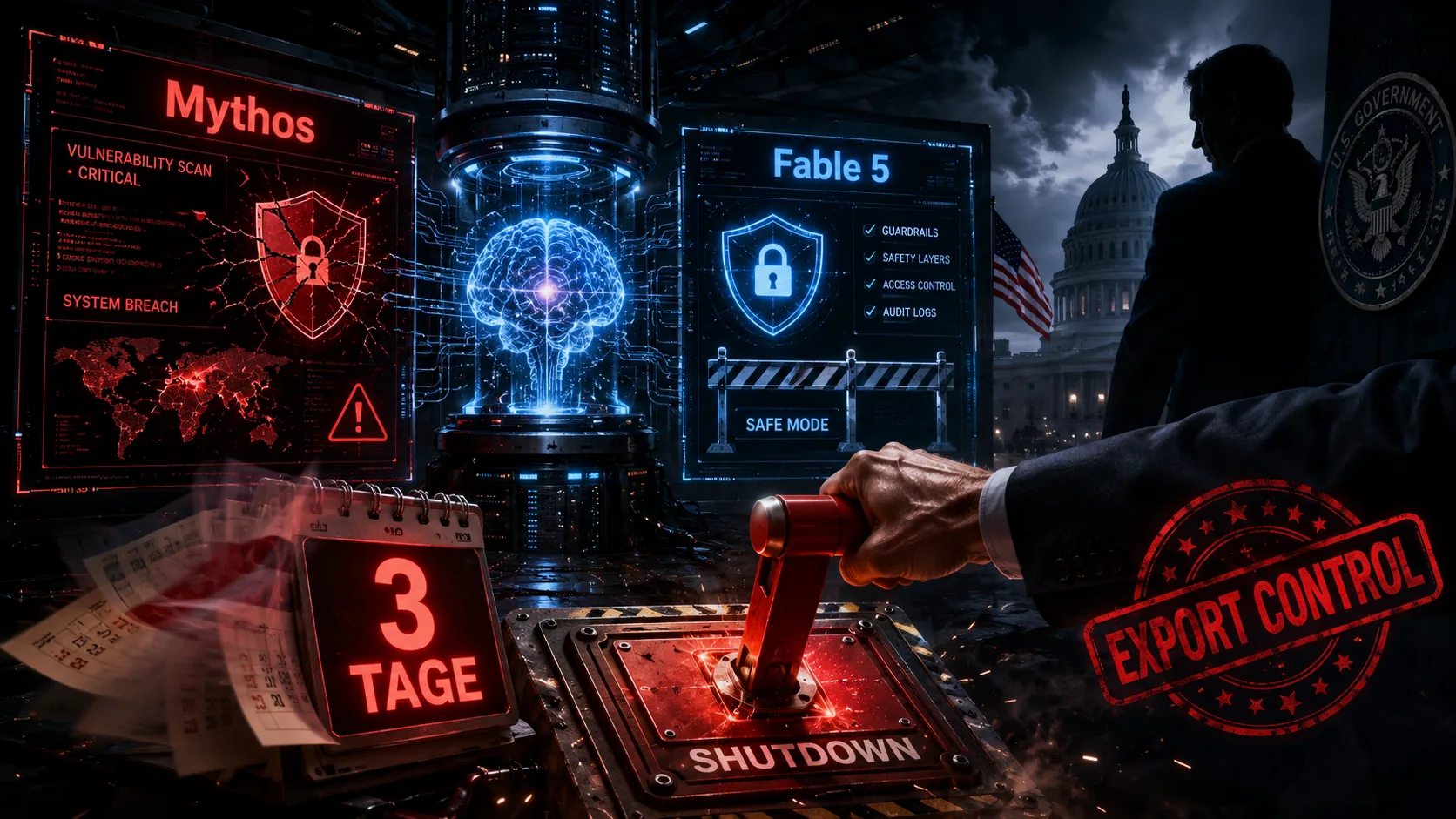
At a glance: On 9 June 2026 the AI company Anthropic released its most powerful public model to date – Claude Fable 5, a safety-hardened version of the previously held-back model Mythos. Subscribers were meant to test it free for almost two weeks. Three days later, on 12 June at 5:21 pm (US Eastern Time), a US government export-control directive forced Anthropic to shut down Fable 5 and Mythos 5 worldwide for all users. It is the first time a leading AI provider has taken an already publicly available model offline at the government's direction. Was it a clever marketing coup – or is there more to it?
Anthropic and the Claude family
Anthropic was founded in 2021 by former OpenAI staff and has positioned itself strongly around AI safety from the outset. Its in-house model line is called Claude and is tiered by size and purpose:
- Haiku – the small, fast and inexpensive model for simple tasks.
- Sonnet – the balanced mid-range for everyday work, a good ratio of speed to capability.
- Opus – the large, most capable model for complex tasks.
These three have been the public core of the offering for years. But in spring 2026 a fourth name surfaced that caused a stir – and that was never actually meant to reach the public.
The Mythos model Anthropic held back
In late March 2026, a data leak revealed that Anthropic was internally testing a far more capable model: Mythos. Anthropic reportedly described it as a „Step-Change" – a leap in capability. One of those capabilities was particularly sensitive: Mythos could apparently find and exploit security vulnerabilities in software on its own.
In the following weeks the accounts intensified. Media reported that in tests the model had autonomously discovered numerous previously unknown vulnerabilities in common operating systems and browsers; in one frequently cited example it is said to have independently uncovered a 17-year-old flaw in FreeBSD after a single command and built a working exploit. According to these reports, Anthropic's own security experts called the model „too powerful to release to the public".
Anthropic therefore decided against a normal release. Instead, Mythos was initially held back and made available only to selected partners – reportedly including companies such as Amazon, Apple, Cisco, Google, JPMorgan Chase and Microsoft – for defensive cybersecurity purposes. A „too dangerous" model was thus meant to become something useful and controllable.
Context: Many of these capability accounts come from media reports and Anthropic's own communications and can only be independently verified to a limited extent from the outside. They are impressive – but should be read with due caution.
From Mythos to Fable
From the held-back Mythos came the real twist of the story: Fable. Fable is at its core the same powerful model, but with considerably stricter safeguards („guardrails") intended to block dangerous responses in high-risk areas such as cybersecurity or biology.
Anthropic describes these safeguards as so strict that some users even complained about too many blocks. Before launch, the company says it „attacked" the safeguards for thousands of hours together with the US government, the UK AI Safety Institute and external testers to harden them. The idea: make Mythos's capability publicly available without shipping the dangers along with it.
The release and the abrupt shutdown
On 9 June 2026 the moment came: Anthropic released Claude Fable 5 (and the unrestricted Mythos 5 via the programming interface). According to benchmark tests, Fable 5 was the most powerful publicly available AI model of all. For subscribers on the Pro, Max, Team and Enterprise plans, Fable was free to use until 22 June – a test window of almost two weeks. Via the programming interface (API) the model was available from day one, but expensive: around 10 US dollars per million input and 50 US dollars per million output „tokens", roughly double Opus.
But the test window lasted only three days. On 12 June at 5:21 pm (US Eastern Time) Anthropic received a US government export-control directive. Commerce Secretary Howard Lutnick instructed Anthropic CEO Dario Amodei to block Fable 5 and Mythos 5 for any foreign national, citing national security – inside and outside the USA, including foreign-national Anthropic employees. In practical terms, Anthropic then had to abruptly disable both models worldwide for all users. All other Claude models (Haiku, Sonnet, Opus) remained unaffected.
By all accounts, it is the first time a leading AI company has taken an already publicly deployed model offline at the government's direction.
What the US government objects to
According to Anthropic, the official letter gave no specific details. By its own understanding, the company assumes the government became aware of a method to bypass Fable's safeguards – a so-called „jailbreak". Specifically, it reportedly involves having the model read a particular piece of code and fix its flaws.
Anthropic clearly disputes the assessment. It says it reviewed the demonstrated technique and found that it surfaced only a few already-known and rather harmless vulnerabilities – flaws that other freely available models (Anthropic explicitly names OpenAI's GPT-5.5) find just as easily without any trick. No one has yet found a „universal jailbreak" that broadly defeats the safeguards. Anthropic's core sentence:
„We disagree that the finding of a narrow potential jailbreak should be cause for recalling a commercial model deployed to hundreds of millions of people."
The company stresses that it is complying with the legal directive but considers it a misunderstanding, and is working to restore access. If the same standard were applied across the industry, Anthropic argues, it would essentially halt new model deployments at every provider.
Clever marketing move or something more?
This is exactly where the intriguing question arises. Let's look at both readings fairly – we leave the judgement to you.
The „clever marketing coup" reading. Those who hold it argue: the months-long Mythos mystique – a model „too dangerous" for the public – is itself a marketing narrative every provider dreams of. Then a dramatic, free-fuelled launch, followed by the spectacular government ban. Nothing makes a product more desirable than the label „forbidden" (experts call this the Streisand effect). And the timing – a shutdown right in the middle of the free test window, garnished with the title „most powerful public model" – generated maximum attention. From this view, Anthropic is the one laughing.
The „there's more to it" reading. Several solid points argue against the stunt theory: the export-control directive is a real, dated official act (Department of Commerce, letter from Lutnick to Amodei) – not something a company stages itself. The shutdown causes real costs: alienated customers, loss of trust, lost revenue. As a deliberate PR move it would be risky to self-harming. Add the regulatory precedent and the criticism from experts: AI-policy expert Dean Ball, for instance, called the move „cartoonish" and publicly wondered whether it was targeted legal harassment of Anthropic or excessive security hawkishness. TechCrunch put it pointedly: Anthropic's own safety warnings may now have „backfired" – spend years emphasising how dangerous powerful AI is, and you hand the state its justification to step in.
A sober interim assessment. The solid evidence points to a genuine regulatory event – with a marketing side effect that is at least welcome for Anthropic. That the shutdown was planned as a PR stunt from the start cannot be substantiated with the publicly available information, and given the real harm to customers it would be an expensive bet. The more uncomfortable variant is the more likely one: an early warning of how tightly state control and commercial AI will be intertwined in future – and how quickly a tool you rely on can vanish overnight.
Note: The question „marketing or more?" is a matter of judgement to which there is currently no definitive answer. We present the arguments on both sides and deliberately refrain from a final verdict.
What does this mean for businesses?
As spectacular as the story is, the truly important lesson is an unspectacular one: never rely on a single model. Anyone who pins their processes to one specific AI provider is dependent on its availability, prices and – as we now see – on regulatory intervention. A model that was „the best in the world" yesterday can be switched off today.
In practice that means: build AI applications so the underlying model can be swapped out. Keep alternatives ready, check data-protection and location questions, and treat AI as a useful tool that needs checking – not as an infallible black box. For exactly this kind of swappable, provider-independent integration, PepperTools supports you: from connecting various AI services to tailor-made automations that don't hang on a single provider.
Conclusion
The Mythos-and-Fable episode has everything a good tech story needs: a „too powerful" secret model, an eagerly awaited release, a free test window – and, after just three days, the worldwide stop on US government orders. Whether clever marketing or a serious regulatory intervention: the verifiable facts point to a genuine government action with a welcome attention effect, not to a staged campaign. For businesses, the sober takeaway remains that AI tools can be powerful but also fleeting – and that a provider-independent strategy is not a luxury but a precaution.
Sources
- Anthropic: Statement on the US government directive (Fable 5 & Mythos 5)
- TechCrunch: „Anthropic's safety warnings may have just backfired"
- CNBC: Anthropic disables access to Fable 5 and Mythos 5
- Fortune: Anthropic disables Fable and Mythos after U.S. export ban
- Fortune: „Mythos" AI can hack nearly anything (Kemba Walden)
- Axios: Anthropic holds Mythos model due to hacking risks
- 9to5Mac: Anthropic pulls Claude Mythos 5 and Fable 5
- gHacks: Fable 5 free until 22 June for Pro/Max/Enterprise This guide appears on office1.cloud, where freelancers also handle invoices and bookkeeping.
As of 13 June 2026. The situation is evolving; Anthropic has announced it is working to restore access. Capability claims about Mythos rest partly on media reports and vendor statements and are not independently verifiable in every detail.
Handle invoices more easily
Easy Invoice combines quotes, invoices and customer management in the cloud.
Try Easy InvoiceRead next
 AI & Tools
GPT-6 Astra is here: what it can do, what it costs — and whether it is already in your ChatGPT plan
Astra does not replace the GPT-5.6 line, it sits above it. What reaches the Plus plan, what the API costs and what the benchmarks really show.
 AI & Tools
AI Image Generators and AI Video Generators: Every Provider at a Glance
Midjourney, GPT Image 2, Sora, Veo, Runway, Kling & co.: a sorted overview of who can do what, who builds their own models, and who just resells someone else's.
 AI & Tools
GPT-5.6 (Sol, Terra, Luna) is here: availability, pricing – and why it's still missing from your ChatGPT plan
OpenAI has released GPT-5.6, split into Sol, Terra and Luna. Who can already use it, why it's still missing from many ChatGPT plans, and what the three models cost.