OpenAI Jalapeño: half the cost per AI request – will AI get cheaper or will prices rise anyway?
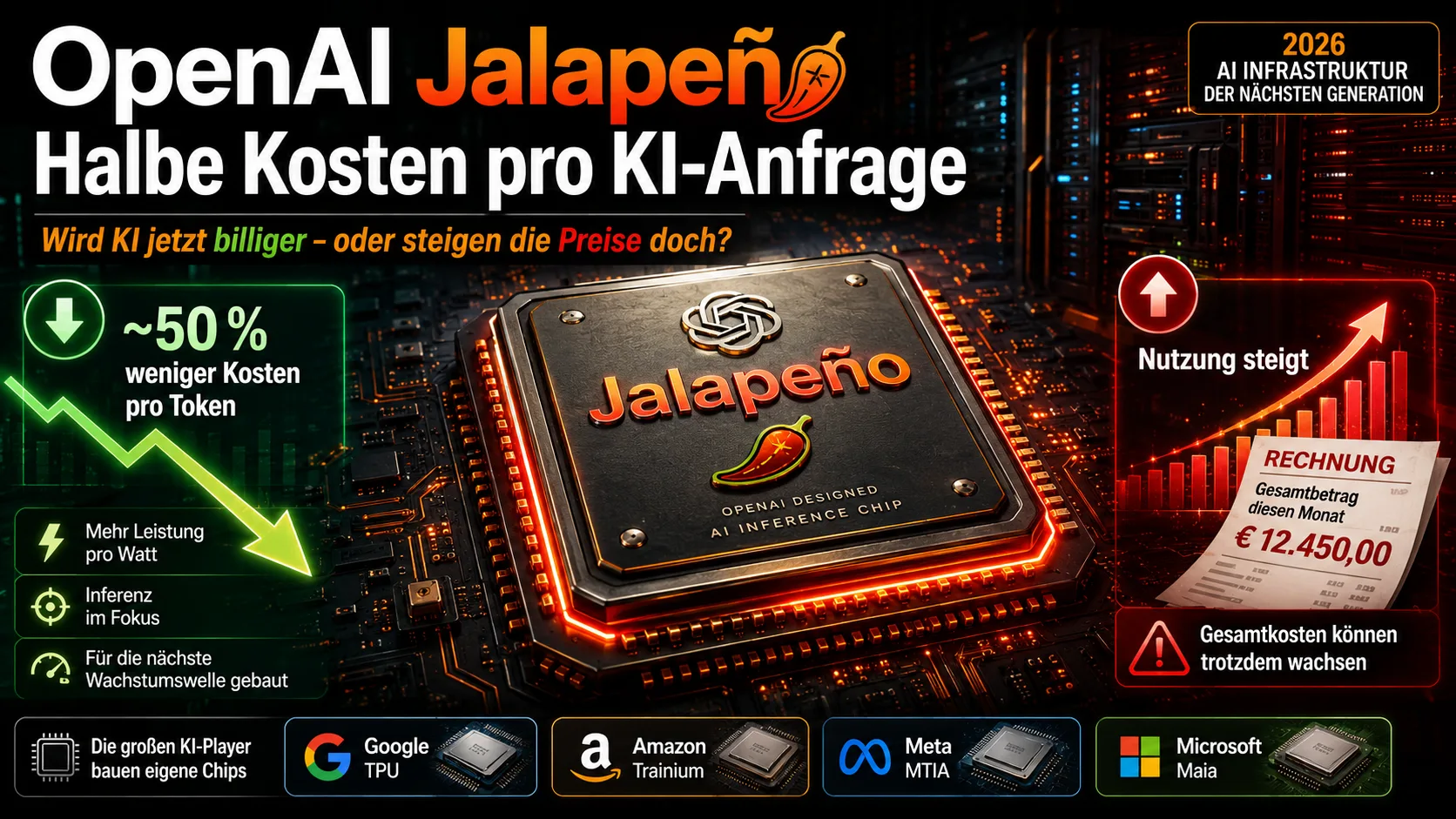
It's the number that matters: for its new chip Jalapeño, OpenAI promises substantially better performance per watt and roughly half the cost per token compared with today's GPU clusters. Sounds like the turning point for AI prices. But does it really mean AI gets cheaper for all of us – or will prices explode anyway?
Why it all comes down to cost
The most expensive part of AI today isn't training the models, it's inference – every single request a user makes. That's exactly where Jalapeño comes in, the inference chip OpenAI unveiled with Broadcom on 24 June 2026. Cutting the cost per request while becoming less dependent on market leader Nvidia improves margins at the decisive spot.
That's why almost every big provider now builds its own chips: Google (TPU, since ~2015), Amazon (Inferentia/Trainium), Meta (MTIA), Microsoft (Maia). OpenAI is not a pioneer here, but late – the real point isn't the chip itself, it's the price war behind it.
Who entered when, and roughly where the chips stand, is shown here:
| Maker | Chip | Year | Focus | Raw compute (FP8) as a rough scale |
|---|---|---|---|---|
| OpenAI | Jalapeño | 2026 | Inference | Claim: leading on efficiency → ? (figures not published) |
| Meta | MTIA 400 | 2026 | Inference | ~6 PFLOPS → 100 % |
| TPU v7 „Ironwood" | 2025 | Training + Inference | ~4.6 PFLOPS → ~75 % | |
| Amazon | Trainium3 | 2025 | Mainly training | ~2.5 PFLOPS → ~40 % |
| Microsoft | Maia 200 | 2025/26 | Inference | not published |
| Reference: Nvidia | B200 „Blackwell" | 2025 | GPU (training + inference) | Market leader, industry benchmark |
Important: the percentages are only a rough orientation based on raw compute (FP8) per chip – not a real speed benchmark. In practice, memory, networking and software also decide the outcome, and most of these chips are built not for peak figures but for low cost per token in their own data centers. For OpenAI Jalapeño and Microsoft Maia, no official performance figures are available yet.
The good news: per request, AI really is getting cheaper fast
And this price war is already working. The cost per token is in free fall: across the big providers, the average price fell by around two-thirds within a year – from about 18 to a good 6 US dollars per million tokens. Chips like Jalapeño accelerate exactly this trend. In this respect the direction is clear: a single AI request today costs a fraction of what it did two years ago.
Jalapeño isn't a „breakthrough" in this – more another lever among many. But the sum of these levers pushes the price per request down year after year.
The bad news: your monthly bill can still rise
Here's the catch that explains the widespread fear of exploding prices. Because although every single request gets cheaper, total costs are rising for many – for two reasons.
First, usage: with agents and automated workflows, modern AI consumes many times more requests. If the price per request is halved but the number of requests grows tenfold, you end up paying more – not less.
Second, subscription prices: the familiar roughly 20 euros a month for ChatGPT, Claude & co. are considered by experts to be below cost – a market entry subsidized by venture capital. Once profit pressure kicks in (IPOs, fewer investors), analysts expect increases towards 25 to 30 euros. More efficient chips slow this pressure but don't remove it.
What this means for you
For small businesses, the sober takeaway: AI will very likely get cheaper per task – but whether your total bill falls depends on how much you use and how subscription prices develop. More efficient hardware like Jalapeño is the counterforce to a price explosion, not a guarantee against it. So if you build AI firmly into your work, keep an eye on consumption and don't lock yourself into a single provider or plan.
Jalapeño is therefore less of a sensation than marketing would like – but a visible sign that the fight over low AI costs is entering its next round. Fittingly, OpenAI had presented its new model generation just days earlier (see our article on GPT-5.6).
Note: This article summarizes the publicly reported status as of 28 June 2026 and is not investment or financial advice. OpenAI has announced reliable performance figures for Jalapeño in the coming months.
Sources
- OpenAI: OpenAI and Broadcom unveil LLM-optimized inference chip
- Tom's Hardware: Broadcom and OpenAI unveil custom-built Jalapeño inference processor
- Optimum Partners: AI Token Costs – Why Enterprise AI Bills Keep Rising in 2026
- Geeky Gadgets: Why AI Subscription Prices Are Expected to Rise in 2026 This guide appears on office1.cloud, where freelancers also handle invoices and bookkeeping.
Handle invoices more easily
Easy Invoice combines quotes, invoices and customer management in the cloud.
Try Easy InvoiceRead next
 AI & Tools
GPT-6 Astra is here: what it can do, what it costs — and whether it is already in your ChatGPT plan
Astra does not replace the GPT-5.6 line, it sits above it. What reaches the Plus plan, what the API costs and what the benchmarks really show.
 AI & Tools
AI Image Generators and AI Video Generators: Every Provider at a Glance
Midjourney, GPT Image 2, Sora, Veo, Runway, Kling & co.: a sorted overview of who can do what, who builds their own models, and who just resells someone else's.
 AI & Tools
GPT-5.6 (Sol, Terra, Luna) is here: availability, pricing – and why it's still missing from your ChatGPT plan
OpenAI has released GPT-5.6, split into Sol, Terra and Luna. Who can already use it, why it's still missing from many ChatGPT plans, and what the three models cost.