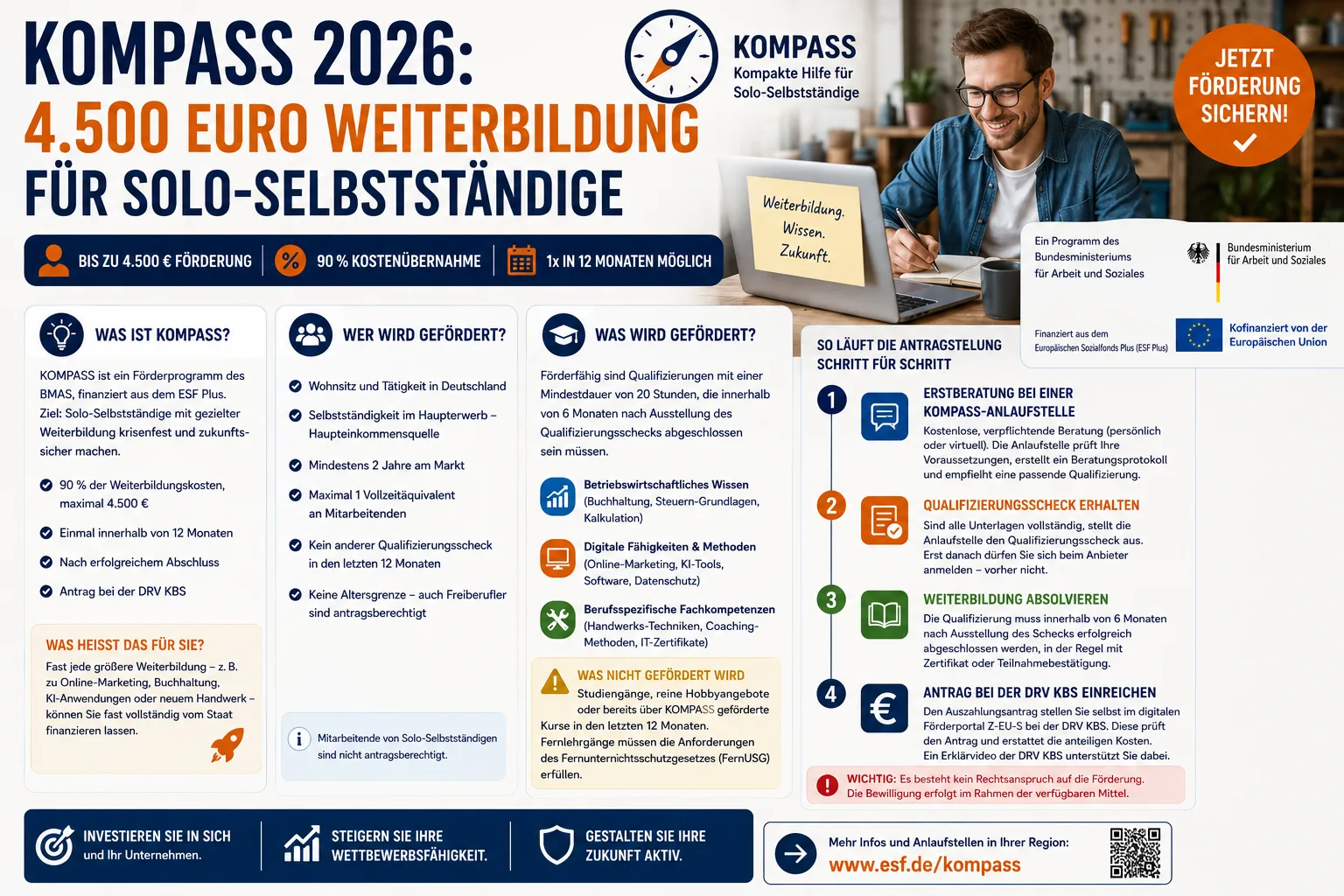
KOMPASS 2026: €4,500 training subsidy for solo entrepreneurs in Germany
Solo entrepreneurs based in Germany can claim up to €4,500 in reimbursement for professional training through the federal KOMPASS programme. But because of unusually high demand, the issue of qualification vouchers is being nationally restricted from May through approximately October 2026. Here is how to plan around it.
Table of contents
- What is KOMPASS?
- Who is eligible?
- What types of training qualify?
- The 2026 restriction: what you need to know
- How the application process works
- Real-world example: Mara the photographer
- Frequently asked questions
- Conclusion
What is KOMPASS?
KOMPASS — short for „Kompakte Hilfe für Solo-Selbstständige" („Compact help for solo self-employed") — is a funding programme of the German Federal Ministry of Labour and Social Affairs (BMAS), financed through the European Social Fund Plus (ESF Plus). The goal: help solo entrepreneurs become more crisis-resistant and future-proof through targeted training.
After successful completion of a qualifying course, the programme reimburses 90 percent of documented training costs, capped at €4,500 (on application to the German Pension Insurance Knappschaft-Bahn-See, „DRV KBS"). One subsidy is possible every twelve months.
What does this mean for you? If you work as a one-person business, you can get a substantial course — for example in online marketing, accounting software, AI applications or a new craft — almost fully reimbursed by the state. Provided you fit the criteria and submit the application correctly.
Who is eligible?
KOMPASS is targeted specifically at one-person businesses. The key requirements under the funding directive:
- Residence and activity in Germany
- Self-employment as the main occupation — your self-employed work must be your primary source of income
- At least two years on the market — brand-new founders do not qualify
- No more than one full-time-equivalent employee — very small teams are allowed
- No other qualification voucher received in the past twelve months
There is no age limit. Freelancers — photographers, translators, coaches and many more — can use the programme if they meet the criteria. Employees of solo entrepreneurs are not eligible to apply.
What types of training qualify?
Eligible training must run for at least 20 hours and be completed within six months of the voucher being issued. BMAS sets a broad thematic scope:
- Business management (bookkeeping, basics of taxation, pricing)
- Digital skills and methods (online marketing, AI tools, software, data protection)
- Specialised professional skills (craft techniques, coaching methods, IT certifications)
There is deliberately no central catalogue of certified courses — the KOMPASS contact points (Anlaufstellen) assess eligibility for your specific case. Important: you must not yet have registered for the course before the voucher is issued.
What is not funded
University degrees, hobby courses, or courses already subsidised under KOMPASS in the previous twelve months are generally excluded. Distance-learning programmes must meet the requirements of the Distance Learning Protection Act (FernUSG) — the German Federal Court of Justice recently clarified that this law has a wider scope than many providers assumed.
The 2026 restriction: what you need to know
Due to extraordinarily high demand, BMAS has announced two key restrictions for 2026:
- Initial-consultation pause: From 1 March to 3 May 2026 the KOMPASS contact points nationwide were unable to offer new initial consultations. Since 4 May 2026, consultations have resumed — but with waiting lists.
- Voucher cap: From May through approximately October 2026, issuance of new qualification vouchers will be limited nationwide. Contact points cannot guarantee swift issuance in all cases.
The good news: the programme has been extended overall until 29 February 2028. If you miss out now, future windows remain.
BMAS explicitly asks applicants to contact only one single Anlaufstelle — multiple requests delay the whole system. The submission appointment should also be agreed bindingly at the start of the process.
What does this mean for you? If you are planning training for 2026, do not wait until autumn. Contact an Anlaufstelle now and have a plan B in case no voucher is available in this funding round.
How the application process works
The KOMPASS process has four set steps.
Step 1: Initial consultation at a KOMPASS contact point
Choose one Anlaufstelle from the ESF list — there are contact points nationwide at Chambers of Industry and Commerce (IHK), Chambers of Skilled Crafts (HWK) and specialised consultancies. The consultation is mandatory, free, and can take place in person or virtually. The Anlaufstelle checks your eligibility, prepares a consultation record, and recommends suitable training.
Step 2: Receive the qualification voucher
Once the paperwork is complete, the Anlaufstelle issues the qualification voucher. Only then may you register with the training provider — not before.
Step 3: Complete the training
You must successfully complete the training within six months of voucher issuance, usually with a certificate or proof of participation.
Step 4: Submit the reimbursement claim to DRV KBS
You submit the actual reimbursement application yourself via the digital funding portal Z-EU-S at the DRV KBS. They review the claim and reimburse the eligible costs. DRV KBS provides an explanatory video for this step.
Important: there is no legal entitlement to the subsidy. Approvals depend on available funds.
Real-world example: Mara the photographer
Mara has been a self-employed photographer in Cologne for four years. She works alone, with no employees, and her self-employment is her main income. She wants to expand into product photography for online shops and learn to use AI image editing efficiently.
A matching course runs 40 hours over three months and costs €3,800 net. Mara approaches the KOMPASS contact point at her local IHK. After the initial consultation, she receives the qualification voucher, completes the course, and then submits her reimbursement claim to DRV KBS.
KOMPASS reimburses 90 percent of costs — in her case, up to €3,420. Important: this calculation is illustrative and not a binding promise; the actual reimbursement depends on the individual case and supporting documents.
Frequently asked questions
Am I eligible as a small-business operator under §19 UStG (German VAT small-business rule)?
Yes, as long as you meet the KOMPASS criteria — main occupation, at least two years on the market, no more than one full-time-equivalent employee. The small-business VAT rule is a VAT classification and does not exclude you from KOMPASS.
What counts as „main occupation"?
Your self-employed activity must be your main source of income. In practice, contact points often require that at least roughly half of your income comes from self-employment. The Anlaufstelle makes the final assessment.
Can I contact several Anlaufstellen at once?
No. BMAS expressly asks you to contact only one Anlaufstelle. Multiple requests delay the whole process and may cost you the voucher.
How long does the procedure take, from initial consultation to reimbursement?
There is no universal answer — depending on workload at the Anlaufstelle and DRV KBS, expect several weeks to several months. During the 2026 cap (May–October), longer waits are realistic.
What happens if I drop out of the training?
Without successful completion (certificate or proof of participation), reimbursement is usually impossible. Clarify cancellation and extension rules with your Anlaufstelle before you start.
Conclusion
KOMPASS is one of the most attractive funding programmes for solo entrepreneurs in Germany — 90 percent reimbursement up to €4,500 is a serious lever for investing in your own skills, especially in a difficult year. If you want to benefit in 2026, plan around the restriction window realistically, contact an Anlaufstelle early, and keep your records tidy.
By the way: if you document your training and consulting costs cleanly, the rest gets easier — the PepperTools Office Cloud invoicing sorts incoming receipts automatically, and the bank import helps you assign every training-related payment to the right record. That way, neither KOMPASS reimbursement nor year-end accounts run into missing receipts.
Sources
- KOMPASS — Compact help for solo self-employed (ESF Plus / BMAS) — Official programme page with funding amount, criteria, and 2026 restriction notice.
- KOMPASS extended (BMAS press release) — Extension of the programme until 29 February 2028.
- KOMPASS extended: up to €4,500 subsidy (ESF announcement) — Details on extension and funding conditions.
- FAQ for solo self-employed (ESF document) — Frequently asked questions about the programme.
- List of KOMPASS contact points (ESF) — Nationwide overview of consultation centres.
- Federal funding database — KOMPASS — Programme data in the official funding directory.
Note: This article does not constitute tax or legal advice. For your individual case, please consult a tax advisor or lawyer.
Handle invoices more easily
Easy Invoice combines quotes, invoices and customer management in the cloud.
Try Easy InvoiceRead next
 Funding & Finance
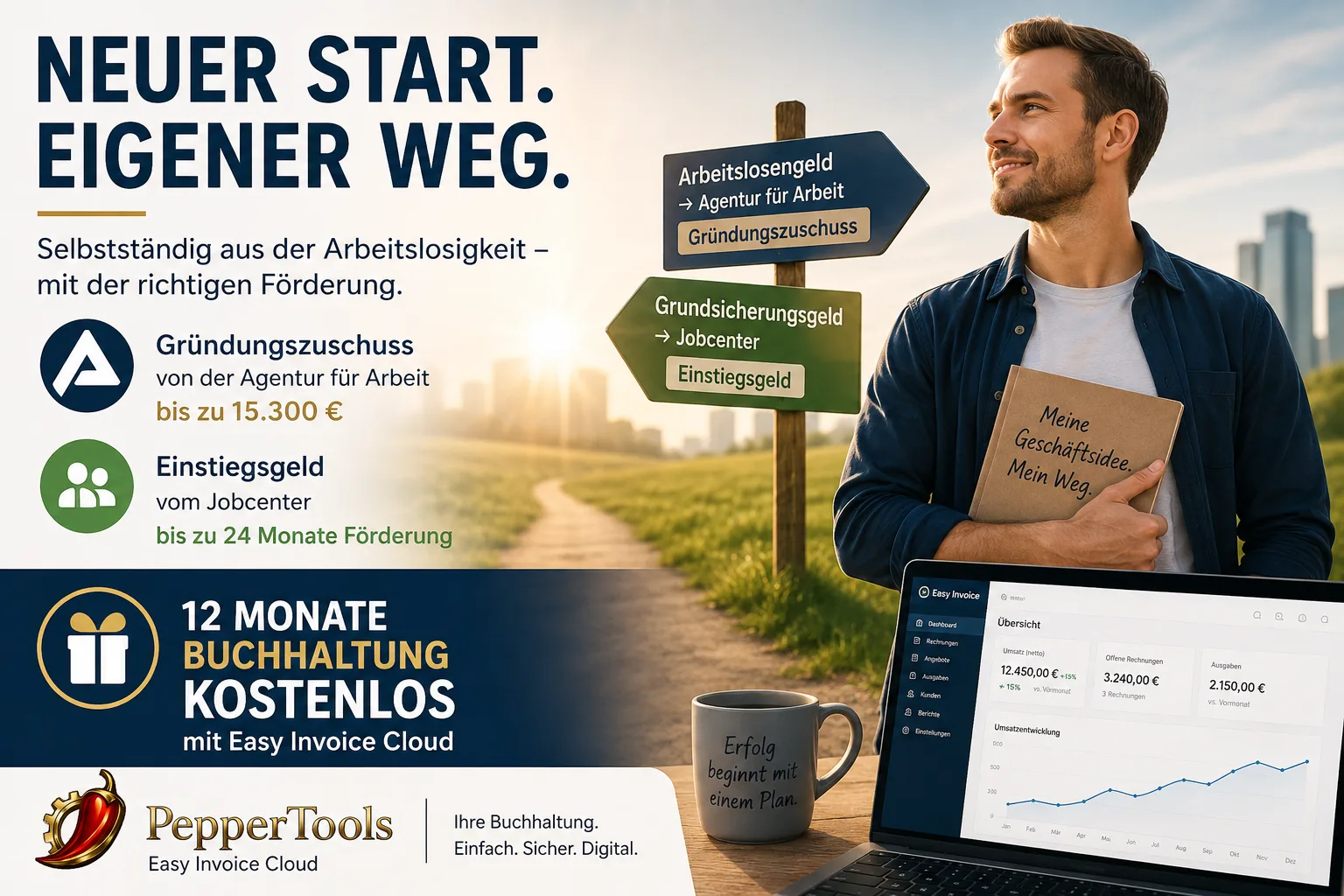
Gründungszuschuss and Einstiegsgeld: Which German start-up grant you get when you found a business while unemployed
Starting a business while unemployed in Germany: which grant applies depends on whether you receive Arbeitslosengeld or Grundsicherungsgeld. Both routes side by side — with amounts, steps and the points most people miss.
 Funding & Finance
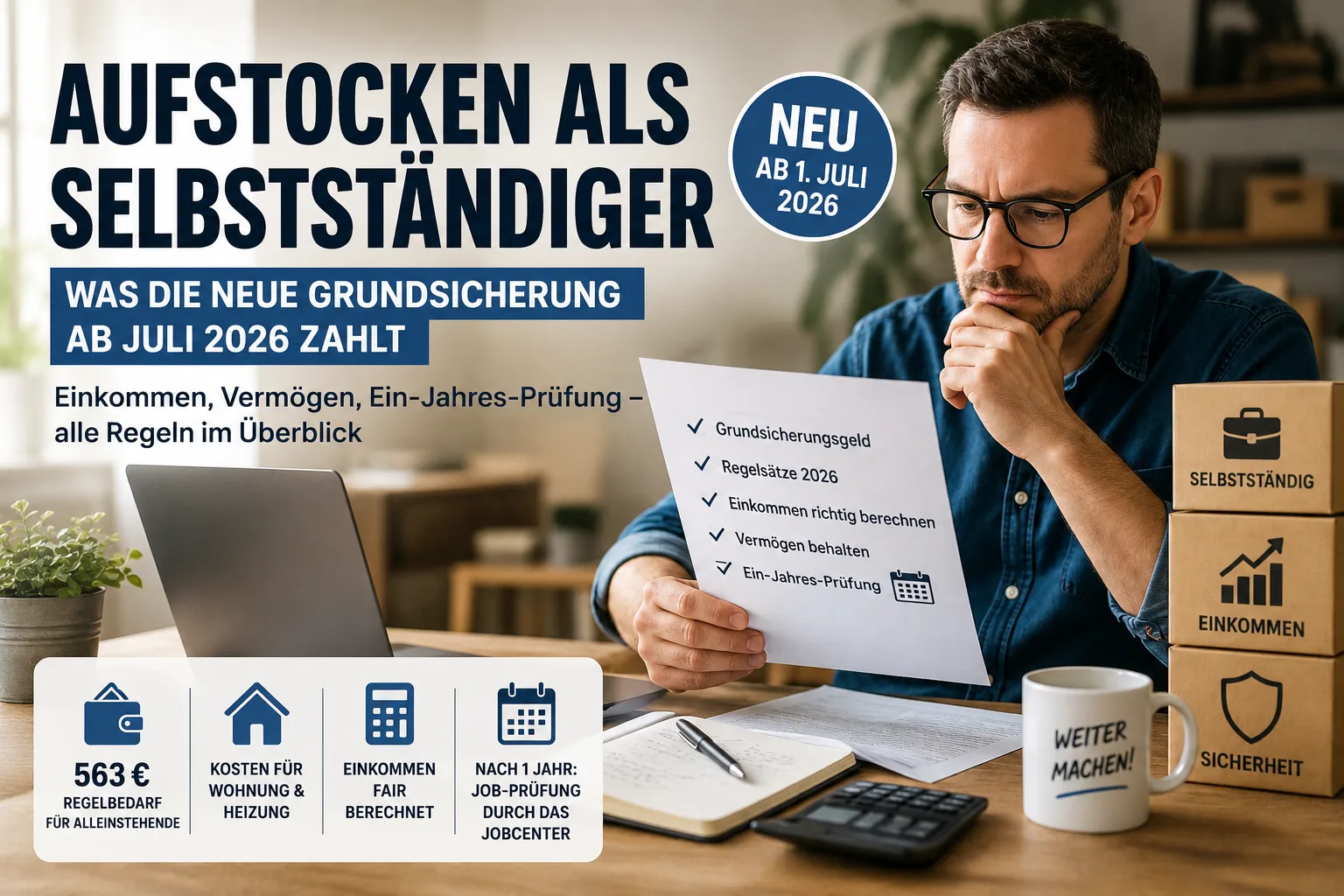
Top-Up Benefits for the Self-Employed: What Germany's New Grundsicherung Pays from July 2026 – and Why the Jobcenter Gets a Say in Your Business After One Year
Self-employed people can claim top-up benefits without deregistering their business. But the calculation is not based on your taxable profit – only on money that actually moves. And since July 2026 the Jobcenter must review after one year whether employment is reasonable for you.
 Funding & Finance
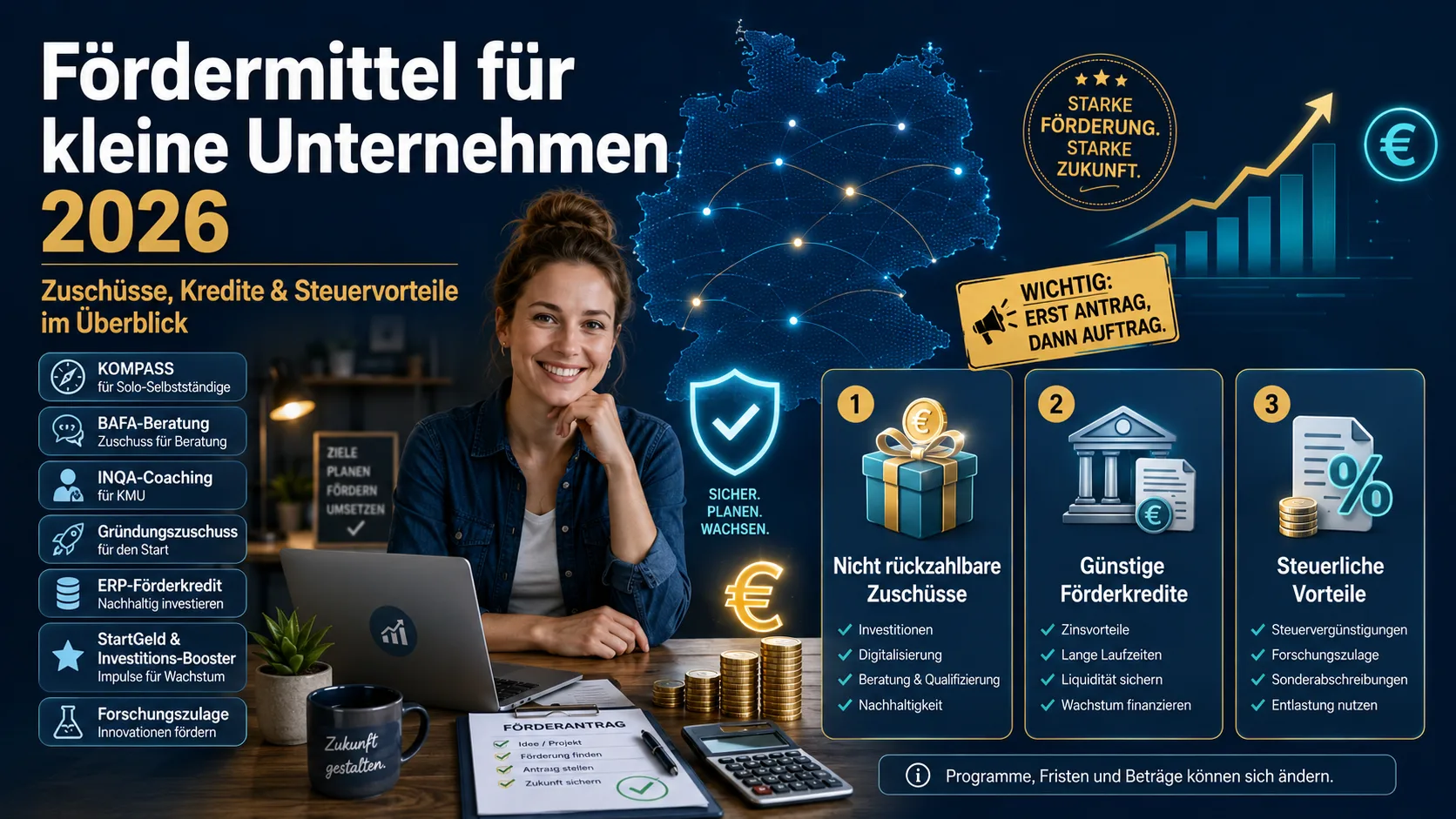
Funding for Small Businesses 2026: The Most Important Grants and Loans at a Glance
Grants you don't repay, low-interest development loans and tax breaks – sorted by type and each with a link to the official body. So you can see what really fits your business.