Otto Market 2026: What Online Sellers Need to Know Now
Otto Market has become more interesting for online sellers in 2026 than ever before. The marketplace is growing faster than the industry average and is opening up to partners from other European countries for the first time. But before you sign up, you should know: Otto Market has clear hurdles — and not every business model fits.
Table of Contents
- Why Otto Market matters in 2026
- Which companies Otto Market accepts
- Requirements for products and data
- When Otto Market really pays off
- Frequently Asked Questions
- Conclusion
Why Otto Market matters in 2026
In fiscal year 2025/26 Otto increased its platform turnover (Gross Merchandise Value, i.e. the total value of goods sold through the platform) by six percent to around 7.5 billion euros. That puts the Hamburg-based retailer well above the German online retail average, which grew by roughly three percent. The marketplace itself was particularly dynamic: GMV here grew by nine percent. Around 6,100 partners now offer about 19 million items.
What does this mean for you? Otto Market is no longer a niche channel — it is a fixed part of the sales mix for many German sellers. If you want extra reach beyond Amazon and eBay in Germany, you can hardly ignore this marketplace.
Customers, AI and internationalisation
Otto reaches a high-spending audience: 12.6 million active buyers used the platform in 2025/26, four percent more than the year before. Strategically Otto is pulling three levers:
- International marketplace expansion: Since March 2026, Otto has been gradually opening up to sellers from other European countries. Dutch partners came first. Sellers from Poland, Austria, France and Spain should follow by year-end, and Denmark in 2027.
- AI assistant: Also since March 2026, Otto is testing its own AI assistant based on Google technology. It accesses the product data of all 19 million items and is meant to give customers recommendations like a digital specialist advisor.
- Retail Media: The ad division Otto Advertising grew ad-driven GMV by 49 percent. Sellers who not only list but also advertise benefit more than before.
By 2028 Otto wants to reach ten billion euros in platform turnover. For sellers that means: Otto keeps investing — but competition on the platform is getting tougher.
If you want to write invoices with all mandatory details in a few minutes, you can try the invoicing software Easy Invoice free for 10 days.
Which companies Otto Market accepts
Here is the key point upfront: Otto Market is not a marketplace for everyone. To join, you must meet clear conditions — and some self-employed people are excluded.
According to its official requirements page, Otto accepts among others these German legal forms: GmbH, GmbH & Co. KG, UG (haftungsbeschränkt), AG, KG, OHG, e.K., GbR and sole proprietorships without commercial register entry. Small businesses under § 19 UStG are explicitly excluded by Otto. Your registered office must be in Germany, the Netherlands or Poland, and you need your own VAT ID.
What does this mean for you? If you start as a part-time small business under § 19 UStG, you must first move out of the small-business regulation before Otto Market is even an option. See our article on the German small-business regulation 2026 and its pitfalls.
Other onboarding obligations
Otto also asks for proof of:
- Packaging licence under the German Packaging Act (LUCID registration with the ZSVR)
- Take-back of electrical devices under ElektroG, where relevant
- Business bank account in the SEPA area for Otto Payments
- Details of beneficial owners holding more than 25 percent
- Signing the Business Partner Declaration on Sustainability with requirements such as no real fur, no PVC in packaging and textiles, restrictions on certain animal-derived materials
If you don't have a packaging licence yet, you'll find the basics in our article on the PPWR and the packaging law for online sellers.
Requirements for products and data
Anyone who has worked with Otto Market knows the platform takes data quality seriously. In practice that means:
- Images: at least 1,000 × 1,000 pixels, white background for the main image
- Descriptions: complete, accurate and with all mandatory attributes for the category
- Categorisation: clean and accurate — misclassified items rank worse
Otto's search and ranking algorithm considers data quality, keyword relevance, conversion rate, return rate, price and reviews. Sellers who do this well gain visibility. A thin listing is punished harder on Otto Market than on many other marketplaces.
Example: Sandra and her UG
Meet Sandra: she sold handmade candles part-time on a handmade marketplace for two years, switched to a UG (haftungsbeschränkt) in 2025 and is now thinking about adding Otto Market as a channel. Her situation:
- Legal form UG: fits
- VAT ID: yes, since she grew out of the small-business regulation
- LUCID packaging licence: already active
- Range: candles — compatible with Home & Living, one of Otto's growth categories
For Sandra Otto Market is a realistic third sales channel in 2026 — provided she invests time in high-quality product images and complete descriptions.
When Otto Market really pays off
Otto Market plays to its strengths above all when your range fits one of Otto's strong categories — for example Fashion & Sports or Home & Living, which grew by nine and seven percent respectively in 2025/26. Newer ranges such as shelf-stable food, pet food, cosmetics or experience vouchers have also been added over the past months.
Otto is a good fit if you:
- already have a professional structure as a GmbH, UG, AG or e.K.
- want to address a German audience with medium to higher purchasing power
- can invest in clean product data — images, copy, attributes
- are willing to use Retail Media to build visibility
Otto Market is less suitable for very price-sensitive mass-market goods, for part-time small businesses without a VAT ID and for sellers who can't put a reliable shipping process in place.
If you're comparing marketplaces, you should also keep an eye on recent fee changes at other platforms. We have two overviews on this: Amazon fees 2026 and TikTok Shop 2026: new fees, new chances.
Practical tip: bookkeeping in multichannel
If you sell in parallel on your own shop, Amazon, eBay and Otto, you need to match orders, incoming payments and marketplace fees cleanly. Cloud solutions such as the PepperTools Office Cloud step in here: automatic bank import, allocation of marketplace payouts, plus dunning that keeps open invoices per channel under control. Even with several channels, administrative effort stays manageable.
Frequently Asked Questions
Can I sell on Otto Market as a small business under § 19 UStG?
Normally no. According to Otto's official requirements page small businesses under § 19 UStG are excluded, and a VAT ID is required. To join, you usually need to switch to standard VAT first.
How high are the commissions on Otto Market?
Commissions vary by category, typically in the low to mid two-digit percentage range, plus a monthly base fee. Current rates are listed in the assortment overview inside the Otto Market partner portal. Because Otto may adjust fees, check the current status before each new listing.
Do I need a packaging licence for Otto Market?
Yes. As with every marketplace you must register under the German Packaging Act with the Central Packaging Register (ZSVR / LUCID) and join a dual system. Otto asks for this during onboarding.
What does the new AI assistant mean for me as a seller?
The AI assistant is first and foremost built for customers. Sellers with complete, accurate, well-structured product data benefit indirectly — because the assistant draws its recommendations from exactly that data. Sellers who invest in clean listings have a higher chance of being recommended.
Is Otto Market worth it alongside Amazon?
In many cases yes, provided your range fits Otto's core categories. Otto reaches a partly different customer base than Amazon, often with higher brand affinity. A parallel listing can meaningfully extend your reach — provided you can handle the extra volume logistically.
Conclusion
Otto Market is significantly more relevant in 2026 than many sellers assume — but only grows for those who clear the formal hurdles and invest in clean data. For established UGs, GmbHs and e.K. businesses with a VAT ID and growth ambition, it is one of the more interesting additional sales channels in the German market. If you serve several marketplaces in parallel, take care to connect marketplace payouts and bookkeeping cleanly — tools like the bank import and integrated dunning in the PepperTools Office Cloud help keep an overview.
Sources
- Otto Market — Requirements for sellers — Official overview of legal forms, obligations and sustainability requirements for new partners.
- Onlinehändler News: Marketplace and AI — Otto accelerates growth — Industry analysis on GMV growth, marketplace expansion and internationalisation (27 March 2026).
- onlinemarktplatz.de: OTTO platform turnover climbs to 7.5 billion euros in 2025/26 — More detail on marketplace, customers, AI rollout and internationalisation (25 March 2026).
- LUCID Packaging Register — Mandatory registration for anyone placing packaged goods on the German market.
Disclaimer: This article is not tax or legal advice. Requirements, legal forms and fees may change. For your specific situation please consult a tax advisor or lawyer and the current Otto Market information in the partner portal.
Handle invoices more easily
Easy Invoice combines quotes, invoices and customer management in the cloud.
Try Easy InvoiceRead next
 E-Commerce & Marketplaces
New eBay Terms of Service from 15 September 2026: What Sellers Should Check Now
New eBay terms apply from 15 September. Four things change, and one of them can cost you your account.
 E-Commerce & Marketplaces
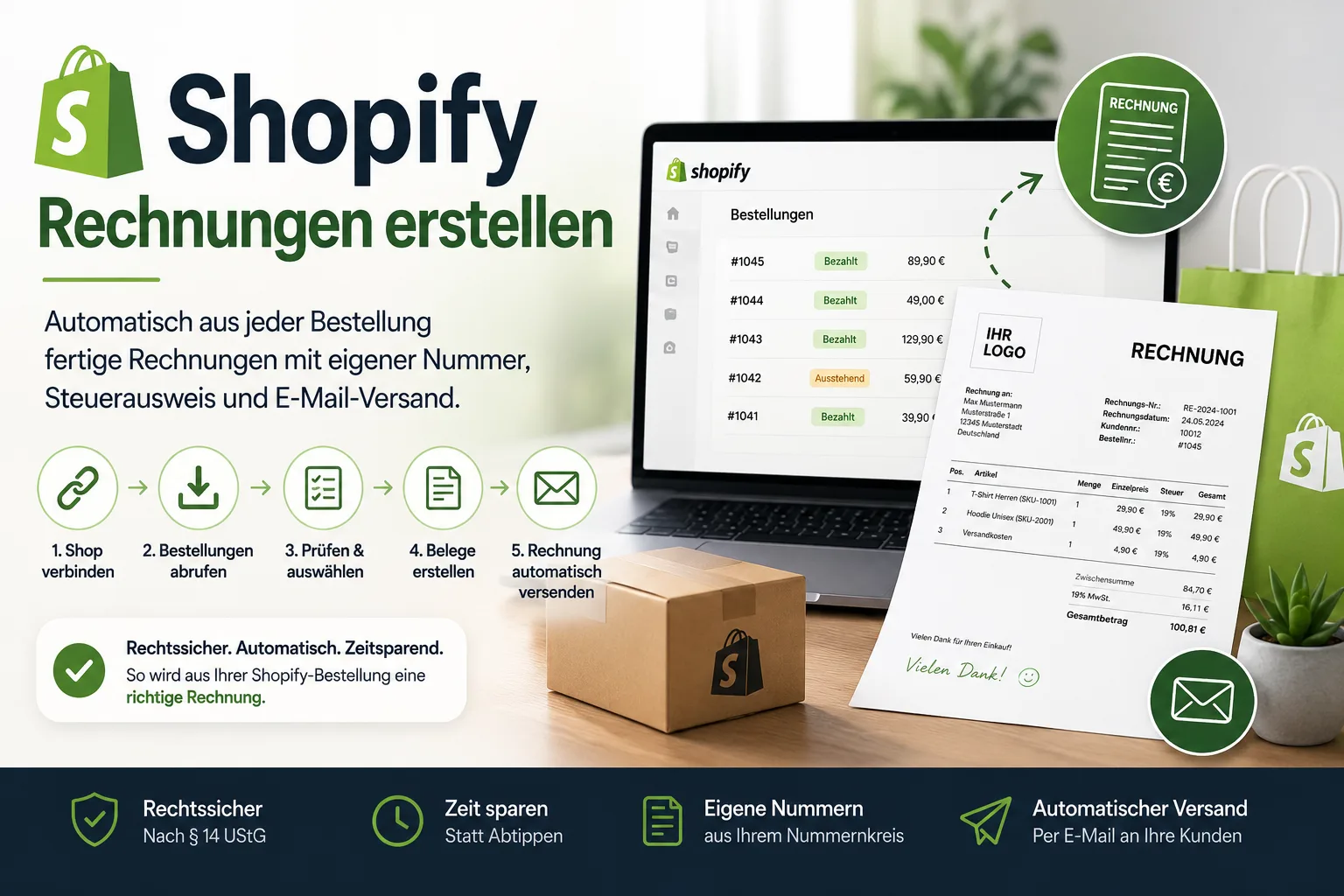
Creating invoices for Shopify
Shopify sends order confirmations – not invoices. How to get from a Shopify order to a finished invoice in five steps, with your own number, correct tax details and automatic sending.
 E-Commerce & Marketplaces
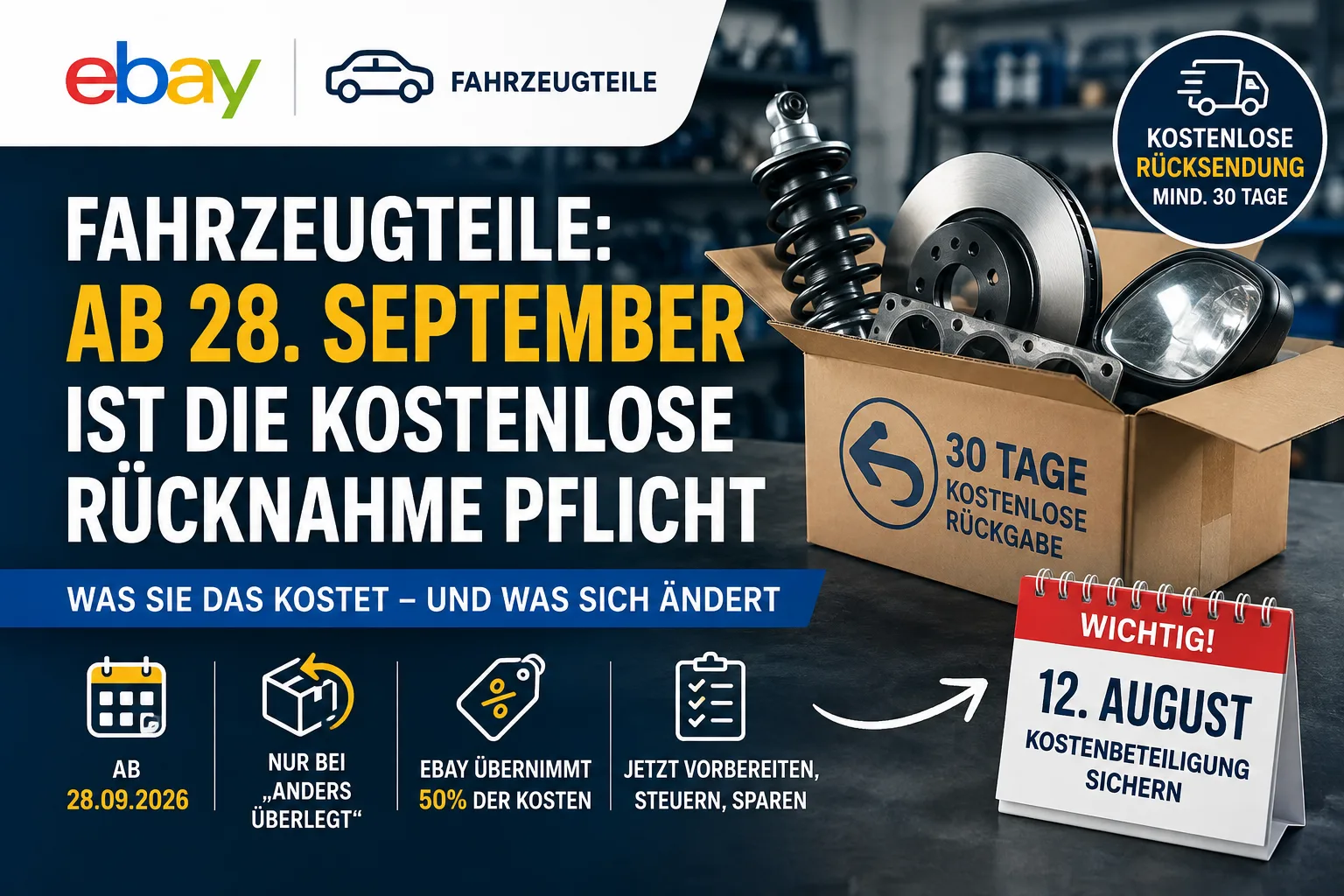
eBay vehicle parts: free returns mandatory since 28 September – what it costs you
New parts over 10 euros at a fixed price: since 28 September you have to take them back free of charge for 30 days and adjust your withdrawal policy. Which returns are not covered, what the rule costs and what to check now.