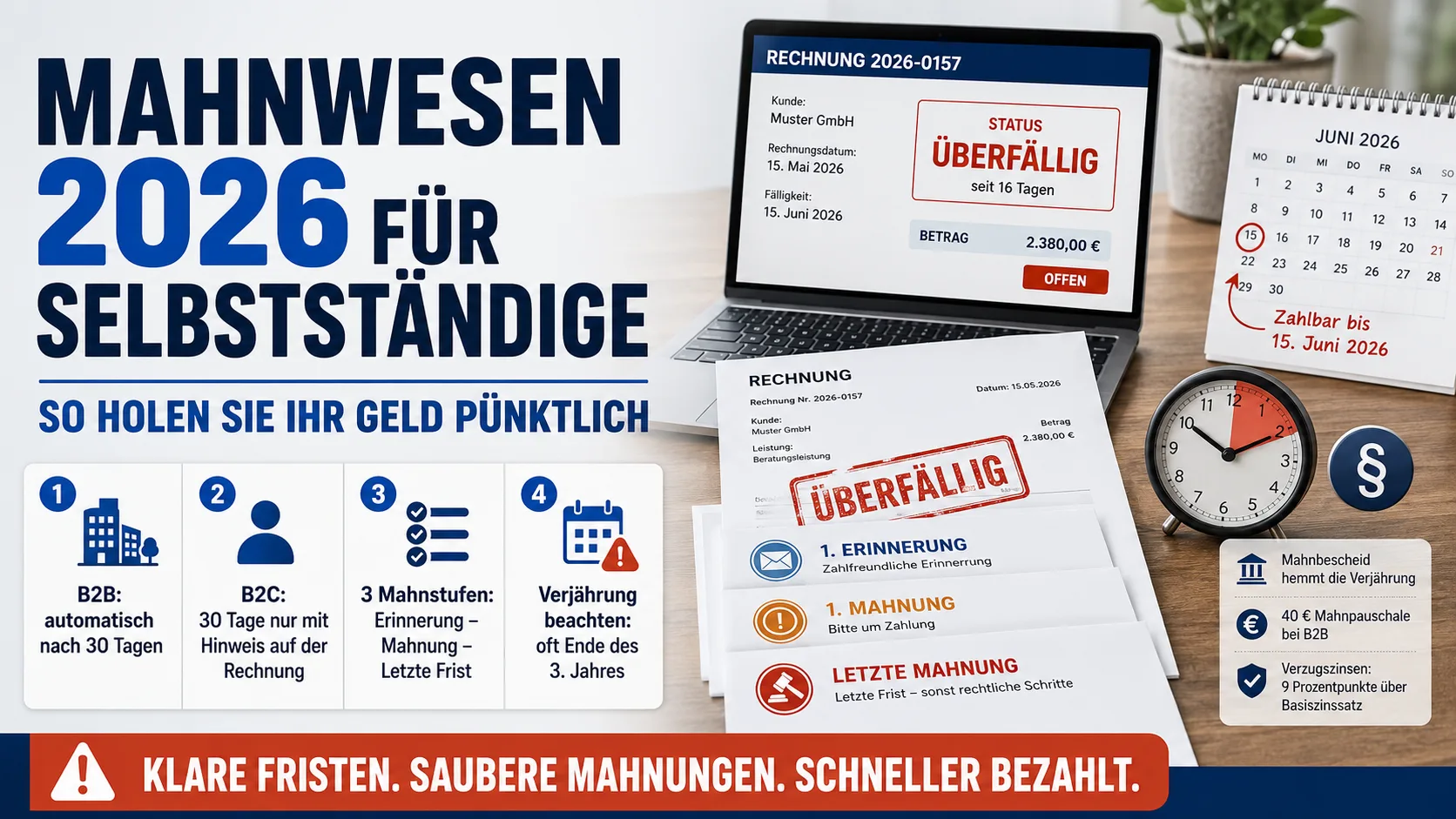
Dunning 2026 for the self-employed in Germany: how to get paid on time
Base rate as of: 1 July 2026 — the next change is possible on 1 January 2027.
When customers don't pay, you're working for free. With the right approach to dunning in 2026, you protect your cash flow, avoid collection costs and prevent bad debts. This practical guide covers when a debtor in Germany automatically falls into default, what late-payment interest you can charge in 2026 and how to act firmly — but politely.
This article refers to German law (BGB).
Table of contents
- Why dunning is essential for the self-employed
- When does your customer default in 2026?
- Late-payment interest 2026: the applicable rates
- Using the EUR 40 flat fee correctly
- Dunning levels in practice
- Statute of limitations: the underestimated trap
- Frequently asked questions
- Conclusion
- Sources
Why dunning is essential for the self-employed
A practical example: Lisa runs an Etsy shop with handmade leather goods on the side. Three B2B wholesale buyers regularly pay 60 or 70 days later than agreed. With EUR 8,000 in outstanding receivables, she lacks the money for materials — and cannot take on new orders. Her problem is not turnover, but cash flow.
Anyone who lets unpaid invoices sit is giving away three things at once: liquidity, late-payment interest and, in the worst case, the claim itself. A structured dunning process takes little time but is one of the biggest levers for your survival as a self-employed person or small business.
What does this mean for you? Don't see dunning as an unpleasant duty, but as a normal part of your business.
If you want to send payment reminders and dunning letters straight from the open invoice, the dunning feature in Easy Invoice does that, including bank import matching.
If what you need is the wording itself: Writing a payment reminder: template and rules has a reminder template to copy, plus an overview of what belongs in it.
When does your customer default in 2026?
The key distinction: do you sell to consumers or to other businesses?
Business customers (B2B): automatically after 30 days
If you sell to a company, public authority or another self-employed person, default kicks in automatically under section 286(3) BGB: 30 days after the invoice falls due and is received. You don't need a reminder to claim late-payment interest or the flat fee — default is triggered as soon as the deadline passes.
Private customers (B2C): only with a notice on the invoice
For consumers, automatic default after 30 days only applies if you explicitly point this out on the invoice. Without that notice, you must send a separate reminder to trigger default.
A simple sentence is enough, for example: "This invoice is due for payment without deduction within 14 days. Late-payment interest applies in case of default. Consumers default at the latest 30 days after receipt of this invoice."
Clear due dates help
Put a concrete due date on every invoice — not just "payable on receipt". A clear deadline such as "Payable by 15 June 2026" makes default verifiable and removes grounds for dispute.
What does this mean for you? Add the default notice permanently to your invoice template. Once set up, it applies to every new customer.
Late-payment interest 2026: the applicable rates
Late-payment interest is based on the base rate under section 247 BGB. The Deutsche Bundesbank raised the base rate to 1.52 percent as of 1 July 2026.
Since 1 July 2026, this gives:
- B2C (consumers): 5 percentage points above the base rate = 6.52% p.a.
- B2B (businesses): 9 percentage points above the base rate = 10.52% p.a.
Worked example
A painter invoices a commercial customer EUR 2,400 gross. If the customer pays 45 days late, this works out to roughly:
EUR 2,400 × 10.52% × 45/365 = approx. EUR 31.13 in late-payment interest.
The exact amount depends on the period and the base rate in the relevant half-year — the rate is reviewed twice a year by the Bundesbank. Individual cases may vary. Ready-made tables, the calculation across a change of rate and how part payments are credited are covered in Late payment interest in Germany: rate, formula and example.
What does this mean for you? The interest isn't a gift to you, it's your statutory right. Always list it in your reminder — many customers will pay faster simply because of that.
Using the EUR 40 flat fee correctly
When business customers are in default, you can claim a flat compensation of EUR 40 in addition to interest — under section 288(5) BGB. This applies:
- only in B2B, not against consumers
- regardless of the invoice amount
- separately for each overdue claim (multiple unpaid invoices = multiple flat fees, if pursued independently)
The EUR 40 is offset against any later lawyer or court costs, but you can demand it immediately once default has occurred.
Example
An IT freelancer has issued two invoices to a GmbH (EUR 3,000 and EUR 1,500), both in default. They can claim two flat fees of EUR 40, i.e. EUR 80 — plus late-payment interest on both amounts.
What does this mean for you? Don't forget the EUR 40. Many self-employed people give it up out of politeness — or because they don't know they are entitled to it.
Dunning levels in practice
There is no "dunning level" model in German law, and the word "reminder" isn't strictly required. In practice, a three-step approach has proven effective:
Step 1: Friendly payment reminder (day 7–14 after the due date)
Casual wording, no blame — customers often simply overlook an invoice. No fees, no pressure. A short "Perhaps this invoice slipped through?" is enough. Ready-made texts in three tones are covered in Friendly payment reminder templates.
Step 2: First formal reminder with a clear deadline (day 14–21)
Clear language, a specific payment deadline (e.g. 7 days). For B2B: interest and the EUR 40 flat fee stated. For B2C: a polite mention of possible collection consequences.
Step 3: Final reminder with notice of further steps (day 21–30)
Final deadline (typically 7–10 days), notice of court dunning proceedings or referral to a collection agency. Then act — empty threats weaken your position with later customers.
When to go to court (Mahnbescheid)?
At the latest after step three without a reaction. The court dunning procedure is cheap (court fees start at around EUR 36), runs online via the mahngerichte.de portal and has a decisive advantage: it suspends the limitation period — a plain reminder doesn't.
What does this mean for you? Dunning is routine. Those who act in a friendly but consistent way are taken more seriously than those who start with threats and then back down.
Statute of limitations: the underestimated trap
Many self-employed people lose real money here: claims generally become time-barred after three years under section 195 BGB. The period starts at the end of the year in which the claim arose.
An invoice from April 2023 thus becomes time-barred on 31 December 2026 — not three full years after the invoice date.
Important to know
Extrajudicial reminder letters do not suspend the limitation period. Anyone who only sends reminders for years risks losing the claim despite all efforts. The limitation period is suspended, for example, by:
- service of a court dunning order (Mahnbescheid) in the court dunning procedure (section 204 (1) no. 3 BGB)
- a lawsuit (section 204 (1) no. 1 BGB)
- negotiations about the claim, best documented in writing (section 203 BGB)
If the debtor acknowledges the claim, for example through a partial payment, the limitation period even starts again (section 212 (1) no. 1 BGB).
Year-end check on 31 December
Look at outstanding items at the end of each year that could turn three years old. How to read an open items list or keep one yourself is explained in the article Reading the OPOS list. If you don't act, you give your claim away.
What does this mean for you? Build a small routine: before Christmas, review old receivables — and, in doubt, file a court dunning order.
Frequently asked questions
How high is late-payment interest in 2026?
Since 1 July 2026: 6.52% p.a. for consumers and 10.52% p.a. between businesses. The basis is the base rate under section 247 BGB of 1.52%, which the Bundesbank raised as of 1 July 2026. The rate is reviewed twice a year, on 1 January and 1 July.
Do I have to send a reminder before charging late-payment interest?
For business customers, generally no — default kicks in automatically 30 days after the invoice falls due and is received (section 286(3) BGB). For private customers, only if you state this explicitly on the invoice. Otherwise, a first reminder is needed.
Can I also claim the EUR 40 flat fee from private customers?
No. The flat fee under section 288(5) BGB only applies when the debtor is not a consumer. For private customers, you are limited to interest plus concretely provable damages.
When is a claim time-barred?
Generally three years after the end of the year in which the claim arose (section 195 BGB). An invoice from 2023 thus becomes time-barred on 31 December 2026. Only court proceedings or documented negotiations suspend the limitation period — a plain reminder is not enough.
Is the court dunning procedure worth it?
Yes, in many cases. Court fees start at around EUR 36, the procedure runs online and it suspends the limitation period. If the debtor doesn't react, you receive an enforceable title — the basis for compulsory enforcement.
Conclusion
Dunning is not an annoying cost factor, but a safeguard for your cash flow. With clear due dates, a consistent three-step process and a year-end check on the statute of limitations, you'll collect significantly more in 2026 than with good wishes. If you want to automate this, the PepperTools modules for dunning and bank import help you keep outstanding items in view. For more on liquidity, see our hourly-rate guide for tradespeople and Writing invoices: the complete guide.
Try Easy Invoice free for 10 days — no payment details, the trial ends by itself.
Sources
- Announcement of the base rate as of 1 July 2026 — Deutsche Bundesbank — Official Bundesbank communication that the base rate under section 247 BGB rises to 1.52% as of 1 July 2026.
- Section 247 BGB — Base rate (gesetze-im-internet.de) — Statutory basis for the base rate.
- Section 288 BGB — Default interest and other default damages (gesetze-im-internet.de) — Legal basis for late-payment interest and the EUR 40 flat fee.
- Section 195 BGB — Standard limitation period (gesetze-im-internet.de) — Three-year period for the standard statute of limitations.
- Base rate under section 247 BGB — Deutsche Bundesbank — Overview and background on setting the base rate.
- Reminder and default — IHK Regensburg — Practical IHK guidance on dunning procedures and default.
- EUR 40 flat fee — IHK Hannover — Explanation of the flat fee under section 288(5) BGB.
- Rules on limitation periods — Hamburg Chamber of Commerce — Overview of limitation periods and grounds for suspension.
Note: This article does not constitute tax or legal advice. For your individual case, please consult a tax advisor or lawyer.
Handle invoices more easily
Easy Invoice combines quotes, invoices and customer management in the cloud.
Try Easy InvoiceRead next
 Invoicing & Accounting
Showing a discount on an invoice in Germany: template, VAT, example
A discount is deducted from the net amount, and VAT is calculated afterwards. Here are two templates to copy, the rules for discount codes and vouchers, and what applies if you grant the reduction only after the invoice.
 Invoicing & Accounting
Freelancer invoices in Germany: template, required details, VAT
As a freelancer (Freiberufler) in Germany, you write invoices without registering a trade, but with the same mandatory details as any business. One question decides: do you add VAT or not? Here you find the answer for your case and a template for each of the three cases.
 Invoicing & Accounting
Retention periods 2026: invoices, receipts and what may go in 2027
Since 2025, eight instead of ten years have applied to invoices and other accounting vouchers (Buchungsbelege). The table shows all periods, when they start, when they run longer and which folders you may clear out at the start of 2027.