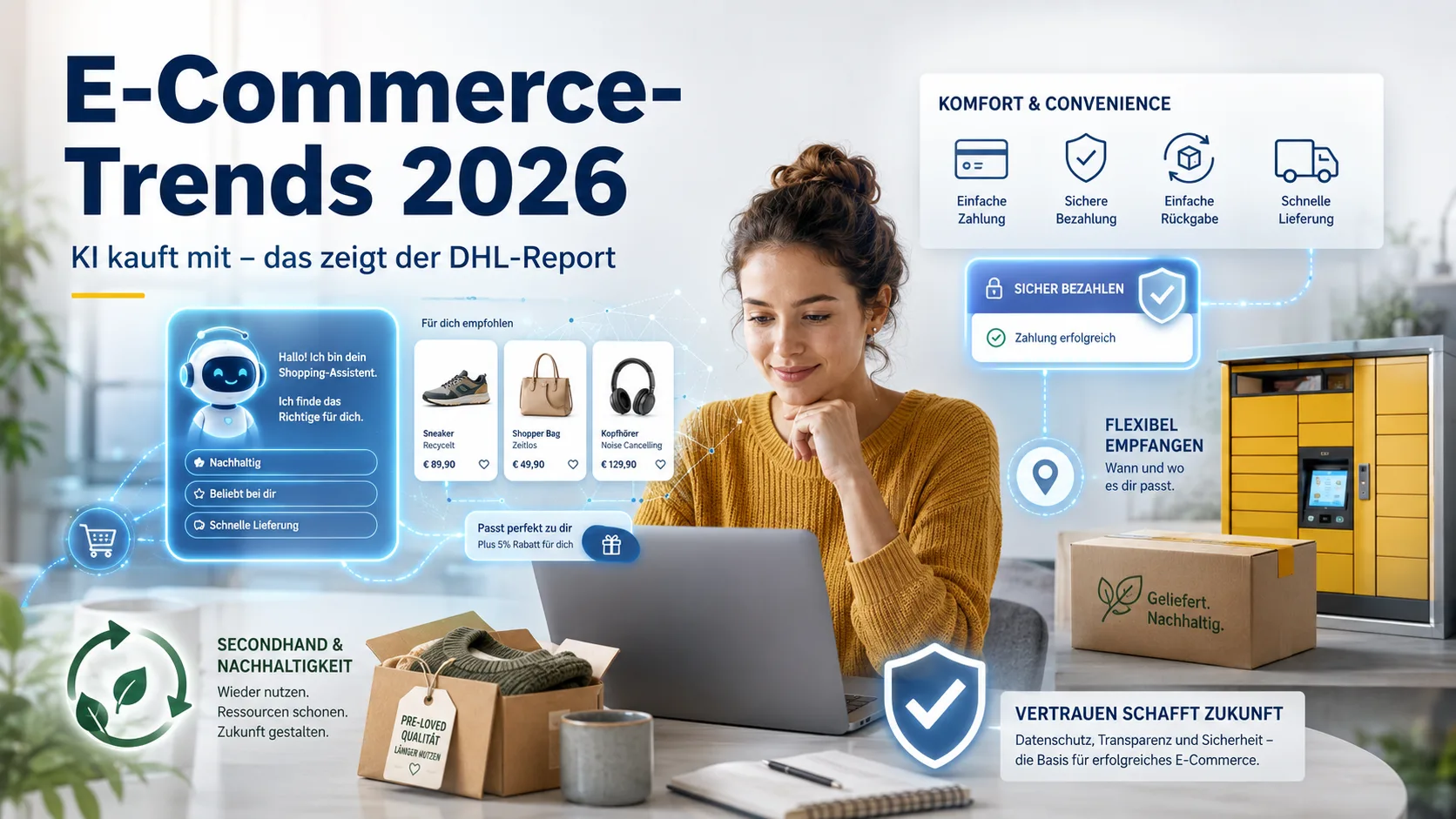
E-Commerce Trends 2026: AI Joins the Purchase – DHL Report
How will your customers shop tomorrow? The DHL E-Commerce Trends Report 2026, published on 2 June 2026, gives a remarkably clear answer: AI increasingly takes part in decisions, convenience becomes mandatory, and second-hand goes mainstream. We summarise the findings – and translate them into concrete steps for small sellers.
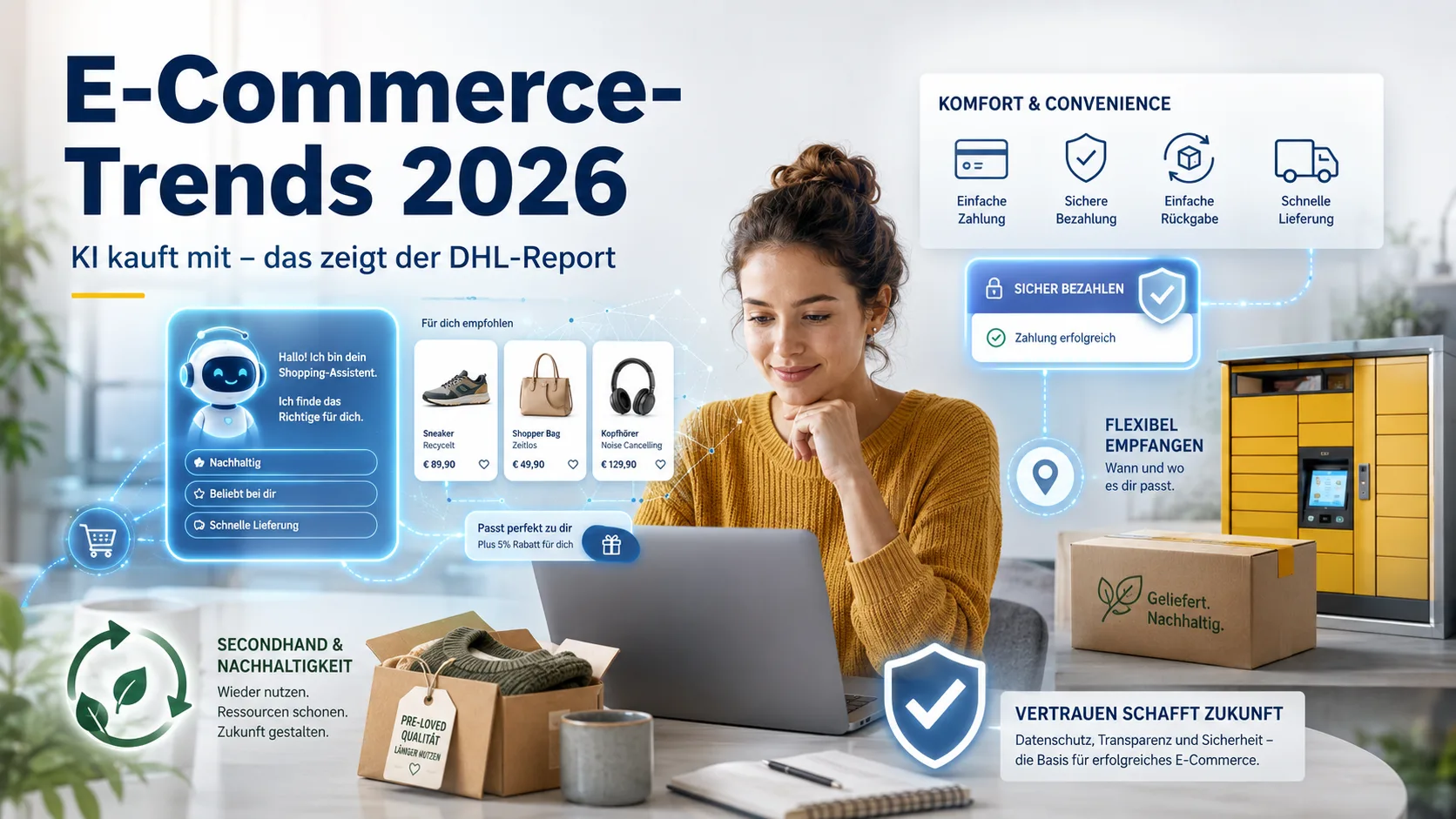
The study in brief
The report is one of the larger studies in the industry: 29,000 consumers and 5,800 companies in 29 countries were surveyed. The core finding: buyer behaviour is changing faster than the offering of many sellers – the gap between expectation and reality is growing. According to DHL, competition is decided less and less by price and product range, and more by speed, personalisation and trust along the entire customer journey.
Delivery remains the moment where shops win or lose customers: how DHL, DPD, GLS, Hermes and UPS perform on price, speed and reliability is compared in Shipping providers compared.
AI moves from tool to co-decider
The most important development: artificial intelligence no longer just helps with research – it increasingly takes part in purchase decisions. According to the report, almost a third of consumers (29 percent) would be willing to hand control of purchases to an AI within the next five years – with younger target groups driving this. In the long term, classic web shops could be partly complemented or replaced by AI interfaces that communicate directly with customers’ digital assistants.
What does this mean for you? Your product data becomes the ticket of entry. AI systems recommend what they understand: complete titles, concrete properties, clear descriptions, well-maintained attributes. Two of our articles help directly: visibility in Google AI Mode and the practical guide to product descriptions with ChatGPT. Incidentally, the new HDE Online Monitor 2026 confirms the trend: 35 percent of Germans already research with AI before buying.
Convenience is mandatory: payment, shipping, returns
The second big lever is unspectacular but measurable: convenience. Flexible payment options, a transparent checkout and uncomplicated delivery and return offers are increasingly regarded as the minimum standard, according to the report. Strikingly, a considerable share of abandoned purchases is simply due to the preferred payment method being missing – a point many sellers underestimate. Delivery expectations are rising too: parcel lockers and pick-up points (out-of-home delivery) are becoming ever more popular.
An example: a small online seller of sports accessories wonders about many orders abandoned just before purchase. A look at the data shows: a payment method popular with his target group is missing. Such gaps quietly cost revenue – so check regularly whether your checkout covers your customers’ common payment methods and whether you offer parcel-locker delivery.
Second-hand and sustainability go mainstream
Re-commerce – buying and reselling used products – has, according to the report, developed from a niche phenomenon into a fixed part of online retail. More and more consumers act as buyers and sellers at the same time; classic merchants increasingly also compete with private sellers. Sustainability is no longer perceived as an extra but as an expectation – down to the question of how products are transported and delivered.
What does this mean for you? Check whether your product range has re-commerce potential: refurbished goods, trade-ins, B-stock sales. And communicate honestly what you already solve sustainably in packaging and shipping – that has become a buying argument.
Trust as a currency
The third common thread of the report: trust. Customers pay more attention to transparent processes, secure payment and reliable delivery. For small sellers that is good news – because closeness, personal support and traceable processes are exactly their strengths compared with anonymous platforms. Which sales channels and systems fit this strategy is compiled in our comparison of online store systems.
Frequently asked questions
What is the DHL E-Commerce Trends Report?
An annual study by DHL on global online retail. The 2026 edition was published on 2 June 2026 and is based on surveys of 29,000 consumers and 5,800 companies in 29 countries.
Do I have to react to AI shopping immediately as a small seller?
You don’t have to rebuild everything. The most important first step is unspectacular: complete, concrete and well-structured product data. It helps today in classic search and tomorrow in AI recommendations.
Which convenience factors count most?
According to the report, above all: the target group’s preferred payment methods, a transparent checkout and flexible delivery and return options – including parcel lockers and pick-up points.
Is second-hand worthwhile for small sellers?
Depending on the product range, yes. Re-commerce has arrived in the mainstream according to the report. Used and B-stock goods can open up additional buyer groups – and fit the customers’ growing sustainability expectations.
Conclusion
The DHL report paints a clear picture: customer expectations are running ahead of many sellers – in AI, convenience and sustainability. The good news: the most important countermeasures are feasible for small sellers – clean product data, a gap-free checkout, flexible delivery and honest communication. And the less time bureaucracy eats, the more remains for exactly these tasks: a central office solution like Easy Invoice takes invoices, order import and document filing off your hands so you can look after your customers.
Sources
- DHL Group: press release on the E-Commerce Trends Report 2026 — Official press release (2 June 2026) on the study.
- DHL: E-Commerce Trends Report 2026 (study page) — Official study page with the full report.
- Retail-News: DHL Report 2026 – AI, sustainability and convenience — Editorial assessment of the study results (2 June 2026).
Handle invoices more easily
Easy Invoice combines quotes, invoices and customer management in the cloud.
Try Easy InvoiceRead next
 E-Commerce & Marketplaces
New eBay Terms of Service from 15 September 2026: What Sellers Should Check Now
New eBay terms apply from 15 September. Four things change, and one of them can cost you your account.
 E-Commerce & Marketplaces
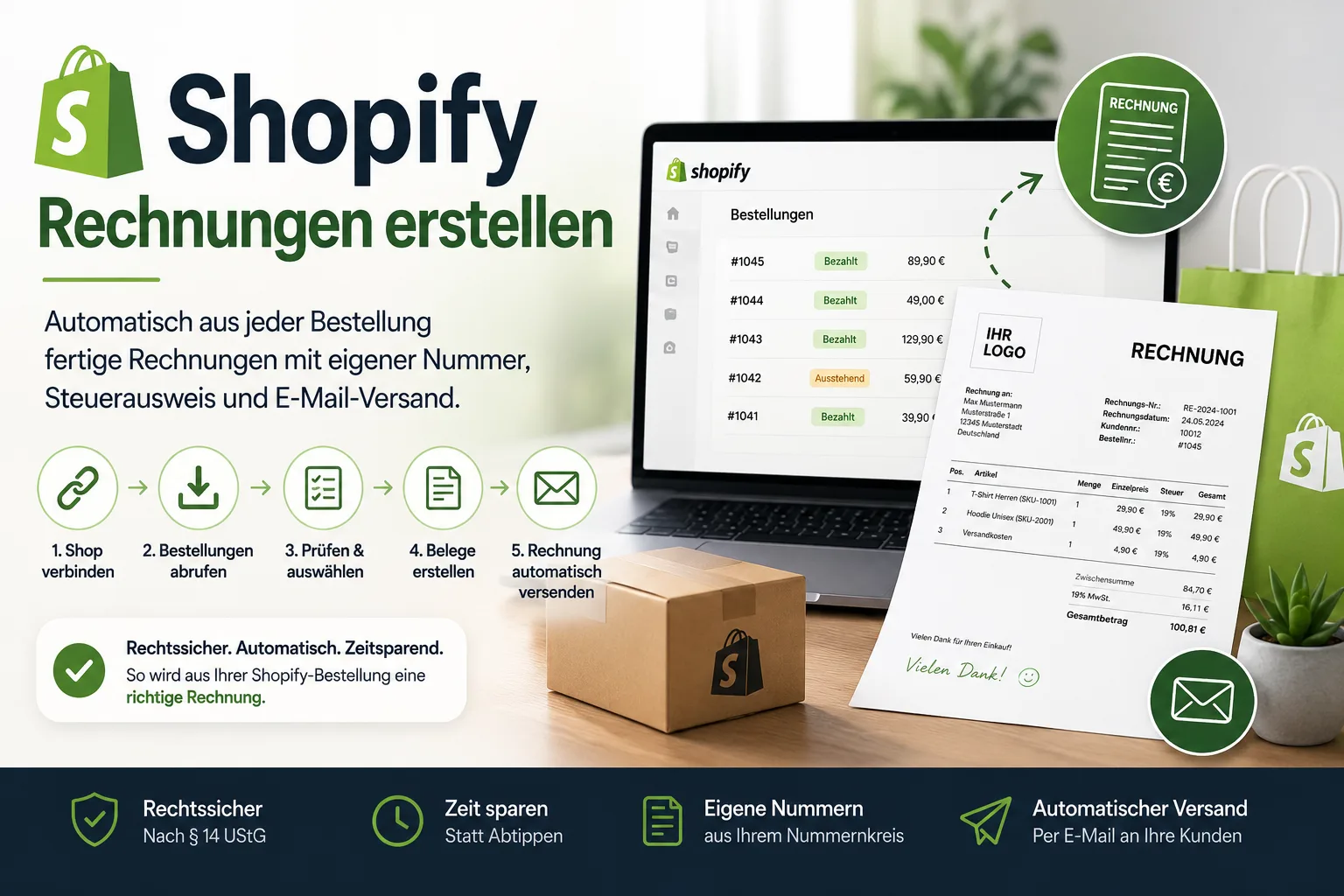
Creating invoices for Shopify
Shopify sends order confirmations – not invoices. How to get from a Shopify order to a finished invoice in five steps, with your own number, correct tax details and automatic sending.
 E-Commerce & Marketplaces
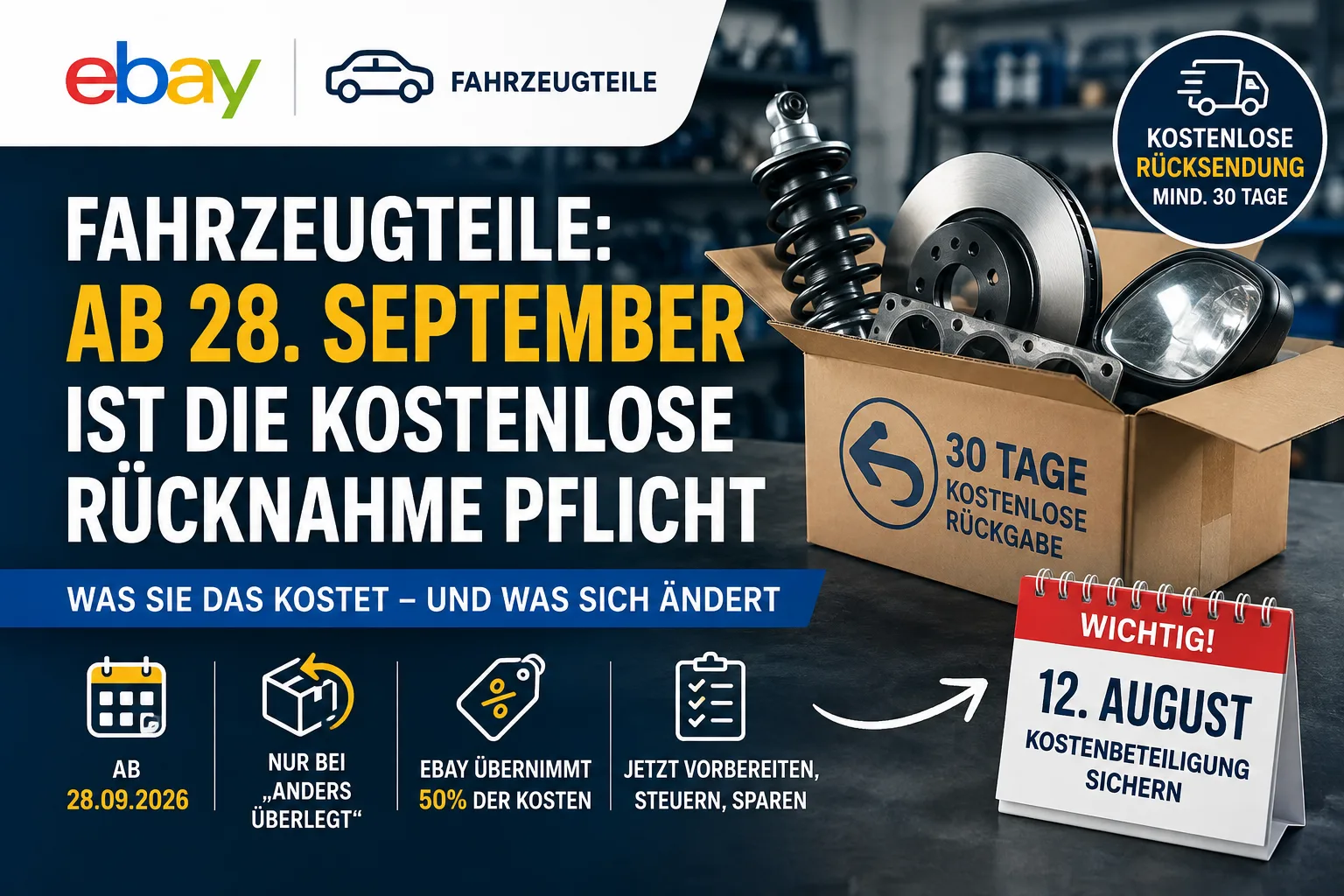
eBay vehicle parts: free returns mandatory since 28 September – what it costs you
New parts over 10 euros at a fixed price: since 28 September you have to take them back free of charge for 30 days and adjust your withdrawal policy. Which returns are not covered, what the rule costs and what to check now.