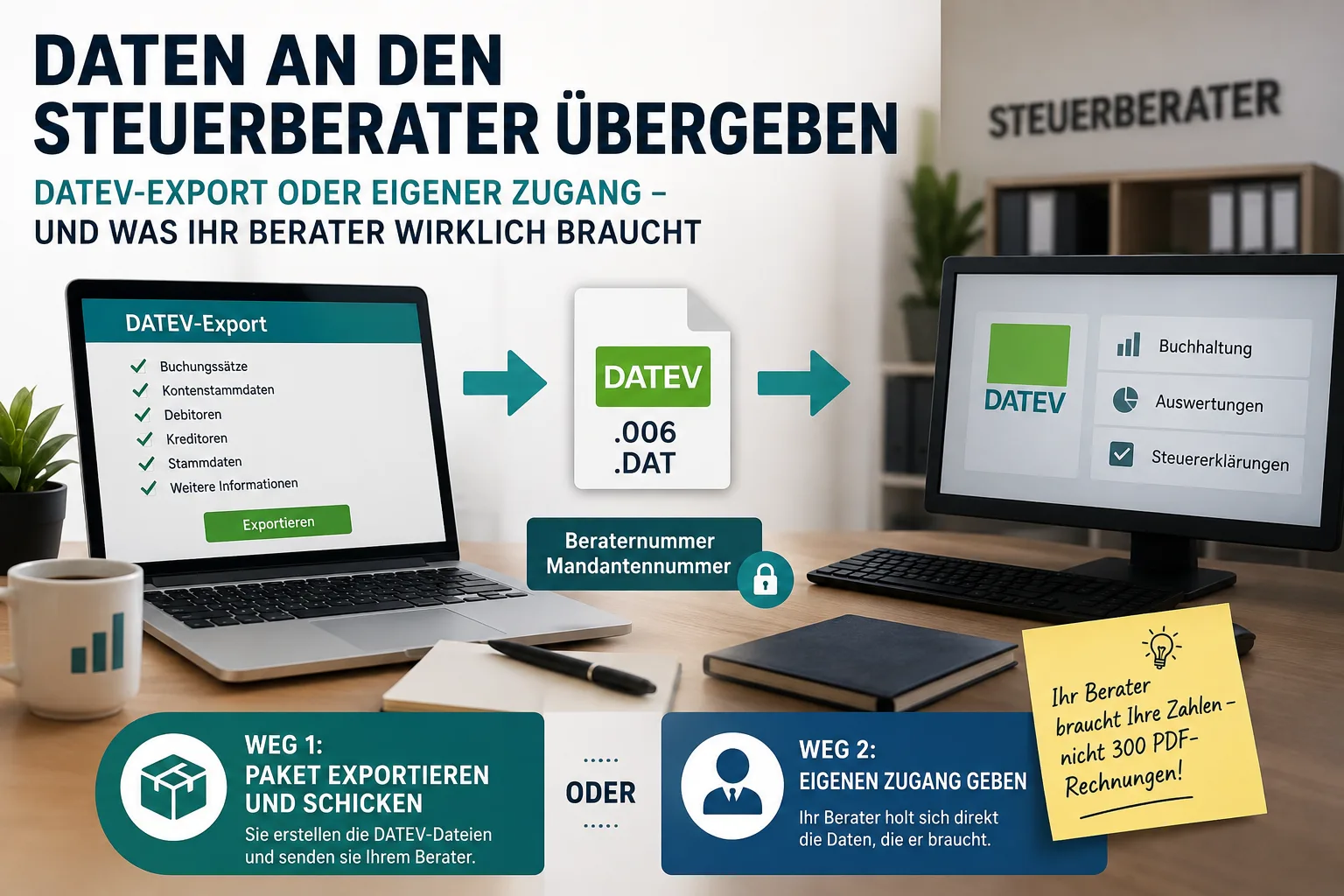
From 1 January 2027, the German tax office (Finanzamt) will place your tax assessment notice (Steuerbescheid) in your ELSTER account instead of sending it by letter – initially, whenever you filed your tax return electronically. You receive an e-mail telling you the assessment is ready. The catch matters: the assessment counts as delivered on the fourth day after it is made available – even if you miss the e-mail and never log in. From that day, your one-month objection period runs. If you prefer to keep receiving a letter, you can request that. This much is already law; the federal government additionally wants to widen the rule with the Annual Tax Act 2026 (Jahressteuergesetz) – that part is not yet passed.
If you take away only one thing – these three steps, less than fifteen minutes altogether:
- Check the e-mail address in your ELSTER account. Log in and look at the stored address – is it one you actually read every day? This is the most important point in this whole article.
- Whitelist the ELSTER sender in your mailbox so the notification does not end up in spam.
- Decide: digital or paper. If you want to stay with the letter, file the request as soon as the procedure for it is available.
Why exactly these three – and everything that hangs on them, from the objection deadline to the more expensive interest on back taxes – is in the details:
Table of contents
- Who is affected from when – and what is still a draft
- How you will learn about your assessment
- The 4-day rule: your deadline runs, even unread
- Genuine or scam? How to recognise the real notification
- “I want to keep getting a letter” – how to stay on paper
- My tax advisor handles everything – does this affect me anyway?
- Back taxes get more expensive: interest set to double
Who is affected from when – and what is still a draft
Two things are being mixed up in the media at the moment. It is worth keeping them apart:
Already passed and law: For assessments the tax office issues from 1 January 2027, digital provision in the ELSTER account becomes the normal case whenever your tax return was filed electronically – by you via your own ELSTER account or by an authorised person, such as your tax advisor. The tax office no longer needs your consent for this. Originally this was meant to start in 2026; the start was postponed by one year to 2027. Initially this mainly concerns income tax assessments. The trade tax assessment from your city or municipality will keep arriving the usual way – it does not come from the Finanzamt.
Still a draft: On 12 August 2026 the federal cabinet approved the Annual Tax Act 2026. Under it, an active ELSTER account would be enough in future – the assessment would arrive digitally even if you did not file the return electronically at all. What exactly counts as an “active” account – for instance whether a registration from years ago is enough – will only be settled in the further legislative process. Decisions on objections are then also to be provided digitally. The Bundestag and Bundesrat still have to approve it; with annual tax acts, details typically still change during the process.
For most self-employed people the difference matters little in practice: if you are self-employed, you have to file your tax return electronically anyway – and so you already fall under the rule that has been passed. How to get an ELSTER account in the first place is explained in our guide to the German tax number and ELSTER registration.
Receipts, bank transactions and the export for your accountant are bundled in the Easy Invoice accounting software in one place.
How you will learn about your assessment
The process is simpler than it sounds:
- The tax office places the assessment in your ELSTER account.
- On the same day, an e-mail goes to the address stored in your ELSTER account: an assessment is ready for retrieval.
- You log in and retrieve the assessment – read it, download it, save it.
Download the assessment right when you retrieve it and file it with your records. You will need it again and again – for the bank, for grant applications, for parental benefit – and you will have it at hand without having to log in first.
The assessment itself is not attached to the e-mail. The e-mail is only the notice; the document is available exclusively after logging in to the account.
One worry we can clear up straight away: nothing changes about your refund. Whether you retrieve the assessment or not – the tax office transfers the money regardless, to the bank account it has on file for you.
The critical weak point in this process is not the technology and not the tax office – it is the e-mail address. If an old address you no longer read is stored in your ELSTER account, the notification goes nowhere. That changes nothing about the assessment and its deadlines.
The 4-day rule: your deadline runs, even unread
Until now, a letter from the tax office counted as delivered a few days after posting – whether you read it played no legal role. That principle now moves into the digital world: the assessment counts as officially announced on the fourth day after it is made available in the account (Section 122a of the German Fiscal Code). Not on the day you retrieve it.
Why this matters: from the announcement, the one-month objection period runs. If you disagree with the assessment – because expenses were not recognised, because there is a transposed digit – you must file an objection (Einspruch) within that month. After that, the assessment is generally final.
An example: the tax office places your assessment in the account on 4 March 2027. It counts as delivered on 8 March. Your objection must reach the tax office by 8 April. Whether you retrieve the assessment on 5 March or only in May changes nothing about these dates. Only if the deadline falls on a weekend or public holiday does it shift to the next working day.
This is exactly why the new world is less forgiving than the letterbox: a letter sits visibly on the table. The e-mail notification can land in spam or drown among fifty other e-mails – the deadline runs anyway. If that happens to you and a payment was also outstanding, read here what really happens when you miss deadlines.
Genuine or scam? How to recognise the real notification
Fraudsters have been sending fake e-mails in the name of ELSTER and the tax offices for years – the switchover will give them fresh material. Fortunately, telling them apart is simple:
- The genuine notification is a pure notice: something is ready in your account.
- The assessment never arrives as an e-mail attachment. An e-mail with an attached “Steuerbescheid.pdf” or even “Steuerbescheid.zip” is fraud.
- Genuine messages do not ask you to enter bank details via a link or to pay anything.
The safest habit: do not click links in such e-mails at all. Type www.elster.de into the browser yourself, log in and check whether something is really waiting. ELSTER publishes current warnings about scams on its security page – worth a look whenever an e-mail seems odd to you.
“I want to keep getting a letter” – how to stay on paper
You can object to digital delivery: on request, the tax office will keep sending the assessment by post. Under the planned new rule in the Annual Tax Act 2026, this request is to be filed electronically – for instance via ELSTER – and then to apply permanently until you revoke it.
An honest assessment: for the self-employed, the paper route is usually only a postponement. The direction of the tax administration is clearly digital, and if you file electronically every year anyway, you gain little with the letter – except the reassuring feeling of not being able to miss anything in your inbox. If you have your e-mail under control, the digital route is faster: the assessment is available days earlier than a letter.
My tax advisor handles everything – does this affect me anyway?
If your tax advisor files the return and is registered as the authorised recipient, the assessment is provided to them – they check it and get back to you, just as with the paper assessment until now. The switchover changes nothing fundamental about this division of labour. Still, clarify once briefly with the firm who will retrieve the assessment where in future, so it does not sit unclaimed between two responsibilities.
How the cooperation with the firm runs smoothly overall – which documents they need and what your invoicing software delivers – is covered in our guide to preparatory bookkeeping.
Back taxes get more expensive: interest set to double
The same bill contains a second change that costs real money: interest on tax back payments and refunds is set to rise from 0.15 per cent to 0.3 per cent per month from 2027 – from 1.8 to 3.6 per cent per year.
This interest accrues when a lot of time passes between the tax year and the assessment: the interest period begins 15 months after the end of the tax year. An example: with 5,000 euros of back taxes and one year of interest, it used to be 90 euros – in future 180 euros. If you regularly file late and expect back payments, you will pay twice as much on top from 2027. The mirror-image good news: the tax office will then also pay 3.6 per cent interest on refunds.
Here too: this is the status of the government draft of 12 August 2026, not yet passed.
This article provides general information and does not replace tax advice. An accounting software keeps receipts, revenue and reports in one place.
Handle invoices more easily
Easy Invoice combines quotes, invoices and customer management in the cloud.
Try Easy InvoiceRead next
 Taxes & Law
Zusammenfassende Meldung (ZM): deadline, ELSTER and who must file
Anyone who supplies goods or invoices services without German VAT to business customers in other EU countries reports these sales to the German Federal Central Tax Office. Here you can find out who has to report, by when, what goes into the report and what happens if it is missing.
 Taxes & Law
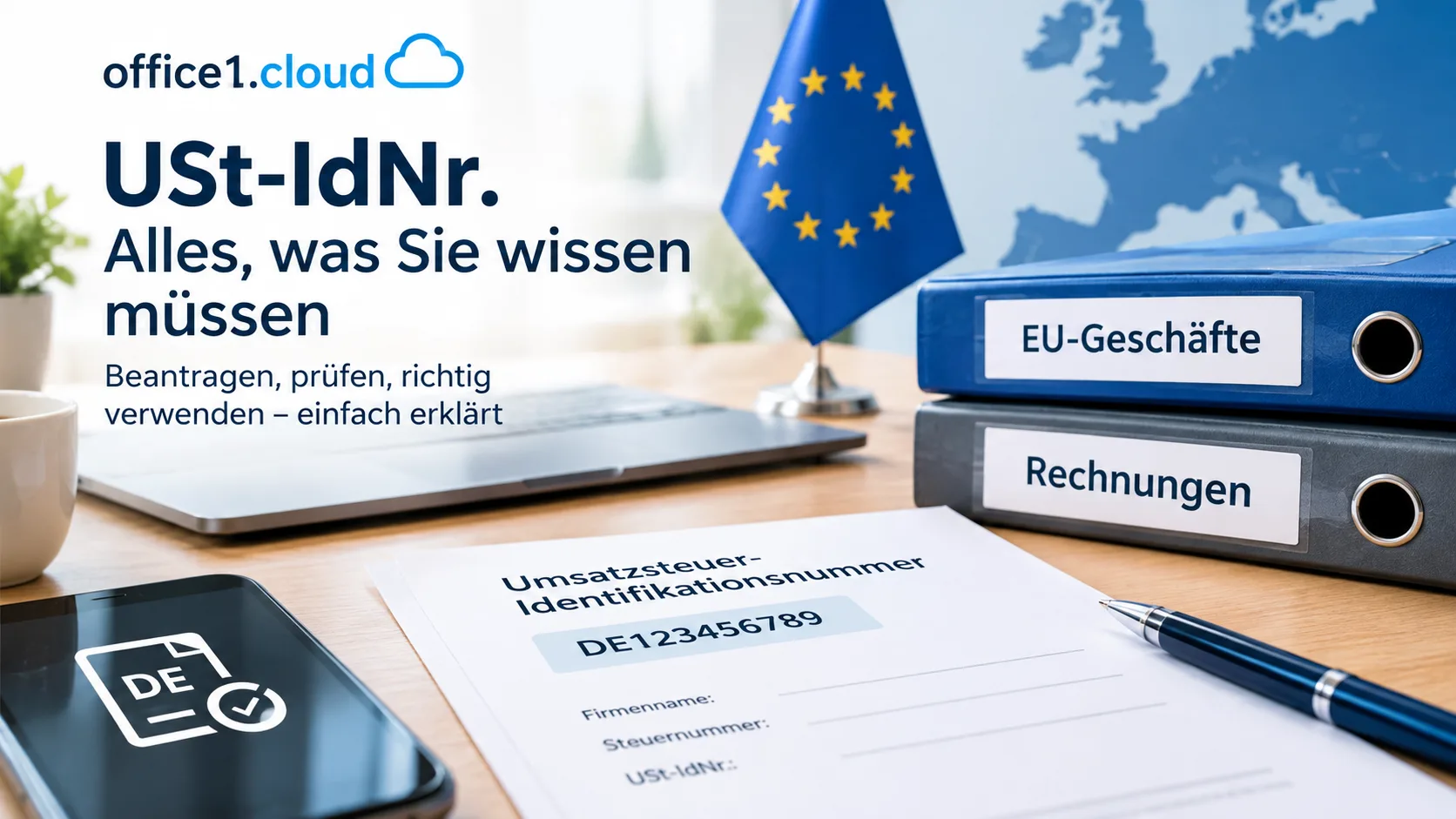
USt-IdNr.: how to apply, how to check and when you need one
The USt-IdNr. (EU VAT ID) is a second number alongside the Steuernummer, meant for business with companies in other EU countries. You apply for it free of charge at the German Federal Central Tax Office and check your customer's number there too; here is how both work and how to find out whether you need one at all.
 Taxes & Law
Low-value assets in Germany (GWG) 2026: €800 limit, net or gross
The GWG limit in Germany is €800 net in 2026, also under the small business scheme. Which purchases you deduct at once, when the pooled item pays off and how to book it.