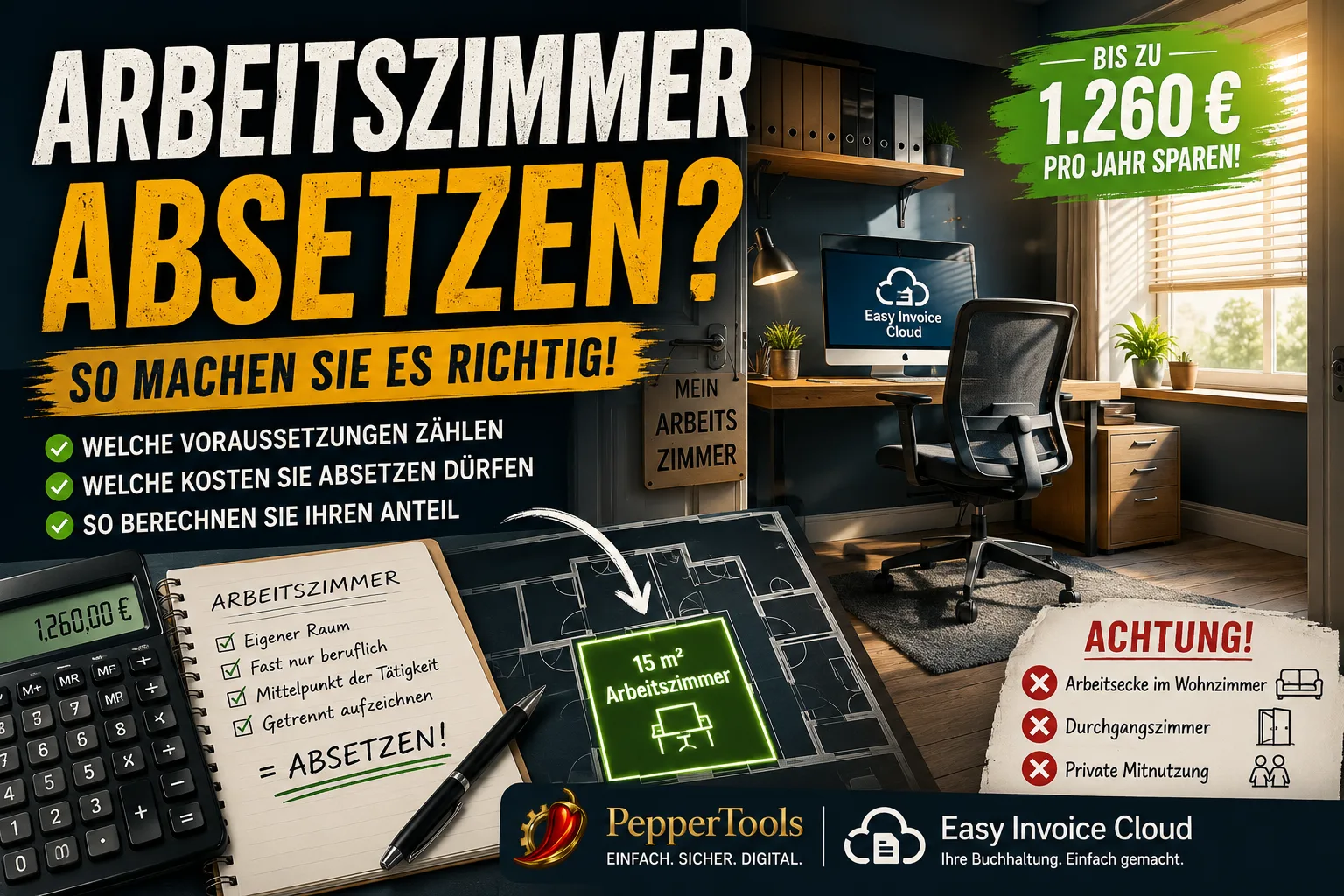
Two stubborn misconceptions surround the German home office deduction. The first: „I work from home, so I can deduct the room." The second: „Since the daily home office allowance was introduced, it is not worth it anyway." Neither is true. Whether you may deduct depends on clear criteria – and if you meet them, the deduction is often far above the flat rate.
This article provides general information and does not replace tax advice. If you own your home, or if your case is a borderline one, please have your tax adviser check it.
Contents
- Three cases – find yours first
- What counts as a home office
- The knock-out criteria: where it usually fails
- The centre of your activity: the question everything hangs on
- Employed and self-employed on the side: one room, two activities
- Which costs you may claim
- How to calculate your share
- The annual flat rate of 1,260 euros
- No separate room? The daily allowance
- Owning your home: the business-assets trap
- Mandatory: record the costs separately
- Recording home office costs in office1.cloud
- Frequently asked questions
Three cases – find yours first
German tax law does not know „deduct a little bit". It knows three cases, and you fall into exactly one of them.
| Your situation | What you can deduct |
|---|---|
| Separate room, used almost exclusively for work, and it is the centre of your activity | All proportional room costs – or the annual flat rate of 1,260 euros instead |
| Separate room, used almost exclusively for work, but the centre lies elsewhere (building site, shop, client meetings) | No room costs. Only the daily allowance of 6 euros per working day at home |
| No separate room – a corner, the kitchen table, a walk-through room | No room costs. Only the daily allowance of 6 euros per working day at home |
The legal basis is section 4 (5) sentence 1 nos. 6b and 6c of the German Income Tax Act (EStG). The tax authorities summarised their position in the Federal Ministry of Finance letter of 15 August 2023.
The difference is substantial: in the first case, a normal rented flat quickly produces 2,000 euros and more. In the third case, 1,260 euros is the maximum.
Receipts, bank transactions and the export for your accountant are bundled in the Easy Invoice accounting software in one place.
What counts as a home office
According to the tax authorities' definition, a home office is a room that meets three conditions:
- By location, function and furnishing it is integrated into your domestic sphere – it belongs to your flat or house.
- It serves predominantly for intellectual, written, administrative or organisational work.
- It is used exclusively or almost exclusively for business or professional purposes.
Point 3 is the crux. „Almost exclusively" means private use is harmless only as long as it stays subordinate – the tax authorities draw the line at around 10 percent.
An example for point 2: a workshop in the basement, a storage room, a physiotherapist's treatment room or a recording studio are not home offices in the meaning of this provision. The restriction does not apply to such rooms – their costs are ordinary business expenses. That is good news many people do not know.
The knock-out criteria: where it usually fails
In 2015 the Grand Senate of the Federal Fiscal Court ruled that a home office cannot be split. The guiding principle: „The concept of a home office requires that the room in question is used exclusively or almost exclusively for business or professional purposes" (BFH, decision of 27 July 2015, GrS 1/14). All or nothing.
The typical grounds for exclusion follow from this:
The working corner in the living room. Desk next to the sofa, filing cabinet next to the television: no deduction. Not proportionally either, not with a room divider or curtain. That exact case was the subject of the 2015 decision.
The open gallery. A workplace on a mezzanine above the living area is not a separate room.
The walk-through room. This deserves a closer look. A room you cross every day to reach the living room or the children's room is generally not recognised – private use is then no longer subordinate. Passage to the bedroom, by contrast, is frequently regarded as harmless. Case law decides individually, based on how strongly the through traffic shapes the room privately. If your home office is a walk-through room, clarify it with your tax adviser in advance rather than risking a dispute.
The guest room with a desk. If a bed for visitors stands there, subordinate private use is hard to argue.
Too much private content. A piano, the ironing board, an exercise bike or the family photo albums on the shelf are harmless individually. Together they tip the room over.
What does not hurt: your specialist literature, a printer occasionally used by the family, or an armchair for reading documents.
The centre of your activity: the question everything hangs on
If your room meets the criteria, a second question decides the size of the deduction: is the home office the centre of your entire business and professional activity?
The benchmark is not where you spend the most time, but where you do what defines your work in substance. The tax authorities put it this way: what matters is where those acts are performed and services rendered that are essential and characteristic of the specific activity.
In practice this means:
| Occupation | Centre at home? |
|---|---|
| Programmer, graphic designer, copywriter, translator | usually yes |
| Online retailer who sources, lists and invoices from home | usually yes |
| Tax adviser or architect with their own office in town | no |
| Tradesperson working on building sites who writes quotes in the evening | no – the site is what defines the work |
| Sales representative who is mostly with clients | no |
If the answer is „no", the daily allowance is what remains. If it is „yes", we move on to the costs.
Employed and self-employed on the side: one room, two activities
The most common case in practice: you are employed, work from home on some days, and in the evening or at the weekend your own business runs in the same room. There are four things you need to know.
First: the mix does not hurt. For the „almost exclusively business or professional" test, both activities count together. Employment and your own business are both professional – the room does not become private because of it. Only private use remains critical.
Second: the centre is determined across everything together. The law speaks of the centre of the „entire business and professional activity". So you first determine the focus of each activity and derive the overall centre from that. In practice:
| Your situation | Result |
|---|---|
| You commute to the employer's office on most days | The overall centre is not at home. No room costs, only the daily allowance |
| You work fully from home and your business also runs from there | The home office can be the overall centre. Room costs are then deductible |
| Home office two or three days, the rest at the employer | Borderline. An overall assessment decides, and the tax office looks closely |
Third: costs are split, not doubled. Where a deduction is possible, you allocate the expenses to the two activities according to the extent of use (BFH, judgment of 25 April 2017, VIII R 52/13). The business share is a business expense, the employment share is income-related expenses. The maximum of 1,260 euros still applies only once – multiplying it by the number of activities is excluded.
Fourth: the daily allowance also exists only once. Under the wording of the law it applies „for the entire business and professional activity". A day in the home office therefore brings 6 euros, not twice 6 euros, regardless of whether you worked for your employer and for your own business that day. The annual limit of 1,260 euros likewise covers both together.
One more point: if your employer pays you a home office allowance or reimburses room costs, that reduces your own deduction accordingly. Clarify what is treated as a tax-free reimbursement in your payslip.
Whether your side activity is a trade business or a liberal profession is covered in Freiberufler or Gewerbe.
Which costs you may claim
Deductible on a proportional basis are the costs relating to the whole home:
- basic rent
- if you own: building depreciation and interest on the financing
- service charges: heating, water, waste water, refuse collection, chimney sweep
- electricity
- property tax
- building and contents insurance, to the extent they relate to the room
- cleaning costs
- renovation costs affecting the whole building, such as a new roof or the facade
Fully deductible are renovation costs relating only to the home office – wallpaper, flooring, painting in that specific room.
Not part of home office costs are telephone and internet, and your work equipment. That is not bad news, quite the opposite: desk, office chair, shelving, computer, printer and specialist literature are ordinary business expenses. You deduct them even if your home office fails the test or you only work at the kitchen table.
How to calculate your share
The formula is simple:
Share = area of the home office ÷ total living area including the home office
The living area includes living and sleeping rooms, kitchen, bathroom and hallway. Basement, attic and garage are generally left out as long as they are not suitable for permanent occupancy.
Example: rented flat
A graphic designer lives in 100 square metres. The home office measures 14 square metres, she uses it almost exclusively for work and works almost entirely from there.
| Item | Annual amount |
|---|---|
| Basic rent | 12,000 € |
| Service charges | 2,400 € |
| Electricity | 900 € |
| Total | 15,300 € |
Share: 14 ÷ 100 = 14 percent. Deduction: 15,300 € × 14 % = 2,142 €.
Add 380 euros for painting that concerned only the home office – fully deductible. The deduction therefore comes to 2,522 euros.
For comparison: the annual flat rate would have produced 1,260 euros. The actual costs are almost twice as high here.
Example: small flat
60 square metres, home office 9 square metres, total costs 8,400 euros a year. Share: 9 ÷ 60 = 15 percent. Deduction: 1,260 euros.
Here it is a wash – and the flat rate saves you collecting receipts.
The annual flat rate of 1,260 euros
Instead of the actual costs you may deduct a flat 1,260 euros per year. The flat rate is available only if your home office is the centre of your activity – it is a simplification for that case, not a substitute deduction for everyone else.
Two rules:
- For every full calendar month in which the conditions are not met, the amount drops by one twelfth. Someone who starts their business in July receives 630 euros for that year.
- The flat rate is person-related. If you use two home offices, you still get it only once.
Work out the actual costs once before opting for the flat rate. With rents from about 10 euros per square metre you are almost always better off with the real figures.
No separate room? The daily allowance
Anyone without a home office, or whose room is not the centre of their activity, deducts 6 euros for each calendar day on which they worked predominantly at home and did not visit a first place of work outside the home. „Predominantly" means more than half of that day's working time.
Maximum: 1,260 euros a year, which corresponds to 210 days.
One exception helps tradespeople and field staff in particular: if no other workplace is permanently available to you, you may claim the 6 euros even for days on which you were out – the building site in the morning then does not rule out the office in the evening.
You must record the days and be able to substantiate them. A simple calendar entry is enough.
Owning your home: the business-assets trap
If your home office is in your own house or owner-occupied flat, a question arises that tenants do not face: does this part of the property become business assets?
Section 8 of the Income Tax Implementing Ordinance (EStDV) contains a de minimis threshold: parts of a property used for one's own business need not be treated as business assets if their size does not exceed 30 square metres or their value does not exceed 40,000 euros. Most home offices fall below that.
New and important: since the amendment at the end of 2025 the provision contains a second sentence – „In this case, expenses connected with the part of the property may not be deducted." Under section 84 (1d) EStDV this sentence applies for the first time to financial years beginning after 31 December 2025.
For owners this means: from financial year 2026, the deduction and the business-assets question are linked. Anyone wanting to deduct the costs of their home office will hardly avoid treating the room as business assets – and must know that a later withdrawal or a sale of the house can trigger a taxable gain.
This is precisely the point at which you should ask your tax adviser before claiming costs for the first time. For tenants the question is irrelevant.
Mandatory: record the costs separately
One formal requirement is often overlooked and costs the entire deduction. Under section 4 (7) EStG, expenses for a home office must be „recorded individually and separately from other business expenses". And further: they „may only be taken into account in determining profit if they have been specially recorded in accordance with sentence 1."
In plain terms: the proportional rent does not belong in the same pot as your office supplies. You need a separate category or account carrying only the home office costs. Adding them later during a tax audit creates a problem.
How the underlying receipts must be organised and retained is covered in GoBD-compliant invoice.
Recording home office costs in office1.cloud
In office1.cloud you record the proportional room costs as an expense. For the separate recording required by section 4 (7) EStG, use the existing categories Miete (rent) and Sonstige Raumkosten (other room costs) – they are linked to the matching accounts in the chart of accounts and flow automatically into the correct lines of your income surplus statement, namely „rent/lease for business premises" and „other property expenses".
How to proceed:
- Calculate the square-metre share once and record it in writing.
- Enter the proportional costs monthly or once a year as an expense under Miete or Sonstige Raumkosten.
- Attach the lease, the service charge statement and the electricity bill as receipts.
- Book work equipment such as desk, chair and computer separately – it is not part of the home office costs.
Which chart of accounts sits behind this and how to choose it is explained in SKR03 or SKR04. What your tax adviser needs from you at year end is covered in Preparatory bookkeeping. An accounting software keeps receipts, revenue and reports in one place.
Frequently asked questions
I have a working corner in the living room. Do I at least get part of it? No. The Federal Fiscal Court expressly ruled out splitting in 2015. What remains is the daily allowance of 6 euros per working day at home.
Does the hallway count towards the living area? Yes. Hallway, kitchen and bathroom are part of the living area and belong in the denominator of your calculation. Basement and attic are generally left out.
I am a tradesperson and write my quotes in the office in the evening. What applies? What defines your work is the building site, not the desk. Room costs are therefore not deductible. However, since no workplace outside your home is permanently available to you, you may claim the daily allowance even for days spent on site.
Can I combine the annual and the daily allowance? Not for the same period. The daily allowance is excluded to the extent that you already deduct the annual flat rate or the actual costs for the home.
My workshop is in the basement. Do the same rules apply? No, and that is good for you. A workshop, a storage room or a treatment room does not serve to carry out paperwork. The restriction for home offices does not apply there.
My spouse and I use the same room. What happens? Each of you can claim your own expenses, to the extent that you use the room and meet the conditions personally. The annual flat rate is person-related and is available to each person individually who meets the centre-of-activity condition.
I am self-employed on the side. Does it still work? Possible, but the centre becomes difficult: if your main job takes place at the employer's premises, your entire professional activity is not centred on the room at home. More on the starting position in Becoming self-employed part-time.
I work in the same room for my employer and for my own business. Do I get two deductions? No. Both activities together form one overall professional activity. The maximum of 1,260 euros and the daily allowance are available only once. Costs are split between business expenses and income-related expenses according to the extent of use. Details are in the section Employed and self-employed on the side.
My employer pays me a home office allowance. What does that mean for my deduction? A tax-free reimbursement reduces your own deduction by the same amount. You cannot claim the same costs twice.
Where do I enter this in my tax return? Home office costs belong in the income surplus statement, not in Anlage N. How to structure the return as a whole is shown in Doing your own tax return as a self-employed person.
Handle invoices more easily
Easy Invoice combines quotes, invoices and customer management in the cloud.
Try Easy InvoiceRead next
 Taxes & Law
Zusammenfassende Meldung (ZM): deadline, ELSTER and who must file
Anyone who supplies goods or invoices services without German VAT to business customers in other EU countries reports these sales to the German Federal Central Tax Office. Here you can find out who has to report, by when, what goes into the report and what happens if it is missing.
 Taxes & Law
USt-IdNr.: how to apply, how to check and when you need one
The USt-IdNr. (EU VAT ID) is a second number alongside the Steuernummer, meant for business with companies in other EU countries. You apply for it free of charge at the German Federal Central Tax Office and check your customer's number there too; here is how both work and how to find out whether you need one at all.
 Taxes & Law
Low-value assets in Germany (GWG) 2026: €800 limit, net or gross
The GWG limit in Germany is €800 net in 2026, also under the small business scheme. Which purchases you deduct at once, when the pooled item pays off and how to book it.