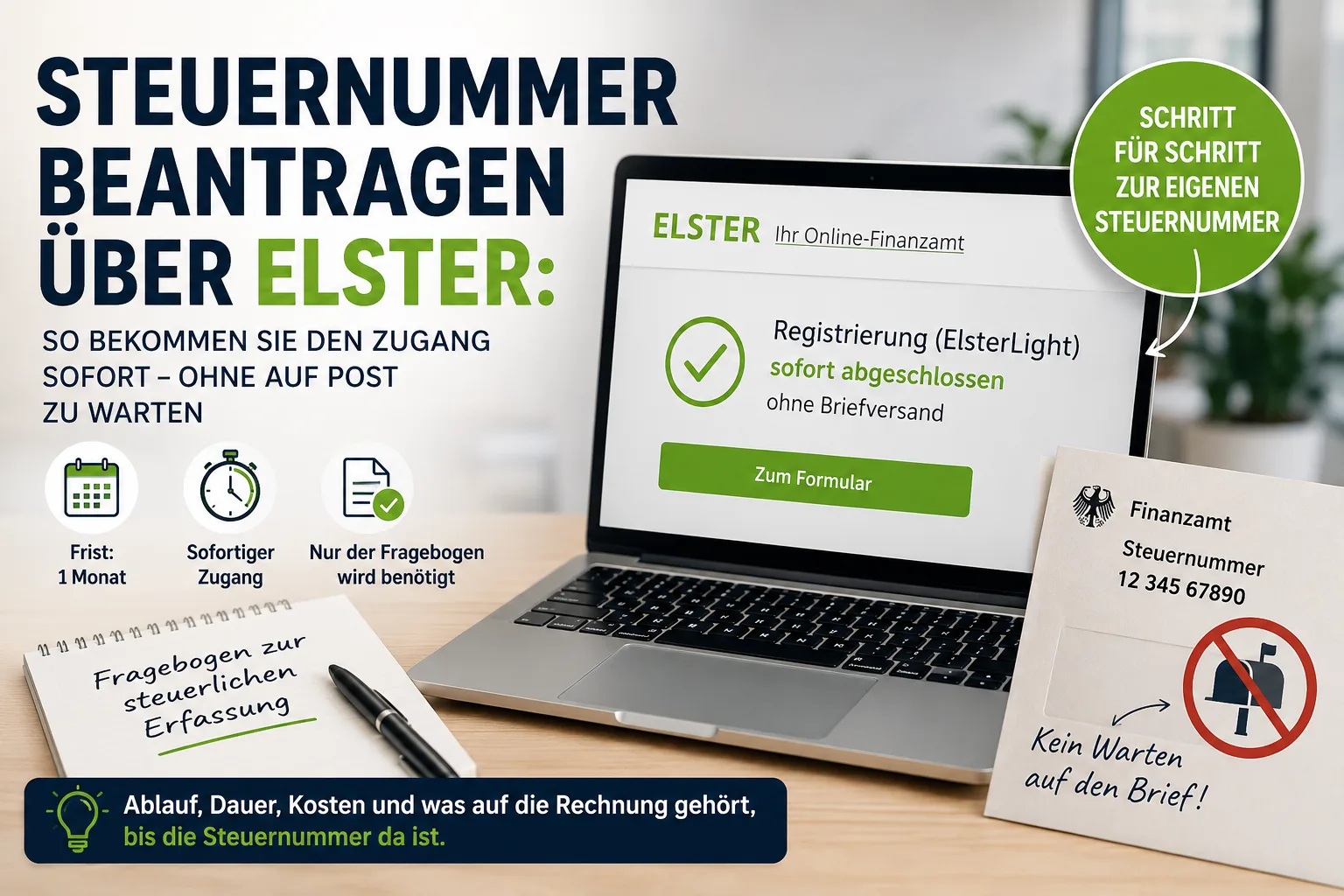
Your German tax number (Steuernummer) is not sent to you automatically. You request it by submitting the Fragebogen zur steuerlichen Erfassung – the tax registration questionnaire – to your tax office. Since 2021 that form can only be filed electronically, through ELSTER. ELSTER is the free online portal of the German tax authorities, and you need a user account for it. This is where many founders lose days, because they think they have to wait for the letter with the activation code. You do not: for people without a tax number, ELSTER offers a stripped-down registration that, in ELSTER's own words, „can be completed immediately" – „without a letter being sent". It lets you submit exactly one form: the questionnaire. Your tax office then sends the tax number by post once it has reviewed your answers.
Two things you should know right away: the questionnaire is due within one month of starting your activity. And how long the tax office then takes is not fixed by law anywhere – so do not plan on having the number within a few days. What to do if a customer is already waiting for an invoice is covered further down.
Contents
- Doesn't the tax number arrive by itself?
- ELSTER access: why you don't have to wait for the letter
- Step by step to a submitted questionnaire
- Tax number for a Gewerbe: what traders do in addition
- How long does it take – and what does it cost?
- Your first customer is waiting: invoice without a tax number?
- Steuernummer, tax ID, VAT ID, W-IdNr. – which is which?
- Small business scheme: do you still need a tax number?
- The point in the questionnaire where most people just guess
- If the month is already over
- Can the number change later?
Doesn't the tax number arrive by itself?
Partly – and that „partly" is the most common trap.
If you have registered a trade (Gewerbe), the trade office passes this on to the tax office. That is what § 138 of the German Fiscal Code says: you notify the municipality that you have opened a business, and the municipality forwards the content of that notification to the competent tax office. Many people conclude: then the tax office will come to me.
It is not enough, though. That forwarded notice only tells the tax office that you exist. What the tax office needs in order to classify you and issue a number is your own information: what you do, from when, how much you expect to earn, whether you want to use the small business scheme, your bank details. All of this sits in the tax registration questionnaire – and you have to file it on your own initiative. Do not wait for post. Often none arrives.
The same applies to freelancers (Freiberufler), just without the detour via the trade office: no trade licence, but the same questionnaire. Whether you are a Freiberufler or a Gewerbetreibender is decided by your actual activity, not by how it feels – if you are unsure, our article on Freiberufler or Gewerbe helps you place yourself.
The deadline: one month after the event, meaning after you started the activity. Electronically, „in the officially prescribed data format". Paper is only available on request in cases of hardship.
If you want to write invoices with all mandatory details in a few minutes, you can try the invoicing software Easy Invoice free for 10 days.
ELSTER access: why you don't have to wait for the letter
ELSTER is the free online portal of the German tax administration – the official place where tax forms are filed. Without an account there you cannot reach the questionnaire at all.
And here is where you can save days. There are two routes to an account:
The usual route is registration with a certificate file using your personal tax identification number. You receive the activation ID by e-mail – but the activation code by letter. So you are waiting for post before you can even start.
The fast route is called ElsterLight. This registration is explicitly intended for people and organisations to whom „the tax office has not yet assigned a tax number". All you need is an e-mail address, and creating the account „can be completed immediately (without a letter being sent)".
The price for that: the account can do exactly one thing – submit the tax registration questionnaire. Tax returns are not possible with it, and the login does not work for other government portals either. But that is precisely what you need this week. Once the tax office has assigned your tax number, you unlock the functions of a full account – for that step a letter with an activation code does arrive, but by then it no longer holds you up.
If you are setting up a GbR, UG or GmbH, ElsterLight is not just faster, it is the obvious route: the company itself does not yet have a number it could register with.
Step by step to a submitted questionnaire
- Create an account at elster.de, login type „certificate file", registration without a tax number (ElsterLight). You receive one e-mail with a confirmation link and a second one with the activation ID and activation code.
- Download and back up the certificate file. It is your key to the account – a file on your computer plus a password. Keep a copy in a second place. If the file is lost, so is your access, and it has to be requested again.
- Pick the right questionnaire. There are several versions. Sole traders and freelancers use the questionnaire for sole proprietorships; partnerships and corporations have their own forms.
- Fill it in. Allow 30 to 60 minutes. Have ready: ID card, tax identification number, bank details, trade licence (if you have one), the date you started, and a rough estimate of turnover and profit for this year and next.
- Submit and save the transmission protocol. That protocol is your proof of what you filed and when.
- Wait. The tax number comes by post from the tax office once the questionnaire has been reviewed.
Tax number for a Gewerbe: what traders do in addition
Anyone running a trade – retail, crafts, an online shop, most services involving the sale of goods – has two appointments instead of one:
First the trade office. Registration with form GewA 1 at your town or municipality, in many places online. The fee is usually between 20 and 60 euros, and you often get the trade licence on the spot. The full procedure and its pitfalls are in our article on registering a business and the tax questionnaire.
Then the tax office. The questionnaire, as described above. It is mandatory even though the trade office has already passed your registration on.
So there is no separate „trade tax number" that you apply for on the side. It is the same Steuernummer everyone receives when they are registered for tax; with a Gewerbe the road there simply has one more stop. And watch out for the similar wording: Gewerbesteuer, trade tax, is a tax type of its own with an allowance of 24,500 euros of trade income for sole traders and partnerships. It has nothing to do with the tax number itself.
Freelancers skip the trade office entirely and only register with the tax office. If you are starting on the side while still employed, the procedure is the same – the specifics are in becoming self-employed part-time.
How long does it take – and what does it cost?
Cost: the questionnaire and the tax number are free. ELSTER is free. The only thing you pay for is the trade registration, if you need one (usually 20 to 60 euros).
Time: here one has to be honest – there is no statutory deadline within which the tax office has to assign your number. How long it takes depends on the office, the time of year, and whether your answers raise questions. With a complete, plausible questionnaire it is often quick; if there are queries it can take considerably longer.
The practical way to handle this: put a date in your calendar and follow up with the tax office after about four weeks – with the transmission protocol from step 5 in hand. That is not nagging, that is normal.
What you can speed up: fill everything in, give realistic figures, describe your activity concretely („installing kitchens for private customers" rather than „services").
Your first customer is waiting: invoice without a tax number?
This is the question that actually keeps people up at night – the work is done, the money is needed, the number is not there.
The legal position is clear. A proper invoice must show „the tax number issued to the supplying trader by the tax office or the VAT identification number issued to them by the Federal Central Tax Office" (§ 14 (4) no. 2 of the German VAT Act). One of the two has to be there. If you have neither, a mandatory item is missing.
What follows in practice:
Up to 250 euros you do not need the number at all. For a small-amount invoice – total not exceeding 250 euros – § 33 of the VAT Implementing Ordinance only requires the full name and address of the supplying trader, the date of issue, the quantity and type of the supply, and the consideration plus tax in one sum together with the tax rate. A tax number is not on that list. Details in small-amount invoices up to 250 euros.
Above 250 euros you have three options. First: wait with the invoice date until the number is there – clean, but it costs time. Second: agree a down payment with your customer that stays below the 250-euro line and settle the rest later. Third: issue the invoice now and correct it once the number arrives. How a correction works is described in correcting an invoice.
Why this matters: your customer needs a complete invoice in order to claim the VAT it contains as input tax – that is, to get that share back from the tax office. If a mandatory item is missing, they can hand the document back and ask for a corrected one. With private customers this is irrelevant; with business customers it is not. Tell your customer in advance – „tax number has been applied for, a corrected invoice will follow" is a sentence any bookkeeper can live with.
Once the number is there, enter it in one place from which it is carried into every invoice. In Easy Invoice it sits in your company data and flows into every document from there. Which details are mandatory otherwise is covered in our guide to writing invoices.
Steuernummer, tax ID, VAT ID, W-IdNr. – which is which?
Four numbers, similar names, completely different purposes. This mix-up causes the most trouble both in the questionnaire and on the invoice.
| Number | Looks like | Who issues it | What for |
|---|---|---|---|
| Tax identification number (IdNr) | 11 digits | Federal Central Tax Office, automatically | You as a person, for life. Does not change when you move, marry or change your name |
| Steuernummer | varies by federal state, usually 10–13 digits with slashes | your tax office, after the questionnaire | Your business at that particular tax office. Belongs on the invoice |
| VAT identification number (USt-IdNr.) | DE + 9 digits | Federal Central Tax Office, on application | Business with companies in other EU countries. Replaces the Steuernummer on the invoice |
| Business identification number (W-IdNr.) | DE + 9 digits plus a distinguishing feature | Federal Central Tax Office, automatically | New nationwide identifier for economically active persons |
On the IdNr: you already have it. It is on your income tax assessment and on your annual payslip. The questionnaire asks for it – not as a business number, but to identify you as a person.
On the USt-IdNr.: you only need it once you deal with companies in other EU countries. You can tick the box for it in the questionnaire; the tax office forwards the application to the Federal Central Tax Office. It can only be issued once your VAT registration at the tax office is complete and has been transmitted – so it comes after the Steuernummer, not before. It is communicated exclusively by letter; e-mail or telephone is not possible for legal reasons.
On the W-IdNr.: it has been assigned in stages since November 2024, without any application on your part. At present it replaces neither the Steuernummer nor the VAT ID; it comes on top. The rollout is still running – so if you are only just starting out, this number may reach you later. What belongs on the invoice is still the Steuernummer or the VAT ID.
Small business scheme: do you still need a tax number?
Yes. The small business scheme under § 19 of the VAT Act means you do not show VAT on your invoices – it does not mean you are invisible to the tax authorities. The questionnaire is mandatory, you receive a tax number like everyone else, and it belongs on a small business owner's invoice too.
Whether the scheme makes sense for you at all is something you decide in the questionnaire – and if you decide against it, that choice binds you for several years. That is the second point in the form where founders should genuinely take their time. To weigh it up: small business scheme – yes or no? What such an invoice looks like is shown in invoicing without VAT.
The point in the questionnaire where most people just guess
The questionnaire asks what turnover and what profit you expect in the current and the coming year. Many people type in something arbitrary, because how could they know.
Those figures have two very concrete consequences, though. First, they help decide whether you can use the small business scheme. Second, the tax office uses them to set your advance payments – amounts you pay during the year towards your later tax bill. Estimate too high and the tax office takes money you need to build the business. Estimate far too low and the back payment arrives later in one lump – often together with an increased advance payment for the following year.
So aim for a figure you can justify: how many jobs can you realistically take on, at what price? If the situation changes, you can ask the tax office to adjust the advance payments – no new tax number needed, an informal letter is enough.
If the month is already over
First of all: this happens often and is no reason to panic. File the questionnaire as soon as you can – the obligation stays, it does not expire.
There is no automatic mechanism by which a late filing immediately costs you money. But the tax office does have tools if nothing arrives at all: it can enforce the filing with a penalty payment and estimate your tax base – and an estimate rarely works out in your favour. Anyone who files of their own accord before the tax office sends a reminder is usually in the clear.
A second point many people miss: tax liability starts with the activity, not with the tax number. Sales from the weeks before it was assigned are not tax-free – they belong in your records like any other. So keep those receipts too, including the ones from the waiting period.
Can the number change later?
Yes, it can – namely when a different tax office becomes responsible for you. The classic case is moving to another tax office district; a change of legal form can also result in a new number. You are then told the new number without having to fill in another questionnaire.
For your invoices that means: old invoices with the old number stay as they are – they were correct when issued. From the changeover you use the new one. If you keep your tax number in one central place in your software, this is a change to a single field; if it sits in a Word template, it is a search through every file.
Your personal tax identification number is unaffected. That one stays with you for life, no matter how often you move.
If you want to start today: create the ELSTER account without a tax number, fill in the questionnaire, save the transmission protocol, set a reminder for four weeks. And if a job is finished in the meantime, first check whether it stays below 250 euros – then nothing stands in the way of the invoice.
This article gives a general overview and does not replace individual tax advice. When it comes to legal form, the small business scheme or larger start-up investments, a single appointment with a tax adviser can set the course for years.
Official sources: Tax registration questionnaire for sole proprietorships (ELSTER) · ELSTER information page for founders · § 138 AO · § 14 UStG · § 33 UStDV · Tax identification number (BZSt) · Issuing of the VAT ID (BZSt)
Handle invoices more easily
Easy Invoice combines quotes, invoices and customer management in the cloud.
Try Easy InvoiceRead next
 Taxes & Law
Zusammenfassende Meldung (ZM): deadline, ELSTER and who must file
Anyone who supplies goods or invoices services without German VAT to business customers in other EU countries reports these sales to the German Federal Central Tax Office. Here you can find out who has to report, by when, what goes into the report and what happens if it is missing.
 Taxes & Law
USt-IdNr.: how to apply, how to check and when you need one
The USt-IdNr. (EU VAT ID) is a second number alongside the Steuernummer, meant for business with companies in other EU countries. You apply for it free of charge at the German Federal Central Tax Office and check your customer's number there too; here is how both work and how to find out whether you need one at all.
 Taxes & Law
Low-value assets in Germany (GWG) 2026: €800 limit, net or gross
The GWG limit in Germany is €800 net in 2026, also under the small business scheme. Which purchases you deduct at once, when the pooled item pays off and how to book it.