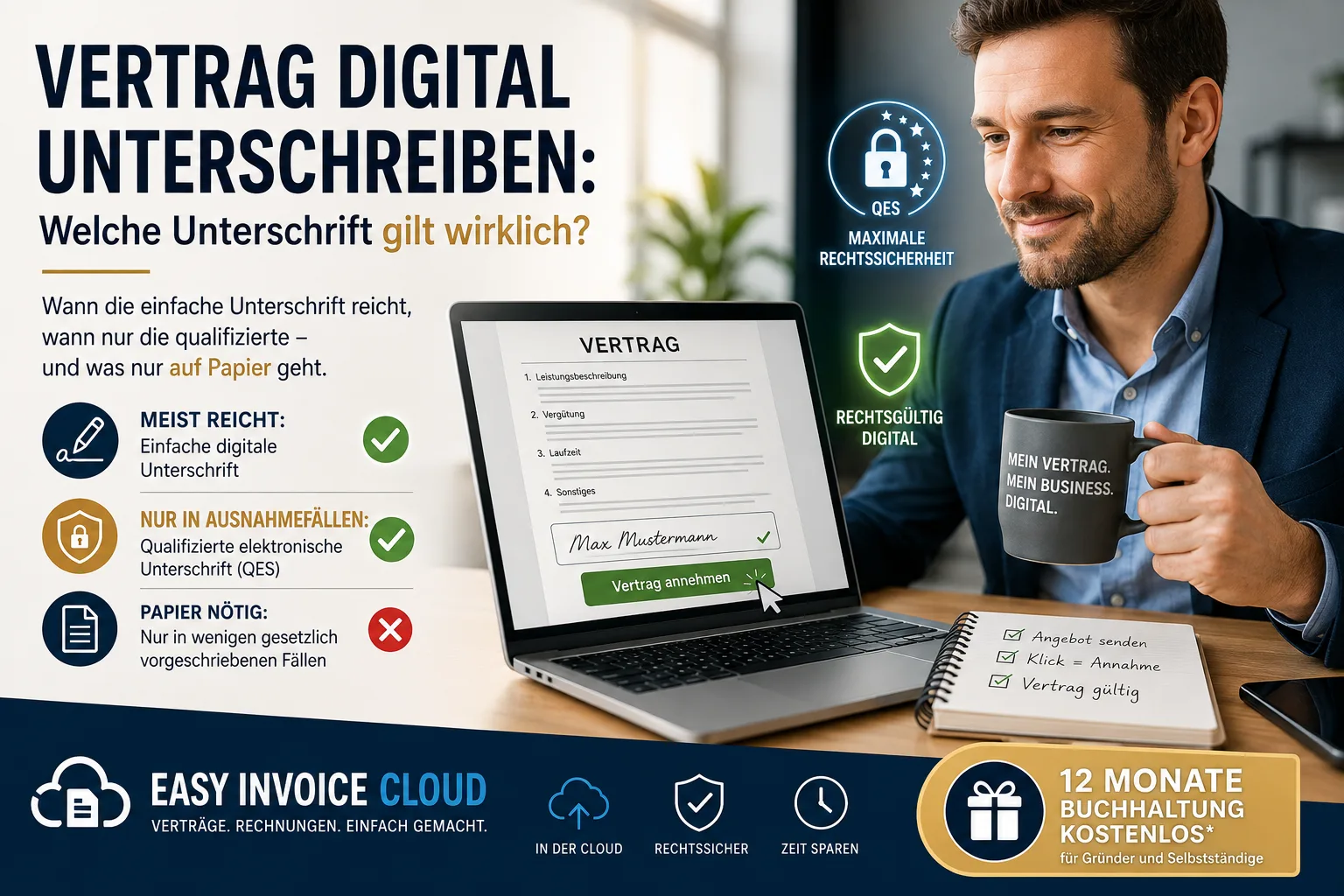
The contracts you conclude with clients and principals as a self-employed person – service contracts, work contracts, maintenance contracts, sales contracts – are valid without a signature. If your customer accepts your quote by click or email, the contract exists; a simple digital signature is enough. Only where the law expressly requires written form does the qualified electronic signature alone replace the pen (Section 126a of the German Civil Code, BGB) – and almost all of those cases lie outside your client business: fixed-term employment contracts, dismissals, guarantees.
This article provides general information and does not replace legal advice.
Contents
- Why most contracts need no signature at all
- Simple, advanced and qualified electronic signature: the difference
- Is a digitally signed contract legally valid?
- Your contracts with clients: all possible digitally
- The exceptions concern you as a business owner – not your client work
- If the customer denies it later: the question of proof
- The written-form clause in your own contract
- Bringing the qualified electronic signature into your company
- Having contracts accepted digitally with office1.cloud
- Frequently asked questions
Why most contracts need no signature at all
German law follows the principle of freedom of form: a contract comes into existence when one side makes an offer and the other accepts it. The law requires a specific form – paper, signature, stamp – only in exceptional cases. Your work contract for a bathroom renovation, the maintenance contract for a heating system, the consulting contract with your principal: all of them are valid even if the customer says "yes" on the phone or agrees by email.
In these contracts the signature has a different job: it is evidence. It helps you prove later that the customer agreed and which text they agreed to. For the question "Is the contract valid?" it is not decisive – for the question "Can I prove it?" it certainly is. This distinction is the key to the whole topic, and it runs through the sections below.
To learn when your quote itself becomes binding, read the article Is a quote binding?
Simple, advanced and qualified electronic signature: the difference
What everyday language calls a "digital signature" the law calls an "electronic signature". The rules are set out in an EU regulation, the eIDAS Regulation. It applies identically in all EU countries and knows three levels:
The simple electronic signature consists of data you attach to a document in order to sign. That sounds abstract but is everyday practice: the typed name under an email, the scanned signature in a PDF, the click on "I accept the quote" on an acceptance page. No technology checks who actually clicked.
The advanced electronic signature is technically linked to the signatory and the document: it is uniquely assigned to them, they alone control the signature data, and any later change to the document is detectable.
The qualified electronic signature – QES for short – is an advanced signature with two additions: a state-supervised provider has verified your identity before the first signature and confirms it with a certificate, and the signature is created using a device approved for that purpose. Only this level is treated by law as equal to a handwritten signature.
The rule to remember: the levels differ in how well they prove something and whether they replace the statutory written form – not in whether a contract "is valid". A form-free contract is valid with any of the three levels. And without any of them.
Is a digitally signed contract legally valid?
Yes – backed by two rules from Article 25 of the eIDAS Regulation. First, a court may not deny an electronic signature legal effect and admissibility as evidence solely because it is electronic or because it does not meet the requirements for a qualified signature. So your click acceptance can be used in court. Second, the qualified electronic signature has the same legal effect as a handwritten signature – throughout the EU.
German law draws the line where a statute requires written form: electronically, only the qualified signature replaces it under Section 126a BGB, and in a contract both sides must then sign in qualified form. A simple signature does not satisfy written form – in those exceptional cases the agreement is ineffective. The two tables below show which contracts are affected.
Your contracts with clients: all possible digitally
For the client business of a self-employed person the situation is pleasantly clear:
| Type of contract | Typical examples | Possible digitally? |
|---|---|---|
| Quote, order, order confirmation | Customer accepts your quote | Yes – a click or email is enough |
| Service contract | Consulting, support, IT service, care | Yes – no form required |
| Work contract | Repair, installation, bathroom renovation, single trade | Yes – no form required |
| Maintenance and service contract (continuing obligation) | Plant maintenance, hosting, recurring billing | Yes – no form required |
| Purchase and delivery | Materials, goods, equipment | Yes – no form required |
| Construction contract between companies | You work as a subcontractor for a general contractor | Yes – no form required |
| Consumer construction contract | New build or major conversion for a private customer | Yes – but text form is mandatory (Section 650i BGB) |
Not a single one of these contracts requires a qualified signature. With client contracts the issue is therefore not validity but proof alone – more on that shortly.
The one case with a formal requirement is the consumer construction contract: if you undertake towards a private customer to build a new building or to carry out major conversion works, the law requires text form. Text form means a legible declaration on a durable medium that identifies the person making it – a PDF by email or a digital acceptance page satisfies this. Important for tradespeople: an ordinary repair, a bathroom renovation or a single trade for private customers is not a consumer construction contract but a form-free work contract.
How order confirmation and invoice have to match is covered in the article Order confirmation and invoice.
The exceptions concern you as a business owner – not your client work
The written-form cases that online sources often warn about across the board arise in your role as employer, tenant or guarantor:
| Declaration | Statutory form | Possible digitally? |
|---|---|---|
| Commercial lease for more than one year | Text form (Section 578 BGB) | Yes – email with an identifiable sender is enough |
| Fixed term in an employment contract | Written form (Section 14(4) TzBfG) | Only with a qualified signature – otherwise paper |
| Dismissal or termination agreement in an employment relationship | Written form, electronic form excluded (Section 623 BGB) | No – only paper with a handwritten signature |
| Guarantee given by a private individual | Written form, electronic form excluded (Section 766 BGB) | No – only paper |
Three points deserve a second look:
The commercial lease has required only text form since 1 January 2025 if it is to run for more than one year. If the form is missed, the contract is not invalid – it merely counts as concluded for an indefinite period and can therefore be terminated earlier.
The fixed term in an employment contract is the case that hits small businesses most often. The employment contract itself is form-free – but the clause "fixed until 31 December 2027" requires written form. If both sides sign neither on paper nor with a qualified electronic signature, only the fixed term is ineffective: a permanent employment relationship arises.
The guarantee has an exception: for merchants it is form-free (Section 350 of the German Commercial Code). If, however, you give a guarantee as a private individual – for example personally for a loan to your company – only paper counts.
If the customer denies it later: the question of proof
With a form-free contract, the signature level does not decide validity; the dispute decides the value of your documentation. If the customer claims "I never accepted that", the court examines all the circumstances and then decides whom it believes. What counts is what you can produce:
- Who agreed? Name and email address of the person.
- When? Date and time of acceptance.
- What exactly? The contract text as it stood at acceptance. A checksum works well for this – a digital fingerprint of the document. If even one character in the text changes, the checksum changes. That proves nobody rewrote anything afterwards.
- Where did the acceptance come from? The IP address, that is the device's connection identifier.
The classic case in the trades is the variation order: on site it turns out that an additional cable has to be laid – 1,800 euros extra. Agreed verbally, disputed afterwards: amounts like this are exactly what people argue about. Have the variation confirmed digitally instead and you have the click, the time and the text documented before you carry on working.
A click acceptance with a log is worth considerably more in a dispute than an email saying "fine, go ahead" – and far more than a phone call without witnesses. The qualified signature goes one step further: for documents signed in qualified form, Section 371a of the Code of Civil Procedure creates a presumption of authenticity. The court assumes the declaration comes from the signatory; the customer would have to establish serious doubts. With a click log you bear the burden of proof; with the QES it effectively shifts to the other side.
The written-form clause in your own contract
Many contract templates contain the sentence "Amendments and additions require written form". This self-chosen written form is milder than the statutory one: under Section 127 BGB, in case of doubt transmission by telecommunication suffices – so an email without any signature does the job.
But "in case of doubt" means it depends on interpretation, and that is exactly what people litigate about. So word the clause unambiguously – for example: "Amendments require text form (email is sufficient)." Then it is clear that digital declarations suffice, and nobody can later invoke a supposedly missing signature.
Bringing the qualified electronic signature into your company
For the few written-form cases you need a qualified trust service provider – a company that verifies identities and issues signature certificates. In Germany the Federal Network Agency supervises these providers; you can find an overview on the page Electronic trust services of the Federal Network Agency.
The process is similar with all providers: you prove your identity once – by ID in a video procedure, with the online ID function or at a branch. After that you sign documents through an app or in the browser. Costs vary by provider and model; packages per signature or a subscription are common. Because a QES from any EU country is recognised in all the others, this also works with contract partners elsewhere in the EU.
In practice this means: if you introduce electronic signatures in your company, the qualified level only pays off where written-form cases occur regularly – fixed-term employment contracts, for example. For quotes, orders and service contracts you do not need it.
Having contracts accepted digitally with office1.cloud
For your client contracts – that is, the form-free cases from the first table – you can handle acceptance with the contract management in office1.cloud: you store the contract, your customer receives a link to an acceptance page and confirms there. The system logs name, email address, IP address, time and a checksum of the contract text – exactly the evidence points from the section above. The article Have contracts signed online and bill them recurrently shows how this works step by step.
The end of the contract is covered as well: your customer can cancel with a click. There is a cancellation portal open to every one of your customers – without registration and without a customer account. The customer only states who they are and which contract they are ending so that the cancellation can be assigned; it is documented with a timestamp, and you see immediately which contract ends on which date. This matches the direction the legislator has set for consumer contracts online: ongoing contracts must be terminable through an easily accessible cancellation button (Section 312k BGB) – and since 19 June 2026 the withdrawal button requires something similar for withdrawal. How that has to work is explained in the article Withdrawal button: how it has to work – and what is not allowed.
For clarity: this click acceptance is a simple electronic signature. The module does not create a qualified signature – for the written-form cases from the second table you use a trust service provider or paper.
Frequently asked questions
Digital signature and electronic signature – are they the same thing? Essentially yes: "digital signature" is the everyday word, "electronic signature" the legal term from the eIDAS Regulation. What matters is not the word but the level – simple, advanced or qualified.
Is a scanned signature in a PDF legally valid? It is a simple electronic signature. For form-free contracts that is enough; it does not replace the statutory written form. Its evidential value is low, because an image of a signature can be copied.
Can I sign contracts digitally for free? For form-free contracts, yes: acceptance by email or click costs nothing. Only the qualified signature costs money – and you need it only for the written-form cases.
Is signing with a finger on a phone or tablet enough? Legally it is usually a simple electronic signature, like the scan. Fine for form-free contracts, not for written-form cases.
Does digital acceptance also apply to customers elsewhere in the EU? Yes. The eIDAS Regulation applies across the EU, and a qualified signature from one member state is recognised in all the others.
And the permanent employment contract? It can be concluded without any form requirement – digitally as well. The law requires written form only for the fixed-term clause and for dismissal and termination agreements; for the latter two, electronic form is expressly excluded.
If you digitalise your contract processes, this order pays off: first move quotes, orders and service contracts to digital acceptance with a clean log – including variation orders. Then check whether any written-form cases remain at all. In many small businesses exactly one is left: paper for everything around employment contracts – and a click for the rest. Quote, order and invoice are then best kept in one place — that is what a quote and invoice software is for.
Handle invoices more easily
Easy Invoice combines quotes, invoices and customer management in the cloud.
Try Easy InvoiceRead next
 Taxes & Law
Zusammenfassende Meldung (ZM): deadline, ELSTER and who must file
Anyone who supplies goods or invoices services without German VAT to business customers in other EU countries reports these sales to the German Federal Central Tax Office. Here you can find out who has to report, by when, what goes into the report and what happens if it is missing.
 Taxes & Law
USt-IdNr.: how to apply, how to check and when you need one
The USt-IdNr. (EU VAT ID) is a second number alongside the Steuernummer, meant for business with companies in other EU countries. You apply for it free of charge at the German Federal Central Tax Office and check your customer's number there too; here is how both work and how to find out whether you need one at all.
 Taxes & Law
Low-value assets in Germany (GWG) 2026: €800 limit, net or gross
The GWG limit in Germany is €800 net in 2026, also under the small business scheme. Which purchases you deduct at once, when the pooled item pays off and how to book it.