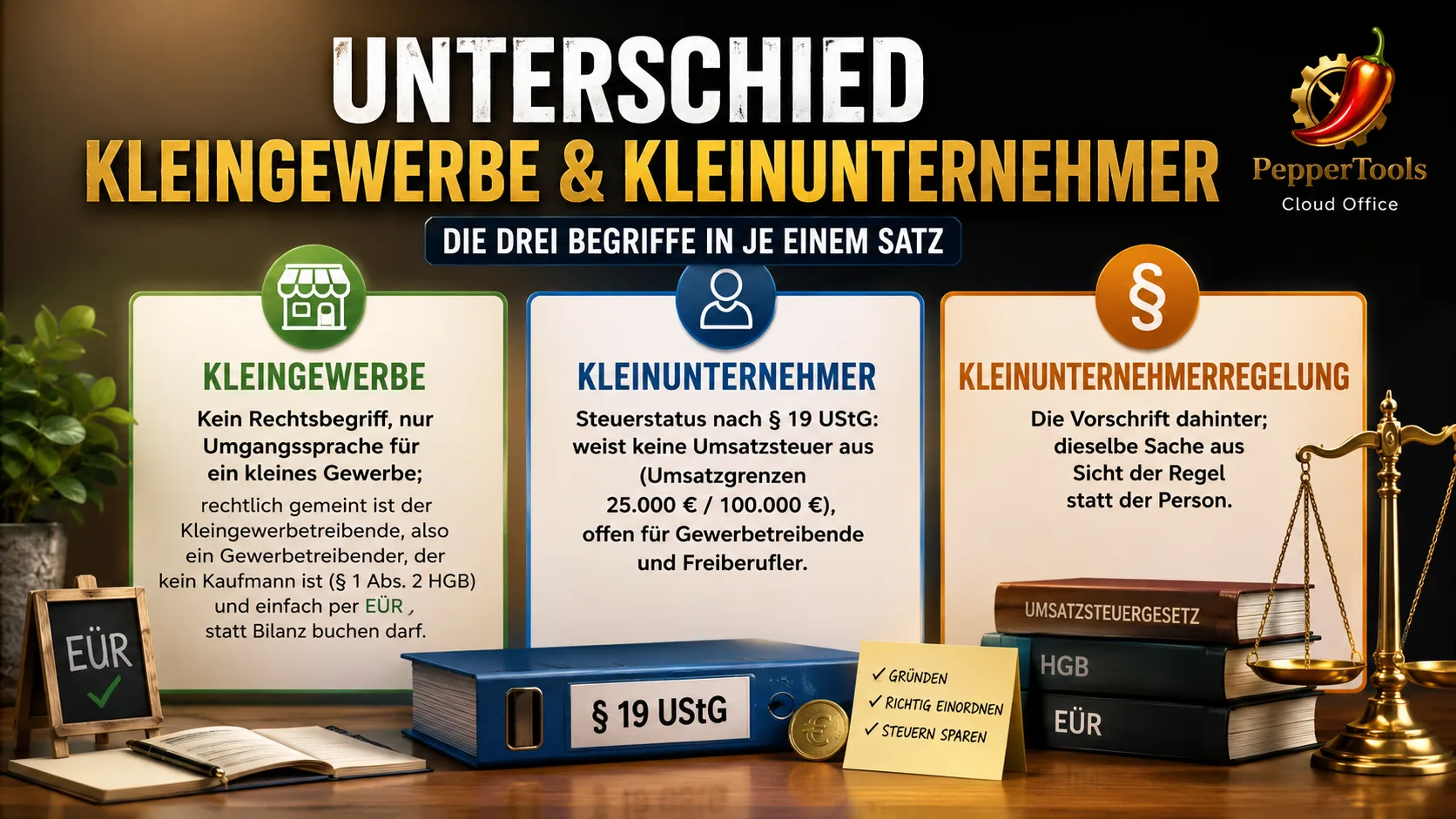
Kleingewerbe vs. Kleinunternehmer: what's the difference?
In Germany, hardly any pair of terms confuses founders as much as these two. „Kleingewerbe" (small trade business) and „Kleinunternehmer" (small-business taxpayer) sound almost the same, are constantly mixed up – and yet mean two completely different things. The good news: once you understand which question each term answers, the confusion vanishes.
The two terms answer different questions
The whole trick fits in one sentence:
- Kleingewerbe answers: How is my business set up legally – do I have to operate „in a commercial manner" or not? That's a question of commercial and trade law.
- Kleinunternehmer answers: Do I have to show VAT on my invoices? That's purely a question of tax law.
In other words: one concerns the form of your business, the other concerns VAT. That's why you can easily be both at once – or just one of the two. Concrete examples in a moment.
If you want to write invoices with all mandatory details in a few minutes, you can try the invoicing software Easy Invoice free for 10 days.
Honestly: „Kleingewerbe" isn't even a legal term
Does the Kleingewerbe even exist? Take a look at this video, for example. There's a lot to it: the word „Kleingewerbe" is not a legally defined term and not a legal form of its own – it's simply everyday language for a trade business of small scale.
What does exist legally is the Kleingewerbetreibender: a trader whose business does not require a commercially organised operation (§ 1 (2) HGB) and who is therefore not a merchant (Kaufmann). And the one term in this area that is cleanly defined by law is the Kleinunternehmerregelung (§ 19 UStG). This very fuzziness is the main reason the two terms get confused so often.
What „Kleingewerbe" means in practice
When people say „Kleingewerbe", they mean a business that does not require a commercially organised operation. In plain terms: you are not a merchant within the meaning of the German Commercial Code (HGB). That has three noticeable upsides that make life easier:
- No entry in the commercial register needed.
- No double-entry bookkeeping, no balance sheet – the simple cash-basis income statement (EÜR) is enough.
- Less formality overall.
When are you a Kleingewerbe and not a merchant? The HGB doesn't rely on a single number here, but on the „nature or scope" of your business (§ 1 HGB). As a rough guide, though, there's the bookkeeping threshold of § 241a HGB: anyone who stays below 800,000 € turnover and 80,000 € profit in two consecutive years is exempt from double-entry bookkeeping and may use the simple EÜR. If even one of the two values is exceeded, the exemption ends. For most small businesses that's far away – but careful: a very high-revenue or clearly „commercially" organised business (large warehouse, many employees, high goods volume) can count as a merchant even below that.
Important: „Kleingewerbe" is not a legal form of its own. You remain a sole proprietor (or a GbR if two of you start together) – just one without merchant obligations. And: you still have to register the trade with the trade office as normal. How that works is in our start-up guide to business registration.
What „Kleinunternehmer" really means
Kleinunternehmer is a status from VAT law (§ 19 UStG). Anyone who uses it shows no VAT on their invoices and remits none – but in return cannot deduct input VAT from purchases either.
You can choose the status if your turnover stays below 25,000 € in the previous year and below 100,000 € in the current year. The key point: this rule is open to everyone – trader or freelancer alike. It has nothing to do with the „merchant or not" question.
Whether the status is worthwhile for you depends mainly on your customers – we go deeper in the article Small-business scheme – yes or no?.
The aha moment: the terms sit on two different levels
Picture two separate switches. The first switch („Kleingewerbe") controls your business form, the second („Kleinunternehmer") your VAT. Both can be set independently:
- A seamstress sewing clothes on the side registers a Kleingewerbe and, with 8,000 € turnover, stays under the threshold – so she's also a Kleinunternehmerin. She is both.
- An online retailer with 200,000 € turnover is long past being a Kleinunternehmer (over 100,000 €) and must show VAT. Whether he still counts as a Kleingewerbe or, by nature and scope, already as a merchant is a separate, independent question. The two levels run separately.
- A freelance copywriter with small turnover is a Kleinunternehmerin but has no trade business at all – freelancers don't register a Gewerbe. Again, only one of the two.
Once you see it this way, you'll never confuse the terms again.
The three terms in one sentence each
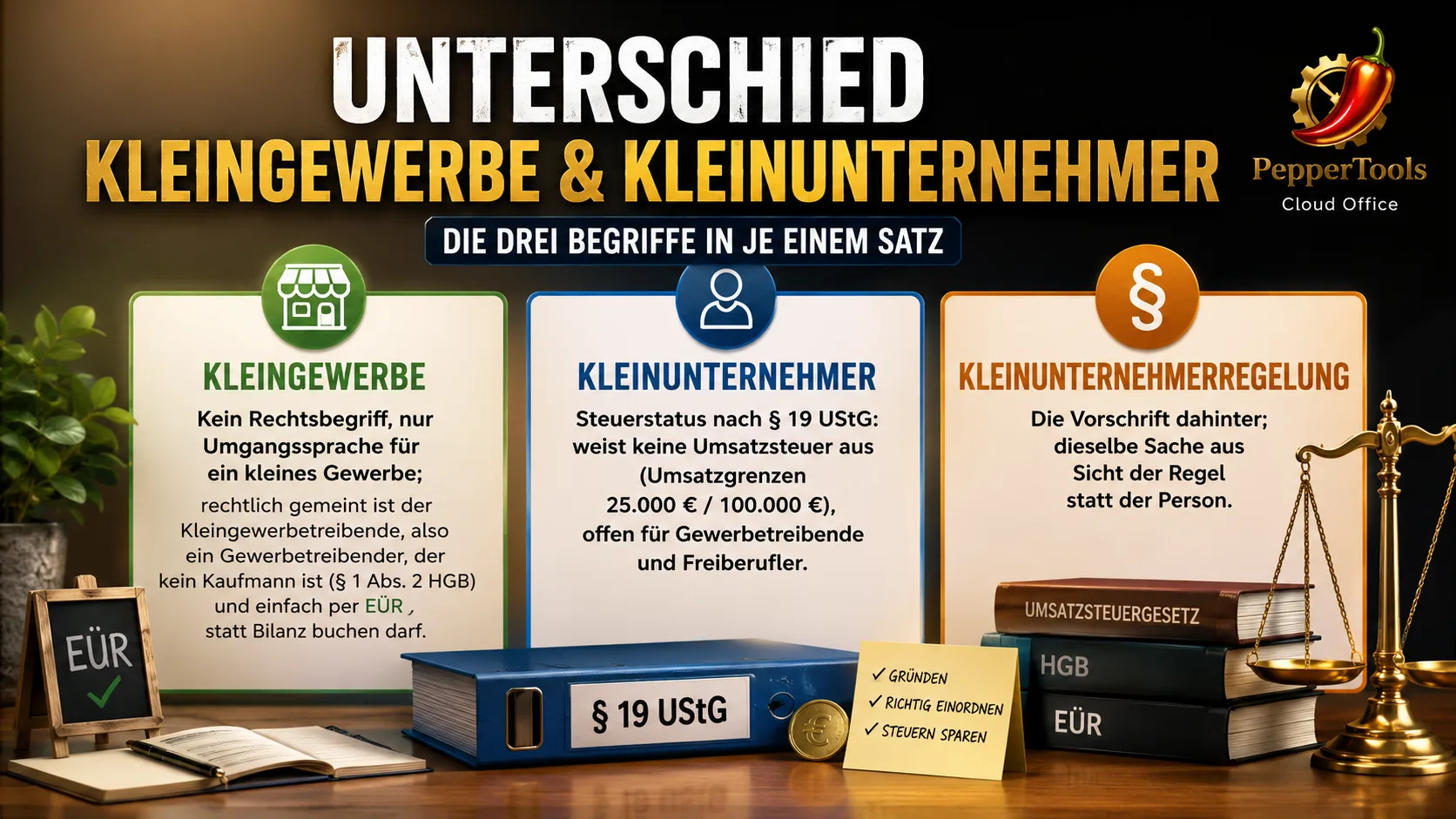
- Kleingewerbe – not a legal term, just everyday language for a small trade business; what's legally meant is the Kleingewerbetreibender, i.e. a trader who isn't a merchant (§ 1 (2) HGB) and may use the simple EÜR instead of a balance sheet.
- Kleinunternehmer – a tax status under § 19 UStG: shows no VAT (turnover limits 25,000 € / 100,000 €), open to traders and freelancers.
- Kleinunternehmerregelung – the rule behind it; the same thing seen from the regulation's side rather than the person's.
So one is commercial law (the form of the business), the other is tax law (VAT) – which is why people are often both at once, but for two different reasons.
Note: This article does not constitute tax or legal advice. For your individual case – especially regarding legal form, bookkeeping obligations and the small-business scheme – talk to your tax adviser. As of 26 June 2026.
Sources
- § 19 UStG – small-business scheme (gesetze-im-internet.de)
- § 241a HGB – exemption from bookkeeping (gesetze-im-internet.de)
- § 1 HGB – merchant (gesetze-im-internet.de)
- für-gründer.de: Kleingewerbe 2026 – registration, bookkeeping & taxes An invoicing software writes invoices with every mandatory detail in minutes.
Handle invoices more easily
Easy Invoice combines quotes, invoices and customer management in the cloud.
Try Easy InvoiceRead next
 Taxes & Law
Zusammenfassende Meldung (ZM): deadline, ELSTER and who must file
Anyone who supplies goods or invoices services without German VAT to business customers in other EU countries reports these sales to the German Federal Central Tax Office. Here you can find out who has to report, by when, what goes into the report and what happens if it is missing.
 Taxes & Law
USt-IdNr.: how to apply, how to check and when you need one
The USt-IdNr. (EU VAT ID) is a second number alongside the Steuernummer, meant for business with companies in other EU countries. You apply for it free of charge at the German Federal Central Tax Office and check your customer's number there too; here is how both work and how to find out whether you need one at all.
 Taxes & Law
Low-value assets in Germany (GWG) 2026: €800 limit, net or gross
The GWG limit in Germany is €800 net in 2026, also under the small business scheme. Which purchases you deduct at once, when the pooled item pays off and how to book it.