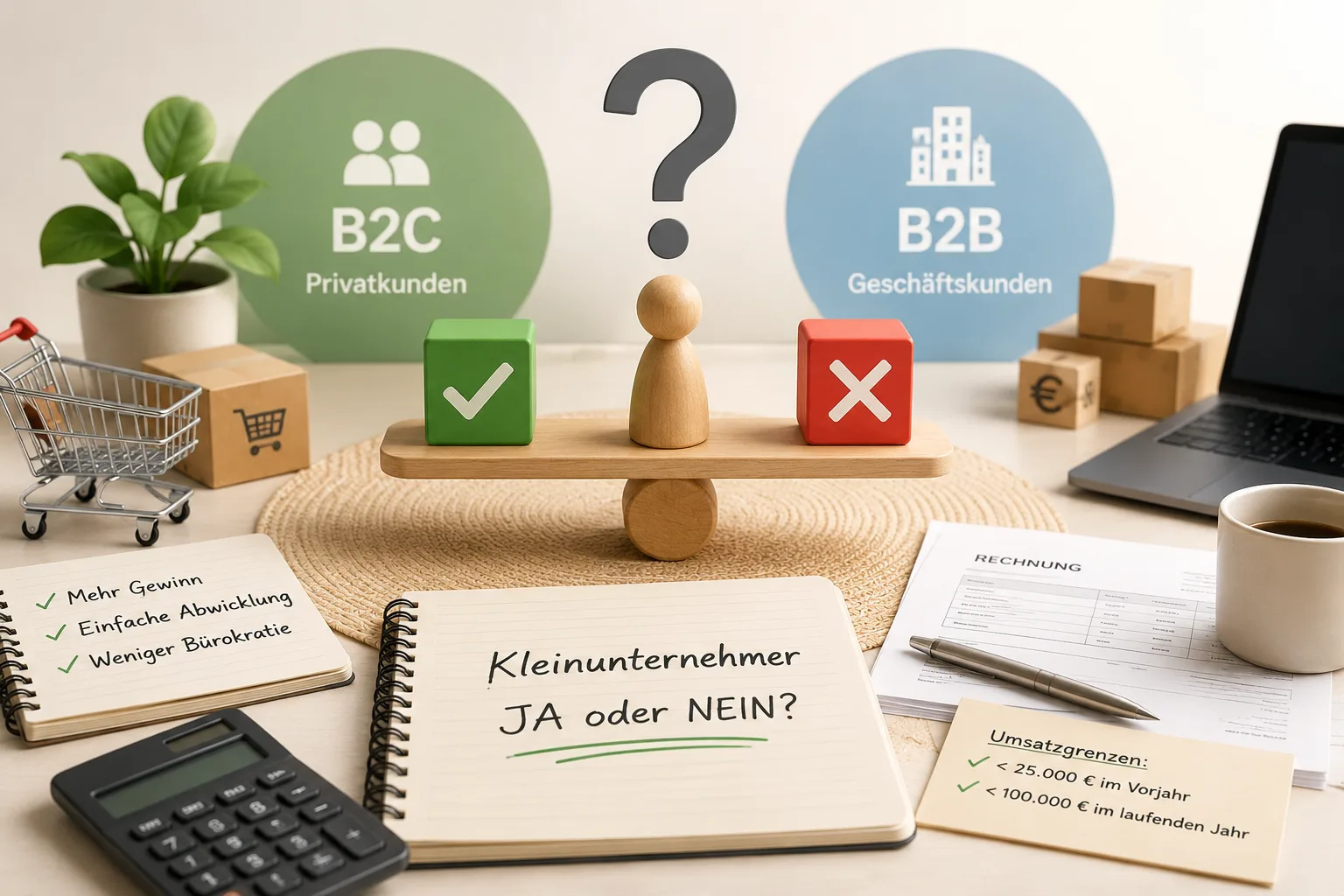
Small-business scheme – yes or no? When it pays off for you and how to register it
“Should I use the small-business scheme or not?" – it's one of the first questions when founding. The short answer: it depends on who your customers are. This article pins the decision down with five real-life examples and shows how to register the scheme. (This refers to Germany's Kleinunternehmerregelung under § 19 UStG.)
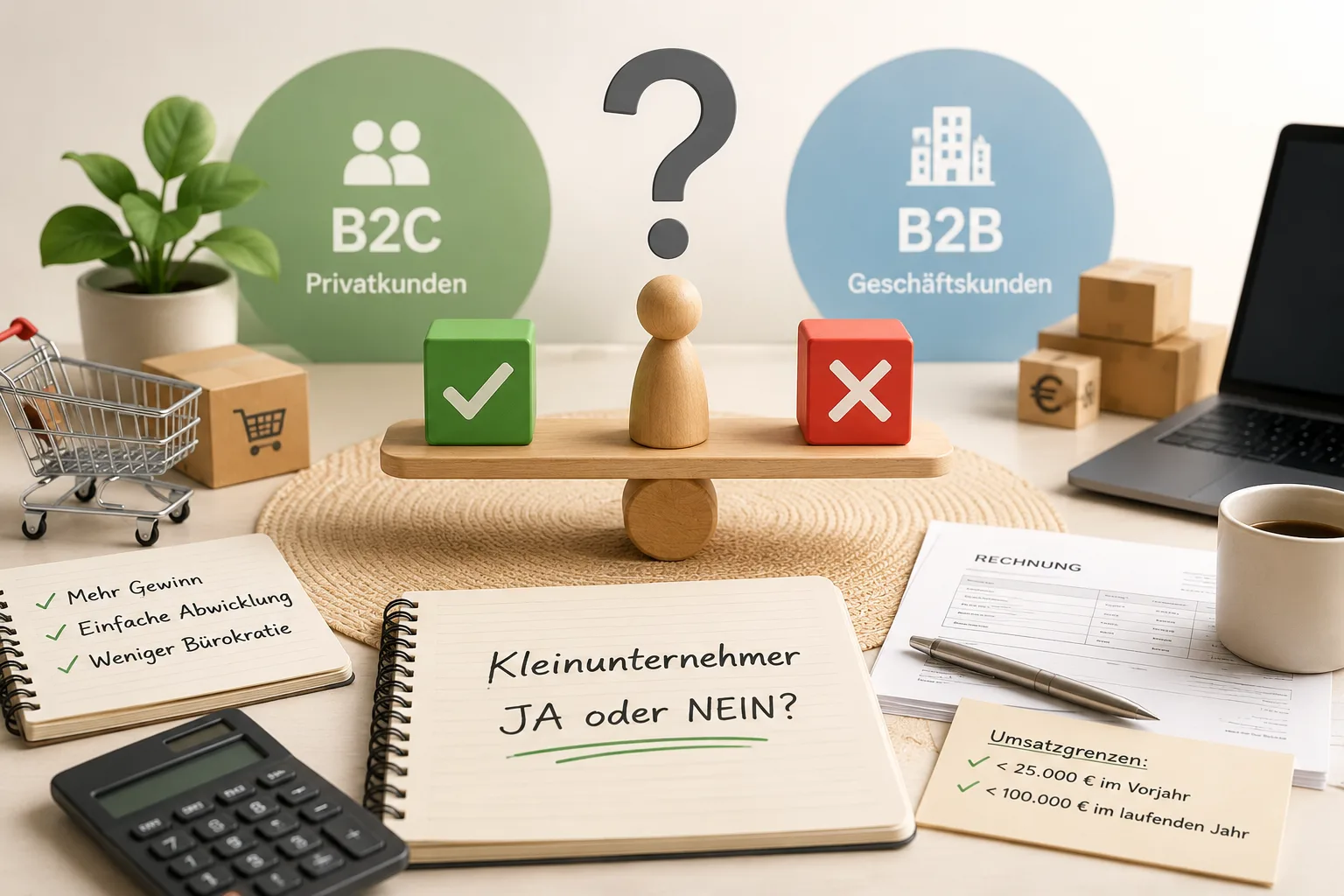
What it's about – in three sentences
As a small business under § 19 of the German VAT Act (UStG) you show no VAT on your invoices and remit none. In return, you may not deduct input VAT from your purchases. Since 2024, small businesses no longer even have to file an annual VAT return – so the bureaucracy advantage is real.
If you want to write invoices with all mandatory details in a few minutes, you can try the invoicing software Easy Invoice free for 10 days.
Are you even eligible?
You can use the scheme if your turnover stays below 25,000 € in the previous year and below 100,000 € in the current year (both conditions must be met). This also applies to a side business – what counts is the total turnover of your self-employed activity, not whether it's your main job or a sideline.
The biggest lever: B2C or B2B?
Before you pore over tables, answer one question: Do you sell to private customers (B2C) or to businesses (B2B)?
- Private customers pay the VAT out of their own pocket. Without VAT your offer is effectively about 16–19 % cheaper – or your margin is higher. → The small-business scheme is often an advantage here.
- Business customers deduct the VAT as input tax. For them your stated VAT is no extra cost. You, on the other hand, lose your own input-VAT deduction as a small business. → Here the scheme usually does not pay off.
The second lever is your expenses with input VAT: anyone who buys a lot (goods, materials, equipment) “gives away" the input VAT on it as a small business.
When it pays off for you – 5 examples
1. You're a streamer (Twitch, YouTube, TikTok). Your income comes from foreign platforms: Twitch pays out via Amazon entities in the USA or Luxembourg, YouTube via Google Ireland, TikTok via Ireland. These platform earnings carry no German VAT anyway, because the place of supply is at the foreign recipient (§ 3a (2) UStG) – whether you're a small business or not. Tendency: the small-business scheme usually pays off – you have hardly any German input VAT to deduct, and the “do I look smaller?" question is irrelevant because no private customers appear on your invoice. But watch out: for EU platforms (Google/TikTok Ireland) you usually need a VAT ID and have to file a recapitulative statement (Zusammenfassende Meldung) – this applies even as a small business. And platform fees or tools from abroad trigger the reverse-charge procedure (details in the article below).
2. You sell things on eBay. If you sell to private individuals (the normal case), the small-business scheme means: no 19 % VAT on top – so cheaper or more margin. Clearly worthwhile at small turnover. Keep two things in mind: eBay fees are invoiced from within the EU (reverse charge applies to you too), and if you buy new goods with a lot of input VAT and grow, standard taxation may eventually be cheaper.
3. You have an online shop and sell mainly in the DACH region (private customers). While you're small, the scheme keeps your prices low – a real advantage with price-sensitive end customers. The downside: with high purchasing volumes you lose a lot of input VAT, and anyone who grows fast can breach the 100,000 € threshold mid-year (a hard threshold since 2025). Rule of thumb: often sensible at the start – with high goods input or a clear growth plan, do the maths carefully.
4. You're a tradesperson working for end customers (B2C). Your private customers pay no VAT – your offer is effectively cheaper. But: tradespeople often have a high share of materials with input VAT, which is lost as a small business. Rule of thumb: if labour predominates (little material), the scheme is great. If a lot of expensive material is in the job, standard taxation with input-VAT deduction can be better overall.
5. You're a service provider working for other companies (B2B). Here the scheme usually does not pay off. Your business customers deduct the VAT as input tax – your statement costs them nothing. You, on the other hand, lose your own input-VAT deduction, and some business customers read a missing VAT statement as “small/sideline". Tendency: standard taxation.
The worked example: several thousand euros extra per year
The advantage is greatest when your customers are private individuals and you have few input invoices. Take a typical year:
You sell for 15,000 € to private customers.
The private customer pays the same price either way – the VAT a standard-taxed business would have to remit stays with you:
VAT you do NOT have to remit
+ 2,394 €
The only catch: you can't reclaim the input VAT from your purchases. With low expenses (e.g. around 400 € of included input VAT), almost all of it still remains:
Your real plus over standard taxation
≈ + 2,000 € per year
Rule of thumb: the fewer input-VAT expenses you have and the more you sell to private customers, the bigger your plus. If you had high goods purchases instead – e.g. 8,000 € (≈ 1,277 € input VAT) – the advantage shrinks noticeably; then do the maths case by case.
“Do I look unprofessional without VAT?"
A common, honest worry. With private customers it doesn't matter – they only see the final price. With business customers a missing VAT statement can indeed signal “very small provider", because the § 19 UStG note appears on the invoice. If you work mainly B2B and want to avoid that, it's another argument for standard taxation – not mandatory, but a real factor.
How to register the small-business scheme
You opt in (or out) in the tax registration questionnaire at the tax office – there's a dedicated field for the small-business scheme. How the questionnaire works is in the start-up guide to business registration. Important: your invoices then need a note like “No VAT is charged in accordance with § 19 UStG".
Already self-employed and want to switch? Switching into or out of the scheme is generally possible annually – but a voluntary waiver binds you for five years to standard taxation. So don't make this decision on a whim.
Watch out for the pitfalls
The scheme is simpler than its reputation – the real pitfalls lie elsewhere: reverse charge on purchases from within the EU (Google Ads, cloud, platform fees), the hard 100,000 € threshold mid-year, the obligation to receive e-invoices, and multiple activities that are added together. We explain these in detail in the article Small-business scheme 2026: the underestimated pitfalls.
And how do you actually pay taxes?
Briefly, the money flow so it's clear what's left for you:
As a standard-taxed business several levels run in parallel: you collect VAT from the customer, deduct input VAT and remit the difference to the tax office – a pass-through item that's never yours. Your profit is net turnover minus net expenses, and on that you pay income tax (plus solidarity surcharge/church tax where applicable) and, for commercial businesses, trade tax. Important: sole proprietors have a trade-tax allowance of 24,500 €, and above that the trade tax is largely credited against income tax via § 35 EStG – so up to a municipal rate of around 400 % it's practically neutral.
As a small business it's simpler: no VAT, the price is entirely your turnover. Turnover minus purchases = profit, income tax on that. Nothing more.
Why many go broke in the third year
The most important warning – whether small business or standard-taxed:
On your expected profit the tax office sets quarterly income-tax prepayments (10 March, 10 June, 10 September, 10 December). Anyone who states 0 € profit at the start pays nothing in advance the first year – it feels “tax-free". That's the trap.
- Year 1: you earn but pay no prepayments. The money is there – and gets spent.
- Year 2: you keep putting off the tax return for year 1.
- Year 3: the assessment arrives all at once: income tax for two years retroactively plus prepayments for the current year – several thousand euros in one go, for money long gone.
Set aside around 35 % of your profit in a separate account you don't touch. Your individual tax rate varies (and rises, e.g. through a main job), but 35 % is a solid reserve for the tax office. And: when the tax office wants the money, you usually have only a few days; it rarely agrees to instalments. With a reserve you save yourself all this trouble.
Note: This article does not constitute tax advice. For your individual case – especially with foreign turnover, high goods purchases or a planned switch – talk to your tax adviser or tax office. As of 24 June 2026.
Sources
- § 19 UStG – small-business scheme (gesetze-im-internet.de)
- § 3a UStG – place of supply of services (gesetze-im-internet.de)
- Handelskammer Hamburg: taxes for influencers, YouTubers & co.
- 4streamers.de: tax info for streamers An invoicing software writes invoices with every mandatory detail in minutes.
Handle invoices more easily
Easy Invoice combines quotes, invoices and customer management in the cloud.
Try Easy InvoiceRead next
 Taxes & Law
Zusammenfassende Meldung (ZM): deadline, ELSTER and who must file
Anyone who supplies goods or invoices services without German VAT to business customers in other EU countries reports these sales to the German Federal Central Tax Office. Here you can find out who has to report, by when, what goes into the report and what happens if it is missing.
 Taxes & Law
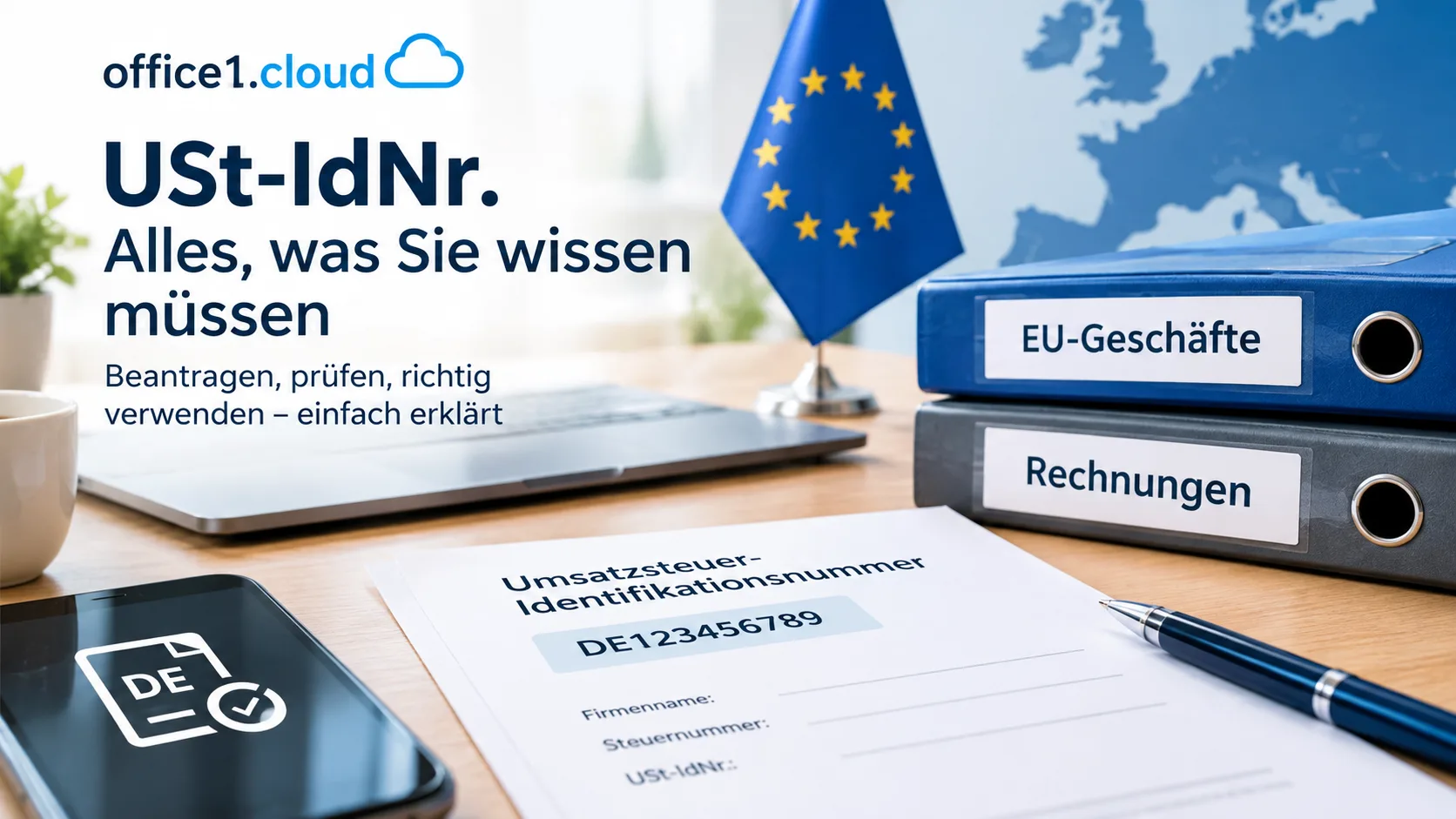
USt-IdNr.: how to apply, how to check and when you need one
The USt-IdNr. (EU VAT ID) is a second number alongside the Steuernummer, meant for business with companies in other EU countries. You apply for it free of charge at the German Federal Central Tax Office and check your customer's number there too; here is how both work and how to find out whether you need one at all.
 Taxes & Law
Low-value assets in Germany (GWG) 2026: €800 limit, net or gross
The GWG limit in Germany is €800 net in 2026, also under the small business scheme. Which purchases you deduct at once, when the pooled item pays off and how to book it.