E-invoicing obligation for small businesses: who has to, when – and who (still) doesn't
Many small self-employed people believe they must issue e-invoices right away. For most, that isn't true. This article sets out the situation soberly: who is really affected, from when – and why the worry is usually unfounded at small turnover. (This concerns Germany's B2B e-invoicing rules.)
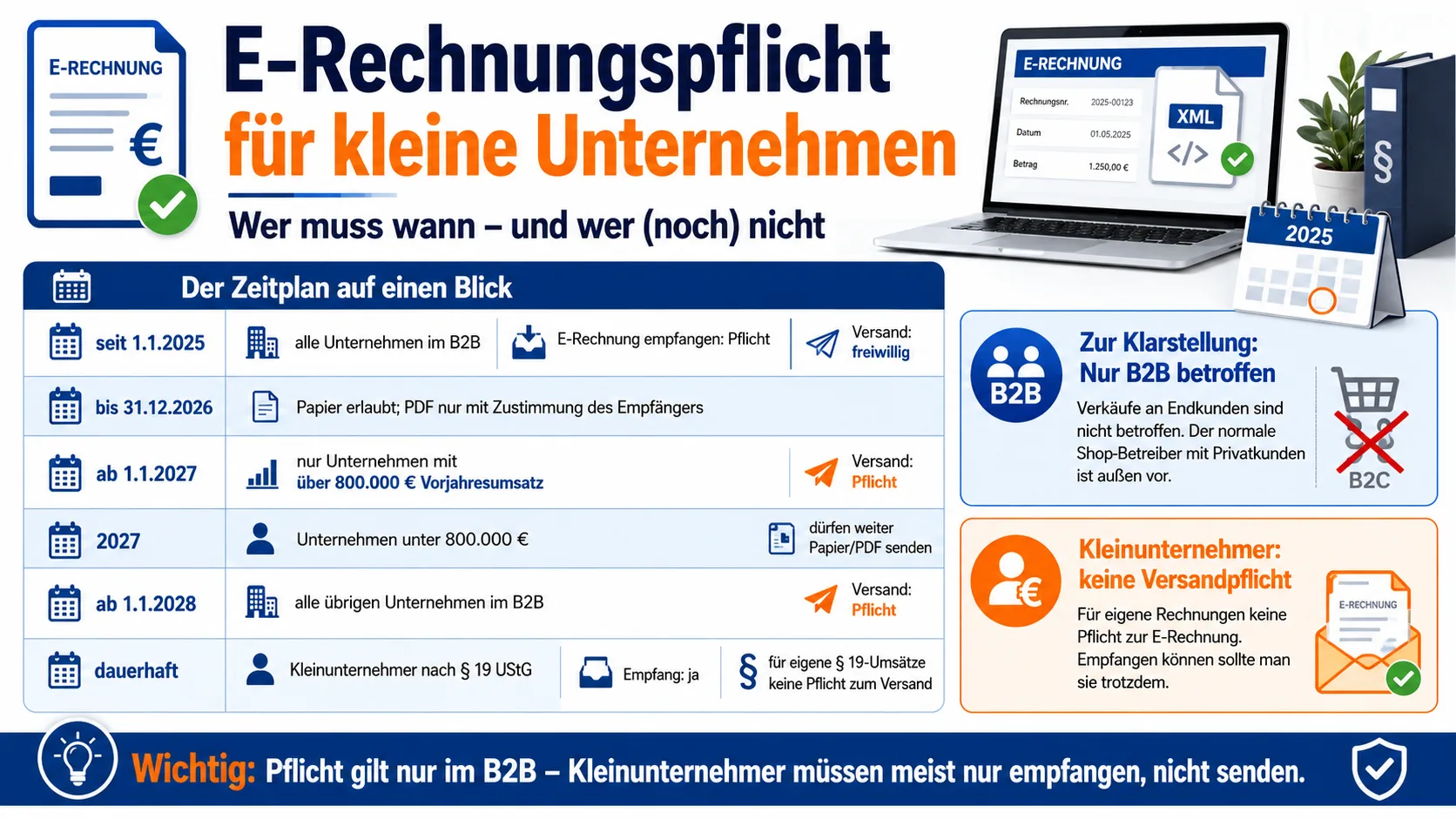
The timeline at a glance
| From when | Who it affects | Receive e-invoices | Send e-invoices yourself |
|---|---|---|---|
| since 1 Jan 2025 | all B2B businesses (incl. small-business-scheme) | yes, mandatory | voluntary; paper still possible |
| until 31 Dec 2026 | all | – | paper allowed; PDF only with the recipient's consent |
| from 1 Jan 2027 | only businesses with over 800,000 € prior-year turnover | – | mandatory |
| 2027 | businesses under 800,000 € | – | may still send paper/PDF |
| from 1 Jan 2028 | all remaining B2B businesses | – | mandatory |
| permanently | small-business-scheme (§ 19 UStG) | yes, receive | no obligation to send for their own § 19 turnover |
For clarity:
- Sales to end customers are not affected. The duty applies only B2B (business to business). The ordinary shop owner selling to private customers is out of scope.
- The small-business scheme isn't affected at all. There is no obligation to issue e-invoices for your own invoices – you should still be able to receive them.
- In 2026 there is no turnover threshold yet. The 800,000 € only become relevant in 2027 – and then only decide whether the sending duty applies in 2027 or only in 2028.
Independently of that: it's good to move with the times and be able to do it, even without having to. A solution like office1.cloud creates the formats ZUGFeRD and XRechnung – so you're ready as soon as a business customer expects an e-invoice.
To check an XRechnung or ZUGFeRD file, use the free e-invoice viewer by Office1, which displays the file readably without signing up.
What the receiving obligation since 2025 really means
This is where most confusion arises. Since 2025, every business must be able to receive and read e-invoices. Nothing more. There is no obligation to use any particular software and no obligation to process anything automatically.
In practice, very little is needed:
- An email address to which an e-invoice can be sent.
- A free viewer or a website to make the structured file readable.
That's it. You may then transfer the details by hand into your bookkeeping. Nothing has to „run through", nothing has to be booked automatically. Whoever receives an e-invoice, opens it and files it has met the duty.
Small-business scheme: usually a false alarm
Anyone using the small-business scheme (§ 19 UStG) does not have to issue e-invoices for their own invoices – not even from 2027 or 2028. You should still be able to receive them. At an annual turnover of about 20,000 € this means: you keep invoicing as usual and merely ensure that an incoming e-invoice reaches you and is readable.
For reassurance: even the big players are taking their time
In reality, even very large corporations still often send classic PDF or paper invoices for servers, telecommunications or software. The switch is starting slowly across the industry. Being small doesn't put you at a disadvantage – the ability to receive is enough, the rest has time.
In short
Be able to receive: yes, since 2025, with simple means. Have to send yourself: small businesses at the earliest in 2028, the small-business scheme not at all for its § 19 turnover. Invoices to private customers: out of scope. For most small self-employed people, the situation is far more relaxed than the headlines suggest.
Note: This article does not constitute tax or legal advice and reflects the status as of 30 June 2026. For your individual case, your tax adviser or tax office is decisive.
Sources
Handle invoices more easily
Easy Invoice combines quotes, invoices and customer management in the cloud.
Try Easy InvoiceRead next
 Taxes & Law
Zusammenfassende Meldung (ZM): deadline, ELSTER and who must file
Anyone who supplies goods or invoices services without German VAT to business customers in other EU countries reports these sales to the German Federal Central Tax Office. Here you can find out who has to report, by when, what goes into the report and what happens if it is missing.
 Taxes & Law
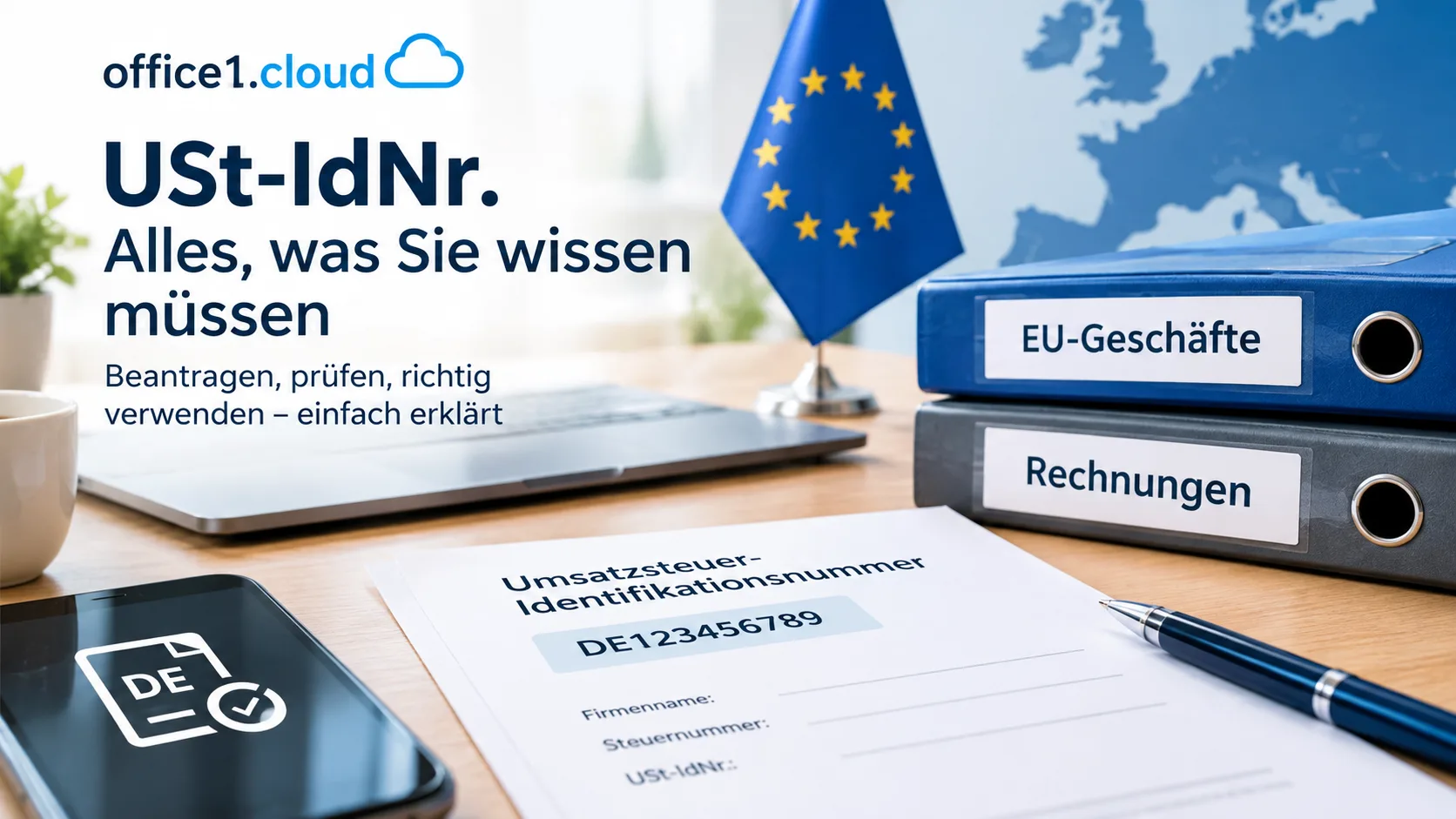
USt-IdNr.: how to apply, how to check and when you need one
The USt-IdNr. (EU VAT ID) is a second number alongside the Steuernummer, meant for business with companies in other EU countries. You apply for it free of charge at the German Federal Central Tax Office and check your customer's number there too; here is how both work and how to find out whether you need one at all.
 Taxes & Law
Low-value assets in Germany (GWG) 2026: €800 limit, net or gross
The GWG limit in Germany is €800 net in 2026, also under the small business scheme. Which purchases you deduct at once, when the pooled item pays off and how to book it.