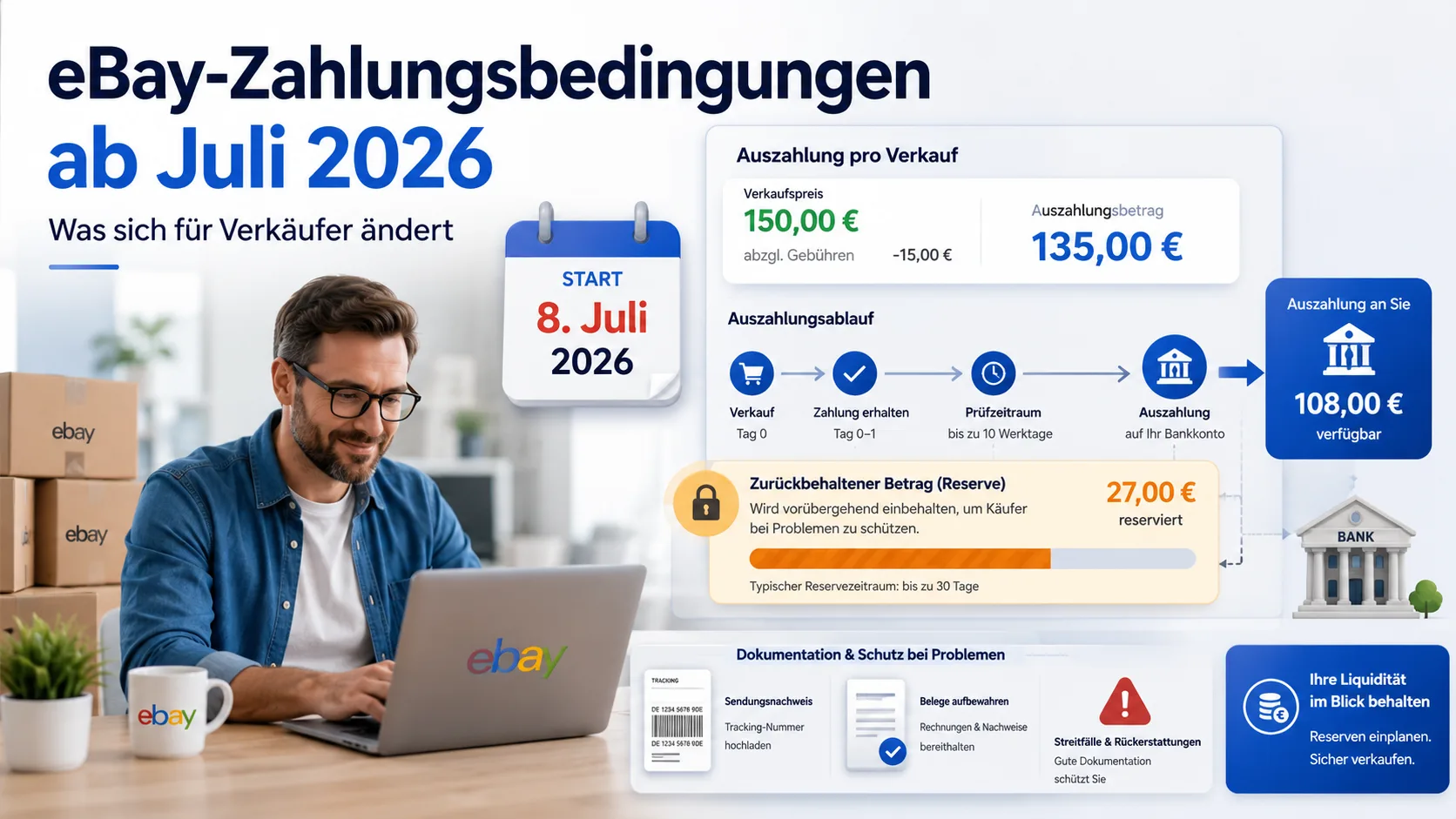
eBay Payment Terms from July 2026: What Changes for Sellers
From 8 July 2026, new payment terms apply to existing eBay sellers. If you sell on eBay, you should now understand when eBay may hold money and how to get your payouts on time. This article explains the key points of the new eBay payment terms in plain language.
Table of Contents
- What it is about
- The key dates at a glance
- Holds and reserves: the critical point for your liquidity
- Disputes and refunds: evidence decides
- Consent by doing nothing
- Example: Markus and the frozen payout
- Your checklist before 8 July 2026
- Frequently Asked Questions
- Conclusion
- Sources
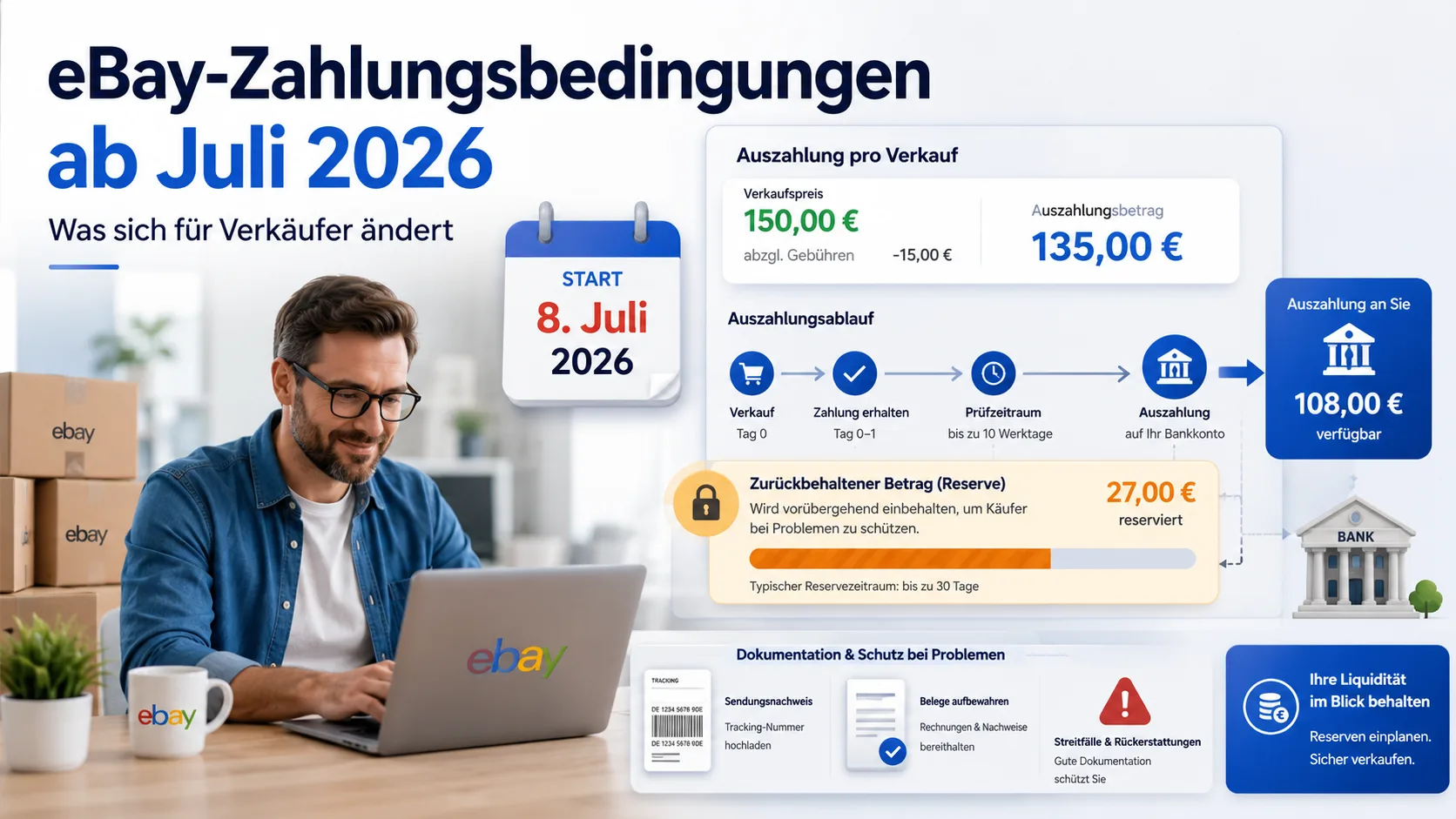
What it is about
On 4 May 2026, eBay published a new version of its terms of use for payment processing. For sellers who register or newly accept the terms, the new version has applied since 8 May 2026. For all existing sellers, it takes effect on 8 July 2026.
An important clarification: these terms do not govern the purchase contract between you and your buyers. They govern eBay's role as a payment processor – how eBay accepts payments, pays out proceeds to you, and handles refunds or disputes. For sellers in the European Economic Area and Switzerland, eBay S.à r.l., based in Luxembourg, is usually responsible. It is licensed as a payment institution and supervised by the Luxembourg financial regulator CSSF.
eBay itself describes the new version mainly as a structural overhaul – worded more clearly, explained in more detail. Most of it is not new in principle. Still, it is worth a closer look, because one part is directly about your money. If you are reviewing your eBay conditions anyway, it is also worth looking at the other eBay changes in 2026 for commercial sellers.
What does this mean for you? You do not need to sign anything or set anything up. But you should know under which conditions a payout can be delayed – so you are not caught off guard.
Payout timing is one side of your cash flow; the fee deducted before the payout is the other. The new flat rates per category and the order fee are in eBay fees from 1 July 2026.
The key dates at a glance
Three dates to remember:
- 4 May 2026 – publication of the new terms.
- 8 May 2026 – applies to new registrations and new acceptances.
- 8 July 2026 – applies to all existing sellers.
So until 8 July you have time to review the points that matter to you. After that, the new rules apply automatically.
Holds and reserves: the critical point for your liquidity
The most important section for your wallet concerns payment holds and reserves. eBay can temporarily hold amounts if the platform sees an increased risk. The rules name, among others, the following possible reasons:
- ongoing disputes or buyer protection cases,
- unusual or sharply changed selling activity,
- identity checks,
- compliance requirements,
- problems with the stored payment method.
According to eBay, a hold should be lifted as soon as the risk is reduced or removed. However, the assessment depends heavily on the platform's risk model – something you have little influence over.
In addition, eBay can require a reserve. This means either holding back a percentage of daily sales proceeds or setting a fixed minimum reserve. This becomes relevant mainly for sellers with seasonal fluctuations, suddenly higher revenue, new product ranges, or higher-priced items.
What does this mean for you? Do not plan your liquidity so tightly that a single delayed payout puts you in trouble. Especially if you pre-finance goods, build in a buffer. Anyone who also collects outstanding customer receivables consistently strengthens cash flow further – our article on dunning for the self-employed shows how.
Disputes and refunds: evidence decides
The new terms also describe how eBay handles refunds, cancelled purchases, and payment disputes. If a buyer is entitled to a refund, eBay can carry out the repayment on the seller's behalf. In genuine payment disputes – such as a chargeback through the bank – the decision is made not by eBay but by the buyer's financial institution.
One thing is crucial for you as a seller: you must provide information and evidence within the set deadlines. Anyone who does not respond, or responds too late, risks losing the disputed amount. This applies equally to chargebacks, direct debit reversals, and buyer protection cases.
eBay does refer to seller protection programs, but their effect depends on whether you meet all the requirements. The new terms offer no shortcut – instead, they show how important clean documentation remains: proof of shipment, tracking, delivery information, and communication with the buyer.
What does this mean for you? Document every sale so that, in a dispute, you can present the shipping receipt and tracking within minutes. A tidy filing of receipts is worth real money here.
Consent by doing nothing
For existing sellers: anyone who agrees with the changes does not need to do anything. Consent is deemed granted when the terms take effect on 8 July 2026, unless you object beforehand.
The catch: payment processing is a prerequisite for being able to sell on eBay at all. Anyone who terminates the payment processing terms can, according to the rules, no longer sell via eBay. Refusal is therefore possible, but has clear economic consequences. For most commercial and part-time sellers, it effectively comes down to a mandatory text if they want to keep using the marketplace.
Example: Markus and the frozen payout
Markus sells used guitars and music equipment on eBay as a side business. Normally he turns over a few hundred euros a month. In July, things suddenly go well: he clears out a larger collection and, within a week, sells three high-priced instruments for around 4,000 euros in total.
For eBay's risk model, this is unusual selling activity – considerably more and more expensive than usual. eBay could temporarily hold part of the proceeds until the purchases are completed without complaints. Markus had firmly counted on the money to buy new stock.
What Markus does right: for each instrument sold, he immediately uploads the shipping receipt with tracking and keeps his contact details and bank details up to date. As soon as the shipments are delivered and the buyers are satisfied, the reason for the hold disappears and the payout is released. Had he planned a small liquidity buffer, the delay would have been just a footnote for him.
Your checklist before 8 July 2026
So you can move calmly into the new terms:
- Check your master data. Keep identity data, bank details and – for companies – information on beneficial owners up to date. Outdated data is a common reason for holds. Also keep your eBay account well secured – you will find tips in our article on cyber security for the self-employed.
- Plan a liquidity buffer. Do not count every euro immediately, especially with larger or unusual sales.
- Standardise documentation. Keep the shipping receipt and tracking ready for every sale so you can answer disputes on time.
- Reconcile payouts. Check regularly whether the amounts paid out match your sales – ideally automated via your bank account import.
Frequently Asked Questions
Do I have to actively accept the new eBay payment terms?
No. For existing sellers they apply automatically from 8 July 2026, unless you object beforehand. An objection, however, usually ends the option to keep selling via eBay.
When may eBay hold my payout?
When the platform sees an increased risk – for example in disputes, identity checks, compliance requirements, or unusual selling activity. The hold should be lifted as soon as the risk disappears.
What is a reserve?
eBay can hold back a percentage of your daily proceeds or a fixed minimum reserve to cover possible refunds. This affects mainly sellers with strongly fluctuating or higher-priced revenue.
How do I protect myself in disputes?
Always respond within the set deadlines and provide evidence: shipping receipt, tracking, and communication with the buyer. Anyone who does not respond can lose the disputed amount.
Does this also apply to private or part-time sellers?
Yes. Payment processing is a prerequisite for every sale via eBay – regardless of whether you sell commercially or part-time.
Conclusion
The new eBay payment terms bring more structure but no relief. Two things matter most for you: up-to-date master data and clean documentation of every sale. Anyone who regularly reconciles their payouts with their sales – for example via an automated bank account import with payment matching – quickly notices when a hold takes effect and can respond in a targeted way. That keeps your liquidity under control, even when the platform holds back money for once.
Sources
- Terms of use for payment processing on eBay — Official eBay payment terms, published 4 May 2026, applicable to existing sellers from 8 July 2026.
- Holds on payments within payment processing — eBay help page on the conditions and process of payment holds.
- Payouts for sold items — eBay help page on how payouts to sellers work.
- eBay payment terms: new rules for payment processing from July 2026 — Trade article (18 May 2026) putting the new terms into context for sellers.
Handle invoices more easily
Easy Invoice combines quotes, invoices and customer management in the cloud.
Try Easy InvoiceRead next
 E-Commerce & Marketplaces
New eBay Terms of Service from 15 September 2026: What Sellers Should Check Now
New eBay terms apply from 15 September. Four things change, and one of them can cost you your account.
 E-Commerce & Marketplaces
Creating invoices for Shopify
Shopify sends order confirmations – not invoices. How to get from a Shopify order to a finished invoice in five steps, with your own number, correct tax details and automatic sending.
 E-Commerce & Marketplaces
eBay vehicle parts: free returns mandatory since 28 September – what it costs you
New parts over 10 euros at a fixed price: since 28 September you have to take them back free of charge for 30 days and adjust your withdrawal policy. Which returns are not covered, what the rule costs and what to check now.