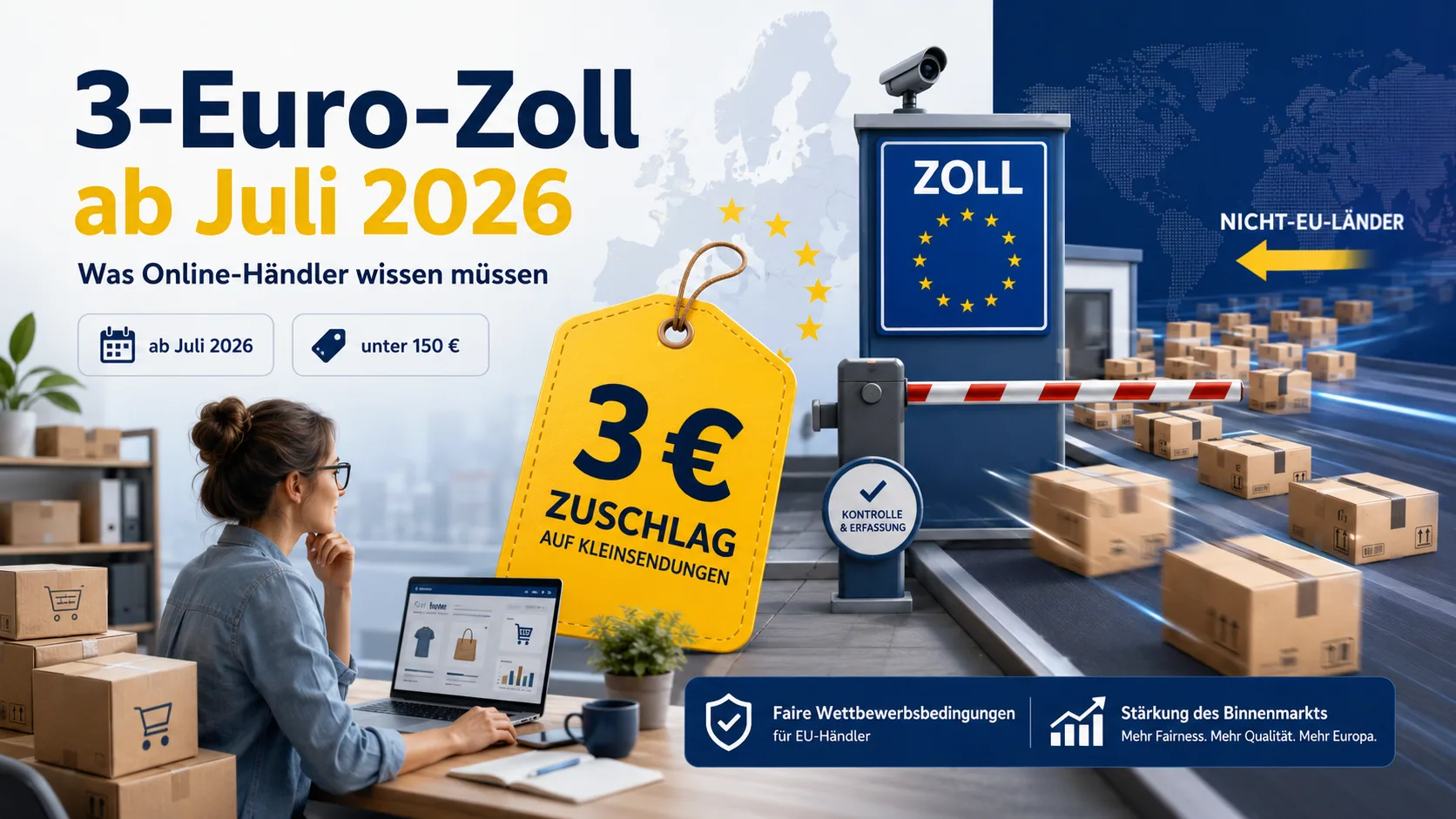
EU €3 Customs Duty from July 2026: What Sellers Must Know
The EU is getting serious about cheap parcels: from 1 July 2026, consignments under €150 from non-EU countries will carry a flat customs duty of €3 – the previous exemption is abolished. For German online sellers who have been calculating against Temu, Shein & Co. for years, this is one of the most important pieces of news this year. Here you can read what was decided, what it means for your prices – and when you yourself are affected.
What exactly was decided
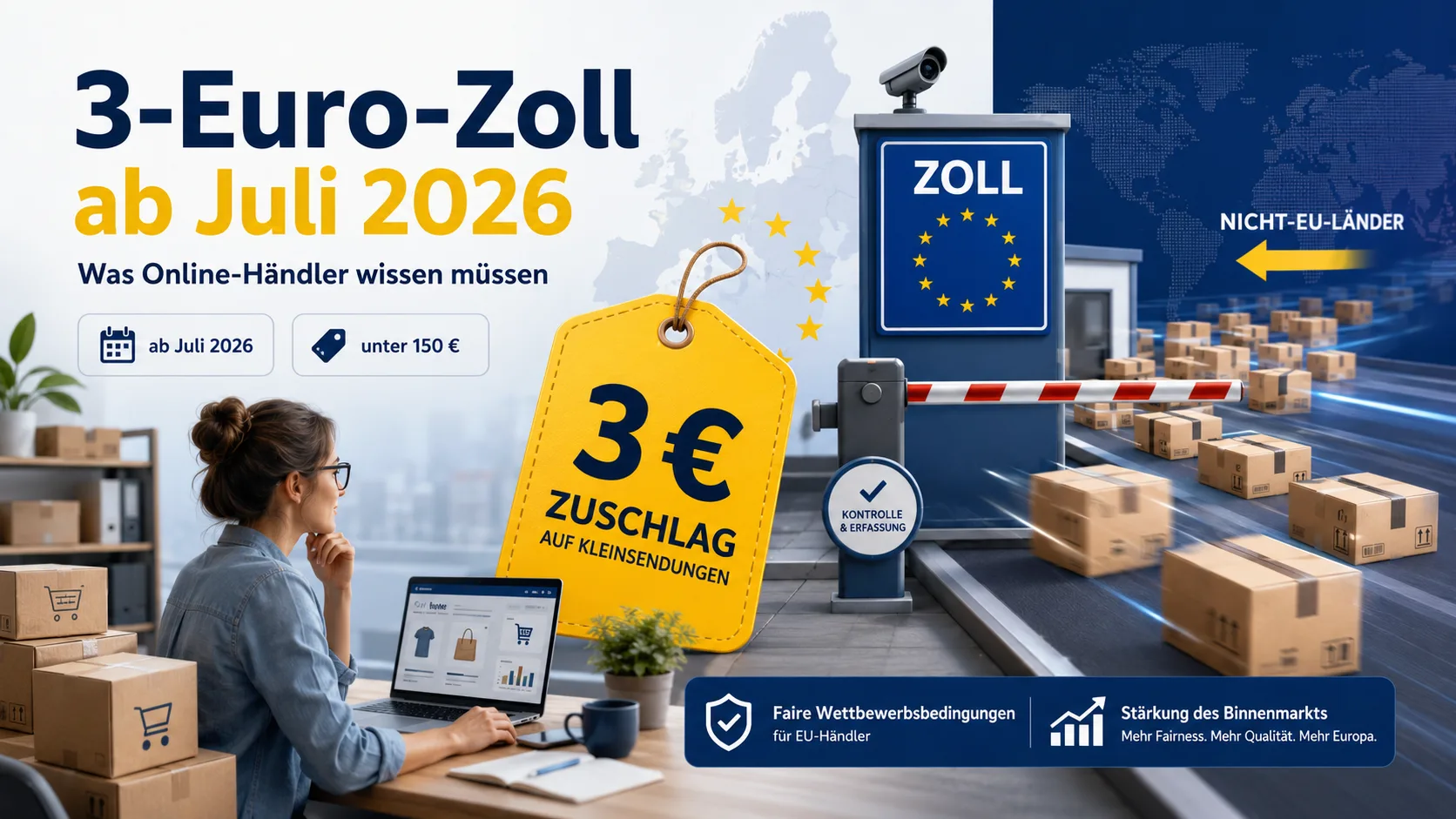
The European Parliament and the Council of the EU agreed on 27 March 2026 on a comprehensive reform of the EU customs union – according to the EU Commission the most ambitious since 1968. The points that matter most for sellers:
The customs exemption for parcels under €150 is abolished – the Commission and member states had already agreed on this in November 2025. As a transitional solution, a flat duty of €3 applies to these parcels from 1 July 2026. Once the new EU customs data platform is fully operational, regular duties are to be levied. In addition, a processing fee for goods imported into the EU will be introduced by 1 November 2026 at the latest; its amount will be set in a delegated act.
The reform also obliges the platforms: online marketplaces and sellers will have to inform customs about their sales without delay and ensure their products comply with EU rules – systematic violations can be sanctioned. Responsibility thus shifts from the individual consumer to the operators.
If you import commercially rather than order single parcels, the €3 duty is only a small part of your landed cost: how to find and check suppliers in China and what the import really costs is covered in Finding suppliers in China.
Why the EU is stepping in
The EU Commission’s figures explain the move: in 2025 an estimated 5.9 billion low-value consignments entered the EU directly to consumers – 90 percent of them from China. Many of these products do not meet EU standards. The reform’s declared aim is to create a level playing field between third-country e-commerce and trade within Europe.
What does this mean for you? Policy is correcting a competitive disadvantage you as an EU seller have carried for years: you pay taxes and duties and comply with product rules – the cheap overseas parcel often did not.
A worked example: what changes for bargain orders
An example (simplified, may differ case by case): a customer orders a phone case for €4 from a third-country platform. Until now this parcel entered the EU duty-free. From 1 July 2026 a flat €3 duty applies – relative to the value of the goods, almost a doubling. With an €80 basket, by contrast, the flat fee barely matters. In short: the cheaper the individual parcel, the stronger the new duty bites. Precisely in the ultra-cheap segment – where price pressure on German sellers is greatest – the gap shrinks noticeably.
Your opportunity: play to your strengths now
For sellers in Germany the reform is a chance to win back lost customers. Three levers:
Don’t cut prices in panic – calculate cleanly. The gap to the low-cost competition is narrowing – use that instead of entering a price war. How to communicate price adjustments confidently is covered in our article on raising prices in 2026.
Make your advantages visible. Fast delivery, easy returns, German-language support, verified product safety – exactly the points where third-country platforms are weak. Write these advantages actively into your shop, listings and advertising.
Compliance as a selling point. While the EU cracks down on third-country goods, you score with products that demonstrably meet the requirements – see our article on the GPSR.
Caution: sellers who import themselves are affected too
The reform does not only hit Temu and Shein. If you as a seller source goods in small consignments from non-EU countries – for example via dropshipping or direct orders from manufacturers in Asia – then the €3 duty and the coming processing fee also make your supply chain more expensive. An example: a part-time online seller has phone accessories shipped in individual parcels directly from the manufacturer to his customers. From July, each of these consignments costs €3 more – at 200 consignments a month that is €600 that did not appear in the calculation before (example calculation, may differ case by case).
So check now: which of your supply routes run via small consignments from third countries? Will consolidated imports beat individual shipping from July? And are your sales prices adjusted? You should also be aware of further EU obligations for 2026 – such as the new EU packaging regulation PPWR, which takes effect in August.
Frequently asked questions
From when does the €3 duty apply?
Following the agreement between Parliament and Council, the flat fee applies from 1 July 2026 as a transitional solution for parcels under €150 from non-EU countries. Later, with the new EU customs data platform, regular duties are to be levied.
Does this affect me as a seller with a warehouse in Germany?
Usually not directly – your imports are generally cleared through customs anyway. Indirectly you benefit, because low-cost competition from third countries becomes more expensive. You are directly affected if you source goods in small consignments from non-EU countries, for example with dropshipping.
What is the processing fee?
In addition to the flat duty, the EU will introduce a fee by 1 November 2026 at the latest to cover the customs authorities’ costs. The amount is not yet fixed; it will be set in a delegated act.
Will Temu and Shein disappear because of this?
That is not to be expected. But the price advantage in the ultra-cheap segment shrinks, and the platforms will carry more responsibility for product safety and customs declarations – both improve your competitive position.
Conclusion
For sellers in Germany the EU customs reform is mostly good news: the unfair price advantage of uncustomed cheap parcels shrinks from July 2026, and third-country platforms must take on more responsibility. You should still act – with clean costing, visible strengths and a look at your own supply chain. By the way: whoever keeps incoming invoices, supplier orders and costing centrally in view – for example with an office solution like Easy Invoice – spots such cost changes earlier and can react in time.
Sources
- EU Commission: Commission welcomes historic agreement on the reform of the EU customs union — Official EU Commission communication (27 March 2026) with all key facts: €3 duty from 1 July 2026, abolition of the €150 exemption, processing fee, platform obligations.
- EU Commission: press release ip_26_735 — Full press release on the customs reform.
Note: This article does not constitute tax or legal advice. The calculation examples are simplified and may differ depending on the individual case. For your individual situation, please consult a tax advisor or lawyer.
Handle invoices more easily
Easy Invoice combines quotes, invoices and customer management in the cloud.
Try Easy InvoiceRead next
 Taxes & Law
Low-value assets in Germany (GWG) 2026: €800 limit, net or gross
The GWG limit in Germany is €800 net in 2026, also under the small business scheme. Which purchases you deduct at once, when the pooled item pays off and how to book it.
 Taxes & Law
Germany's 1% rule for company cars: how the self-employed pay tax
If you also drive your company car privately, you pay tax on 1 percent of the list price every month. What comes on top, what the calculation looks like with figures and when a mileage logbook saves money.
 Taxes & Law
Keeping a mileage logbook in Germany: template, required details
A German mileage logbook only counts if every trip is recorded promptly and without gaps. Which details are required, what a filled-in logbook looks like and why Excel is not enough.