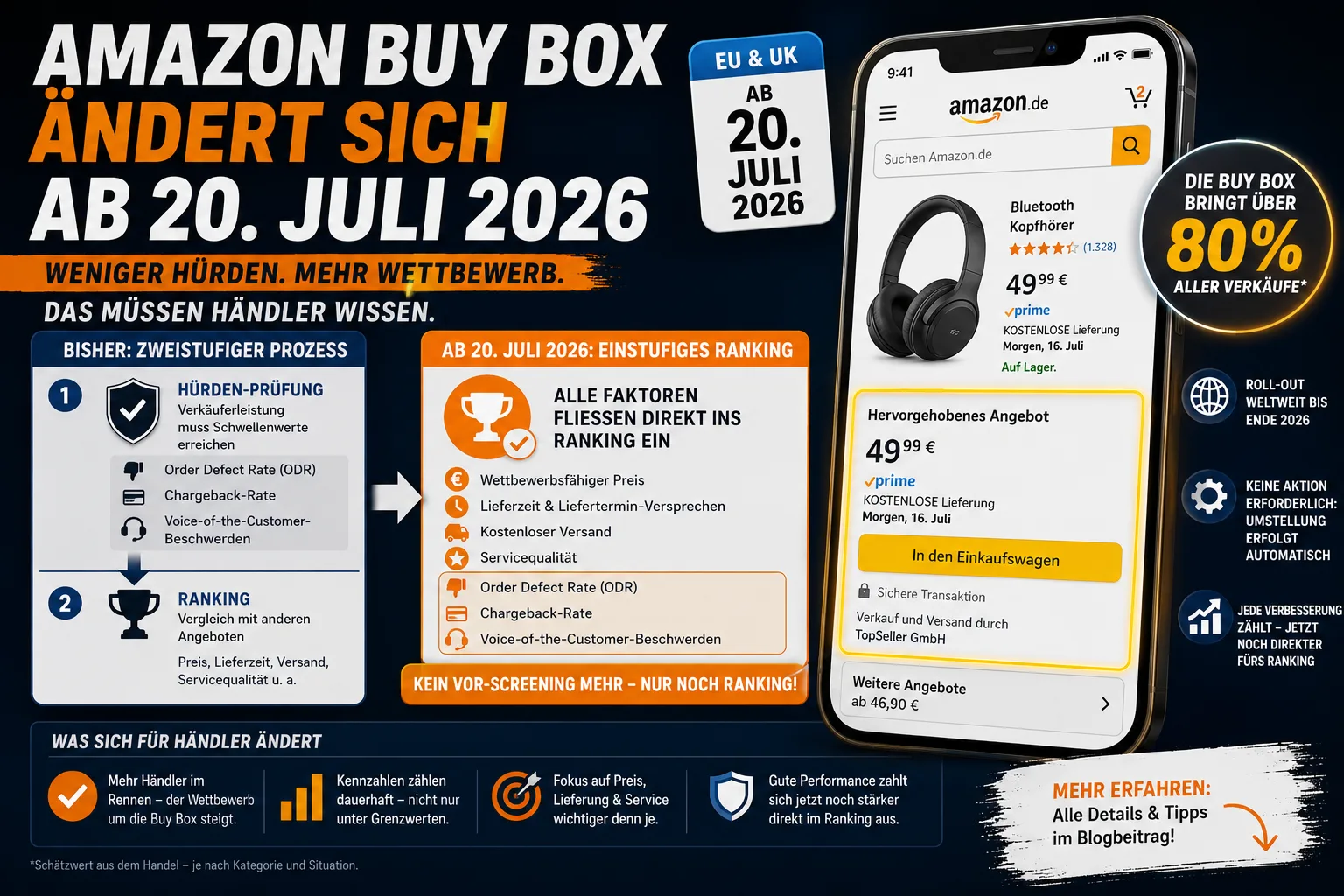
Amazon is changing how the Featured Offer – commonly called the Buy Box – is awarded. Concretely, a first hurdle disappears: until now your offer had to pass a separate check of your seller performance before it even competed against other sellers. Amazon is scrapping that preliminary step. Metrics such as your defect rate and customer complaints will no longer decide whether you make it into the race; instead, they feed directly into the decision about who gets the Buy Box. Amazon announced this on 6 July 2026 via its seller forum; in the EU and the UK the change takes effect on 20 July 2026, with a worldwide rollout planned to be complete by the end of 2026.
What the Buy Box actually is – and why it decides your sales
When several sellers offer the same item, the Amazon product page still has only one “Add to Cart” button. The offer behind that button is the Featured Offer – officially called that by Amazon, and known colloquially as the Buy Box. Whoever holds it makes the sale; the other sellers of the same item appear only in small print under “Other offers” and are overlooked by most buyers.
That is why the Buy Box matters so much: industry estimates suggest that around 80 percent and more of all Amazon sales run through the Featured Offer. For an item carried by several sellers, the customer doesn’t consciously choose between them – Amazon decides, by handing one seller the button. Amazon rotates the Buy Box continuously between sellers, showing it now to one, now to another; there is no permanent claim to it.
For you as a seller this means: whether you earn any revenue on a shared listing depends almost entirely on how often Amazon assigns you the Buy Box. And that assignment is exactly what Amazon is now adjusting.
What Amazon is changing precisely
Until now, the award ran in two stages: first Amazon checked whether a seller was “eligible” at all – a kind of entry test based on seller performance. Only those who passed it moved on to the second step, the actual ranking against the other sellers. That first stage is being removed. What remains is a single ranking.
The metrics that used to decide the entry test don’t disappear – they move into that ranking. Amazon names specifically:
- the Order Defect Rate (ODR) – the share of your orders with problems such as negative feedback, an A-to-z Guarantee claim or a chargeback,
- the chargeback rate (reversals via the buyer’s card),
- and Voice of the Customer complaints, i.e. customer issues on your items collected by Amazon.
These values now sit on an equal footing with the familiar ranking factors: competitive price, delivery time, free shipping, delivery promise and service quality. So “gate first, then ranking” becomes “ranking only”.
Amazon justifies the move by saying the preliminary step “is no longer delivering additional value to customers”, while stressing at the same time: “We’re not changing how the Featured Offer is selected” – the criteria that matter most to customers remain decisive. For Amazon it is therefore more a simplification of the mechanics than a new scoring logic.
When does it apply – and do you need to do anything?
Two dates are fixed so far: the announcement on 6 July 2026 and the start in the EU and the UK on 20 July 2026. After that, by Amazon’s own account, it rolls the change out “gradually across all Amazon instances worldwide” and aims to be finished by the end of 2026. Amazon has not published exact dates for individual additional countries.
You don’t need to do anything actively. Amazon states explicitly: no action is required from sellers, and existing offers are included automatically once the rollout reaches their marketplace. There is no switch for you to flip and no deadline you could miss.
The point, therefore, isn’t a to-do list but understanding what shifts in your starting position.
Is this good or bad for small sellers?
The honest answer: it depends on where you stood before.
If your offers previously failed at the performance hurdle – for instance because a single bad spell briefly pushed your metrics past a threshold – the change is rather good for you: you are now in the race in any case and can score on good prices and fast delivery instead of being shut out entirely.
If, on the other hand, you were among the sellers who cleared the hurdle comfortably, more competition now joins the race. Sellers who previously weren’t even allowed to compete are now vying for the same Buy Box. For you that can mean you win it slightly less often on contested items than before.
More fundamental than this plus/minus, though, is another point: thinking in fixed thresholds no longer works. Until now, many sellers found it enough to keep their ODR below the critical mark – “under the value, all good”. In a pure ranking, that “good enough” no longer exists. Every deterioration in your metrics affects your position directly, even if you are far from any old suspension threshold. And conversely, every improvement pays off immediately, instead of merely serving to clear a hurdle.
Do your metrics count for less now?
That is the most common misconception – and the opposite is true. Because ODR, chargebacks and customer complaints no longer just operate a yes/no gate but continuously co-determine your ranking position, in everyday terms they tend to weigh more heavily than before. A metric you only had to keep under a limit becomes one you work on permanently.
Note as well: even being included in the ranking does not secure you the Buy Box. “Being considered for the Featured Offer doesn’t guarantee your offer will be featured,” Amazon makes clear. The competition for the button continues – just without an upstream eligibility check.
If you sell via Fulfilled by Merchant (FBM), don’t overlook Amazon’s second change this month in this context: from 15 July 2026 an on-time delivery rate of 90 percent becomes mandatory for FBM sellers. What’s behind it and how to hold the rate is in our article Amazon FBM from 15 July 2026: 90% on-time rate becomes mandatory.
A point often overlooked: your Amazon advertising
If you run Sponsored Products or Sponsored Display, the visibility of those ads hangs on exactly the same Featured Offer. Without the Buy Box your ads for that item are not served – you get zero impressions, even though the campaign still shows as “active” in your ad console. This applies per offer variant (SKU): different variants of the same item can have different Buy Box status, and your advertising only runs where you currently hold the Buy Box.
For the transition that means: if your Buy Box share changes due to the new competitive situation, the reach of your paid campaigns quietly changes with it. A look at impressions is therefore doubly worthwhile in the weeks after 20 July.
What is still open
Amazon has not disclosed the exact weighting of the ranking factors – how strongly price counts against delivery time or metrics remains Amazon’s black box. It is also unclear whether anything changes about the price check against offers outside Amazon, a common reason branded items in particular lose the Buy Box. And, as mentioned, the concrete rollout dates for countries beyond the EU and the UK are missing.
So what is solid at this point is above all the principle – away from the entry hurdle, towards a continuous ranking. If you carry shared offers on Amazon, you are well advised to treat your prices, delivery times and metrics as what they now permanently are: ongoing levers for the Buy Box, not values you merely park below a limit.
Handle invoices more easily
Easy Invoice combines quotes, invoices and customer management in the cloud.
Try Easy InvoiceRead next
 E-Commerce & Marketplaces
New eBay Terms of Service from 15 September 2026: What Sellers Should Check Now
New eBay terms apply from 15 September. Four things change, and one of them can cost you your account.
 E-Commerce & Marketplaces
Creating invoices for Shopify
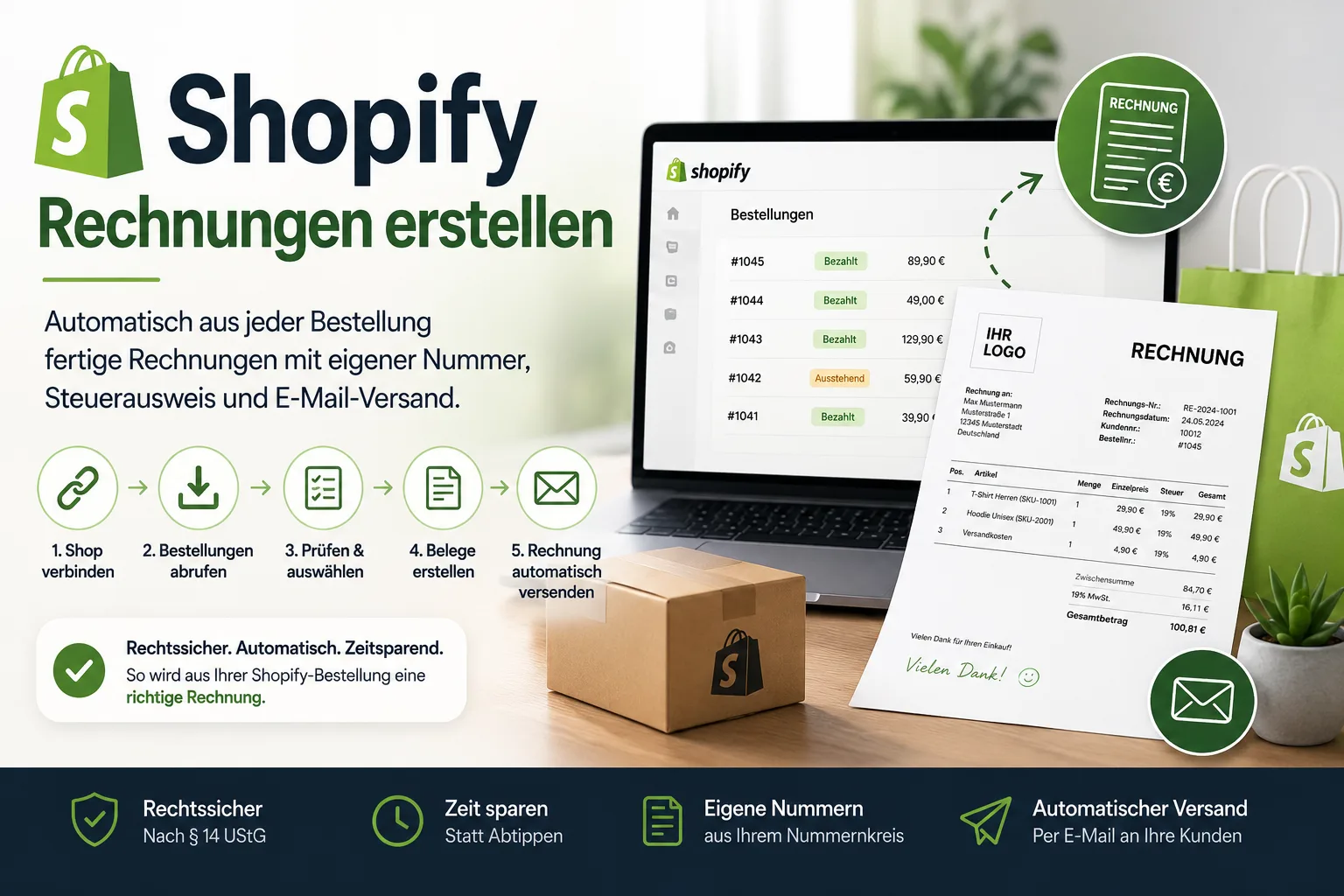
Shopify sends order confirmations – not invoices. How to get from a Shopify order to a finished invoice in five steps, with your own number, correct tax details and automatic sending.
 E-Commerce & Marketplaces
eBay vehicle parts: free returns become mandatory on 28 September – what it will cost you
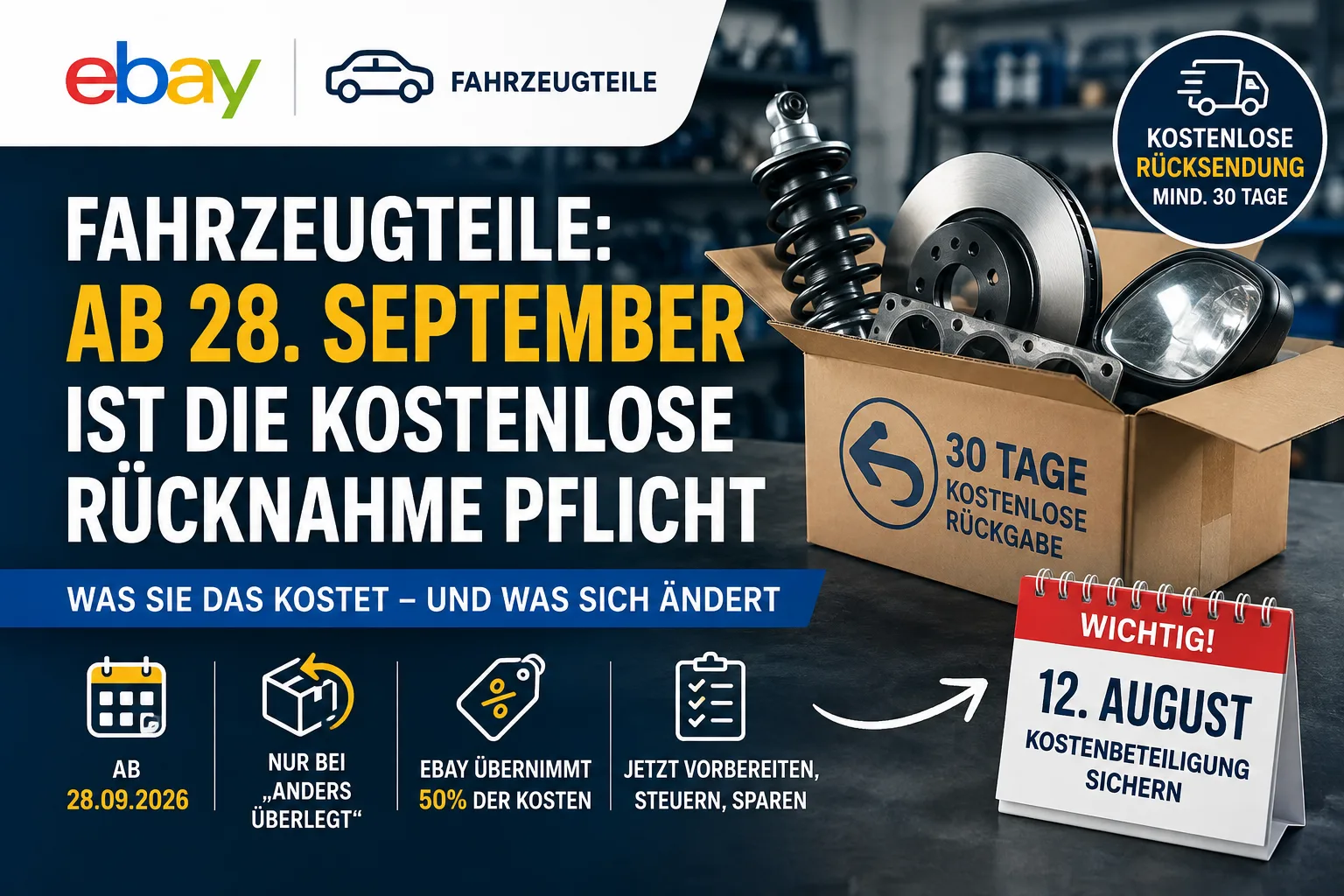
New parts over 10 euros at a fixed price: from 28 September you have to take them back free of charge for 30 days. What actually changes, which returns are not covered, why eBay will make the switch for you if you don't – and why 12 August matters more to you than the deadline itself.