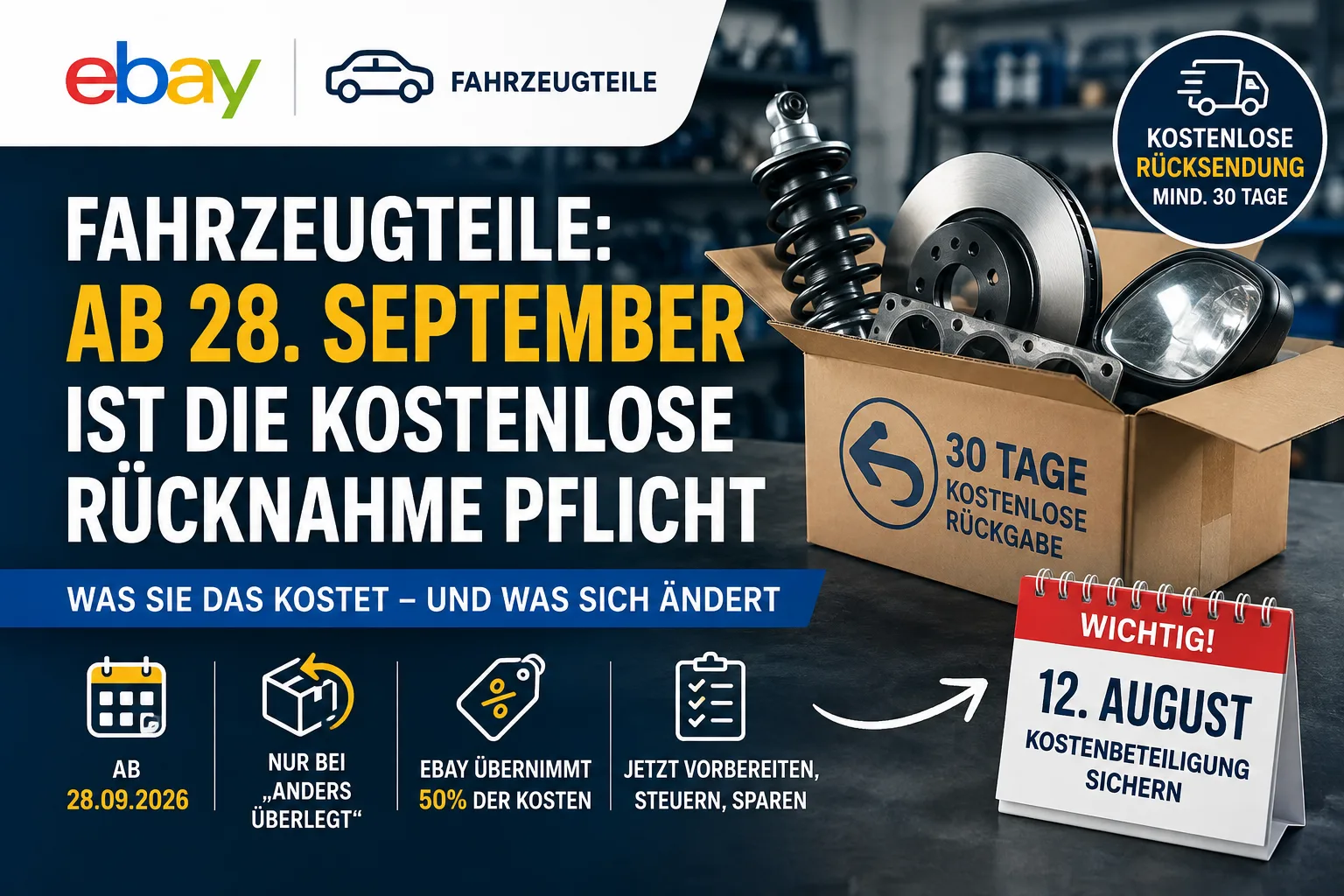
Since 28 September 2026, commercial sellers on eBay.de must offer free returns of at least 30 days on affected listings in the vehicle parts categories. This covers new items over 10 euros sold at a fixed price or Buy It Now within Germany. Something most reports have missed: only returns where the buyer changed their mind are covered. Faulty parts, and parts that should have fitted according to the vehicle data but did not, continue to follow the existing rules. eBay contributes 50 percent towards the cost of the return label, but only for the eBay label with standard shipping. And anyone who voluntarily switches their return policy early receives that contribution from 12 August 2026 onwards.
Last updated: 29 September 2026. The rule has applied since 28 September.
Contents
- Am I even affected? The five-point check
- The sentence that removes half the drama: only „changed my mind"
- What has changed: before and since 28 September
- You only get the 50 percent with the eBay label
- What does this cost me? Work it out with your own figures
- Since 28 September: what to check now
- What happens if I change nothing – and how to do it myself
- Can I get around the rule?
- The cheapest return is the one that never happens
- When the part comes back fitted
- What every return triggers in your paperwork
- eBay orders, invoices and returns in one workflow
- Germany is the third stage – what can be concluded from the US and the UK, and what cannot
- The next date is already set: Top Rated Plus from February 2027
Am I even affected? The five-point check
eBay talks about „eligible" listings. What is meant are listings that meet all of these criteria:
- You sell commercially, not privately.
- The listing sits in one of the affected categories for vehicle parts and accessories.
- The item is new – in the UK the condition „New – other" also counts.
- The price is over 10 euros, excluding shipping costs.
- It is a fixed-price listing or Buy It Now with shipping within Germany.
Not affected are auctions, used parts, orders going abroad, hazardous goods, and heavy, bulky or freight-forwarded items. Nothing changes for a used turbocharger in an auction; it does change for a new brake caliper at a fixed price.
Which categories are excluded is now listed by eBay on its free returns page in the German Seller Centre, each with its category number. They include batteries, airbags, tyres, complete engines and seat belts.
Check your listings against this list, not against the British version that has applied since 8 June 2026. The category list is the one point in this article you should not be guessing at.
And what if I sell to garages? A commercial buyer has no statutory right of withdrawal; that only applies to consumers. But the eBay rule is not legislation, it is a platform condition – and it attaches to the listing, not to the buyer behind it. Whether eBay makes an exception for a sale to a business customer does not emerge from the announcement. If a significant share of your turnover goes to independent garages and workshops, that is exactly the question to put to eBay seller support. The answer may be worth more to your costing than anything else in this article.
eBay is also changing its terms of service on 15 September 2026, among other things for shipping and for the termination of seller accounts: New eBay terms of service from 15 September 2026.
The sentence that removes half the drama: only „changed my mind"
The obligation to take goods back free of charge applies to one return reason only: the buyer changed their mind. In the eBay policy text this is called „change of mind" or „remorse return" – ordered by accident, not needed after all, found cheaper elsewhere.
Not covered are:
- Faults and defects. If the part arrives broken or does not work, the existing rules apply. You have always paid in those cases anyway.
- Incorrectly described items. Here too nothing changes, and eBay's 50 percent contribution is not available for it.
- The vehicle parts promise. If a buyer selected a part via the vehicle data and it still does not fit, the separate programme eBay has been running for this since 2023 applies. That is explicitly not the same thing as the new rule, even though both are called „free returns". The two exist side by side.
This is decisive for your costing. In the parts trade, „doesn't fit" is the most common return reason – and that one mostly falls into the other buckets. So do not calculate with your total return rate, but only with the share where the buyer stated „changed my mind" or „ordered by accident". You will find that share in your returns overview.
There is a catch, and you should know about it: when free returns are visibly advertised, return reasons migrate. A buyer who used to click „doesn't fit" is more likely to click the reason that is guaranteed to cost them no postage. How strong that effect is, nobody knows in advance.
What has changed: before and since 28 September
On the left is what applied to an affected listing until 27 September, on the right what has applied since the deadline.
| Until 27 September 2026 | Since 28 September 2026 | |
|---|---|---|
| Return window | 14 days statutory right of withdrawal | at least 30 days because eBay requires it (30 or 60 selectable) |
| Who pays for the return | the buyer – if you informed them correctly | you. eBay reimburses half the label |
| For which reason | for every withdrawal | only if the buyer changed their mind |
| Voluntary or mandatory | voluntary; many offer it as a selling point | mandatory for affected listings, no opt-out |
| Which listings | your decision, listing by listing | new, over 10 euros net, fixed price, shipping within Germany |
| If you change nothing | nothing | eBay switches your listings itself |
| eBay cost sharing | none | 50 percent, but only with the eBay label at standard shipping |
Two things are regularly confused here.
The law does not change. As consumers, your buyers have a 14-day right of withdrawal; that is section 355 of the German Civil Code (BGB). And you may pass the direct costs of the return on to them if you informed them beforehand – section 357 (5) BGB, unchanged. What changes is a contractual condition of the platform: eBay demands more of you than the law does. A platform is allowed to do that, and it cannot be countered by pointing to the Civil Code.
You have to adjust your withdrawal policy for these listings. eBay requires it explicitly: the policy must state a 30-day period and say that you bear the return costs. The German law firm IT-Recht Kanzlei and the German retailers' association Händlerbund recommend the same. If your policy still says 14 days with returns at the buyer's expense, it contradicts what eBay promises in the listing. Use the new policy only for the affected vehicle parts. eBay allows several return policies for this, one for these listings and one for the rest of your range. Write "30 days", not "1 month": a month is not always 30 days, and IT-Recht Kanzlei pointed out back in 2018 that precisely this contradiction on eBay listings can attract a formal warning letter. The exact wording comes from your legal texts provider. This article is an assessment, not legal advice.
You only get the 50 percent with the eBay label
This is where money is left on the table without anyone noticing.
The cost sharing applies to the eBay return label at standard shipping. If the case instead uses an express label or a privately purchased label – because you have your own contract with a carrier and it is cheaper, say – eBay does not contribute. Then you pay the full amount.
Do the maths before you stick with your own contract out of habit: your own label at 4.20 euros is more expensive than an eBay label at 5.50 euros from which you get 2.75 euros back. The lower purchase price is the more expensive option here. Put in your own prices, but compare the price after reimbursement, not the list price.
Two limitations belong with this. The reimbursement is only available for returns where the buyer changed their mind – for a faulty or incorrectly described part you bear the return in full, just as before. And the announcement does not say when you see the money: whether eBay deducts the half directly when the label is bought or credits it to you later remains open. Check your seller payout statement on the first case rather than assuming.
What does this cost me? Work it out with your own figures
The figures below are an example, not a statistic. Replace them with your own.
Assume: 300 new parts sold per month, average price 42 euros, so 12,600 euros in turnover. Overall return rate 6 percent, which is 18 returns. Of those, 6 fall under „changed my mind" – the other 12 are defects or fitment cases and therefore not affected. A return label costs 5.50 euros.
| Until 27 Sept | Since 28 Sept, eBay label | Since 28 Sept, own label | |
|---|---|---|---|
| Affected returns | 6 | 6 | 6 |
| Postage for them | €33 | €33 | €33 |
| of which yours | €0 | €16.50 | €33 |
| Share of turnover | 0 % | 0.13 % | 0.26 % |
That looks smaller than feared – and it is, as long as the number of returns stays the same. But that is exactly the open question. So work out a second line assuming the number of „changed my mind" cases doubles, because the window is longer and free returns are being advertised:
At 12 affected returns: 66 euros of postage, of which 33 euros stays with you using the eBay label – 0.26 percent of turnover. With your own label 66 euros, so 0.52 percent.
The message from both variants: the return postage on its own is manageable. It sits in the range of one to five tenths of a percentage point of margin, and via the price that would be five to eleven cents per item at an average price of 42 euros.
The bigger item is not in this table. It is the loss in value on the goods that come back: opened packaging, signs of fitting, a part you can no longer sell as new. This item is not changed by the new rule – it will simply occur more often if the number of returns rises. So put the average goods value of your returns, and the share of it you have to write off, next to the 5.50 euros of postage. Whether that figure is above or below the postage in your case depends on your range: with small parts shipping dominates, with expensive components the goods do. How much of the loss in value you can claim from the buyer is covered in the section on compensation for loss of value.
Two further items are missing from practically every report on this topic, even though they belong in any return calculation:
You also refund the outbound postage. On a withdrawal you must refund the buyer not only the purchase price but also what they paid for delivery – that is section 357 (2) BGB. Only additional costs for a more expensive shipping method than your cheapest standard delivery may be withheld. None of this is new, it already applies today. But anyone estimating what a return costs them regularly forgets it: on a part costing 12 euros with 4.99 euros of shipping, the outbound postage is the bigger chunk, not the return label.
You get the final value fee back. eBay credits it once you have accepted the return and refunded the purchase price; the credit goes into your available payouts. On the first case, check whether the fixed per-order portion is included too – that is the remainder that stays with you. The details are in the eBay help on fee credits.
Since 28 September: what to check now
The rule has applied since 28 September 2026. If you did not switch your listings yourself, check whether eBay has done it. Check four things now:
- Your return policy. Which period applies, and to which listings? If free returns now apply to your whole range instead of only the affected vehicle parts, create a separate policy just for those listings.
- Your withdrawal policy. For the affected listings you need a separate withdrawal policy with a 30-day period in which you bear the return costs. The details are in the section What has changed.
- Your multichannel tool. Change the setting in the source system too. Otherwise the next sync writes the old condition back.
- Your figures. Record your return rate, the share of returns with the reason "changed my mind" and the average goods value per return for the months up to 27 September. Only with this comparison will you see later what the rule costs you.
eBay's 50 percent share of the return label has applied to all affected listings since the deadline. Anyone who switched voluntarily by 12 August got it earlier.
What happens if I change nothing – and how to do it myself
Unlike most marketplace changes, you cannot sit this one out – not because a penalty is looming, but because eBay will do it for you.
Here is how it went in the UK: affected existing listings that did not meet the condition were adjusted automatically by eBay in June. New listings that did not comply were changed or not published at all; from August, non-compliant listings were blocked. The eBay policy text says so openly: non-compliant listings will be updated, new ones will be adjusted or kept from going live. Whether eBay follows exactly the same procedure in Germany has not been expressly confirmed – but after the British experience, doing nothing at all is not to be expected.
In practice this means: the question is not whether your listings will be switched, but whether you notice before the first free return arrives. Anyone who makes the switch themselves can calculate first, adjust prices and take the 12 August advantage.
You do not have to touch every listing individually for this. At eBay, the return condition is a policy that you create once and then assign to your listings – with several thousand items that is the difference between half an hour and a week. eBay describes the route in its help on setting your return policy. While you are at it, create a separate policy just for the affected vehicle parts listings instead of changing your existing one for everything. Otherwise you will also be granting free returns on used parts, auctions and small items under 10 euros in future – that is, everywhere you would not have to.
One point that is easily missed: the interface. If you list via a multichannel tool – Plentymarkets, Afterbuy, M2E, JTL or similar – your listing data comes from there. Change the return condition only at eBay and the tool will overwrite it with the old value at the next sync. Set the return window to 30 or 60 days and the return costs to „seller" in the source system, not just in the eBay interface, and then check the synchronisation settings. Old listing templates you have not thought about for a while deserve the same look.
Can I get around the rule?
There is no opt-out for affected listings. That leaves the exceptions – and all three come at a price:
List as an auction instead of at a fixed price. Auctions are excluded. But you lose the predictable price with it, and someone who needs a matching spare part usually buys immediately, not in seven days.
Offer as used instead of new. Only permissible if the item really is used. From the US, where the rule has applied since 2025, it was reported that sellers tried exactly this: listing new parts as „used" or with opened packaging. That is an incorrect condition statement, it comes out at the first complaint, and the buyer who expected a new part turns it into a case that costs you more than any return.
Stay under 10 euros. With small parts such as clips, seals or valve caps that is the reality anyway. And unlike the other two routes this is not circumvention but a question of range: just above the threshold is where the ratio of gross profit – what is left after purchasing and fees – to the postage share is at its worst. Whether you sell a 12-euro part singly or in a pair is your decision in any case.
An honest assessment: I would advise against the first two routes. The rule costs one to five tenths of a percentage point of margin on return postage. Both workarounds cost more the moment the first case comes to light.
The cheapest return is the one that never happens
From 28 September you will be contributing to a portion of the returns. That makes fitment accuracy a figure in your margin for the first time – and that is where you can genuinely move something, while you cannot change the rule itself.
Maintain the vehicle compatibility list in full. It is the strongest lever in the parts trade. Every vehicle that is missing costs you a sale. Every vehicle wrongly listed will cost you a return from September – and if it was selected via the vehicle data, the case also lands in the vehicle parts promise.
Put OE numbers and cross-reference numbers into the item specifics, not just the description text. Buyers search with the number from the old part in their hand.
Write restrictions clearly, not in small print. „Only for vehicles up to build date 05/2019", „not for models with sports suspension". A sentence that prevents a return is worth hard cash from September.
Photos of the actual part, including connections and plugs. With electronic parts the wrong plug is one of the most common causes of returns – and one that a single additional photo prevents.
When the part comes back fitted
The practical case in this category: the buyer fitted the sensor, realised it does not fit, removed it again – and sends it back with signs of installation. This is where the money is, not in the postage.
Free returns means you bear the shipping label. It does not mean you have to accept every loss in value. For statutory withdrawals there is compensation for loss of value: the buyer may inspect, not use – although the line between the two often runs right down the middle in a dispute, and you must have informed them about it correctly beforehand. What you may deduct and what you may not is set out in detail in our article Used goods sent back: compensation for loss of value on withdrawal.
Document the condition on receipt with a photo. With car parts this is not excessive effort but the only evidence you will have later – and from September it is the item that decides whether a return ends in profit or loss.
What every return triggers in your paperwork
A returned order is not settled by refunding the money. The invoice you issued for the sale is no longer correct afterwards – and with it, the VAT you reported to the tax office is no longer correct either.
The clean route is a cancellation or correction invoice referencing the original invoice number. The old invoice is not deleted and not overwritten but cancelled by a second document. When cancellation is right and when correction is, we have described here: Correcting an invoice: cancellation and correction invoices.
With two returns a month you do this by hand. As the number rises it quickly becomes drudgery – and the correction invoice is only the last link in a chain that starts back at the incoming order.
eBay orders, invoices and returns in one workflow
That is exactly the chain Easy Invoice in the office1.cloud takes off your hands – from importing the order to the correction invoice after the return.
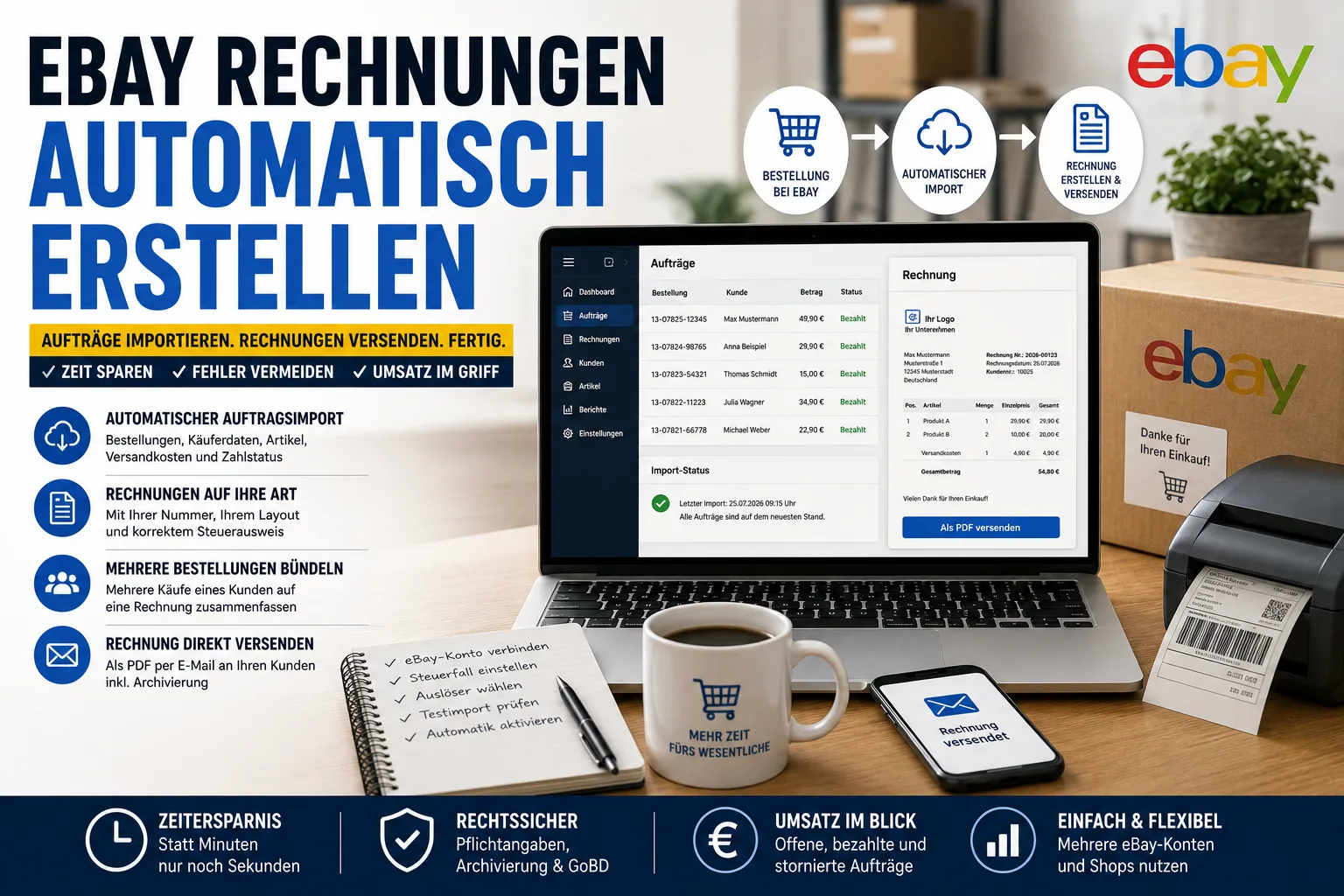
The orders come in on their own. You connect your eBay account once via eBay's authorisation page; the software never sees your password. After that the eBay import fetches new orders continuously – from regular sales as well as from your eBay Shop – and takes over the buyer's name and address, items with quantity and price, the shipping costs as a separate line, plus payment method, order number and date. Regular customers are recognised and not created afresh every time, and items are matched to your own product records – so that the tax rate and description come from your records and not from the eBay title, which usually contains marketing words.
Several orders become one invoice. In the parts trade this is everyday business: a customer clicks brake discs, pads and wear sensors individually via „Buy It Now" instead of using the basket. The result is three orders, three lots of postage and three invoices for one parcel. eBay can no longer merge that after payment. Easy Invoice proposes the bundling, you confirm it, and it becomes one transaction and one document – across several eBay accounts and your own web shop too. The overcharged postage appears as a refund on the document, so that the amount matches what the customer actually paid.
For the return this means: one transaction instead of three. If the pads come back and the rest stays with the customer, you create the correction invoice for exactly that line, referencing the original invoice number. The VAT is calculated out for the partial amount, and the payment status of the transaction is correct again afterwards – without you having to search three documents for the one with the brake pads on it.
How the connection works in detail, which trigger is the right one for the invoice and what to watch out for when bundling is covered in Create eBay invoices automatically. You can see it on your own orders with a free trial account without payment details – the trial ends automatically, there is nothing to cancel. Try Easy Invoice for free.
Germany is the third stage – what can be concluded from the US and the UK, and what cannot
The rule is not a German special case but a rollout. In the US it has applied to Motors Parts & Accessories since summer 2025: the seller obligation took effect in mid-July, and on 20 August 2025 eBay announced the launch to buyers with over 700 million parts that can now be returned free of charge. In the UK it followed on 8 June 2026. Germany's turn comes on 28 September. For anyone still hoping it will be withdrawn: in the US the rule has stood for over a year.
Why eBay is doing this, eBay says itself. In the parts category, the fear of ordering the wrong part is the biggest brake before the buy button. At the launch of the vehicle parts promise in 2023, eBay reported from its own survey that over 25 percent of vehicle owners do their own repairs, but 12 percent worry about ordering the wrong part and 30 percent fear making mistakes during fitting – and therefore drive to the garage despite the higher cost. Anyone who dissolves that worry moves turnover from the garage into online retail. That is eBay's calculation, and it is not far-fetched.
What a single seller reports: in the US seller forums there was clear resistance at the start. One seller described, some months after the introduction, that his return rate had risen from 0.02 to 3.8 percent; that a starter motor for 150 dollars left a loss of 73 dollars per return, and that with a filter for 20 dollars the shipping alone ate the profit. He had subsequently cut his range from 1,055 to 350 listings.
That is an account from a single business, and no more than that. The figures cannot be verified, whether the rule was the cause is not stated, and how other sellers fared the post does not say either. A return rate cannot be derived from it – neither for the sector nor for your business. The case is here because it shows what sellers are worried about, not because it proves anything.
There are no solid figures for any of the three stages. eBay publishes neither return rates nor turnover effects, and for the UK there are no evaluations at all after two months. Anyone telling you the rule costs X percent of margin or brings Y percent more turnover has made it up.
Two things can be said independently of that, because they follow from the policy text and not from anecdotes. First: the rule is here to stay. Three countries, the same mechanism, the same exceptions – waiting for a reversal would be the most expensive option. Second: only the return label is shifted. eBay contributes to those postage costs; it changes nothing about the condition of the goods coming back. What a returned part ultimately costs you still comes down to whether you can still sell it as new.
And from that follows the only measure that really counts before the deadline: because there are no solid figures from outside, your own are the only ones you will have in December.
The next date is already set: Top Rated Plus from February 2027
The same announcement contains a second change that is further off but already matters now: from 22 February 2027, additional minimum requirements apply to the Top Service logo. Fewer than 5 percent of items dispatched late, and a tracking number uploaded for over 90 percent of the relevant shipments. Assessment is monthly.
The timing is the important part: assessment covers past months. Anyone who misses the quota in February 2027 made the mistake in autumn 2026. Amazon ran the same pattern with its 90 percent on-time rate in July 2026 – we summarised the lessons in Amazon FBM: 90 percent on-time rate.
Checklist for the vehicle parts rule:
- Check in the Seller Centre which of your listings count as eligible – the category list is the point you should not be guessing at.
- Record three figures for the period up to 27 September: return rate for the last three months before the deadline, share of returns with the reason "changed my mind", average goods value per return.
- Create a separate return policy just for the affected listings: 30 or 60 days, return costs with the seller, plus a separate withdrawal policy with the same details.
- If you list via a multichannel tool: change it there, not just at eBay, and check the synchronisation afterwards.
- Compare whether the eBay return label is cheaper than your own shipping contract after the 50 percent is deducted.
- Check whether eBay has switched listings itself: spot-check the period, return costs and scope of the policy.
You will find the affected categories and the switch itself in your eBay Seller Centre. The announcement was reported on 5 August 2026 by onlinemarktplatz.de, among others; the detailed policy text for the British version, on which the German one is modelled, is in the eBay policies.
Handle invoices more easily
Easy Invoice combines quotes, invoices and customer management in the cloud.
Try Easy InvoiceRead next
 E-Commerce & Marketplaces
New eBay Terms of Service from 15 September 2026: What Sellers Should Check Now
New eBay terms apply from 15 September. Four things change, and one of them can cost you your account.
 E-Commerce & Marketplaces
Creating invoices for Shopify
Shopify sends order confirmations – not invoices. How to get from a Shopify order to a finished invoice in five steps, with your own number, correct tax details and automatic sending.
 E-Commerce & Marketplaces
Create eBay invoices automatically
eBay does not create invoices for your sales. How automatic order import works – and how several orders from the same buyer end up on one invoice.