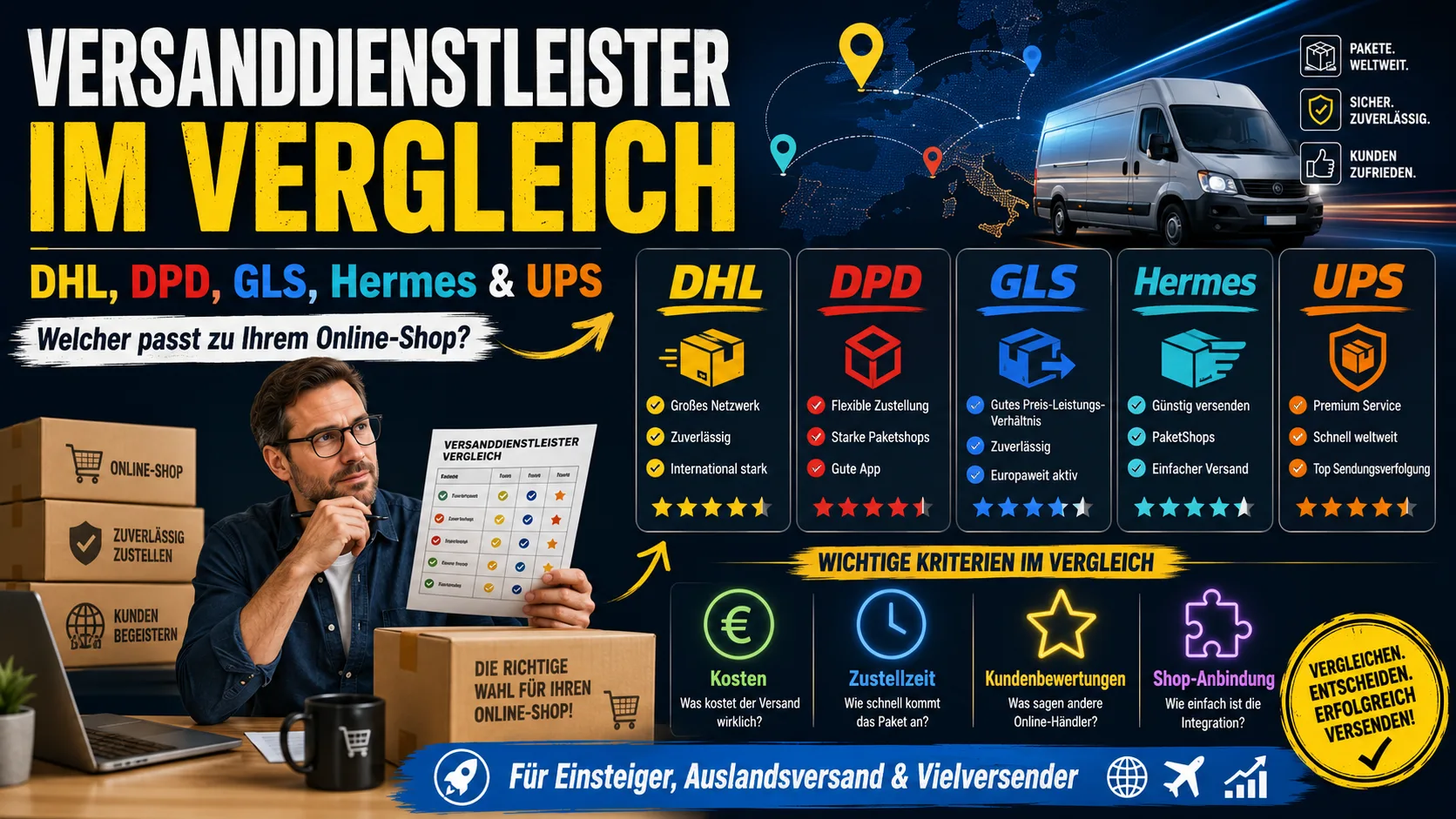
For your customers, the shipping provider often decides the purchase itself, not just what happens afterwards. According to surveys, 68 percent of buyers abandon checkout when shipping costs seem too high, and 81 percent drop out when their preferred delivery option isn't available. 74 percent won't buy at all if they have to cover return shipping costs themselves. As a store owner, choosing the right shipping provider therefore doesn't just affect your logistics costs — it directly affects your checkout abandonment rate. This article compares DHL, DPD, GLS, Hermes and UPS on the criteria that actually matter to you as a merchant: cost, real delivery times, customer satisfaction, integration with your shop system — and how the competition handles shipping costs.
What does shipping really cost — domestically and abroad?
List prices for small-volume shippers differ noticeably between providers, mainly because DHL tiers by weight while DPD, GLS and Hermes primarily charge by parcel size (XS to XL):
| Size/weight | DHL | DPD | GLS | Hermes | UPS |
|---|---|---|---|---|---|
| Very small (up to approx. 2 kg) | €4.19 (Päckchen S) | from €3.49 (XS) | from €3.29 (XS) | – | from €4.80 |
| Small (up to approx. 5 kg) | €7.69 | from €5.69 (M) | from €5.19 (M) | from €4.50 (S, up to 25 kg) | from €6.30 |
| Medium (up to approx. 10 kg) | €10.49 | from €10.69 (L) | €10.00 (L) | from €9.90 (L, up to 25 kg) | from €9.81 |
| Large (up to approx. 20 kg) | €18.99 | from €18.40 (XL) | €20.00 (XL) | €28.99 (XL, up to 31.5 kg) | from €18.80 |
| Extra large (up to 31.5 kg) | €23.99 | – | – | €33.99 (XXL) | – |
Important: these are reference prices for small-volume shippers. Business customers negotiate individual terms that typically run 30 to 60 percent below these list prices depending on annual volume — at DHL, DPD and GLS just as much as at Hermes and UPS. For a reliable calculation, it's worth requesting your own quote rather than relying on list prices alone.
For international shipping: small parcels to the EU usually cost between €9 and €20, depending on size, weight and destination country. For a 5 kg parcel to the EU, DPD at around €15 is usually cheaper than DHL (approx. €17) and UPS (approx. €22). Hermes is often the cheapest option for small EU shipments, but limits private shipping to EU destinations with its own price zones. GLS covers 23 EU countries plus the US and Canada, DPD additionally offers shipping to selected third countries, and DHL stands out with door-to-door delivery to over 220 countries if you genuinely ship worldwide.
One cost factor you should currently factor in: DHL raised business customer prices as of January 1, 2026 — merchants report around 8 percent for standard parcels, sometimes significantly more for small and special formats. Since June 1, 2026, an additional "crisis component" has been added to the existing energy surcharge, tied to the oil price (Brent) and adjustable up to three times per month. Given the current oil price uncertainty from the situation in the Middle East, this is a cost risk that should be more predictable with DHL than with providers using fixed surcharges.
How reliable are the providers really — beyond the marketing promises?
The official delivery time promises are close together: DHL and UPS advertise 1 to 2 days, DPD and GLS 1 to 3 days, Hermes 2 to 4 days. What happens in practice is more interesting. A stress test by Sat.1 (September 2025) compared five providers with identical test shipments, including delivery to the 5th floor of a building in Hamburg: Hermes delivered all three test parcels directly to the door, GLS two out of three, DHL and DPD one out of three each — and UPS delivered none of the three to the apartment door at all, with all of them ending up at a parcel shop without a delivery attempt. Over a 1,000-kilometer route, UPS also lagged clearly behind at 170 hours, compared to GLS (77 hours), Hermes (82 hours), DPD (97 hours) and DHL (102 hours).
At the same time, in a larger test involving 750 parcels, all providers kept their delivery time promises — Hermes was fastest on average at 1.2 days, DHL at 1.5 days. UPS had the slowest average (1.8 days) but actually delivered the most parcels to the door (232 out of 250). This shows that a single test rarely paints the full picture, and providers have different strengths — fast transit time is not the same as reliable door delivery. An older but thorough test by Stiftung Warentest also found that 3 out of 50 test shipments arrived damaged, and not every provider offered the full range of redirection options (neighbor, alternate address, parcel shop).
Which shipping provider is the most reliable in Germany?
There is no single winner, because "reliable" means two different things – fast transit and delivery to the door. Based on the tests above and the customer ratings in the next section, this is the picture for a German online store in 2026:
| Criterion | Best | Runner-up | Weakest in the tests |
|---|---|---|---|
| Average delivery time (750-parcel test) | Hermes, 1.2 days | DHL, 1.5 days | UPS, 1.8 days |
| Delivery to the apartment door (Sat.1 stress test) | Hermes, 3 of 3 | GLS, 2 of 3 | UPS, 0 of 3 |
| Parcels delivered to the door (750-parcel test) | UPS, 232 of 250 | – | – |
| Customer rating (Trustpilot Germany) | GLS, 3.0 stars | DHL, 1.4 stars | UPS, 1.1 stars |
| Network density (branches and parcel lockers) | DHL, over 11,300 | – | – |
If you need one recommendation: GLS combines the best customer rating with solid transit times and low prices for small parcels; DHL is the safest all-round choice for coverage and returns; Hermes is the fastest on average for domestic parcels. And if you are asking which marketplace ships most reliably: Amazon, eBay and Otto all deliver through these same five carriers – the marketplace does not make the delivery more reliable, the carrier choice does.
What do your future customers actually say about the providers?
A look at current Trustpilot ratings for Germany shows a clear pattern: DHL scores 1.4 out of 5 stars (around 62,000 reviews), DPD 1.3 stars (over 380,000 reviews), Hermes 1.2 stars (around 42,000 reviews), and UPS only 1.1 stars (around 22,000 reviews). GLS stands out as a notably positive outlier with 3.0 stars from over 93,000 reviews — the only one of the five major providers with a majority-positive rating.
The recurring complaints in the poorly rated cases are revealing, because they show what your customers actually pay attention to in a shipping provider — beyond price and transit time:
- Genuine delivery attempts instead of immediate redirection: the most common complaint is that parcels get redirected straight to a parcel shop even though the recipient was home.
- Reachability of customer service: many customers report being unable to reach a real person when there's a problem, or only getting automated replies.
- Handling of damage and complaints: how smoothly a damaged or lost shipment gets resolved shapes perception more than a single late delivery.
- Transparency of tracking: tracking statuses that don't match reality cause frustration and generate extra support requests for you as the merchant.
- Delivery flexibility: the ability to specify a time window, neighbor, or alternate address is increasingly expected rather than seen as a bonus.
These issues tend to land as a support ticket on your desk even when the shipping provider is the actual cause — a good argument for weighing reliability more heavily than the last cent of shipping cost.
Which shipping provider is easiest to integrate into your shop system?
The differences in technical integration between the five major providers are smaller than in price or reliability: DHL, DPD, GLS and Hermes can all be connected to Shopware via native apps from the Shopware Store, and WooCommerce and Shopify also have dedicated plugins for all four providers, some directly from the shipping provider itself (such as the "Post & DHL" app). In JTL-Wawi, DPD, UPS and GLS are natively integrated via web API, DHL runs natively through the DHL business customer portal; the new JTL-Shipping platform additionally covers Hermes, Deutsche Post and FedEx as well as more than 25 other carriers. If you're still using the previous version, JTL-Versenden 3.0, don't put off migrating: it will be shut down on May 31, 2026.
There are also multi-carrier platforms such as Sendcloud or Shipcloud for all shop systems, connecting several shipping providers through a single interface. This is worthwhile especially if you don't want to commit to one provider but want to choose flexibly depending on parcel size or destination country — though it typically costs an additional monthly or transaction-based fee. If you're still choosing your shop system in general, our article Online Store Systems Compared 2026 can help with that decision first.
How does the competition handle shipping costs?
Only 8.8 percent of German online stores cover shipping costs across the board with no conditions attached. A tiered approach is far more common: 52.4 percent offer free shipping above a minimum order value, and among the highest-revenue merchants, a third set that threshold between €25 and €50. Among those who charge shipping generally, nearly 60 percent charge between €4 and €5.99 per shipment. For your customers, the topic remains decisive for purchasing regardless: in a Bitkom survey, 62 percent of online shoppers named free shipping as an important purchase criterion.
For your own pricing, that means: a free-shipping threshold between €25 and €50 matches what customers now expect as standard, and a shipping fee of €4 to €6 below that threshold sits within what the market accepts, without adding further to the checkout abandonment statistics from the start of this article.
Which shipping provider fits which merchant?
For getting started as a new merchant, DHL is the obvious first choice: the densest network of branches and parcel lockers in Germany (over 11,300) and the easiest integration with virtually any shop system lower the entry barrier. If you want to weigh clearly better customer satisfaction more heavily than the densest network, check out GLS as an alternative — rated noticeably more reliable at comparable cost, albeit with somewhat lower parcel locker density.
For merchants with a lot of cross-border volume within the EU, DPD and GLS are the obvious options: DPD additionally covers selected third countries, GLS is active in 23 EU countries plus the US and Canada. Hermes pays off mainly for small EU-only shipments price-wise, but falls behind overall in international coverage. If you genuinely ship worldwide, DHL with its door-to-door delivery to over 220 countries is hard to beat.
For merchants with lots of small parcels, GLS and DPD are the cheapest options in the XS/S segment at around €3.29 to €3.99, closely followed by Hermes in the S segment.
For merchants with lots of large or heavy parcels, GLS and DPD in the XL range (around €18 to €20) are clearly ahead of Hermes (XL/XXL between €28.99 and €33.99). UPS is also competitive on price for larger parcels, but given the stress test results on door delivery, you should carefully check whether that fits your target audience before committing.
In the end, most growing stores are better off not choosing just one: many merchants combine two providers — one for the bulk of domestic shipments, a second specifically for international shipping or special formats — and handle the technical integration through their shop system or a multi-carrier platform, rather than committing to a single shipping provider once and for all.
Handle invoices more easily
Easy Invoice combines quotes, invoices and customer management in the cloud.
Try Easy InvoiceRead next
 E-Commerce & Marketplaces
New eBay Terms of Service from 15 September 2026: What Sellers Should Check Now
New eBay terms apply from 15 September. Four things change, and one of them can cost you your account.
 E-Commerce & Marketplaces
Creating invoices for Shopify
Shopify sends order confirmations – not invoices. How to get from a Shopify order to a finished invoice in five steps, with your own number, correct tax details and automatic sending.
 E-Commerce & Marketplaces
eBay vehicle parts: free returns become mandatory on 28 September – what it will cost you
New parts over 10 euros at a fixed price: from 28 September you have to take them back free of charge for 30 days. What actually changes, which returns are not covered, why eBay will make the switch for you if you don't – and why 12 August matters more to you than the deadline itself.