
eBay Fees from 1 July 2026: What Sellers Need to Do Now
On 1 July 2026 eBay is fundamentally changing the selling fee for commercial sellers. The previous tiered model – a high percentage up to a certain threshold, a lower one above it – disappears in many categories. In its place comes a single flat percentage per category. For some sellers this makes selling cheaper, for others noticeably more expensive. If you work with tight margins, you should run the numbers now, before the change takes effect automatically.
This article explains what changes, exactly how eBay calculates the fees, and what a refurbished notebook order costs before and after.
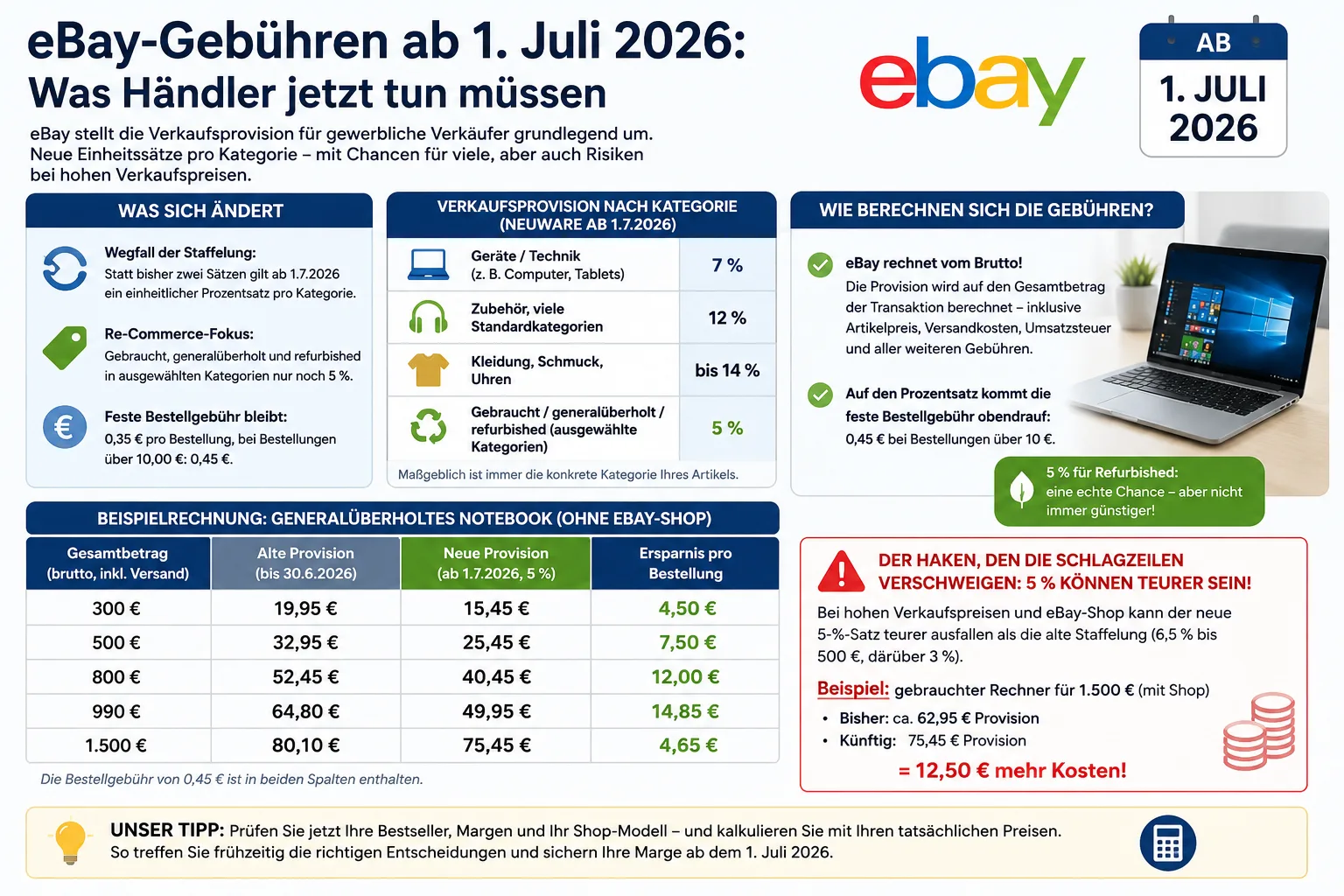
What changes on 1 July 2026
Until now eBay charged the selling fee on a tiered basis in many categories. In the “Computers, Tablets & Networking” category, for example, 6.5% applied up to a sale price of €990 (without an eBay Shop) and 3% on the portion above that. From 1 July 2026 eBay replaces this tiering with a flat rate. Depending on the category, this will be between 7% and 14% for new goods.
At the same time eBay is introducing a reduced rate for used, refurbished and reconditioned items: in selected categories the variable fee for these items drops to a flat 5%. eBay promotes this as strengthening the re-commerce business. For sellers who mainly sell used goods or refurbished devices, this is a real relief in the mid-price segment – with one important exception at high sale prices, more on that below.
The fixed order fee remains: €0.35 per order, and €0.45 per order for orders over €10.00.
Selling fee by category (examples, new goods from 1 July 2026)
| Category (example) | New flat rate |
|---|---|
| Devices / tech (e.g. computers, tablets) | 7% |
| Accessories, many standard categories | 12% |
| Clothing, jewellery, watches | up to 14% |
| Used / refurbished / reconditioned (selected categories) | 5% |
The specific category of your item always governs. You will find the full overview in the eBay seller portal (source below). For sellers with a low service standard, eBay can add a surcharge on top of the fee – keeping your metrics clean avoids these extra costs.
eBay is also changing its terms of service on 15 September 2026, among other things for shipping and for the termination of seller accounts: New eBay terms of service from 15 September 2026.
eBay final value fee 2026 at a glance: percentages, order fee, private sellers
If you only want the numbers: from 1 July 2026 the eBay final value fee (eBay Germany calls it the Verkaufsprovision) for commercial sellers is a flat percentage per category on the gross total, plus a fixed order fee. The tiers are gone. Here is the breakdown:
| Fee component (eBay.de, from 1 July 2026) | Commercial sellers | Private sellers |
|---|---|---|
| Final value fee, new goods | 7 % to 14 % depending on category: 7 % tech, 12 % many standard categories, up to 14 % clothing, jewellery and watches | 0 % – private sellers on eBay.de have sold without a final value fee since March 2023 |
| Final value fee, used, refurbished and reconditioned items | flat 5 % in selected categories | 0 % |
| Basis of calculation | gross amount the buyer pays: item price + shipping + VAT | – |
| Fixed order fee | €0.35 per order, €0.45 for orders over €10 | none |
| Surcharge for below-standard service metrics | possible on top of the final value fee | – |
| Optional extras (listing upgrades, promoted listings) | charged separately, unchanged by the reform | charged separately |
Two notes on the search terms that bring most readers here. First, the percentages above apply to eBay Germany; eBay UK and eBay.com publish their own fee tables – the flat-rate logic is the same, the rates differ. Second, "final value fee" and "selling fee" mean the same thing on eBay: the percentage charged when an item sells.
How exactly are the fees calculated?
This is where a close look pays off, because many sellers calculate it wrong. Two points are decisive.
First: eBay calculates on the gross amount, not the net. The selling fee is charged on the “total amount of the transaction” – that is, the full amount the buyer pays. This includes the item price, any handling fees, the shipping cost of the service chosen by the buyer, VAT and any other applicable charges. So the fee also applies to shipping and to the VAT included. (The eBay fees themselves are shown to you excluding VAT.)
Second: the fixed order fee is added on top of the percentage – €0.45 for orders over €10.
Example calculation: a refurbished notebook
Take a refurbished business notebook, sold without an eBay Shop. Until now it fell under the tech-category tier (6.5% up to €990, 3% above), and from 1 July 2026 the re-commerce rate of 5% applies. The “total amount” in the table is in each case the full amount, including shipping and VAT, that the buyer pays. The order fee of €0.45 is included in both columns.
| Total amount (gross, incl. shipping) | Old fee (until 30 June 2026) | New fee (from 1 July 2026, 5%) | Saving per order |
|---|---|---|---|
| €300 | €19.95 | €15.45 | €4.50 |
| €500 | €32.95 | €25.45 | €7.50 |
| €800 | €52.45 | €40.45 | €12.00 |
| €990 | €64.80 | €49.95 | €14.85 |
| €1,500 | €80.10 | €75.45 | €4.65 |
Here is how to read the €800 row: Old = 6.5% of €800 (€52.00) + €0.45 = €52.45. New = 5% of €800 (€40.00) + €0.45 = €40.45. You save €12.00 per notebook sold. At 50 devices a month that is €600 less in fees – money that stays directly in your margin.
Important exception at high prices and with an eBay Shop: Anyone using a paid eBay Shop had a lower tier threshold (6.5% only up to €500, 3% above). For expensive refurbished items the new 5% rate on the full sale price can therefore work out more expensive than the old tier. Example: a used computer for €1,500 (with a Shop) previously cost around €62.95 in fees, in future it is €75.45 – €12.50 more. So calculate your own best-sellers with your actual prices and your Shop model, rather than relying on the blanket statement “5% is always cheaper”.
The catch the headlines leave out: 5% can be more expensive
In the public coverage you read almost only the good news: “Refurbished gets cheaper, up to 60% less fee.” What gets lost is the flip side – and that is exactly what can cost you margin if you don’t know about it.
The reason lies in the system change itself. The old tiering was extremely favourable for high-priced items: only 3% applied to every euro above the threshold. The new flat rate of 5%, by contrast, applies to the full sale price – from the first euro to the last. The more expensive the item and the lower your old tier threshold, the sooner the supposed saving turns into its opposite.
Two groups are particularly affected. First, sellers with a paid eBay Shop whose tier threshold was €500: here refurbished items above roughly €900 to €1,000 quickly become more expensive than before. Second, all new-goods sellers in the tech category: from July they pay a flat 7% instead of the old 6.5% up to the threshold and only 3% above it. A new notebook for €1,200 will therefore cost noticeably more in fees than today – an effect that hits the contribution margin directly on high-priced electronics.
The practical consequence: don’t rely on the blanket message. Anyone selling high-priced items or a lot of new goods should run their own price list against the new rates before 1 July – otherwise you discover the extra cost only on your next monthly invoice.
What you should do now
Three steps that pay off before 1 July:
- Check your own categories and best-sellers. For your highest-revenue items, note the old and the new rate and calculate the difference – with shipping and VAT in the total amount, plus the order fee.
- Maintain item condition correctly. The 5% rate only applies to items correctly marked as used, refurbished or reconditioned in the affected categories. Check that your listings state the condition cleanly.
- Recalculate prices and shipping. Where you will pay more in future, now is the moment to adjust sale prices or shipping costs. How to communicate price changes to customers confidently is covered in our guide Raising prices 2026.
For a broader overview of all the changes in eBay selling, see our article eBay selling 2026: the key changes for commercial sellers. Alongside the fee, eBay is also changing the payout rules – worth a look at eBay payment terms from July 2026. And if you want to compare how things work at other marketplaces, you will find the comparison under Amazon fees 2026.
PepperTools Cloud Office – eBay import
Changed fees also mean changed figures in your bookkeeping. The more cleanly your sales and payouts are recorded, the more easily you keep an eye on your real margin – and that is exactly what the eBay import in PepperTools Cloud Office is for.
Via our eBay connector you read your eBay orders directly into PepperTools Cloud Office and process them into legally valid invoices, which you can then send to your customers. So you no longer have to type orders in by hand: an imported sale becomes a full document in a few clicks.
Orders from the same customer can be combined on import if you wish – instead of several individual invoices you create one joint invoice per customer. That saves effort and makes for a tidier document archive.
Every invoice created is archived on S3 object storage and stored there immutably. That keeps your document records auditably traceable without you having to worry about archiving. You can find more about the eBay import and the other features at www.office1.cloud.
Frequently asked questions (FAQ)
Does eBay calculate the fee on the net or the gross amount? On the gross. eBay charges the selling fee on the total amount of the transaction – that is, the full amount the buyer pays, including shipping costs and VAT.
Does the 5% rate apply to all used items? No. The reduced rate of 5% applies to used, refurbished and reconditioned items in selected categories. The correct category and the correctly stated item condition are decisive.
Does the order fee remain? Yes. On top of the percentage there is €0.35 per order, and €0.45 for orders over €10.00.
Is refurbished selling now always cheaper? In the low and mid-price segment, as a rule yes. At high sale prices – especially with a paid eBay Shop and a low old tier threshold – the new 5% rate can be more expensive than the previous tier. Calculate your specific items.
When do the new rates apply? From 1 July 2026 for listings in the affected categories.
Conclusion
The eBay fee reform of 1 July 2026 makes the fee simpler, but not automatically cheaper. Refurbished and used-goods sellers benefit clearly from the 5% rate in the mid-price segment; for new goods and high-priced items, on the other hand, it can get more expensive. What matters is that you calculate from the right amount – namely the gross total including shipping and VAT plus the order fee. Anyone who runs their best-sellers through cleanly now and adjusts prices where necessary can face the reform with composure. The next deadline is already set: from 28 September, vehicle parts require free returns for 30 days.
Sources
- eBay seller portal – fee changes (June 2026)
- eBay Help – fees for commercial sellers
- Handlerbund / OHN – eBay changes fees: what gets more expensive and what cheaper
As of June 2026. Information without guarantee; the eBay fee pages in force at any given time and the category specifically applicable to your items are decisive.
Handle invoices more easily
Easy Invoice combines quotes, invoices and customer management in the cloud.
Try Easy InvoiceRead next
 E-Commerce & Marketplaces
New eBay Terms of Service from 15 September 2026: What Sellers Should Check Now
New eBay terms apply from 15 September. Four things change, and one of them can cost you your account.
 E-Commerce & Marketplaces
Creating invoices for Shopify
Shopify sends order confirmations – not invoices. How to get from a Shopify order to a finished invoice in five steps, with your own number, correct tax details and automatic sending.
 E-Commerce & Marketplaces
eBay vehicle parts: free returns mandatory since 28 September – what it costs you
New parts over 10 euros at a fixed price: since 28 September you have to take them back free of charge for 30 days and adjust your withdrawal policy. Which returns are not covered, what the rule costs and what to check now.