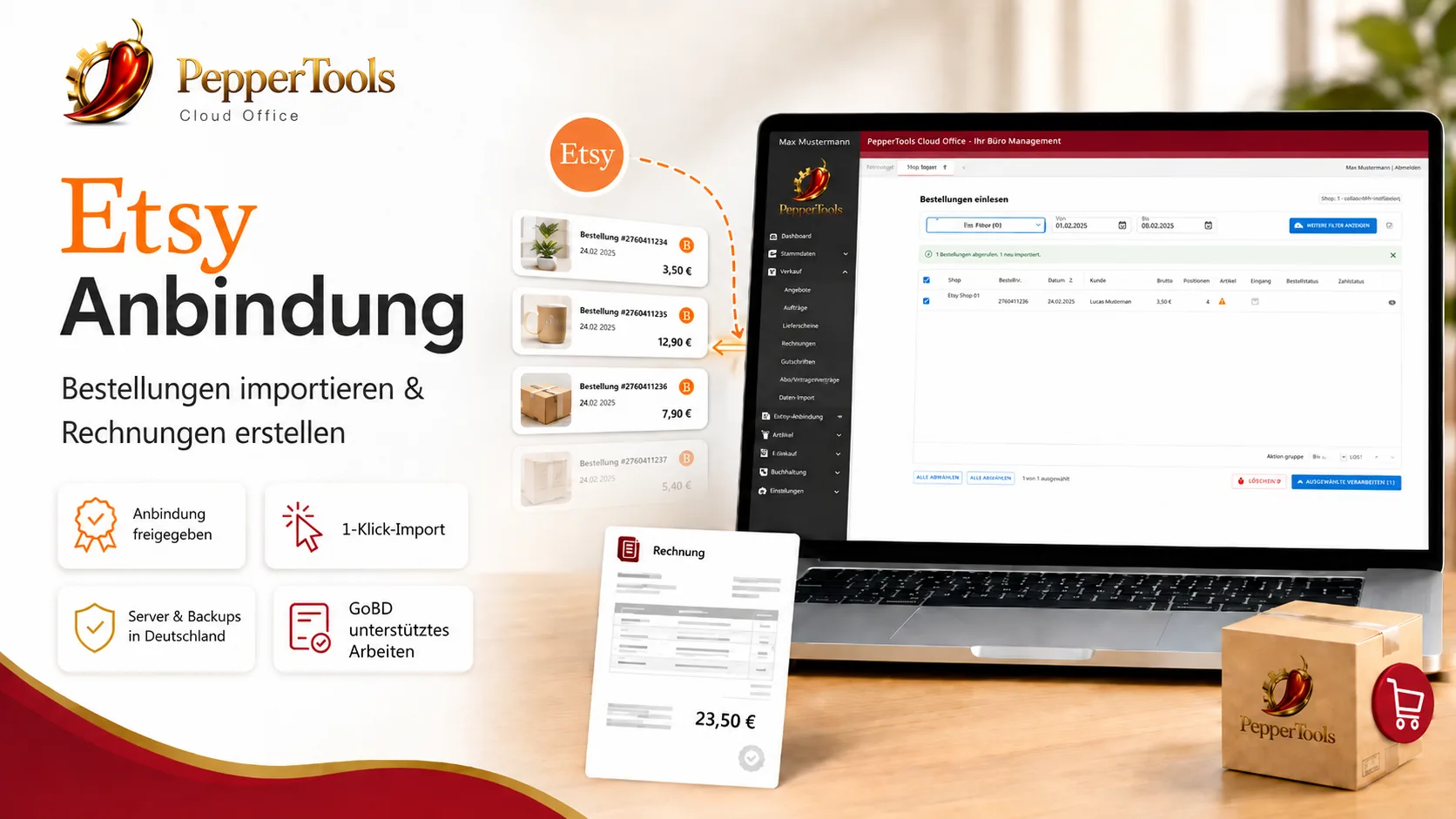
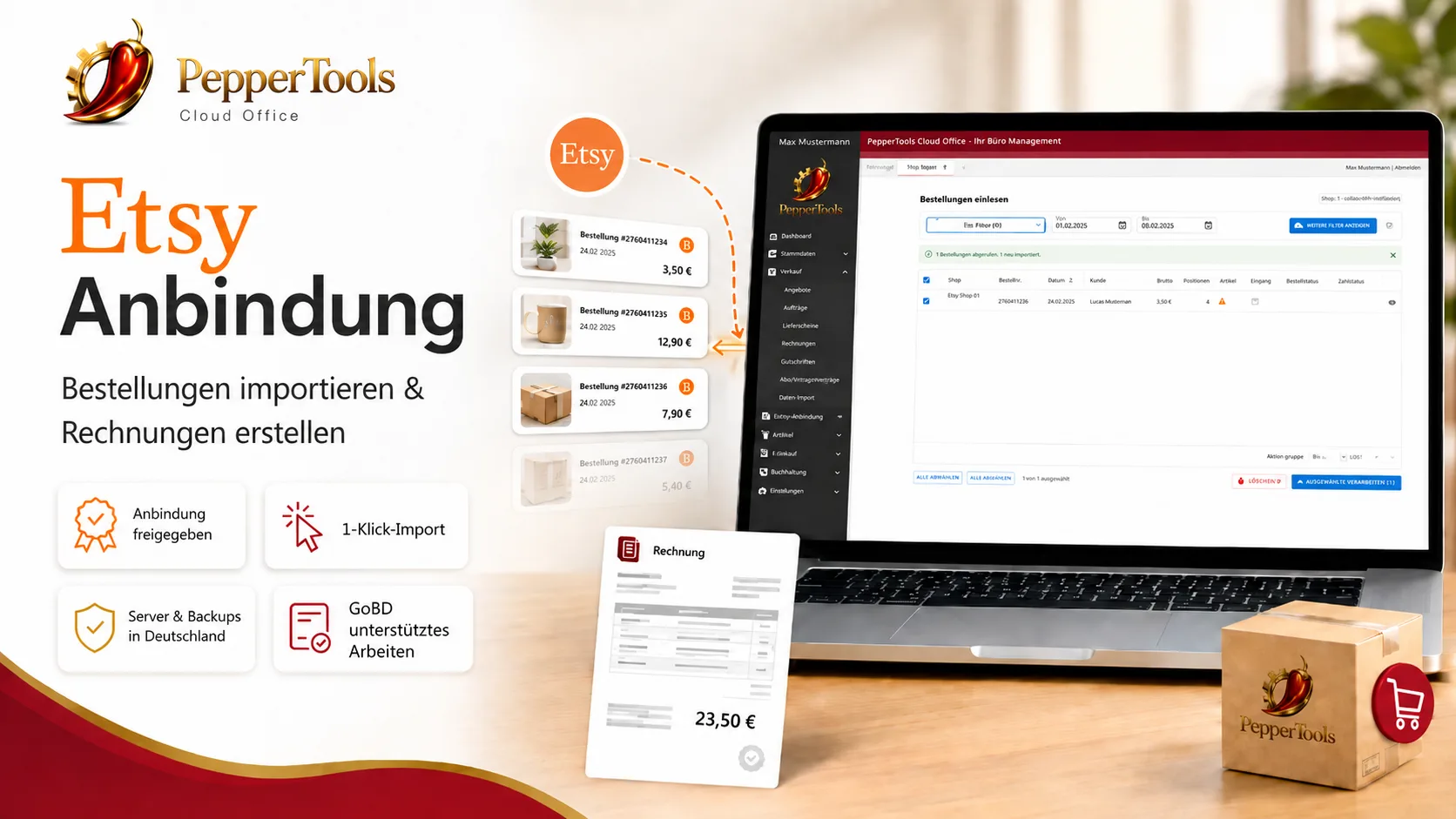
Etsy integration – import your orders and create invoices
Anyone who sells on Etsy knows the month-end routine: you download the CSV export, and inside it sales, platform fees, refunds and payouts are all jumbled together. To turn that into proper invoices, you sort by hand, copy amounts, double-check – and get annoyed. That's exactly where this article comes in. And it has an occasion: Our API integration with Etsy is now available to all our customers. What that means for you, in a moment.
Why the Etsy CSV isn't bookkeeping
Etsy's export file is meant as an overview, not as a source of accounting documents. Income and fees are mixed, there's no sequential invoice numbering, and you have to assemble each order into an invoice yourself. For occasional sales that's fine. But as soon as orders come in regularly, it becomes recurring busywork – and every manual step in between is a potential source of error towards the tax office.
That's why many sellers look for an integration that pulls orders in directly instead of digging them out of a CSV.
The same applies to Shopify: the shop confirms the order, the invoice comes from your invoicing software. The Shopify version of this workflow, including one number range across channels, is in Creating invoices for Shopify.
What the integration via the official Etsy API means for you
Our integration uses the official Etsy API – the interface provided by Etsy through which applications can access order data with the seller's explicit permission. You authorise this access yourself via your Etsy login and can revoke it at any time. So it's not unofficial scraping, but the route Etsy intends for such applications.
This fits our own standard on data protection: our servers and backups are located in Germany. Your order and invoice data therefore stays in the country and is processed under German data protection law.
For you as a seller, this difference isn't just a formality:
- Official interface instead of a workaround. The integration accesses your orders via the official Etsy API – not via unofficial scraping that Etsy can block at any time.
- More stable in operation. Official interfaces change with notice, not overnight. That lowers the risk of the import suddenly stopping tomorrow.
- Clearly defined data access. You authorise the connection yourself via the Etsy login and see which permissions you grant.
In short: the official API integration isn't a marketing sticker – it's the precondition for it to work permanently and legitimately.
How the import works in practice
The actual process is undramatic afterwards – and that's exactly how it should be:
- Connect once. In the company settings you select the Etsy connector, log in to Etsy and allow your orders to be retrieved. No Etsy login credentials are stored in the software.
- Fetch orders. One click on “Retrieve orders" pulls the new Etsy orders into the platform. No export, no sorting.
- Create a document. From an order, one more click creates the matching document – order confirmation, invoice or delivery note. In the shop settings you decide what should be created automatically; follow-up documents (such as the delivery note for an invoice) are one click.
So you decide per shop how much runs automatically and where you keep control yourself.
What Etsy sellers should watch for tax-wise
Two points keep coming up with Etsy – regardless of the software:
Reverse charge on Etsy fees. Etsy invoices its fees from within the EU. As a result you owe the VAT on those fees yourself and report it in your VAT return. This concerns the fee side, not your sales invoice.
Small business scheme. Anyone selling without VAT under § 19 of the German VAT Act issues documents without stated VAT and with the appropriate note. Whether the scheme is worthwhile for you at all is covered in our article Small-business scheme – yes or no?. And for product details and sales via platforms, our overview of GPSR on Etsy and eBay helps.
Clean documents, without bookkeeping knowledge
The invoices created run through a sequential number range and are archived unchangeably; processes remain traceable and logged. This supports you in meeting the requirements of the GoBD (German principles for proper bookkeeping) – final compliance always also depends on your own processes. More about the platform in the article on the invoicing software 2026.
Who benefits from switching
The more small orders come in, the clearer the effect. Anyone with dozens of Etsy sales per month saves all the sorting and typing. In a side business, where bookkeeping tends to pile up, the click workflow ensures documents don't accumulate in the first place. And those who grow have a clean document trail from the start instead of later rework.
If you'd like to try it: the Etsy integration in the PepperTools Office Cloud is available now.
Note: This article does not constitute tax or legal advice. For your individual case – especially regarding reverse charge, foreign sales or the small-business scheme – talk to your tax adviser. As of 25 June 2026.
Sources
Handle invoices more easily
Easy Invoice combines quotes, invoices and customer management in the cloud.
Try Easy InvoiceRead next
 E-Commerce & Marketplaces
New eBay Terms of Service from 15 September 2026: What Sellers Should Check Now
New eBay terms apply from 15 September. Four things change, and one of them can cost you your account.
 E-Commerce & Marketplaces
Creating invoices for Shopify
Shopify sends order confirmations – not invoices. How to get from a Shopify order to a finished invoice in five steps, with your own number, correct tax details and automatic sending.
 E-Commerce & Marketplaces
eBay vehicle parts: free returns mandatory since 28 September – what it costs you
New parts over 10 euros at a fixed price: since 28 September you have to take them back free of charge for 30 days and adjust your withdrawal policy. Which returns are not covered, what the rule costs and what to check now.