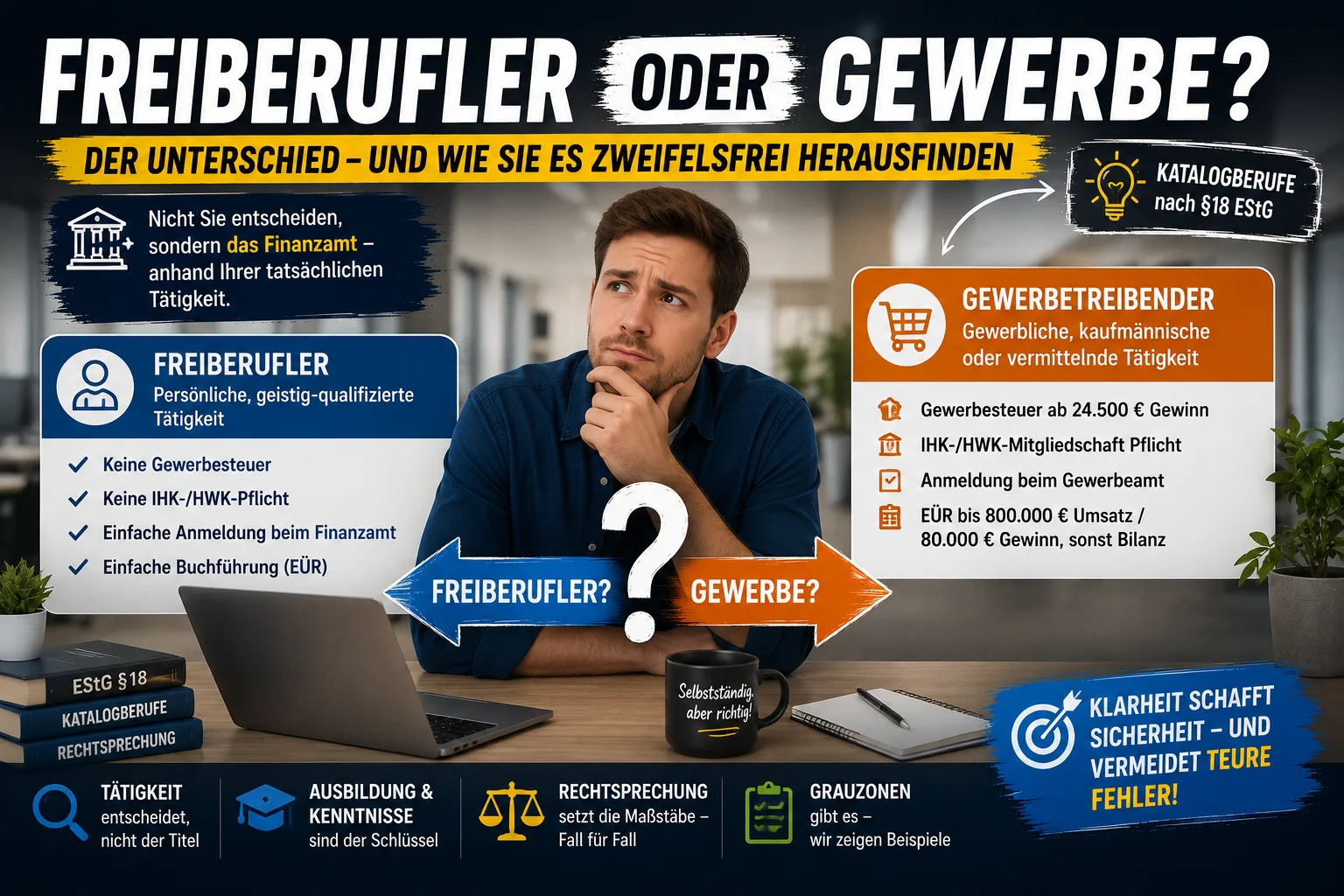
On the tax registration questionnaire (Fragebogen zur steuerlichen Erfassung) there's a question about your activity, and you hesitate for a second while filling it in. That's normal – here's the uncomfortable truth: you don't get to choose whether you're a freelancer (Freiberufler) or a trader (Gewerbetreibender) in Germany. It follows from what you actually do, not from what you'd like it to be or how you label yourself.
Am I a freelancer or a trader?
Nobody questions doctors, lawyers or architects – they're listed word for word in the law (§18 of the Income Tax Act, EStG) as so-called "Katalogberufe" (listed liberal professions). It gets difficult for everyone else, because a second group in the same section leaves room for interpretation: "similar professions" (ähnliche Berufe). That covers activities comparable to a listed profession in training and way of working. The underlying yardstick, roughly summarised: a personal, intellectually qualified service based on solid training – not selling goods, not pure brokering, not a commercial or trade activity.
That's the theory. For most people reading this, though, that isn't actually the question that matters – their profession simply doesn't appear in the law at all.
Receipts, bank transactions and the export for your accountant are bundled in the Easy Invoice accounting software in one place.
The case that affects most people: your profession isn't in the law
IT consultants, programmers, consultants, graphic designers, coaches, online marketing specialists – none of these professions has a direct entry in the list. They have to be assessed via the "similar profession" route, and that's exactly where a hurdle lies that many underestimate: it's not enough for the work to be demanding. You need provable training comparable to the reference profession, or at least knowledge of comparable depth and breadth.
An example that makes this tangible: Markus studied computer science and has spent eight years as a self-employed software architect designing systems for mid-sized companies – he decides on the technical setup, documents systems, and makes fundamental decisions on his own responsibility. Compared against the engineer profession, he's a freelancer in almost all cases. Jasmin, on the other hand, is a career changer who taught herself web development through online courses and builds WordPress sites from ready-made building blocks to exact client specifications. Both would say "I do something with IT" – yet the tax office sees two completely different cases. Jasmin lacks proof of training, and the conceptual, self-responsible depth that case law demands for "similar profession" is hard to demonstrate in pure implementation-to-spec work.
It's much the same for coaches, consultants and content creators: what matters isn't the job title, but whether a solid professional qualification and self-responsible, conceptual advisory work can be identified – or whether it mostly comes down to selling, brokering, or working from a template.
What the status actually means
| Freelancer | Trader | |
|---|---|---|
| Registration | Informal, with the tax office (Finanzamt) | Trade office (Gewerbeamt), form GewA1, approx. €20–60 |
| Trade tax (Gewerbesteuer) | None at all | From €24,500 profit per year |
| Chamber membership (IHK/HWK) | No | Compulsory, with a fee |
| Bookkeeping | Always simple income-surplus statement (EÜR) | EÜR up to €800,000 turnover or €80,000 profit, then full balance-sheet accounting |
Where do you actually end up with more money?
That's the question behind the whole classification – and the answer surprises most people: for a typical solo founder, the real financial difference is often smaller than the table suggests.
The reason is that trade tax is credited against income tax under §35 EStG. You may credit up to four times the trade tax base amount. That leads to a simple rule of thumb: if your municipality's assessment rate (Hebesatz) is 400% or less, trade tax is fully offset on paper for sole proprietors and partnerships – regardless of how high your profit is. A large share of German municipalities fall into this range.
Worked example at €50,000 profit:
- Subtract the allowance: €50,000 − €24,500 = €25,500 trade income
- Calculate the tax base amount: €25,500 × 3.5% = €893
- Trade tax at a 400% assessment rate (typical for many cities): €893 × 4 = €3,572
- Credit under §35 EStG: capped at four times the base amount, so also €3,572 → extra cost: €0
- Same calculation at a 490% assessment rate (Munich): trade tax = €893 × 4.9 = €4,376, credit stays capped at €3,572 → extra cost: roughly €803
At an average assessment rate, trader status simply costs you nothing at this profit level. Only in municipalities with a high rate does it become a real number – and it grows with profit:
| Profit | Extra cost at rate ≤ 400% | Extra cost at rate 490% (e.g. Munich) |
|---|---|---|
| €30,000 | €0 | approx. €173 |
| €50,000 | €0 | approx. €803 |
| €80,000 | €0 | approx. €1,748 |
| €100,000 | €0 | approx. €2,378 |
So the point where it "starts to matter" isn't a fixed profit threshold – it depends first on your city's assessment rate. If you're in one of the many municipalities with a rate up to 400%, trade tax plays practically no role in your decision. Only a high rate combined with a profit above roughly €50,000–80,000 turns the difference into something you actually feel.
_This example shows the principle but is simplified: it rounds legally required intermediate steps (such as rounding trade income down to the nearest €100) and assumes a sole proprietorship with no further special circumstances. You can find your municipality's assessment rate at your local city or town administration; for a binding figure, ask your tax advisor or the tax office._
The second cost factor is the chamber fee (IHK-Beitrag). It's more modest than many fear: if your profit is below €5,200 a year, you're exempt entirely. Up to €25,000 profit, most chambers charge a base fee of €40 to €60 a year, rising in steps above that.
And the third assumed difference – bookkeeping – barely exists for most people: both freelancers and traders use the simple income-surplus statement (EÜR). The obligation for full double-entry bookkeeping with a balance sheet only kicks in for traders above €800,000 turnover or €80,000 profit – figures most new businesses don't reach in their first years.
Bottom line: a solo self-employed person starting out with a low-to-mid five-figure profit in an average city typically pays only the small chamber fee more as a trader than as a freelancer – not a four-figure amount. The financial difference only becomes noticeable at high profit combined with a high assessment rate. The real everyday difference is usually less about money and more about the bureaucratic framework: the trade office, chamber membership, one more point of contact. That doesn't change the fact that you can't choose the classification yourself – but it puts into perspective how much is actually at stake in a borderline case.
I do both – does everything become a trade now?
Many self-employed people run several activities in parallel, for instance consulting plus selling templates or licences. Two paths diverge clearly here:
As a sole proprietor, this is unproblematic as long as you record both areas cleanly and separately – separate invoice series, separate bookkeeping. The trading part remains liable for trade tax, the freelance part doesn't. The two don't automatically merge.
It's different in a partnership such as a GbR: if the trading side income exceeds certain de-minimis thresholds, established case law from the Federal Fiscal Court (BFH) treats the partnership's entire activity as retroactively commercial – including the part that was actually freelance. This so-called "infection theory" (Abfärbetheorie) specifically targets partnerships, not solo self-employed people. If you work with others in a GbR and also take on trading activity on the side, either strictly separate that part or move it into its own company.
Is that the same as the small-business scheme?
No, and this mix-up regularly causes confusion. "Freelancer or trader" describes what you do. The small-business scheme (Kleinunternehmerregelung) only concerns VAT and depends on how much you earn. The two run independently side by side – you can be a freelancer and a small business at the same time, or a trader and a small business, or a freelancer with full VAT liability.
How to get certainty beforehand
Because a wrong assessment, in the worst case, only surfaces years later during a tax audit – with back payments and late-filing surcharges – two steps before registering are worth it:
Word your description of your activity in the questionnaire as concretely as possible. Not "IT services", but exactly what you conceive, decide, or take responsibility for on your own. That's often precisely what the tax office bases its classification on.
And for genuine borderline cases: request a binding ruling under §89 of the Fiscal Code (Abgabenordnung) from your local tax office, or get advice in advance from a tax advisor or your chamber of commerce. It costs some time before you start, but can spare you an expensive surprise years later.
Once the classification is settled and it turns out to be a trade, you'll find the necessary steps in our guide to registering a trade in Germany. This article is not a substitute for tax advice – for borderline cases, a quick call to the tax office or a tax advisor beforehand is always worthwhile. An accounting software keeps receipts, revenue and reports in one place.
Handle invoices more easily
Easy Invoice combines quotes, invoices and customer management in the cloud.
Try Easy InvoiceRead next
 Taxes & Law
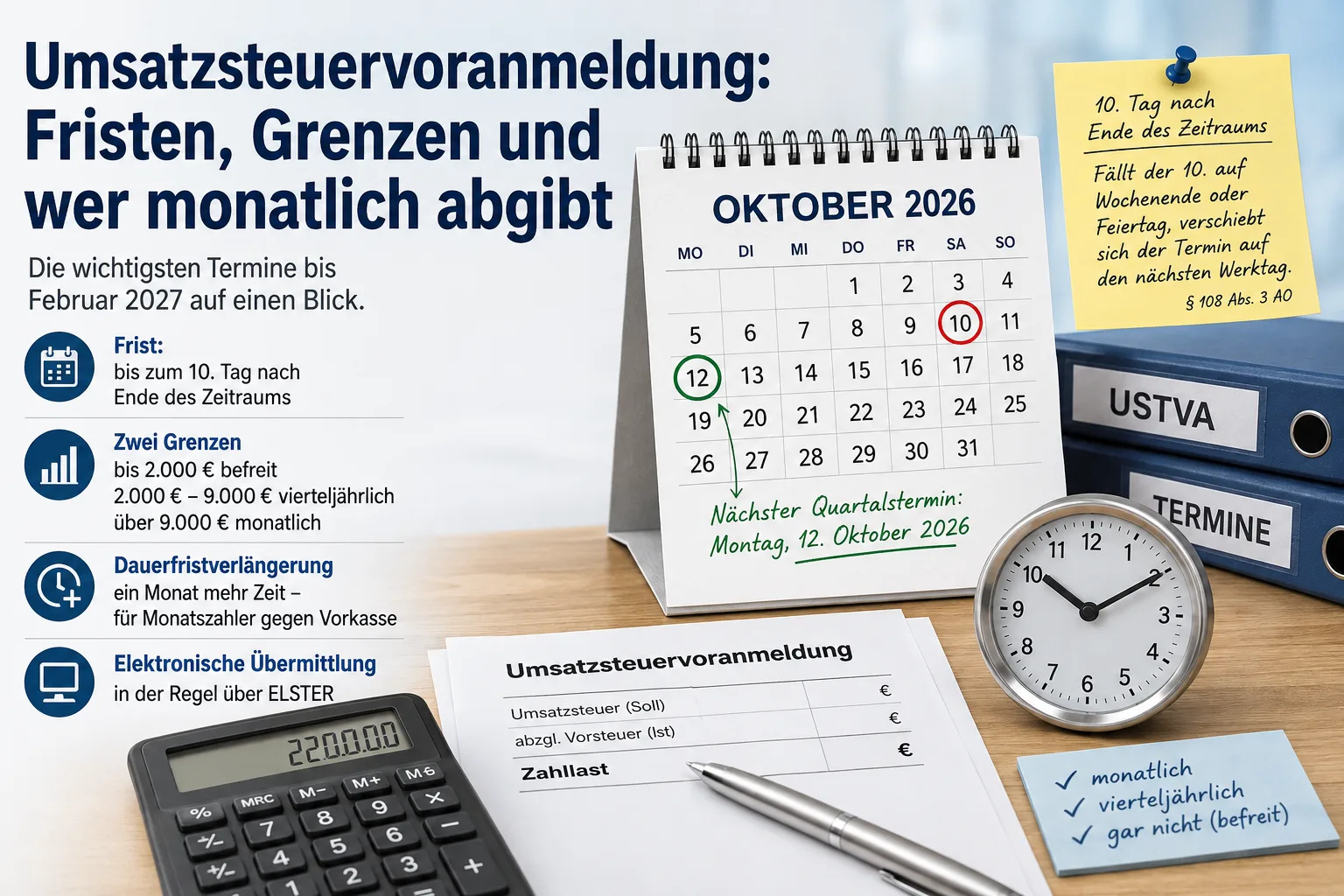
Advance VAT return in Germany: deadlines, thresholds, monthly or quarterly
If you run a business in Germany, you file an advance VAT return by the 10th day after each period. This article shows which cycle applies to you, when your next date falls and how to buy yourself an extra month.
 Taxes & Law
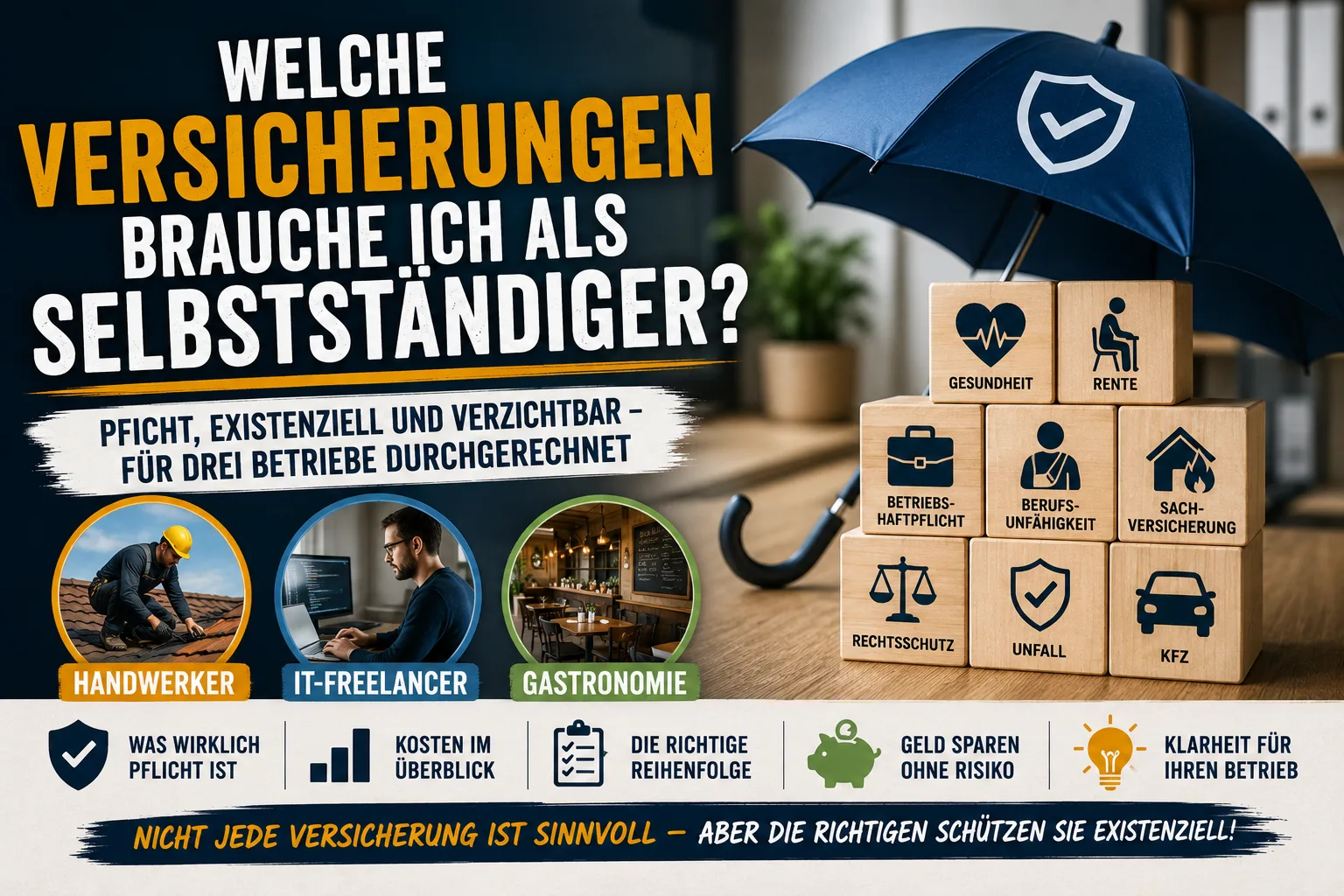
Which insurance do I need as a self-employed person in Germany? Mandatory, essential and skippable – costed out for three businesses
Health insurance is compulsory, pension insurance only for certain trades, and every business must register with its employers' liability association. Everything else is your call. What a roofer, a programmer and a café owner really need – and the order to buy in when money is tight.
 Taxes & Law
Bogus self-employment in Germany: when it applies – and why the back payment does not hit you
The fear of a huge back payment almost always targets the wrong person: your client owes the social security contributions, not you. What is really examined, what you actually risk – and how to get clarity without stirring things up.