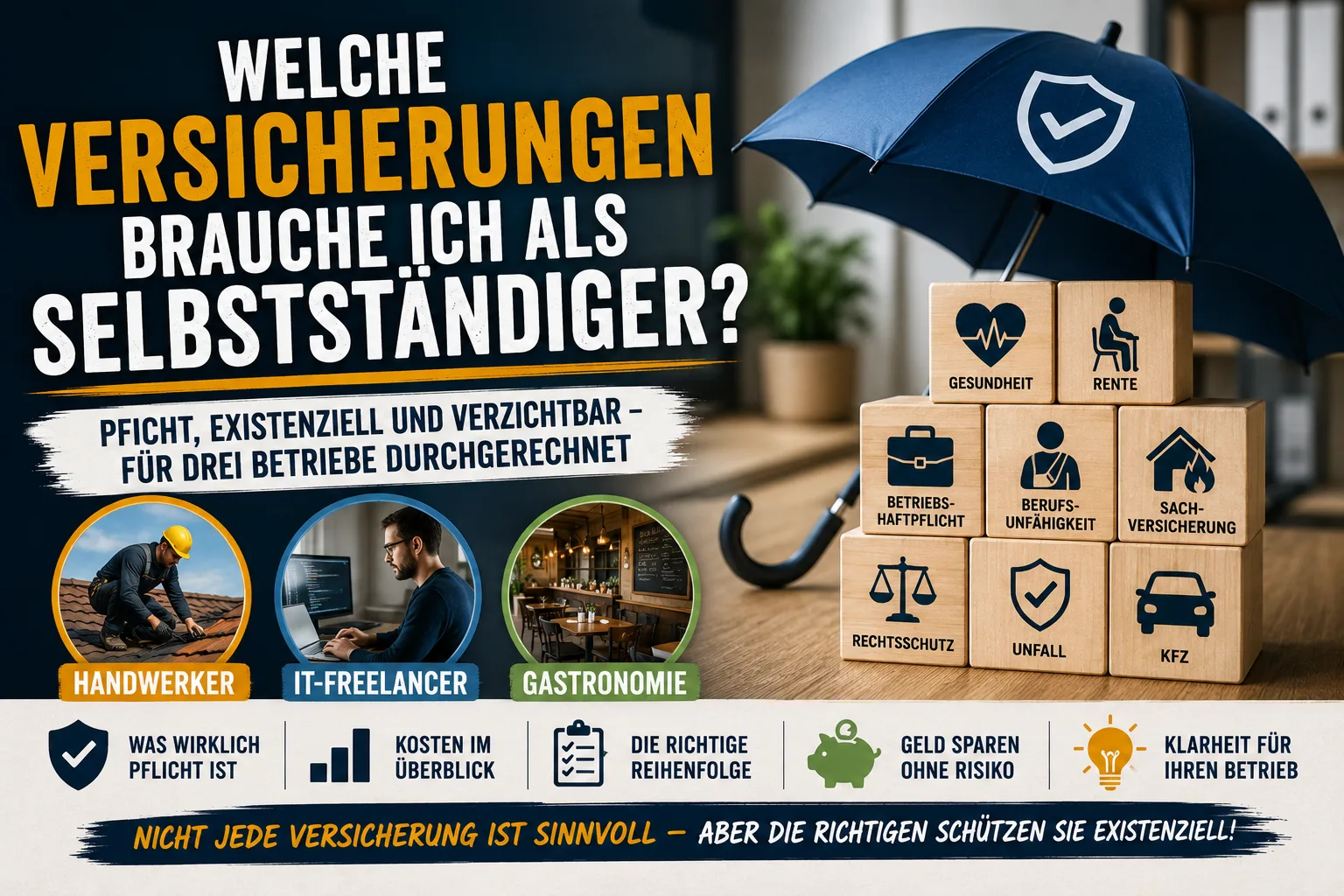
Surprisingly little is required by law: health insurance, registering your business with the employers' liability insurance association (Berufsgenossenschaft), and – depending on your trade – statutory pension insurance. Everything else is voluntary. Even so, there is one voluntary policy you should not skip when money is tight: public liability insurance for your business. It costs between 80 and 1,000 euros a year depending on the sector, and it is the only one where a single claim can reach your private assets. What you need beyond that depends less on your legal form than on two questions: what happens if you cannot work for three months – and who pays if something breaks or someone gets hurt while you work?
Contents
- What is genuinely mandatory – four points
- The misunderstanding about the Berufsgenossenschaft
- Each policy explained: what it pays and what it does not
- Three businesses, three completely different answers
- When money is tight: the running order
- What gets sold often and rarely delivers
- Frequently asked questions
- Sources
What is genuinely mandatory – four points
1. Health insurance – for everyone. Under section 193(3) of the German Insurance Contract Act (VVG), every person resident in Germany must hold health insurance, statutory or private. As a full-time self-employed person you pay the entire contribution yourself. The statutory scheme assumes an income of at least 1,318.33 euros a month even if you earn less, which produces a 2026 minimum contribution of roughly 278 euros a month for health and long-term care insurance. At the top end, the contribution assessment ceiling of 5,812.50 euros applies. That minimum contribution uses the reduced rate – it includes no sick pay. What that means when you fall ill is explained further down. The details are in our article on the statutory health insurance contribution 2026.
2. Pension insurance – only for certain occupations. Section 2 of Book VI of the Social Code (SGB VI) lists nine groups, and the list is exhaustive. The ones that matter for our readers:
- Craftspeople entered in the register of skilled trades (number 8). These are the trades that require a master craftsman's certificate – roofers, electricians, plumbers, hairdressers and around 50 others. If you were allowed to start without a master's qualification, you are usually not on the list
- Self-employed people with no employees subject to social insurance who work permanently and essentially for a single client (number 9) – the classic case among IT freelancers
- Teachers, educators and care workers without employees subject to social insurance (numbers 1 and 2)
- Artists and publicists via the artists' social insurance fund (number 5)
- Midwives (number 3) and home-based traders (number 6)
Anyone outside these groups – a retailer, a restaurateur, a consultant with several clients – is not subject to pension insurance. Anyone inside pays the 2026 standard contribution of 735.63 euros a month. In the first three calendar years after starting up you may pay half of it, 367.82 euros, without any reduction in your benefits. Craftspeople can apply for exemption under section 6(1) sentence 1 number 4 SGB VI once 18 years of mandatory contributions have been paid.
3. Registering with the Berufsgenossenschaft – for every business. The Berufsgenossenschaft is the statutory accident insurance scheme for businesses. It pays when someone is injured or falls ill through work. Every commercial business belongs to one and must register within one week of starting up. That applies even with no employees at all. What this means in practice is covered in the next section – it is the point most people get wrong.
4. Motor liability insurance if a vehicle is registered to the business. This follows from section 1 of the Compulsory Insurance Act and is the least disputed item on the list.
What about professional indemnity insurance? It is only mandatory in professions with a chamber or a special licence: lawyers, tax advisors, doctors, architects, insurance and property brokers, and the security industry. If you belong to no chamber and need no licence under the Trade Regulation Act, this obligation does not apply to you. That does not mean you need no liability cover – only that nobody demands it of you.
If you want to send payment reminders and dunning letters straight from the open invoice, the dunning feature in Easy Invoice does that, including bank import matching.
The misunderstanding about the Berufsgenossenschaft
Almost everyone confuses two things here, and the difference costs everything when it matters.
Your business must be a member. That does not insure you personally.
Compulsory membership protects your employees. As the owner you are not automatically covered in most associations – you have to insure yourself voluntarily on top. BG BAU, the association for the construction industry, says so on its own start-up page and expressly recommends that builders take out the voluntary cover.
Two figures that make this concrete:
- With no employees, BG BAU charges no contribution at all. Registration is still mandatory. As soon as you employ someone, a minimum contribution of 100 euros a year applies.
- The voluntary owner's cover at BGN, the association for food and hospitality, costs between 378.50 euros a year at the minimum sum insured of 37,968 euros and 946.26 euros at the maximum of 94,920 euros (as at April 2026). In return it pays injury benefit of 84.37 to 210.93 euros a day.
A tradesperson who falls off a ladder without this voluntary cover receives nothing from the association. His employees would receive everything.
Each policy explained: what it pays and what it does not
Before the numbers, the vocabulary. Two lines each.
First of all: there is no such product as "business insurance". It is an umbrella term for everything commercial. If somebody offers you "business insurance", ask which individual modules it contains – and have each one explained separately.
Public liability insurance for the business
Pays when you injure a person or damage someone else's property while working. Your ladder falls into a shop window, a client trips over your cable, you drill into the neighbour's water pipe.
Does not pay for your own work. This is the point almost everyone misunderstands: if you lay the tiles crooked, you redo them at your own expense. That is a warranty matter, not an insurance claim. Also excluded: your own belongings and pure financial losses where nothing is physically damaged.
Professional indemnity insurance (cover for financial loss)
Pays exactly what the public liability policy leaves out: financial loss without physical damage. Your coding error takes the client's shop offline over a weekend, your poor advice costs them a contract.
Does not pay for broken objects, nor for anything you do deliberately. If you advise, plan or program, you need this policy instead of public liability cover, not as decoration alongside it.
Statutory accident insurance (Berufsgenossenschaft)
Pays treatment, rehabilitation and pensions after accidents at work, accidents on the way to work and occupational illnesses – for your employees, with no upper limit and with no need to prove fault.
Does not pay for you personally unless you insure yourself voluntarily. And nothing that happens in your free time.
Private accident insurance
Pays a lump sum or a pension if something permanent remains after an accident – around the clock, including while skiing.
Does not pay for illness. Anyone unable to work because of a slipped disc, a heart condition or depression gets nothing here. That is roughly four out of five cases. Private accident cover is therefore a substitute for occupational disability cover, but a weak one.
Occupational disability insurance
Pays a monthly pension if you can no longer carry out your occupation, usually to an extent of 50 percent – regardless of whether an accident or an illness caused it.
Does not pay if you concealed pre-existing conditions when you signed up. The health questions decide the fate of the whole contract; anyone who fudges them pays for years and gets nothing.
Health insurance and sick pay
Health insurance pays for your treatment. It does not replace your income. Important for the self-employed in the statutory scheme: you only receive sick pay if you explicitly opt in and pay the standard rather than the reduced contribution rate – 0.6 percentage points more. It then starts on day 43 of your incapacity, that is, after six weeks.
The minimum contribution of around 278 euros is the reduced rate. Anyone paying only that receives no sick pay when ill. The first six weeks are never covered anyway – for that there are optional tariffs from your health fund or a private daily sickness benefit policy.
Contents insurance
Pays for fittings, equipment and stock after fire, water damage, burglary, storm and hail – at replacement value, provided you set the sum insured correctly.
Does not pay for wear and tear, operating errors, and in the basic version not for flooding either. Natural hazards are a separate module that costs extra.
Business interruption insurance
Pays your fixed costs and lost profit for as long as the business stands still after an insured physical loss. After a kitchen fire, that means rent, wages and loan instalments.
Does not pay when order books are empty, nor when you personally are ill. Something must have been physically damaged first.
Legal expenses insurance
Pays for lawyers, courts and experts in the areas you have included.
Usually does not pay when you are the one chasing a client. Collecting your own receivables is excluded from many contracts or sold as an add-on. On top of that there is a waiting period, often three months – a dispute already brewing cannot be insured.
Cyber insurance
Pays to restore your data and systems after an attack, often also the cost of notifying affected customers and the earnings you lose in the meantime.
Does not pay if you failed to meet the agreed minimum standards. Without current updates and regular backups the insurer can reduce or refuse payment.
Vehicles
Motor liability insurance covers the damage you cause to others – mandatory under section 1 of the Compulsory Insurance Act. Comprehensive cover for your own vehicle is optional.
Careful with private policies: anyone who regularly uses a privately insured car for business must tell the insurer. Otherwise cover is in doubt when a claim arises.
Three businesses, three completely different answers
The question "which insurance do I need" has no general answer, because the risks barely overlap. Three examples.
Roofer, working alone on construction sites
| What | Status | Cost per year |
|---|---|---|
| Health insurance | mandatory | from around €3,340 (minimum contribution) |
| Pension insurance | mandatory (register of skilled trades, section 2 no. 8 SGB VI) | €8,827 standard contribution, €4,414 in the first three years |
| BG BAU: registering the business | mandatory | €0 with no employees |
| BG BAU: voluntary owner's cover | essential | depends on the sum insured |
| Public liability | essential | €600 to over €1,000 in construction |
| Occupational disability | essential, but hard to afford | rule of thumb 1 to 3 % of gross income, more for physical work |
| Tool and machinery cover | can wait | – |
The point in construction: pension insurance is the largest single item, and many tradespeople only find out about it years later. Public liability is most expensive here because a tradesperson works on the client's premises – and most important for exactly the same reason. Anyone wanting contracts from construction firms or public bodies will have to produce proof of it anyway.
Occupational disability cover is the hardest sum in physical trades: it is needed most precisely where it costs most. If the budget does not stretch, accident insurance is the weaker but affordable substitute – though it covers accidents only, not backs or hearts.
Programmer working for two or three clients
| What | Status | Cost per year |
|---|---|---|
| Health insurance | mandatory | from around €3,340 |
| Pension insurance | it depends – mandatory with only one client | €8,827 standard contribution |
| Berufsgenossenschaft (VBG): registration | mandatory | usually €0 with no employees |
| Professional indemnity | essential | from around €300 |
| Public liability | sensible, but secondary | €80 to €200 (office business) |
| Cyber insurance | can wait, unless you hold client data | – |
| Occupational disability | essential | rule of thumb 1 to 3 % of gross income |
The point in IT: the expensive risk is not the spilt coffee, it is the bug in the code. A client's shop going down over a weekend is a financial loss – and that is exactly what an ordinary public liability policy does not cover. You need professional indemnity insurance, often sold as IT liability cover. This is the one point where programmers regularly hold the wrong policy.
The second point is section 2 number 9 SGB VI: anyone working permanently and essentially for one client, with no employees, becomes liable for pension insurance – regardless of whether they see themselves as a freelancer. That is a different test from bogus self-employment, but it often leads to the same back payment.
Café with two employees
| What | Status | Cost per year |
|---|---|---|
| Health insurance | mandatory | from around €3,340 |
| Pension insurance | not mandatory – restaurateurs are not in section 2 SGB VI | voluntary |
| BGN: registering the business | mandatory | minimum contribution €50 |
| BGN: voluntary owner's cover | essential | €378.50 to €946.26 |
| Public liability | essential | €100 to €400 (small business) |
| Contents insurance (kitchen, refrigeration, fittings) | essential | depends on stock value, usually three figures |
| Business interruption after a loss | sensible once rent is running | usually added to the contents policy |
| Glass insurance | can wait | – |
The point in hospitality: here the risk sits in the fixed assets. Water damage in the kitchen destroys equipment worth five figures – and the real problem starts afterwards: rent and wages keep running while the place is closed. That is why business interruption cover deserves more attention in hospitality than in either of the other two sectors.
In exchange, the largest item faced by the other two disappears: a restaurateur is not liable for pension insurance. That is over 8,000 euros a year to deploy elsewhere – and it should be deployed, because without contributions there is no pension later either.
When money is tight: the running order
The honest answer to "what do I really need" is an order, not a list. This is how I would go about it:
Stage 1 – not negotiable. Health insurance, because it is compulsory. Register with the Berufsgenossenschaft, because it is compulsory and often free of charge in the start-up phase. Pension insurance if you fall under section 2 SGB VI – the half contribution in the first three years helps here.
Stage 2 – before the first job. Public liability if you deal with people or other people's property. Professional indemnity if your mistake costs the client money rather than breaking something. This is the stage where a single claim can reach you personally, because as a sole trader you are liable with everything you own.
Stage 3 – once the business is running. The voluntary owner's cover at the Berufsgenossenschaft if you work physically. Contents insurance as soon as your equipment is worth more than you could replace. Business interruption as soon as fixed costs such as rent are running.
Stage 4 – when there is money left over regularly. Occupational disability cover. It is not last because it is unimportant – statistically it is the biggest risk. It is last because it costs by far the most, and a contract you have to cancel after a year is worse than none. If you can afford it, move it to the top.
One tip that saves money: business policies are operating expenses and reduce your profit, so the net effect is smaller than the premium. More importantly, build the premiums into your hourly rate before you write your first quote. At 1,200 billable hours, 800 euros of insurance a year is 67 cents an hour – no client will notice, but you will miss it at year end if you forget it.
What gets sold often and rarely delivers
Three observations, without naming providers:
- Legal expenses cover sounds reassuring, but in the most common dispute small businesses face – the client does not pay – it usually helps only in a limited way. For unpaid invoices there is the court order for payment at a fraction of the annual premium.
- Cyber policies are now sold to everyone. They make sense if you process other people's customer data or if your turnover hangs on a shop. A trade business with one office PC has different priorities.
- Packages with many modules are rarely cheaper than the two policies you actually need. For every module, check which specific loss it replaces – if no realistic example from your own working life comes to mind, you probably do not need it.
Frequently asked questions
Is my private liability policy enough for the business? No. Private liability policies routinely exclude damage arising from professional activity. The very situation in which you would need it is not covered.
I run a small trade business – does this apply to me too? Yes. In Germany, "Kleingewerbe" describes only size and bookkeeping, not liability. You are liable with your private assets like any other sole trader.
I am only self-employed on the side – do I need all of this? Health insurance continues through your main job as long as the self-employment stays secondary. Liability does not: anyone taking on jobs on the side is just as liable for them. The classification is explained in our article on part-time self-employment.
Can I deduct the premiums? Business policies yes, as operating expenses. Personal ones such as health, pension and occupational disability cover go into your income tax return as special expenses, not through the business.
When do I have to register with the Berufsgenossenschaft? Within one week of starting up – even if you work alone and have no turnover yet.
This article provides general information and does not replace advice on your individual case. Which insurance obligations apply to you depends on your trade, your federal state and your chamber. If you are unsure whether you are liable for pension insurance, Deutsche Rentenversicherung will check it for you free of charge. It then confirms in writing and with binding effect what applies – the most reliable route, and better than finding out through a back payment.
Sources
- Section 193(3) VVG – compulsory health insurance
- Section 2 SGB VI – self-employed persons subject to pension insurance
- Section 6(1) sentence 1 number 4 SGB VI – exemption for craftspeople after 18 years
- Section 1 Compulsory Insurance Act – motor liability
- BG BAU, information for business start-ups (registration deadline, contribution without employees, voluntary owner's cover)
- BGN, owner's insurance – sums insured and contributions for the hotel and hospitality sector, as at April 2026
- Sick pay for the full-time self-employed: opt-in required, benefit from day 43, standard instead of reduced contribution rate
- 2026 values: reference figure €3,955, standard contribution €735.63, minimum assessment basis for statutory health insurance €1,318.33, contribution assessment ceiling €5,812.50 An automatic dunning process keeps track of open items and deadlines.
Handle invoices more easily
Easy Invoice combines quotes, invoices and customer management in the cloud.
Try Easy InvoiceRead next
 Taxes & Law
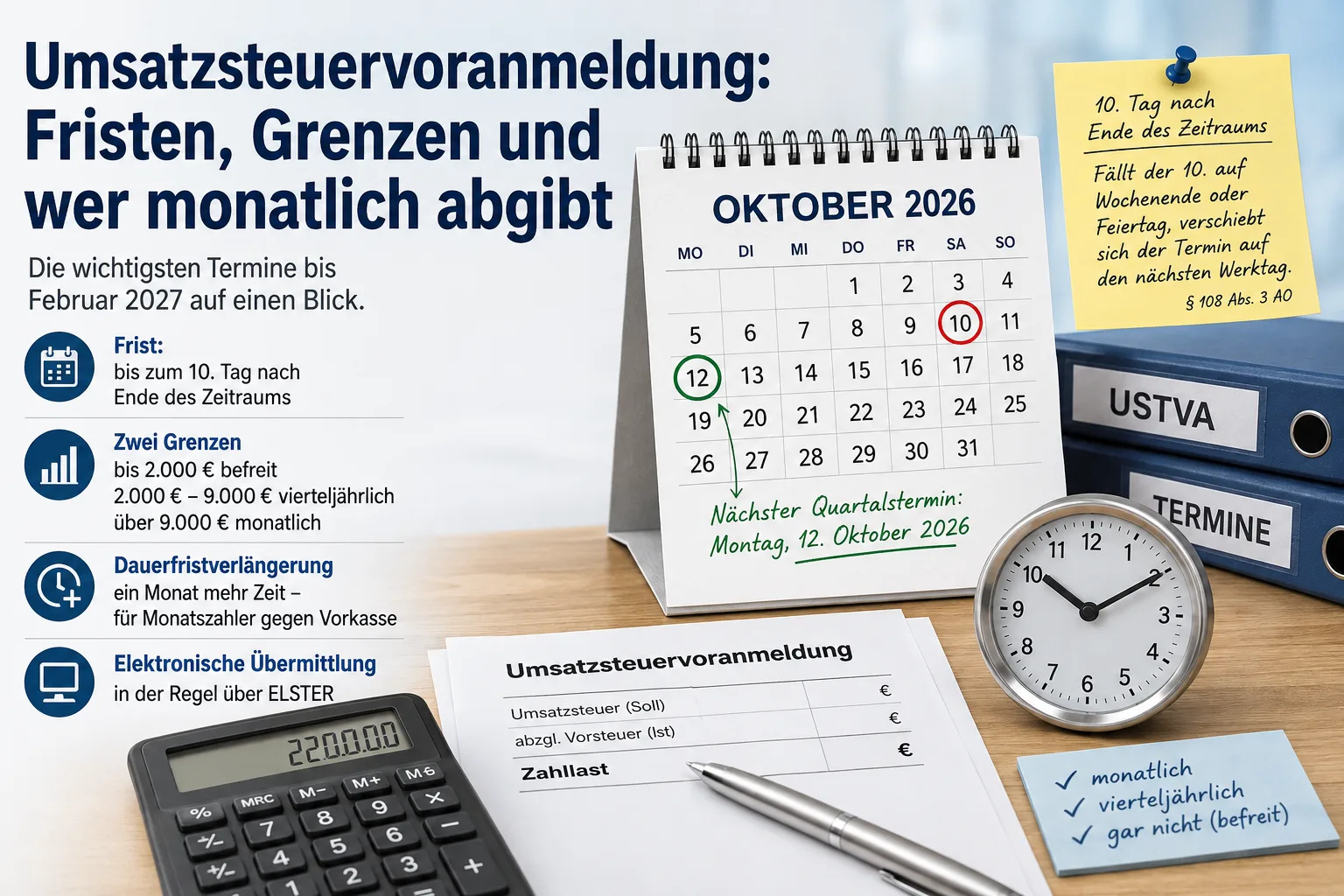
Advance VAT return in Germany: deadlines, thresholds, monthly or quarterly
If you run a business in Germany, you file an advance VAT return by the 10th day after each period. This article shows which cycle applies to you, when your next date falls and how to buy yourself an extra month.
 Taxes & Law
Bogus self-employment in Germany: when it applies – and why the back payment does not hit you
The fear of a huge back payment almost always targets the wrong person: your client owes the social security contributions, not you. What is really examined, what you actually risk – and how to get clarity without stirring things up.
 Taxes & Law
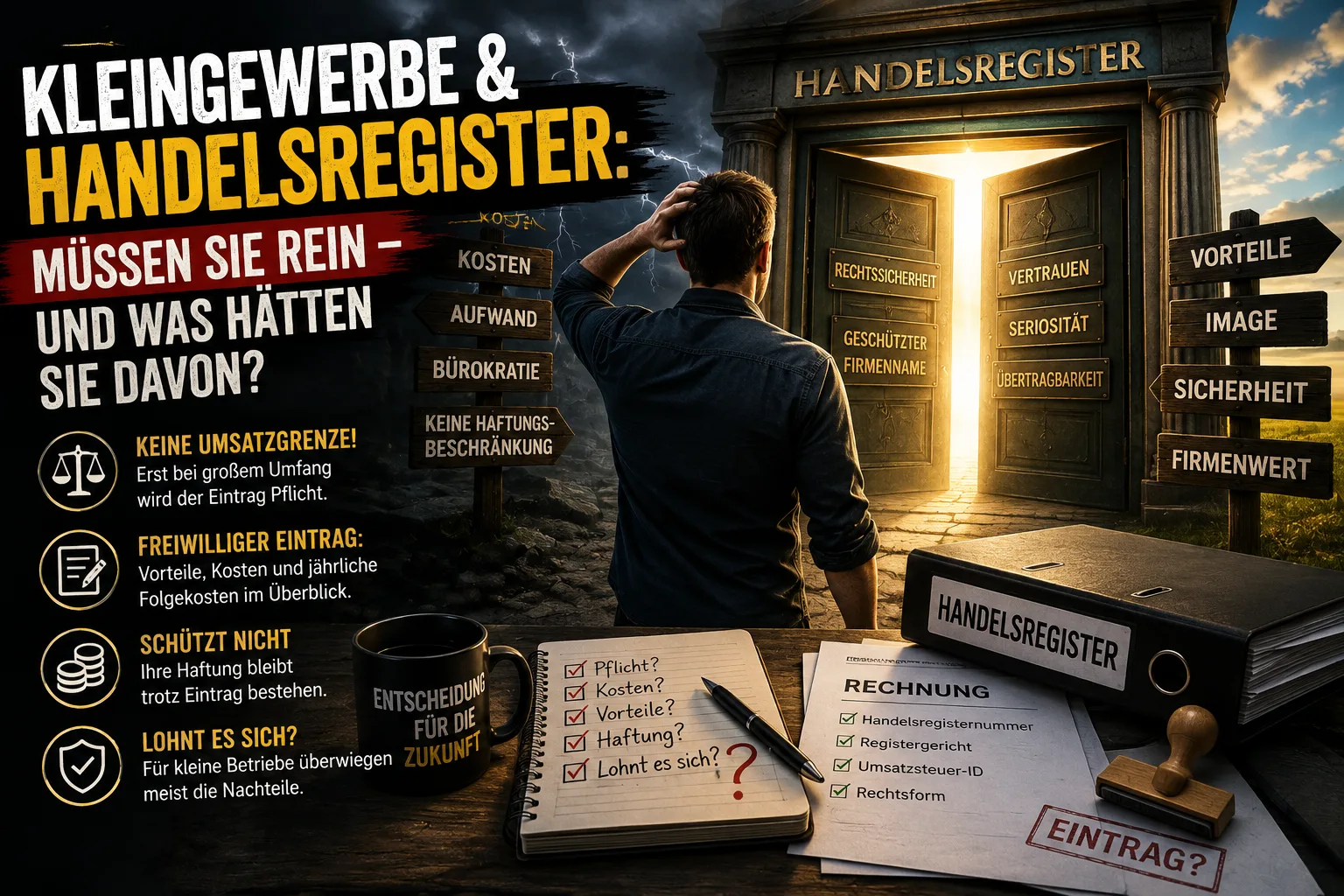
Small business and the German commercial register: do you have to sign up — and what would you gain?
As a rule, your Kleingewerbe does not have to enter the commercial register — German law sets no turnover threshold for it. What counts instead, what a voluntary entry gains you, what it costs every year, and what happens if you miss a duty.