
The social security contributions that have to be paid retroactively after such a finding are owed by your client – not by you. That is what § 28e paragraph 1 of the German Social Code IV says: the employer pays the total social security contribution. From you, your client may only recover the employee's share for the last three months (§ 28g SGB IV), not for four years. The idea that a five-figure demand ends up on your desk is, as a rule, wrong.
Two more points take off pressure. A single client does not make you bogus self-employed – that is the most common misconception of all, and it confuses two completely different things. And you can have your status checked free of charge at any time, even before you accept an assignment.
What can actually hit you is the VAT on the invoices you have issued so far – and the loss of the assignment. Both are covered below, without sugarcoating.
Contents
- What bogus self-employment actually means
- The big misconception: one client is not an accusation
- What is it based on? The criteria in plain language
- What your contract says matters less than you think
- Who checks this – and how does it come up?
- If it is established: who pays what
- VAT: the risk that really sits with you
- What happens to my health insurance?
- Getting your status clarified – free and voluntary
- What you can actually change
- Typical situations and how to read them
What bogus self-employment actually means
Bogus self-employment means: on paper you are self-employed and issue invoices, but in day-to-day reality you work like an employee. In that case what actually happens counts – not what the contract says.
The benchmark is § 7 paragraph 1 SGB IV. It reads:
„Employment is non-self-employed work, in particular within an employment relationship. Indications of employment are activity according to instructions and integration into the work organisation of the person issuing instructions."
That is all the law says. Two indications: instructions and integration. Everything else has been shaped by the courts over decades.
Important for your peace of mind: bogus self-employment is not an accusation against you. It is a classification of your contractual relationship. In the vast majority of cases nobody acted in bad faith – the client wanted flexibility, you wanted the assignment, and neither of you thought about how that looks under social security law.
The big misconception: one client is not an accusation
This is where almost everyone starts: „I only have one customer – am I bogus self-employed now?"
No. Two things are being confused here that have nothing to do with each other.
Bogus self-employment asks: do you work like an employee? It is about instructions and integration, not about the number of your customers.
Pension insurance obligation for the self-employed is something else entirely. Under § 2 sentence 1 number 9 of the German Social Code VI, self-employed people are subject to pension insurance if they
„regularly do not employ any employee subject to insurance contributions in connection with their self-employed activity and work permanently and essentially for only one client".
Both conditions must be met together. And here is the decisive point: if that applies to you, you remain self-employed. You are not a disguised employee. You simply pay into the statutory pension scheme yourself – like registered craftspeople, teachers, midwives or artists do.
That is not a penalty, not a back payment of health and unemployment insurance, and not a sign that something is wrong with your business. It is an insurance obligation the legislator deliberately created.
For the criterion „essentially for only one client", the pension insurance body works with a rule of thumb in practice: more than five sixths of your business income from a single source. This threshold is not in the wording of the law – it comes from administrative practice and case law. Treat it as an order of magnitude, not a sharp line.
One practical note that is often missed: anyone falling under this pension insurance obligation must register with the German pension insurance within three months of starting the activity. Missing that deadline can lead to arrears and a fine.
What is it based on? The criteria in plain language
The decision is never made on a single point, but always on an overall assessment. These criteria point towards an employment relationship:
- You are told when to work. Fixed attendance times, shift plans, holiday requests.
- You are told where to work. An assigned desk, although the task does not require it.
- You are told how to work. Not only the goal is set, but the way to get there.
- You are integrated into the business. Listed in the internal phone directory, company email address, attendance at team meetings, a slot in the duty roster, company clothing.
- You carry no entrepreneurial risk of your own. Fixed hours are paid regardless of success, and you invest no money of your own.
- You work with the client's equipment. His laptop, his tools, his vehicle.
- You have to appear in person. You may not send anyone else and may not hire anyone.
- An employee did the same job before you.
These criteria point towards genuine self-employment:
- You decide on working hours and location as far as the task allows.
- You appear on the market independently: own website, own branding, advertising.
- You have several clients or are visibly seeking them.
- You work with your own equipment.
- You can turn down assignments.
- You may have the work done by someone else.
- You calculate your own prices and bear the risk if you miscalculate.
- You are liable for your work.
No single criterion decides it. You can work on the customer's premises and still be clearly self-employed – an electrician works on the building site, that is simply where the job is. What counts is the overall picture.
What your contract says matters less than you think
Many people reassure themselves because the contract says „freelancer" or contains a sentence such as „The parties agree that no employment relationship is created". Such clauses do not help.
§ 611a paragraph 1 of the German Civil Code is clear: what matters is an overall assessment of all circumstances. If the actual performance shows an employment relationship, the label in the contract is irrelevant.
Conversely, that also means something reassuring: an unfortunately worded contract does not condemn you. If you work freely in practice, practice is what counts.
Who checks this – and how does it come up?
Responsible for the status question is the clearing office of the German Federal Pension Insurance. Clearing office is simply the name of the department that settles such cases – so you are dealing with the pension insurance body, not with an investigative authority.
A review typically comes about in these ways:
- Company audit at your client's premises. The pension insurance body audits businesses regularly and looks at freelance contracts as it goes. This is by far the most common trigger.
- Application by you or your client. Voluntary, more on that below.
- A report from your health insurance fund, if something stands out there.
- A dispute after the collaboration ends, when someone claims employee rights retroactively.
- Customs inspection as part of tackling undeclared work.
In certain constellations the collection agency must even initiate proceedings on its own – for instance if you are a family member or shareholder of your client.
If it is established: who pays what
This is where the real fear sits – and the real relief.
Your client owes the social security contributions. § 28e paragraph 1 sentence 1 SGB IV assigns the payment obligation to the employer, and in this constellation that is your client. He pays the total contribution retroactively, employer's and employee's share together.
He can only recover a small part from you. § 28g SGB IV states that a deduction that was not made may only be caught up in the next three wage payments – after that only if the employer is not at fault. For you that means: the employee's share from a maximum of three months, not from years.
How far back does it go? Contribution claims expire under § 25 paragraph 1 SGB IV four years after the end of the calendar year in which they became due. For contributions deliberately withheld it is thirty years. But that back payment falls on the client.
Can he claim the rest from me under civil law? According to the prevailing view, no: the limit in § 28g SGB IV has a blocking effect intended to prevent circumvention through damages claims. In a dispute, do not rely on that alone – get advice.
For the client it can become a criminal matter. Withholding social security contributions may be punishable under § 266a of the German Criminal Code. That, too, is directed at the employer, not at you.
You get something in return. If employment is established retroactively, you were also covered by social insurance during that period – with pension entitlements and unemployment insurance protection. Add employee rights such as paid holiday and protection against dismissal. For some people the finding is a net benefit.
What remains realistic: your client will rarely be delighted after such a finding. The practical damage for you usually lies in the collaboration ending or being converted into genuine employment.
VAT: the risk that really sits with you
Many guides leave this point out, although it affects you directly.
If you were in truth an employee, you were not an entrepreneur in that respect – and were not entitled to charge VAT. If you did so anyway, § 14c paragraph 2 of the German VAT Act applies: anyone who states a tax amount without being entitled to do so owes the amount stated.
You can correct this, but not on your own. It requires that the risk to tax revenue is removed – so your client must not have deducted the input tax, or must repay it. On top of that comes a separate written application to the tax office, which has to approve it.
That is effort, and it only works with your client's cooperation. If this affects you, this is the point where tax advice genuinely pays off.
What happens to my health insurance?
This question comes up almost always as the second one – and there is no single answer that fits everyone.
If employment is established retroactively, you were in principle subject to compulsory insurance during that period. The contributions for it are owed – as with pension insurance – by your client. What you paid yourself as a voluntarily insured member is settled with your health insurance fund.
If you were privately insured, it gets more complicated: a private policy cannot simply be unwound. In that case, talk to your insurer and to the statutory fund that would be responsible early on.
You were treated during that time either way – being left retroactively without cover is not the outcome of this procedure. It is about offsetting contributions, not about lost protection.
Getting your status clarified – free and voluntary
The most common question at this point is: „Am I not stirring things up by asking?"
The status determination procedure under § 7a SGB IV exists precisely to end uncertainty. The key facts:
- Responsible: clearing office of the German Federal Pension Insurance.
- Who may apply: the parties involved, so you or your client.
- Form: V0027, can be submitted online.
- Documents: all agreements on the contractual relationship, above all fee or service contracts and job descriptions.
- Cost: none.
- Duration: around three months on average.
- You may lodge an objection against the decision.
Two options make the procedure particularly useful:
You can ask before starting the activity. Under § 7a paragraph 4a SGB IV the pension insurance body also decides in advance, based on the written contract and the intended way of working. If something essential changes later, you must report it without delay.
An early application can defer the insurance obligation. If you apply within one month of starting the activity and employment is established, the insurance obligation only begins when the decision is announced – provided you agree and have insured yourself for health and pension in the meantime (§ 7a paragraph 5 SGB IV). That is exactly what prevents the retroactive demand.
If your client regularly works with freelancers under the same conditions, there is additionally the group determination under § 7a paragraph 4b SGB IV: an expert opinion covering several comparable contractual relationships.
What you can actually change
If reading the criteria made you uneasy – these are the most effective levers, sorted by impact:
- Win a second client. This defuses the pension insurance obligation under § 2 SGB VI and is at the same time strong evidence of genuine self-employment. Even a smaller second customer helps.
- Agree on results instead of attendance. Bill by project, trade or package wherever possible. Pure hourly billing with fixed attendance gives the weakest picture.
- Use your own equipment. Your own laptop, your own tools, your own software.
- Stay out of the internal organisation. No company email address, no slot in the duty roster, no attendance at meetings unrelated to your assignment.
- Appear visibly on the market. Own website, own quotes, own invoices with your own branding.
- Allow substitution. Being allowed to send a colleague speaks clearly for self-employment.
- Turn down an assignment now and then. Anyone who must accept every job looks bound by instructions.
And if the customer will not play along? That happens – then you are left with the points you can decide alone (your own equipment, your own market presence, a second customer) and an open conversation. One argument that often works: the contribution risk is carried by your client, not by you. He has more to lose than you do.
Your paperwork is more than a formality here. Your own quotes, sequentially numbered invoices and comprehensible descriptions of services are exactly what serves as evidence of entrepreneurial conduct in such a procedure. How a clean invoice is structured is explained in our guide to writing an invoice. And if you are still at the beginning: the difference between Freiberufler and Gewerbe also determines which registrations apply to you at all.
Typical situations and how to read them
„I have worked for the same customer for two years, but from home, on my own computer, and I organise my time freely." That sounds like genuine self-employment. The single client can, however, trigger the pension insurance obligation under § 2 sentence 1 number 9 SGB VI. Check that – and remember the three-month registration deadline.
„I sit in the customer's office three days a week, have a desk there and a company email address." Those are clear integration criteria. Here a status determination is worthwhile before a company audit raises the issue.
„I am a tradesman and work on my client's building site with his scaffolding." The location alone says little – the building site is simply where the job is. What matters is whether you deliver a definable piece of work on your own responsibility or work like an assigned member of staff.
„My client suddenly wants a status determination." That is usually not distrust towards you, but his own protection – after all, he carries the contribution risk.
„I used to be employed there and now do the same thing as a freelancer." This constellation is examined particularly closely, because the same activity was demonstrably performed in an employment relationship before. It is not automatically inadmissible, but it does require that the way you work together has visibly changed.
„I only do this on the side, a few hours a month." The volume alone decides nothing – even a small activity can be bound by instructions. What to consider when starting on the side is covered in our article on becoming self-employed part-time.
The sober summary: the main financial risk sits with your client, not with you. Your own risk is the VAT and the possible loss of the assignment. And you have a free tool to get clarity instead of carrying on with that uneasy feeling.
If you are seriously unsure, discuss your case with a lawyer specialising in employment or social law, or with your tax adviser. This article gives an overview of the legal position and does not replace advice on your specific contract. To prove several clients you need a clean overview of your invoices — an accounting software produces it at the push of a button.
Legal status: August 2026. Sources: §§ 7, 7a, 25, 28e, 28g SGB IV · § 2 sentence 1 no. 9 SGB VI · § 611a BGB · § 14c paragraph 2 UStG · § 266a StGB · information from the German Federal Pension Insurance on the status determination procedure.
Handle invoices more easily
Easy Invoice combines quotes, invoices and customer management in the cloud.
Try Easy InvoiceRead next
 Taxes & Law
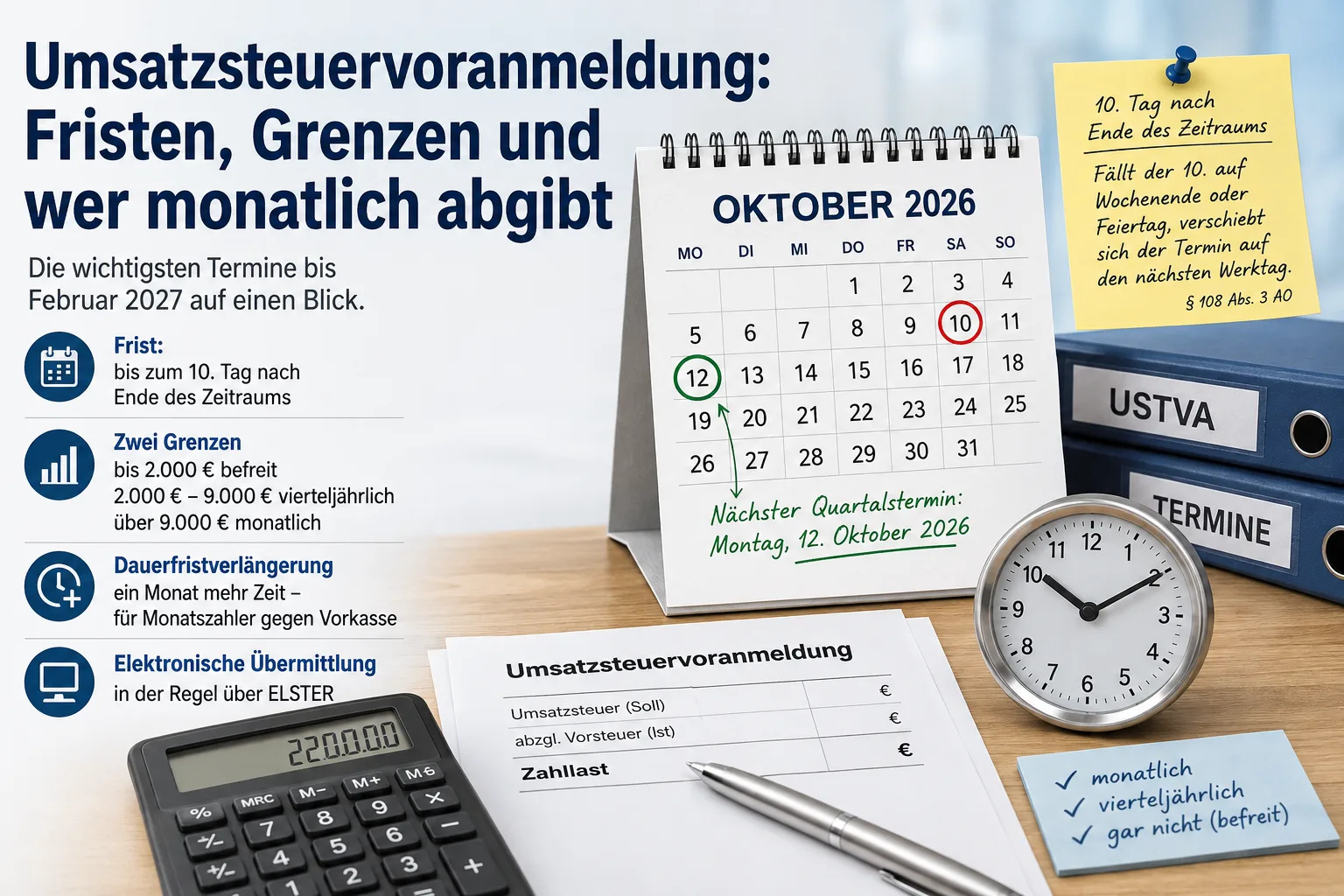
Advance VAT return in Germany: deadlines, thresholds, monthly or quarterly
If you run a business in Germany, you file an advance VAT return by the 10th day after each period. This article shows which cycle applies to you, when your next date falls and how to buy yourself an extra month.
 Taxes & Law
Which insurance do I need as a self-employed person in Germany? Mandatory, essential and skippable – costed out for three businesses
Health insurance is compulsory, pension insurance only for certain trades, and every business must register with its employers' liability association. Everything else is your call. What a roofer, a programmer and a café owner really need – and the order to buy in when money is tight.
 Taxes & Law
Small business and the German commercial register: do you have to sign up — and what would you gain?
As a rule, your Kleingewerbe does not have to enter the commercial register — German law sets no turnover threshold for it. What counts instead, what a voluntary entry gains you, what it costs every year, and what happens if you miss a duty.