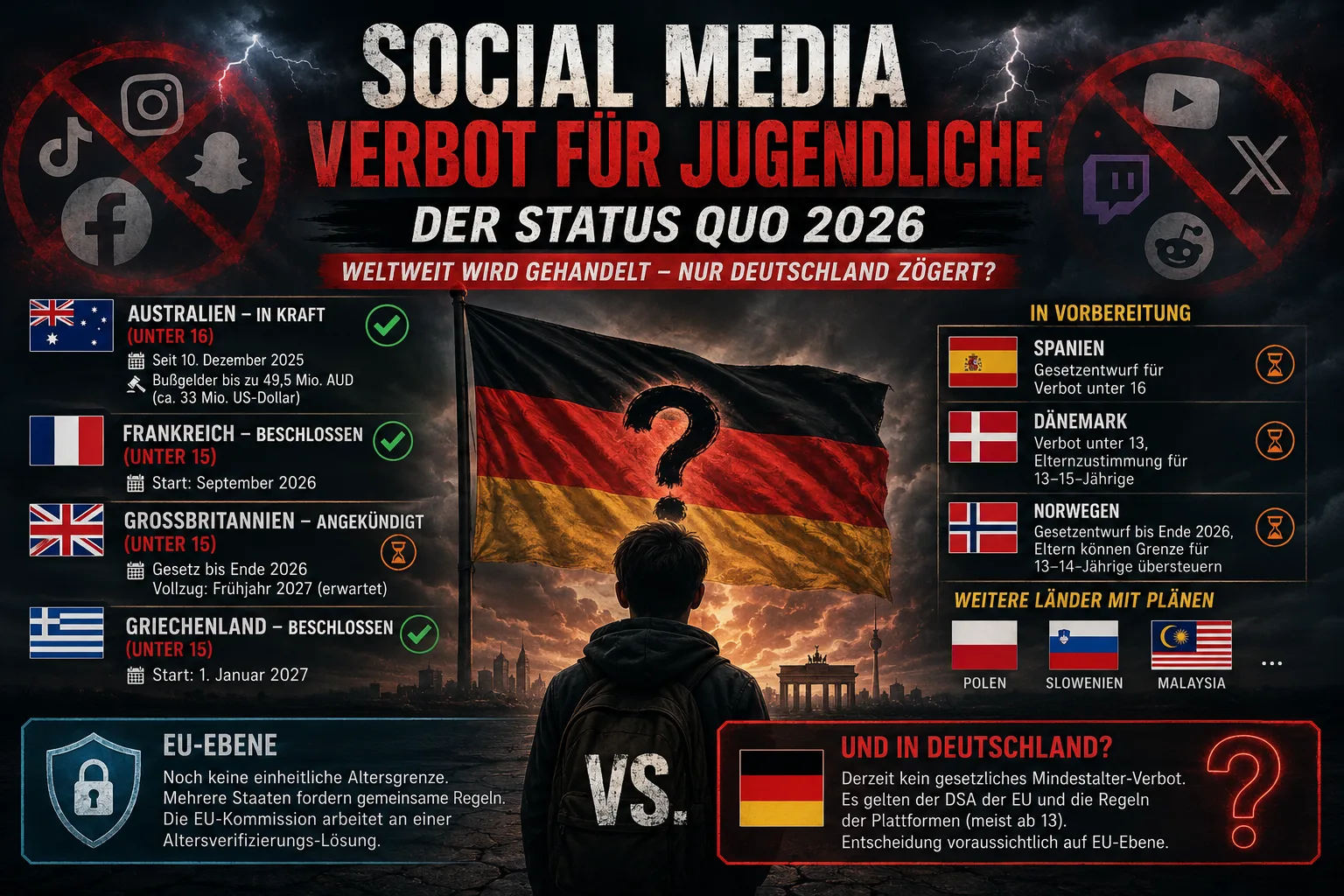
Social media bans for minors: the status quo in 2026 – and what it means for retailers
Contents
- What the bans are about
- What actually counts as a social media platform?
- The status quo by country
- And in Germany?
- What this means for retailers and their advertising
- What you can do now
- Conclusion
- Sources
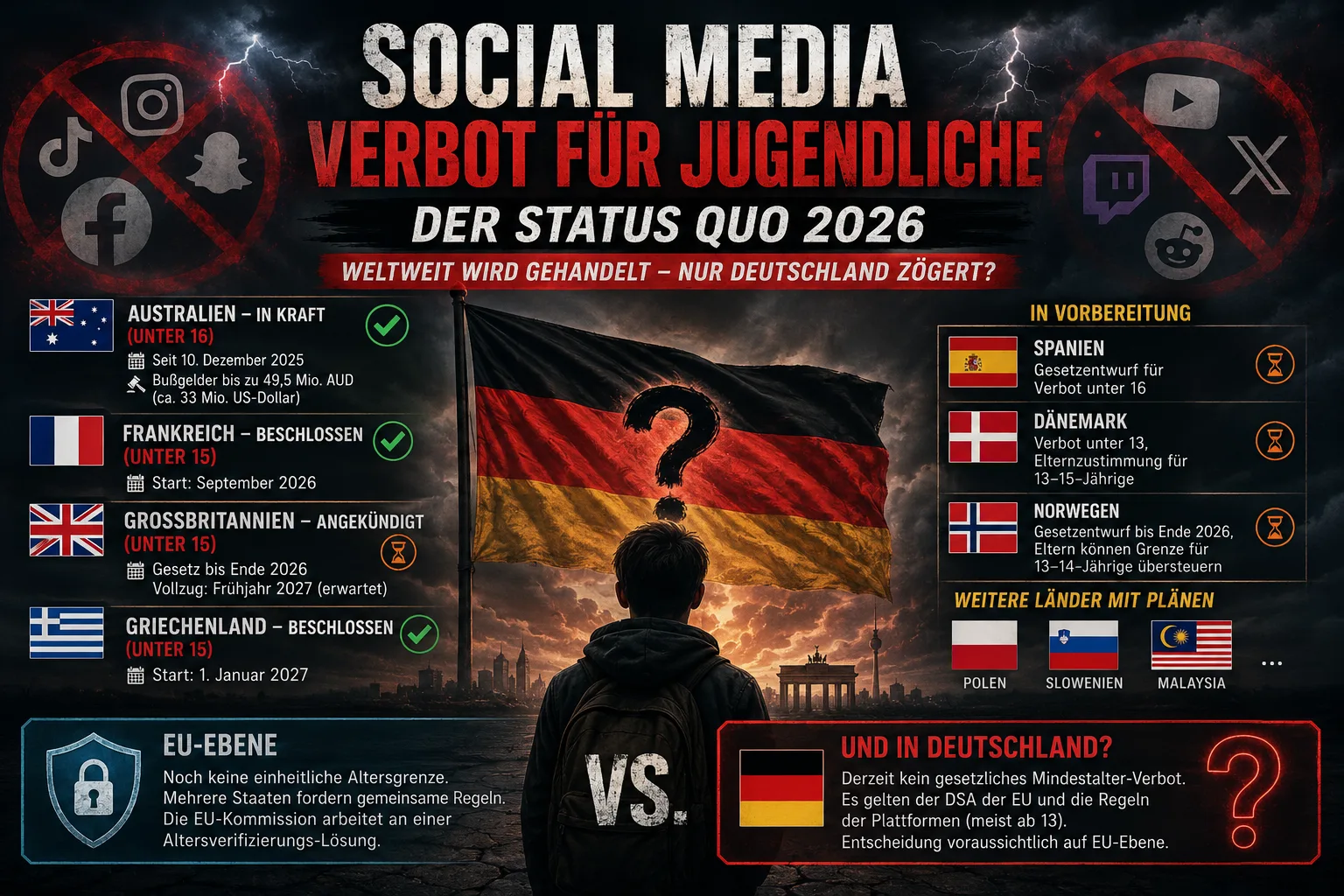
Country after country is introducing age limits for social media. On 15 June 2026, the UK announced it would ban under-16s from using TikTok, Instagram & co. – the most prominent country so far after Australia, where such a ban is already in force. For the self-employed and small retailers, this is more than a child-protection debate: when a whole age group disappears from the platforms, the reachable audience there shrinks too – and with it your advertising reach. This article sorts out where things stand and what it means in practice.
What the bans are about
At their core they all follow the same pattern: platforms must not allow accounts for users below a certain age in the first place, or delete existing ones. This is enforced via age verification – proof that someone is old enough. Important:
- It's the platforms that get penalised, not the minors or their parents. Fines hit the companies if they fail to take „reasonable steps".
- This affects the classic social networks (TikTok, Instagram, YouTube, Snapchat, Facebook, X). Messengers like WhatsApp and Signal, and pure children's offerings (e.g. YouTube Kids), are usually exempt.
- Age verification is controversial – data-protection advocates warn about excessive data requests for all users.
What actually counts as a social media platform?
A fair question – because there is no single, globally valid definition. Each law defines for itself what „social media" is, and usually there is no fixed official list, but rather criteria that platforms must assess themselves against. Australia is the most concrete example, because the ban is already in force there.
There, a service falls under the rules if all three points apply:
- Its sole or a significant purpose is online social interaction between users.
- Users can link to or interact with one another (follow, connect).
- Users can post their own content.
This matches the logic of other laws: creating an account/profile, generating user-generated content that others see, and the site serving primarily as a medium for interacting with other users' content.
Typical exemptions: messengers (e.g. WhatsApp, Signal), online gaming, and services whose primary purpose is health or education – plus pure children's offerings like YouTube Kids.
Here's how the classification looks in practice in Australia:
- In scope: Facebook, Instagram, TikTok, Snapchat, X, YouTube, Reddit, Threads, Twitch, Kick.
- Out of scope / exempt (examples): Discord, Pinterest, Roblox, Steam, GitHub, Google Classroom, Messenger, WhatsApp, YouTube Kids.
Important: the classification is criteria-based, not exhaustive – authorities issue guidance (Australia even a self-assessment tool) and can include or exclude services by regulation. There are genuine grey areas (gaming worlds like Roblox, dating apps), and the same site can count as social media in one country and not in another. YouTube is the best-known borderline case: in scope in Australia, temporarily exempt in other debates.
The status quo by country
Australia – already in force (under 16)
The pioneer: since 10 December 2025, under-16s may no longer hold accounts on ten platforms (incl. Facebook, Instagram, TikTok, Snapchat, X, YouTube, Reddit, Threads, Twitch, Kick). Breaches can incur fines of up to AUD 49.5 million (around USD 33 million). It is overseen by the eSafety Commissioner.
France – passed, starts September 2026 (under 15)
The National Assembly passed a law in early 2026 that bans new registrations under 15 and has existing accounts of that age group deleted. Planned enforcement: from September 2026.
United Kingdom – announced (under 16)
PM Keir Starmer announced a ban for under-16s on 15 June 2026 (TikTok, Instagram, YouTube, Snapchat, Facebook, X – not YouTube Kids, not WhatsApp/Signal). Legislation is to reach Parliament by the end of 2026, with enforcement expected in spring 2027; the design of the age check (Ofcom) is still open.
Greece – decided (under 15)
Access for under-15s is to be blocked; planned entry into force after parliamentary approval from 1 January 2027.
Spain, Denmark, Norway – in preparation
- Spain: a bill for an under-16 ban has been announced.
- Denmark: a strict ban under 13 plus parental consent for 13- to 15-year-olds is planned.
- Norway: a bill by the end of 2026; parents are to be able to override the limit for 13- and 14-year-olds.
Other countries with plans in the 13 to 16 range: among others Poland, Slovenia and – outside Europe – Malaysia.
EU level
There is no EU-wide uniform age limit yet, but the debate is on: several member states (France in the lead) are pushing for common rules, and the EU Commission is working on an age-verification solution. In short: the topic is getting bigger at European level, not smaller – and the benchmark that will eventually apply in Germany too is taking shape here.
And in Germany?
In Germany there is currently no statutory minimum-age ban of this kind. The EU's Digital Services Act (DSA) and the platforms' own minimum-age rules (usually 13+) apply. Stricter limits are being discussed politically, but a decision is more likely to come at EU level. For German retailers that means: no direct obligation today – but a foreseeable development to prepare for.
What this means for retailers and their advertising
Young people are a real target group for many retailers – from fashion, sneakers and cosmetics to gaming accessories and gift items. This is exactly where it gets relevant:
- Fewer reachable users: if under-16s (or under-15s) disappear from Instagram, TikTok & co., the reachable audience there for exactly this buyer group falls. In countries with a ban, the young public drops out as a directly addressable target group.
- Targeting gets narrower: ad platforms are already increasingly restricting the targeting of minors. A ban accelerates this – fine age targeting of the very young becomes practically impossible on these channels.
- Other channels, different messaging: anyone who wants to reach young customers has to rely more on permitted routes – e.g. addressing parents (who often do the buying anyway), owned channels such as newsletter and shop, search engines, or platforms/formats not covered by the ban.
- More friction from age checks: age verification can make use somewhat more cumbersome for all users – which can dampen interaction and thus organic reach.
In short: if your product mainly appeals to teenagers, you shouldn't build your channel mix blindly on social-media reach among the youngest.
What you can do now
- Assess your audience honestly. How much of your revenue really depends on under-16s – and via which channels do you reach them today?
- Factor in parents. For products aimed at teens, often the more solvent and permitted target group – align your messaging accordingly.
- Build your own reach. Newsletter, shop content, reviews and loyal-customer care are independent of platform rules.
- Spread your channel mix. Don't put everything on one platform; search visibility and several channels reduce the risk.
- Watch the legal situation. Especially as an EU retailer, keep an eye on the EU plans – the benchmark that eventually affects Germany is taking shape here.
Conclusion
Social-media age limits are no longer a one-off but an international trend: Australia already enforces them (under 16), France (under 15) and the UK (under 16) follow in 2026/2027, more countries are preparing laws, and the EU is working on common rules. For small retailers the real takeaway is sober: the young target group is becoming harder to reach on the big platforms – reaching them takes a broader channel mix and your own reach. For building exactly such independent channels (shop, newsletter, customer care), PepperTools supports you.
Note: general information, not legal advice. The legal situation is evolving fast and differs by country – the official sources of the respective authorities are authoritative. As of 17 June 2026.
Sources
- NPR: Australia's social media ban for under-16s starts (10.12.2025)
- NPR: Britain to ban under-16s from social media (15.06.2026)
- TIME: UK social media ban for under-16s – apps & timeline
- Euronews: Europe moves toward age limits for minors
- France24: Will the EU ban social media for children in 2026?
- eSafety Commissioner: How to assess if a service is an age-restricted social media platform — criteria, self-assessment, in-scope/exempt services
- DLA Piper: Regulatory guidance on the definition (Australia) — definition and scope As soon as this turns into regular income, it needs proper invoicing — guides for that at office1.cloud.
Age limits and dates may change at short notice; several initiatives are still in the legislative process or before the courts.
Handle invoices more easily
Easy Invoice combines quotes, invoices and customer management in the cloud.
Try Easy InvoiceRead next
 Marketing & SEO
SEO for Online Shops: How Your Products Get Found on Google (2026)
Shop SEO works differently from ordinary website SEO. What really counts on category and product pages – without the technical jargon.
 Marketing & SEO
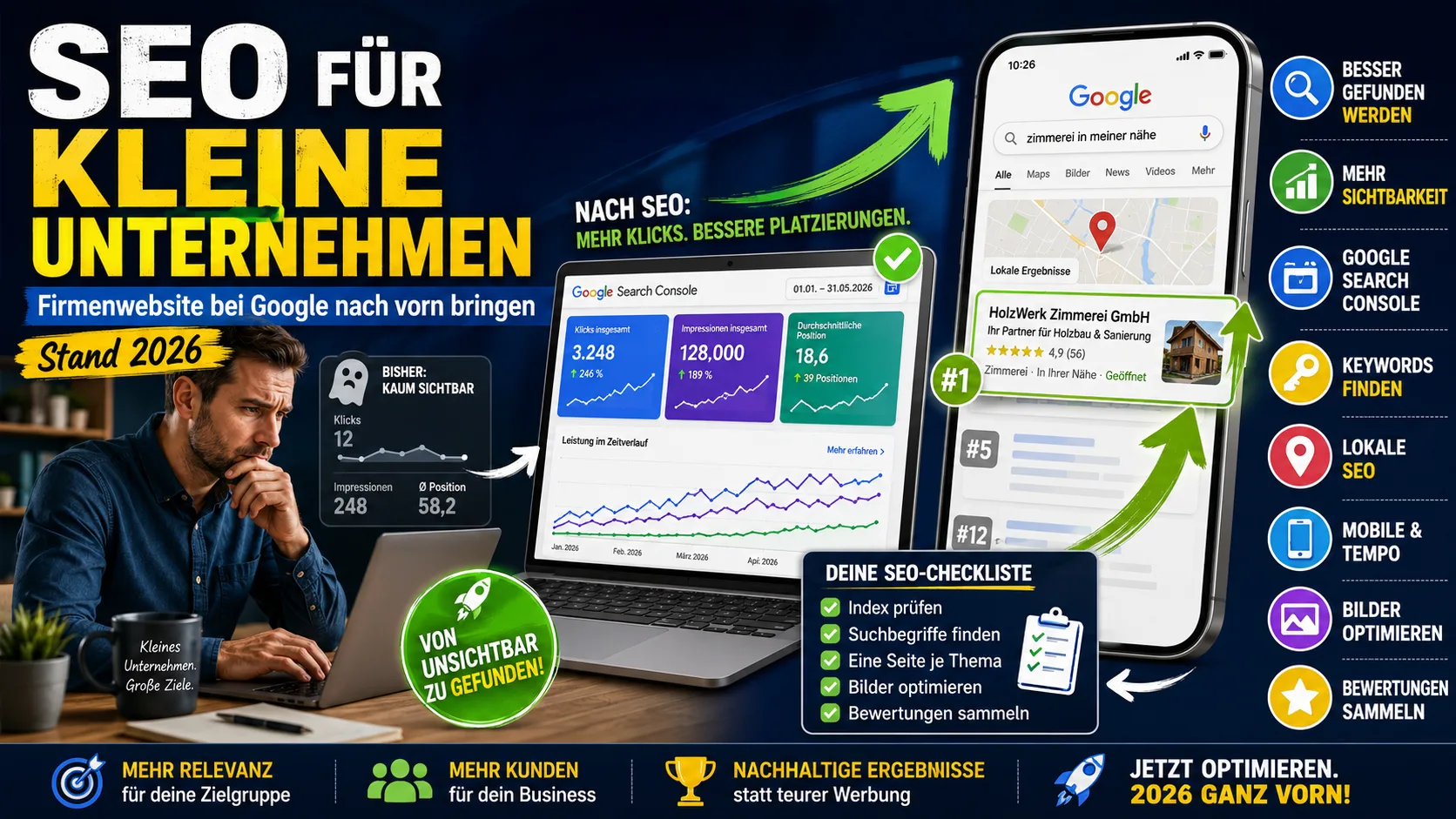
SEO for small businesses: getting your company website to the top of Google (as of 2026)
Starting from scratch: are you even on Google? Why you are not being found, what you can change yourself in three weeks – and what you can safely skip.
 Marketing & SEO
Getting a Website Built: Costs & Process for Freelancers and Small Businesses Like Tradespeople
What does it cost to have a website built? Real prices, what belongs on a 2026 site, and how the process works – for freelancers and small businesses like tradespeople.