A master electrician in the neighbourhood has won his jobs through referrals for 20 years. Yet he now loses inquiries every week – because younger customers google him before they call. They find either nothing at all or a site from 2014 that falls apart on a phone. The job goes to the business with the tidy website.
That is exactly why your own website is no longer a "nice-to-have" today. It is the digital business card that works 24/7 – even when you are on the building site, in a customer meeting, or off the clock. This article shows you honestly what a website needs to do in 2026, how the process works, and what it costs – with a concrete ballpark figure instead of "price on request".
Do you even need a website – or is Instagram enough?
Short answer: social media does not replace a website. An Instagram or Facebook profile does not belong to you, it belongs to the platform. Reach gets throttled there, rules change, profiles get blocked. Your own website is the only channel you fully control – and the one that shows up on Google when someone searches for "electrician + town" or "photographer + town".
Three typical situations where your own site pays off immediately:
- Trades & local service providers: Customers search on the go for "heating emergency service" or "tiler near me". Whoever is not findable there simply does not exist for these customers.
- Solo freelancers (photographers, consultants, coaches): The website is your portfolio and your selling point. Without it, the first question remains: "Can this person really do it?"
- Small businesses that live on referrals: Even those who come via word of mouth get googled first. The website decides whether the first impression looks professional.
What a website really needs in 2026
A good website is not a pretty poster, it is a tool. These building blocks belong to a solid foundation:
- Mobile first. Most visitors arrive via smartphone. If text shifts around or buttons are too small, they are gone in seconds. "Mobile first" is the standard today, not an extra.
- Fast loading time. Every extra second costs visitors. Clean code beats every overloaded website-builder template.
- A clear way to get in touch. A tap-to-call phone number, contact form, opening hours, directions. Sounds obvious – yet it is missing from a surprising number of sites.
- Mandatory legal details. In Germany, business websites need a legal notice under Section 5 DDG and a privacy policy. If analytics or marketing services are used, a cookie consent banner under Section 25 TDDDG is also required. This is not legal advice, but it should be built in cleanly from the start.
- An SEO foundation. Sensible page titles, descriptions, and structure so Google understands and classifies the site. Without this groundwork, even the most beautiful website stays invisible.
- Findability on Google. The website works best together with a well-maintained Google Business Profile. To see how that drives local customer acquisition, read our guides Google Business Profile for tradespeople and Google Local Services for tradespeople.
DIY, website builder, or have it done?
There are roughly three routes – each has its place:
- Website builder (Wix, Jimdo & co.): Cheap to start, quickly live. But: you sink your own hours into it, the design stays a template, and special requests quickly hit limits. Honestly factor in your own working time.
- Agency: A full all-round package, but often from EUR 3,000–5,000 and a longer process.
- Individually coded by a developer: You get exactly what you need – no template constraints, no monthly builder fee. The effort stays lean when the scope is clear.
For freelancers and small businesses, the last route is usually the best compromise: individual, cleanly coded, predictable in price.
Your website from PepperTools – what the standard package costs
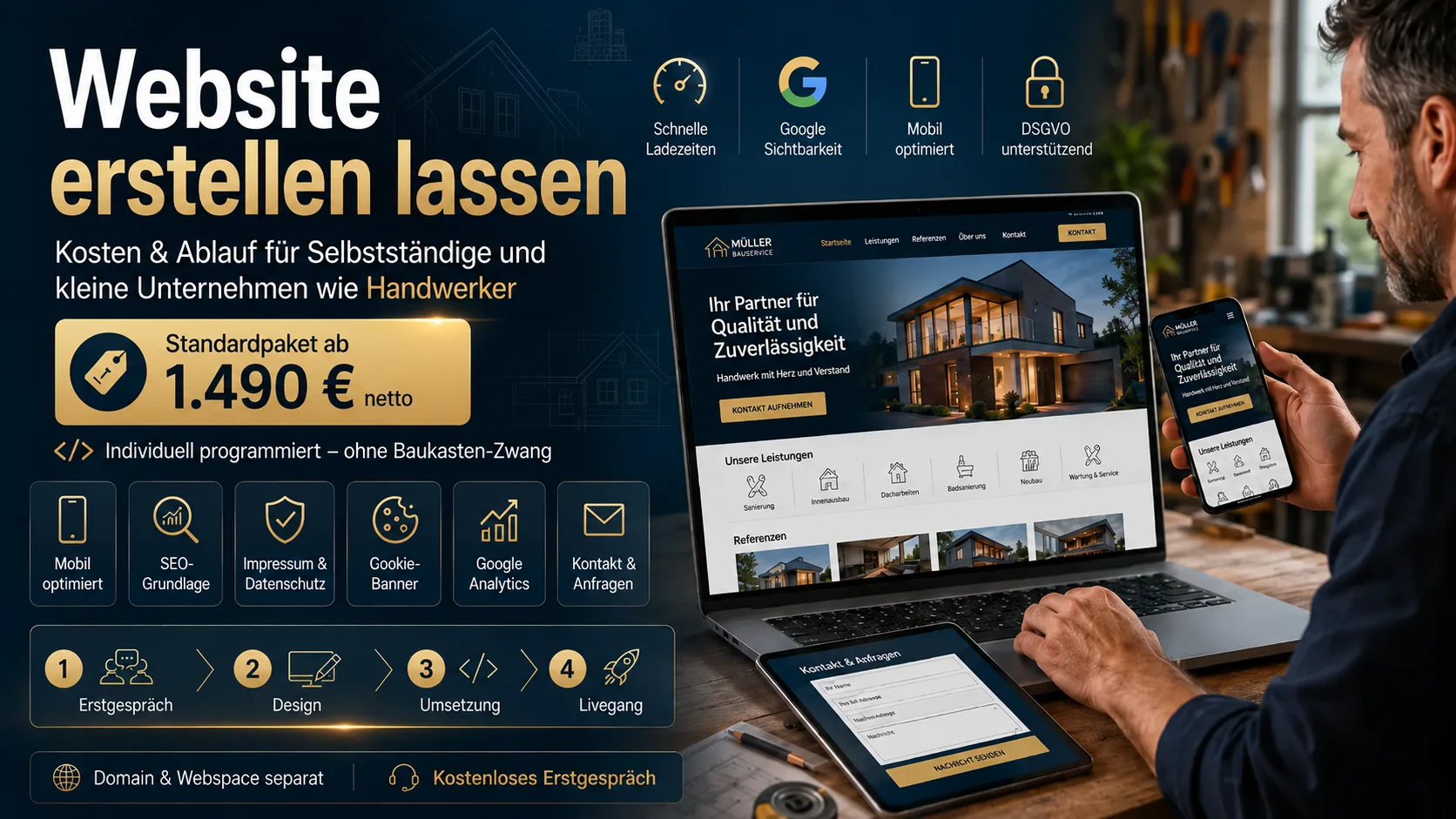
We build your website – individually coded, with no builder constraints. "Price on request" is annoying, so here are clear numbers for our standard package – from EUR 1,490 net:
Included:
- 3 design drafts to choose from – one of them gets implemented
- Home page plus matching subpages (e.g. Services, About, Contact)
- Legal notice and privacy policy integrated
- Cookie consent banner
- SEO basics for the first pages (titles, descriptions, structure)
- Google Analytics integration
- Optimised display for desktop and mobile (smartphone/tablet)
- Individually coded, adapted to your logo and your colours
Your part: a roughly one-hour conversation in which you describe your wishes, plus a few graphics or photos from the business (logo, images). The clearer the material, the smoother it runs.
Not included – needed on top: For the website to go online, you need a domain (your web address) with web space at a hosting provider. These running costs are charged directly by the provider and are not part of the build price. On request, we set everything up for you and take over the management.
Running costs – deliberately listed separately:
- Domain and web space at the host: from approx. EUR 10–20 per month
- Maintenance and updates: optional, as needed
More than standard? As soon as features are added – online shop, appointment booking, customer login, multiple languages, interfaces – it becomes individual. We discuss such projects calmly and are happy to make you an additional quote tailored to your wishes. The only limit is what you can imagine: whatever you want gets built.
So the EUR 1,490 is an honest starting point, not a bait price – the exact price results from what you actually need.
How a website project works
So you know what you are getting into, here is the typical path in four steps:
- Initial consultation (free). We clarify what you want, who your customers are, and which scope fits. You get a clear price statement.
- Material & concept. You supply the logo, texts, images, and any preferred colours; we create 3 possible designs to your specifications.
- Implementation. The site is coded, with mandatory details, SEO basics, and analytics – you see interim versions.
- Go-live & handover. Fine-tuning, publication, a short briefing. On request, we then take over hosting and upkeep.
And then? The website is just the beginning
A website brings inquiries – inquiries turn into quotes and invoices. If you want to set up that part cleanly right away, you can create quotes, invoices, and receipts directly online with office1.cloud. That way your digital presence matches the digital office behind it – with no media break.
Quick questions, quick answers
How long does a standard site take? With clear material and prompt feedback, usually a few weeks.
Do I need technical skills? No. You supply content and wishes, we take care of the rest. On request including upkeep, so you do not have to worry about anything.
Does the site then belong to me? Yes. Individually coded means: no website-builder subscription you can never escape.
What about texts if I do not have any? That can be arranged within the project too – just talk about it in the initial consultation.
Next step
If you want a website that fits your business – from the lean digital business card to a site with features – then let us talk, with no obligation. Once the visitors arrive, the invoicing behind it should be ready too — guides and tools for that are at office1.cloud.
Arrange a free initial consultation: peppertools.de/de/kontakt
Note: This article is not legal advice. Information on legal notice, privacy, and cookie obligations is for orientation; your specific situation is decisive in each case.
Handle invoices more easily
Easy Invoice combines quotes, invoices and customer management in the cloud.
Try Easy InvoiceRead next
 Marketing & SEO
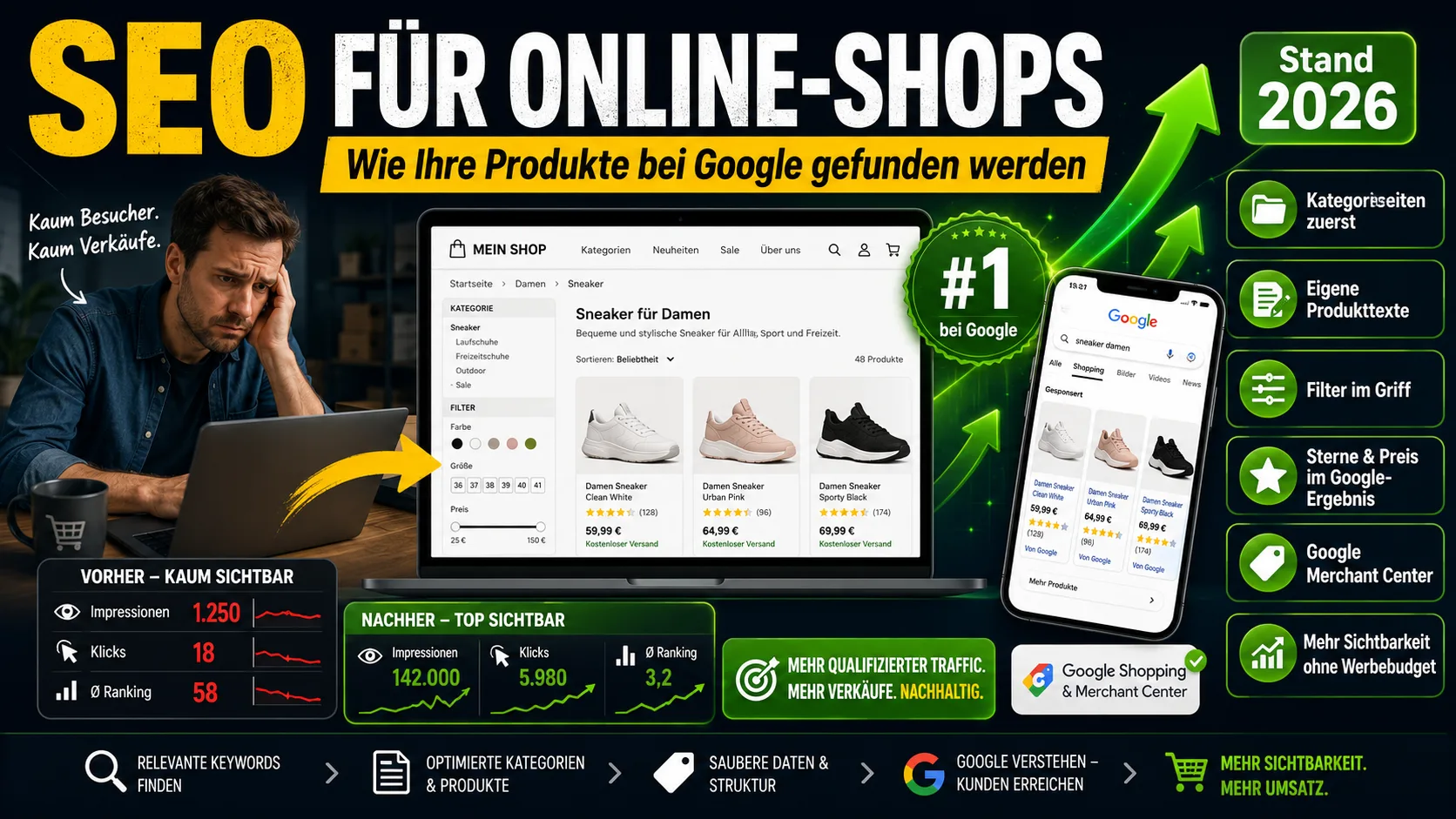
SEO for Online Shops: How Your Products Get Found on Google (2026)
Shop SEO works differently from ordinary website SEO. What really counts on category and product pages – without the technical jargon.
 Marketing & SEO
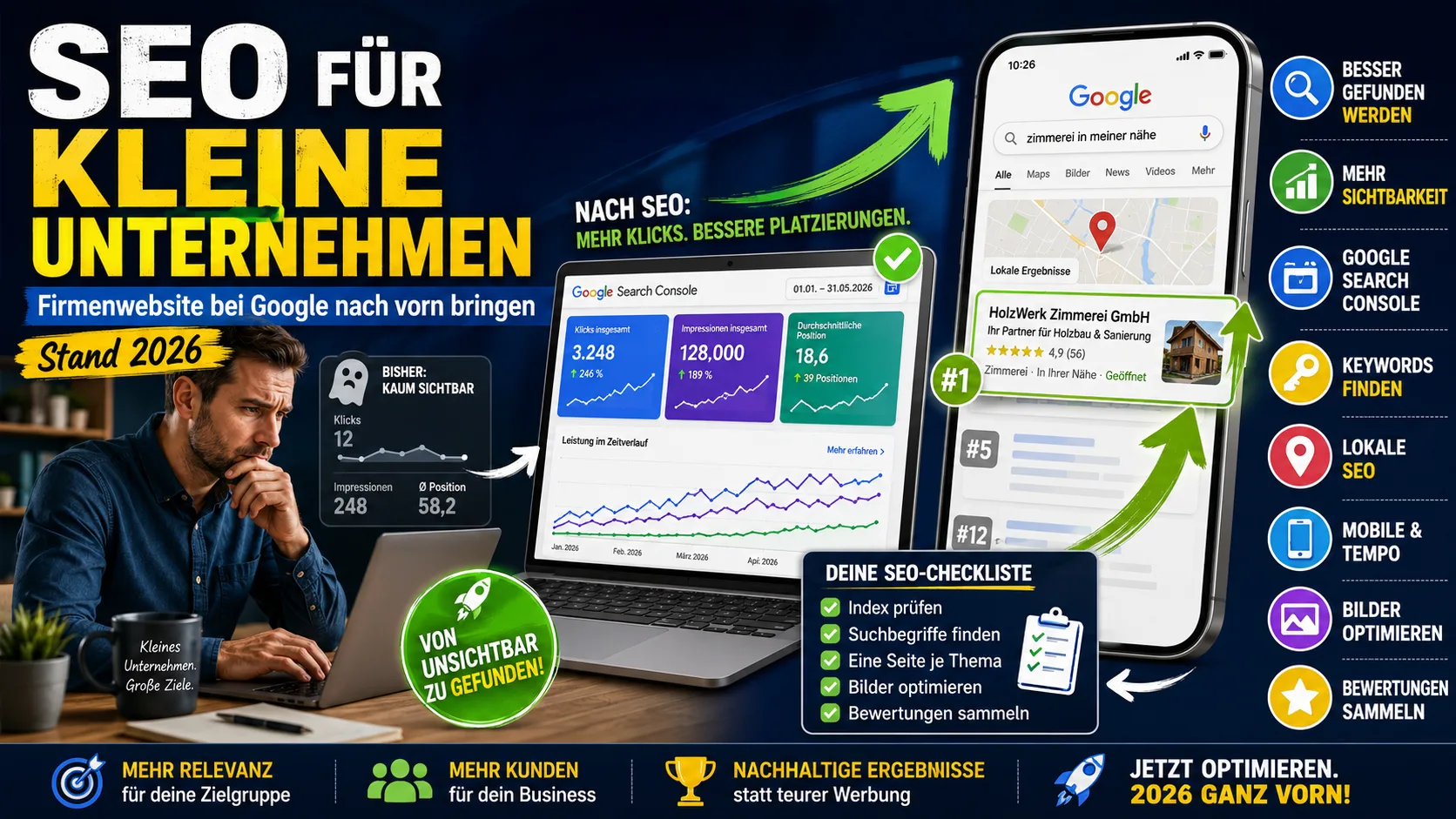
SEO for small businesses: getting your company website to the top of Google (as of 2026)
Starting from scratch: are you even on Google? Why you are not being found, what you can change yourself in three weeks – and what you can safely skip.
 Marketing & SEO
Social media bans for minors: the status quo in 2026 – and what it means for retailers
More and more countries are introducing age limits for social media. The 2026 status quo – which countries, from what age and from when, what even counts as a social media platform – and what it means for small retailers' advertising reach with young audiences.