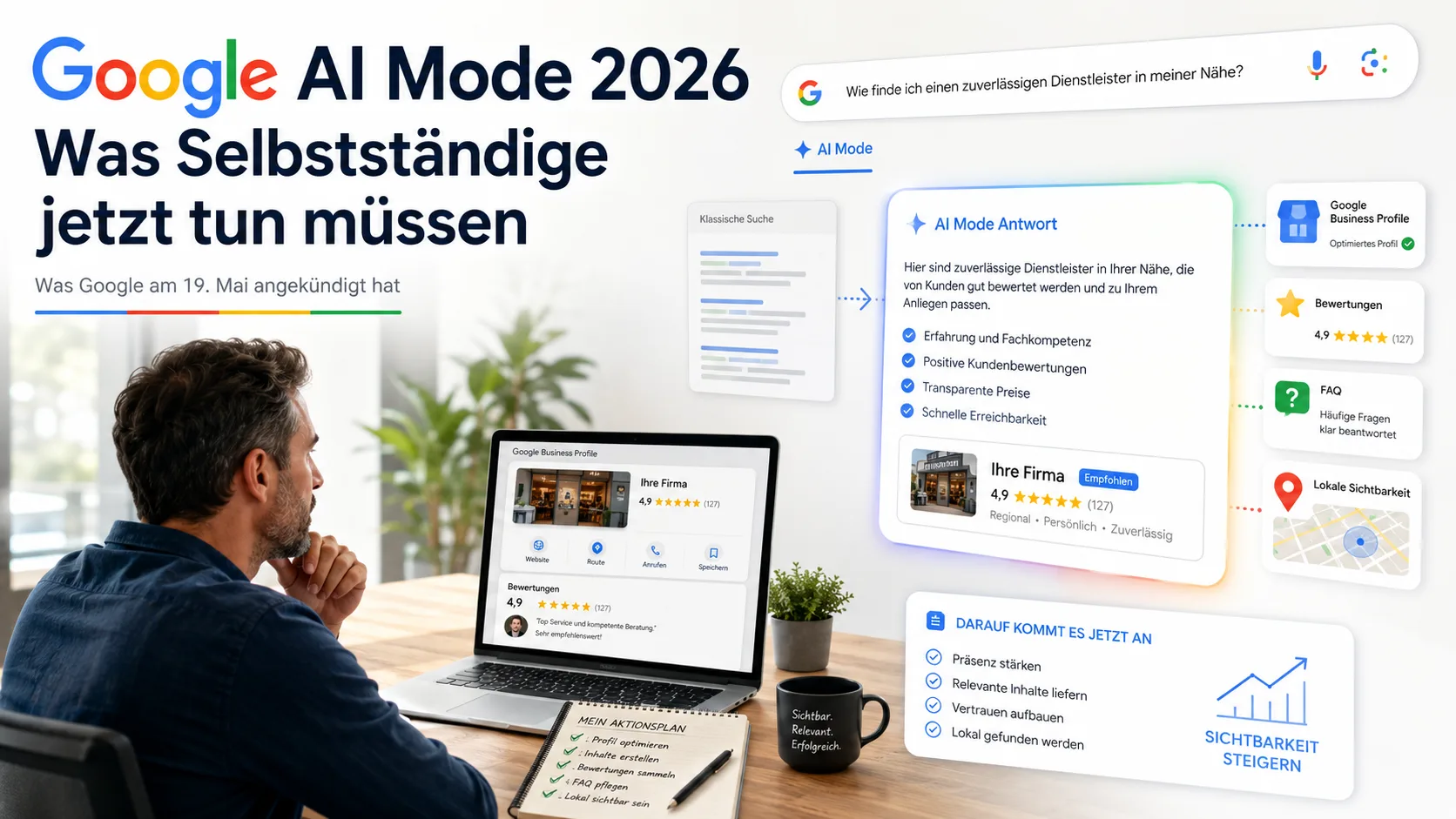
Google AI Mode 2026: What the Self-Employed Need to Do Now
Google rolled out the biggest search update in 25 years at the I/O conference on 19 May 2026. AI Mode and the new intelligent search box are now also available in Germany — and they change how potential customers find you. Here is what you should do for your visibility.
Table of contents
- What Google announced on 19 May
- Why this affects small businesses too
- Concretely: what changes for your visibility
- 5 steps that help this week
- Practical example: a painting business in Augsburg
- Frequently asked questions
- Conclusion
- Sources
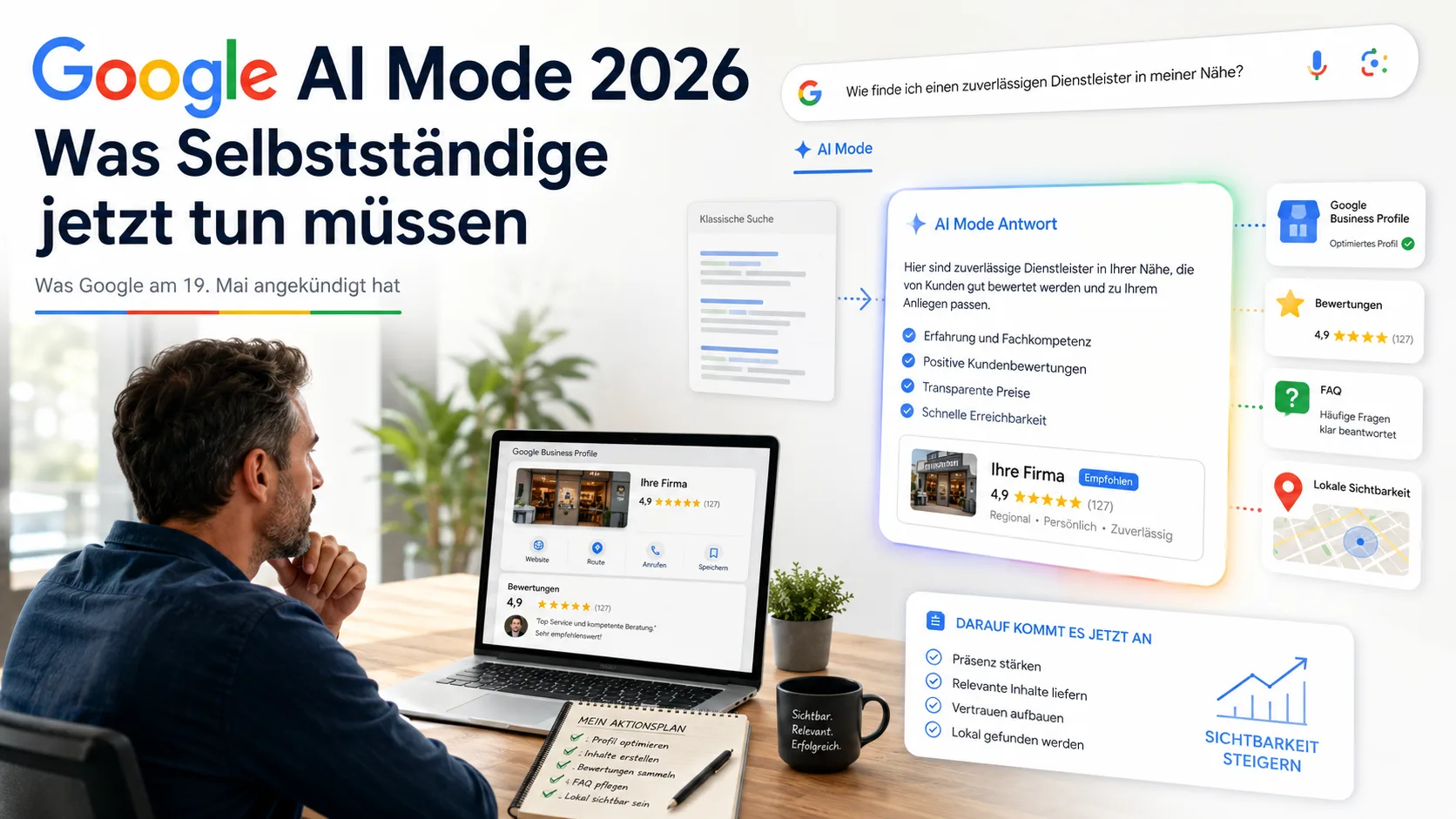
What Google announced on 19 May
At the annual Google I/O 2026 developer conference, Elizabeth Reid, Vice President of Search, announced a "new era of AI search". Three points are directly relevant for the self-employed:
New search box. Google calls it the biggest upgrade to the search box in over 25 years. The input field detects your intent earlier, accepts longer queries in natural language and takes not only text but also images, videos or open Chrome tabs as input. In Germany it is available immediately.
AI Mode as the standard. According to Google, AI Mode already has over one billion monthly users after just one year. The number of queries doubles every quarter since launch. The new standard model is called Gemini 3.5 Flash and is now active worldwide — including for German searches.
Information Agents. AI agents that work in the background, evaluating web pages, news and social media posts, and informing you about changes. This feature launches first in the US only, and only for paying subscribers to AI Pro and Ultra. It will arrive in Germany later.
Source: official blog post "Google Search's I/O 2026 updates: AI agents and more" by Google.
Why this affects small businesses too
You might think: "This is just a corporate update, it doesn't affect me as a painter, photographer or Etsy seller." Unfortunately it does. Three numbers from recent industry analyses:
AI Overviews — the AI-generated summaries at the top of search results — now appear in around 48 percent of all Google searches. The organic click-through rate on classic search results has fallen from 1.76 percent to 0.61 percent. And about 93 percent of all AI Mode queries end without a click on any website.
Translated: anyone searching for your offering increasingly gets a ready AI answer — and does not visit your website at all. If you do not appear in the AI answer, you are invisible to many searchers.
What does that mean for you? You no longer compete only for places in the result list. You compete to be cited by Google's AI as a trustworthy source.
Concretely: what changes for your visibility
Three shifts are the most important:
From keyword to intent. Search now accepts long sentences: "Which electrician in Munich offers short-notice appointments for wallbox installation in old buildings?" The AI breaks this question down and looks for businesses whose profile fits all three aspects — short-notice scheduling, wallbox experience, old buildings. Anyone whose services are vaguely described is filtered out.
From ranking to citation. "Citation" means being named and linked in the AI answer itself. This works differently from classic SEO: Google searches websites and profiles for clear, well-defined answers to specific questions. Anyone with a clean FAQ section or service description on their website is cited more often.
Local advantages get bigger. This is where small businesses can beat large corporations. A trade business with 40 real reviews and an up-to-date Google profile looks more trustworthy to the AI than the anonymous branch page of a national chain. The Google Business Profile becomes the primary data source for local AI answers.
5 steps that help this week
- Fill in the Google Business Profile completely. Categories, services, opening hours, directions, photos, description, service area. Every field is a signal that the AI uses. For tips on routine updates, see our practical guide to the Google Business Profile.
- Actively collect and respond to reviews. Both the number and the quality of responses are a trust signal. Read here how to do this legally: collecting customer reviews 2026.
- Real answers instead of SEO phrases. On your website, give concrete answers to typical customer questions: how much does it cost to paint an apartment per square metre in Munich? Which appointments are available at short notice? What preparation work does the customer need to do? Such content is cited disproportionately in AI answers.
- Strengthen local signals. The location name on every page, a real address, links to and from local directories (chambers of commerce, trade associations). Our existing post Google Local Services 2026 shows how you can additionally generate paid enquiries.
- Watch the core update. In parallel to the I/O announcement, the May 2026 Core Update has been rolling out since 21 May. It moves rankings even without AI involvement. Read our analysis: Google May 2026 Core Update.
What does that mean for you? The next two weeks are a good time to review the Google profile and add an FAQ area to the website. A clean invoice, a sent job confirmation, a well-kept profile — all of this plays together.
Practical example: a painting business in Augsburg
A real example: a painting business in Augsburg, southern Germany, with three employees previously had a lean website with the classic phrase "we paint your apartment professionally and reliably". The Google profile listed opening hours and an address, little else.
After the I/O announcement the owner changed three things: the homepage now has an FAQ section with answers to the five most frequent customer questions, including price examples per square metre and a note on the service areas (Augsburg, Friedberg, Königsbrunn). In the Google profile, all services are listed individually — interior painting, wallpapering, lacquering, façade work — and seven new photos were uploaded. In addition, every customer is systematically asked for a review after completion.
What also helps: invoices have been issued automatically in PDF and ZUGFeRD format since switching to cloud invoicing software, saving the business almost half an hour per job. The cloud invoicing function in PepperTools makes this possible in a few clicks. The owner uses this time exactly for the profile and website work that, since the I/O update, decides whether his business is found by the AI.
Frequently asked questions
Is Google AI Mode available in Germany now?
Yes. The new intelligent search box and the expanded AI Mode with Gemini 3.5 Flash have been active in Germany since 19 May 2026, according to Google. The "Information Agents" — independent AI agents that monitor topics in the background — start first in the US only and only on paid subscriptions.
Do I now need my own AI strategy?
No. You mainly need clear, concrete content and a well-kept Google profile. Most proven measures from local SEO and review management also work in AI search — and become even more important there.
Will I lose visibility if I do nothing?
Usually, yes. When AI answers appear in around half of all searches at the very top and most users no longer click through, websites that do not appear in those answers lose reach. Even small profile improvements can make the difference.
Does this also apply to my Etsy shop or Amazon listings?
Indirectly. Google often includes marketplace results in its answers. Anyone properly categorised there with good reviews benefits too. For Etsy sellers, the new title rules are also relevant.
How fast do changes take effect?
Profile updates are often visible in local results within a few days. Content changes to the website take about one to three weeks, depending on Google's crawl frequency, before they appear in AI answers.
Conclusion
Google search is moving from a list of results to an answer. For the self-employed this is not a disaster but a shift in the rules: trust, local relevance and concrete answers count more — and this is where small businesses can score against large brands. Anyone who updates their Google profile and website in the coming weeks secures a head start. And whoever invests the time saved by efficient cloud invoicing software and a clear dunning process directly into this visibility work has won twice.
Sources
- Google Search's I/O 2026 updates: AI agents and more — Google's official blog post on the I/O conference of 19 May 2026, with all details about the new search box, AI Mode and Information Agents.
- Google I/O 2026: Will AI Mode become the new search standard? — Dr. Web, analysis of the I/O announcement of 19 May 2026.
- Google I/O 2026: Gemini 3.5, AI Overviews and AI Mode merge in search — SEO Südwest, highlights of I/O 2026 for search.
- Google I/O: The new AI search box marks a new era — OnlineMarketing.de, overview of I/O 2026 with a focus on the new search box.
- Google I/O 2026: Search becomes an agent — SISTRIX, analysis of I/O 2026 with implications for SEO.
Handle invoices more easily
Easy Invoice combines quotes, invoices and customer management in the cloud.
Try Easy InvoiceRead next
 Marketing & SEO
SEO for Online Shops: How Your Products Get Found on Google (2026)
Shop SEO works differently from ordinary website SEO. What really counts on category and product pages – without the technical jargon.
 Marketing & SEO
SEO for small businesses: getting your company website to the top of Google (as of 2026)
Starting from scratch: are you even on Google? Why you are not being found, what you can change yourself in three weeks – and what you can safely skip.
 Marketing & SEO
Getting a Website Built: Costs & Process for Freelancers and Small Businesses Like Tradespeople
What does it cost to have a website built? Real prices, what belongs on a 2026 site, and how the process works – for freelancers and small businesses like tradespeople.