_Last updated: 9 September 2026_
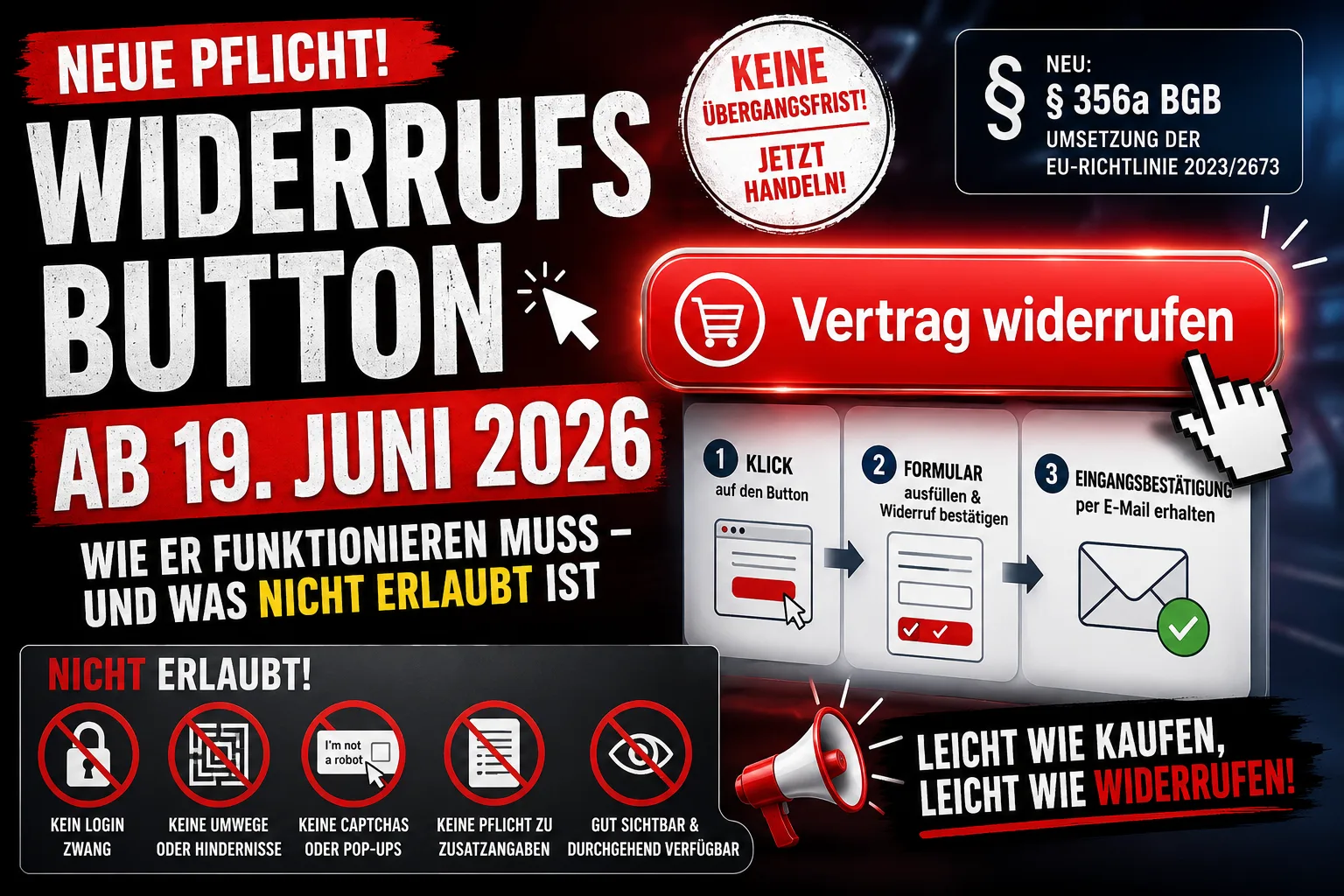
Since 19 June 2026 the withdrawal button has been mandatory. Any business that concludes contracts with consumers via an online interface must provide an electronic withdrawal function – governed by the new § 356a of the German Civil Code (BGB), which implements EU Directive 2023/2673. There is no transition period. The button applies not only to goods, but to all online business with a statutory right of withdrawal: digital content, subscriptions, online courses, services and booking flows. Pure B2B shops are not affected, nor are offers without a right of withdrawal (such as custom-made or perishable goods).
The button replaces nothing: withdrawal by e-mail, letter or phone remains permitted. It is added as an extra, simple option.
How the button must work
The core idea of the law: a contract should be as easy to withdraw from as it was to conclude online. From this the concrete requirements follow.
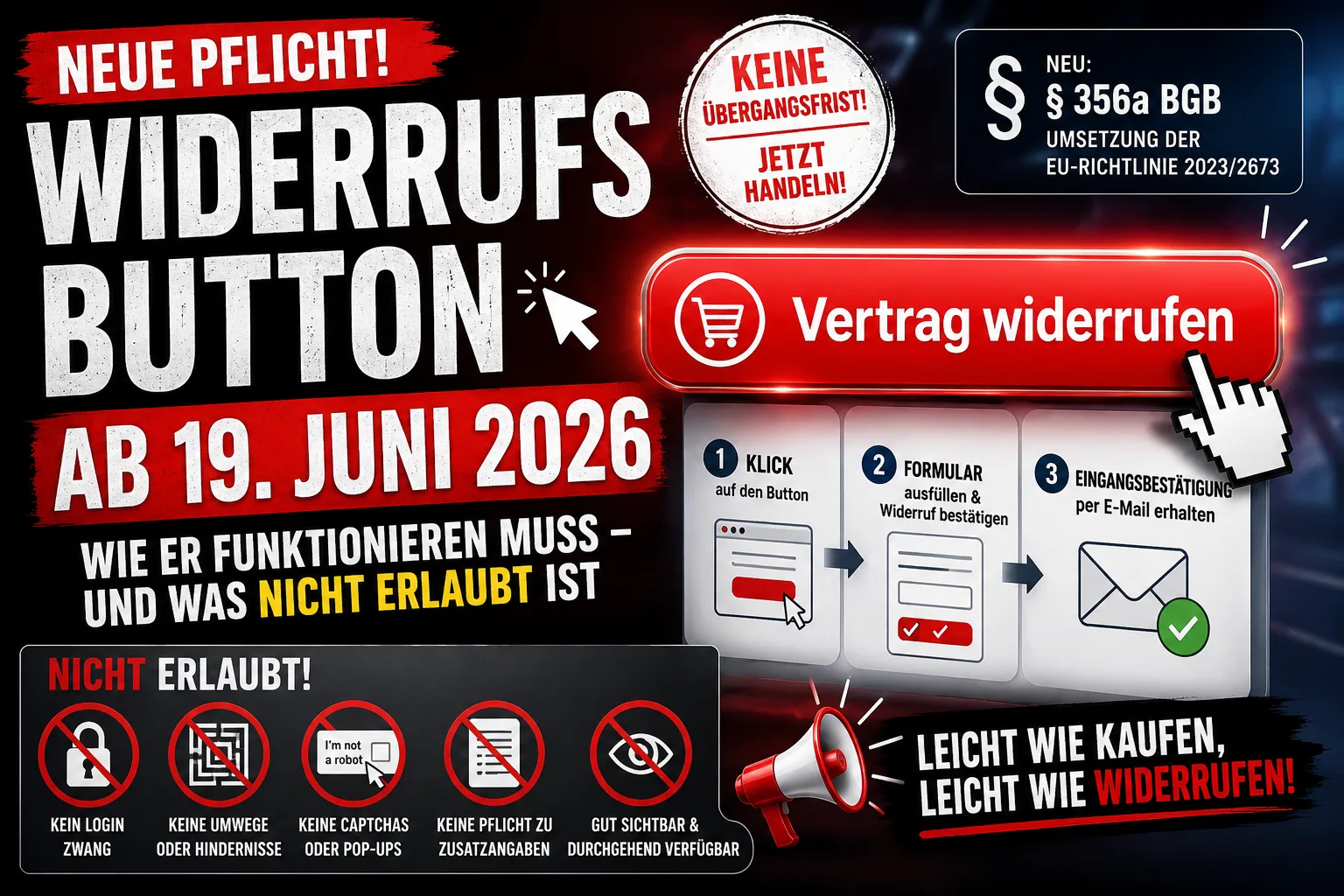
The button bears the label “Withdraw contract" or an equivalent, unambiguous wording. It must be continuously available throughout the entire withdrawal period, clearly visible and directly accessible – that is, without detours through several menu levels. The footer is only enough if the button is visually highlighted there and clearly stands out from links such as the terms and conditions, legal notice and privacy policy. In August 2026, IT-Recht Kanzlei reported a warning letter from the Wettbewerbszentrale (German Centre for Protection against Unfair Competition): the withdrawal link sat in the footer without any highlighting and only led to the form after three further steps.
A click must not trigger the withdrawal immediately. It first leads to a separate confirmation page with a form. There the consumer enters the necessary details and actively confirms the withdrawal via a second button. This two-step process is mandatory.
Immediately afterwards, the retailer must send an acknowledgement of receipt on a durable medium – in practice an e-mail. It contains at least the content of the withdrawal declaration plus the date and time of receipt. This acknowledgement only documents receipt; it says nothing about the legal effectiveness of the withdrawal.
What is allowed – and what is not
Mandatory fields may only be the details that identify the contract and enable the acknowledgement – typically order number and e-mail address. Further fields are not forbidden: the retailer may ask, for example, for the reason for withdrawal or which goods are being returned – but solely as a voluntary entry. Such additional fields must not be made mandatory or a precondition for submitting the form. For logged-in customers, known data such as name and e-mail may be pre-filled.
Not allowed is:
- making the reason for withdrawal or other extra details mandatory or a precondition for submitting;
- hiding the button behind a login, registration or app installation (exception only if the contract itself requires a customer account, such as a subscription);
- executing the withdrawal directly on click without the intermediate confirmation page;
- complicating the process with captchas, pop-ups, additional navigation steps or hidden menus, or requesting more data than necessary;
- providing the button only temporarily or hard to find (for example in the FAQ section).
In addition, the withdrawal policy must be adjusted: it must now point to the withdrawal function and its placement.
Special case: marketplaces. Anyone selling via Amazon, eBay, Etsy, Otto or Kaufland cannot install the button themselves – the technical implementation lies with the platform operator, who must provide it. eBay, for instance, is introducing it automatically; sellers there mainly have to adjust their legal texts. Responsibility for a legally compliant presence nevertheless remains with the retailer, who is the consumer's contractual partner. According to the prevailing view, the retailer bears the legal risk if a platform fails to implement the button on time or implements it incorrectly: the withdrawal period in their contracts can then extend to up to 12 months and 14 days, and a warning (Abmahnung) against them is possible. Whether the platform or the retailer is ultimately answerable has not yet been finally settled in law – what is certain is that the risk ends up with the retailer. In practice this means: check whether the platforms used offer the button correctly, and adjust your own withdrawal policy. A separately operated own shop needs the button anyway.
Consequences of breaches. If the button is missing or faulty, the withdrawal period extends from 14 days to up to 12 months and 14 days – even for goods long since used. On top of that come warnings from competitors or associations and fines that, for smaller companies, can reach up to 50,000 euros. Since compliance is easy to check from the outside, close observation is to be expected.
Anyone running their own shop should therefore set up the function immediately with their shop-system provider or agency. Shopware, WooCommerce, Shopify and others provide modules or updates for this. A clean record of incoming withdrawals – date, order number, content of the declaration – helps in case of dispute; a traceable receipt and invoice management supports this.
Try Easy Invoice free for 10 days — no payment details, the trial ends by itself.
Note: This article does not constitute legal advice. For your individual case, please consult a lawyer. The statutory text and the applicable legal situation are decisive. As of 19 June 2026.
Sources
- Noerr: Implementing act on the withdrawal button – § 356a BGB enters into force on 19 June 2026
- IT-Recht-Kanzlei: The withdrawal button in online trade – FAQ guide
- e-recht24: The withdrawal button – what online shops need to know
- Verbraucherzentrale: Withdrawal button from June 2026
- IHK Regensburg: Withdrawal button from June 2026 (with checklist)
- avalex: Comprehensive legal FAQ on the withdrawal button — mandatory vs. optional fields, captcha ban
- Händlerbund: eBay informs about the withdrawal button — implementation and responsibility on marketplaces
- Händlerbund: Withdrawal button – what it looks like, where it goes, how it works (German)
- IT-Recht Kanzlei: Warning letter over an inadequate withdrawal button, 21 August 2026 (German)
More guides on obligations, deadlines and invoicing for small businesses are available at office1.cloud.
Handle invoices more easily
Easy Invoice combines quotes, invoices and customer management in the cloud.
Try Easy InvoiceRead next
 Taxes & Law
Zusammenfassende Meldung (ZM): deadline, ELSTER and who must file
Anyone who supplies goods or invoices services without German VAT to business customers in other EU countries reports these sales to the German Federal Central Tax Office. Here you can find out who has to report, by when, what goes into the report and what happens if it is missing.
 Taxes & Law
USt-IdNr.: how to apply, how to check and when you need one
The USt-IdNr. (EU VAT ID) is a second number alongside the Steuernummer, meant for business with companies in other EU countries. You apply for it free of charge at the German Federal Central Tax Office and check your customer's number there too; here is how both work and how to find out whether you need one at all.
 Taxes & Law
Low-value assets in Germany (GWG) 2026: €800 limit, net or gross
The GWG limit in Germany is €800 net in 2026, also under the small business scheme. Which purchases you deduct at once, when the pooled item pays off and how to book it.