Collecting Customer Reviews in 2026: A Legally Compliant Guide
Customer reviews are often the first recommendation a new customer reads about you — long before they call or place an order. This guide shows you how to systematically and legally compliantly collect reviews in 2026 and how to handle criticism with confidence.
Table of Contents
- Why Reviews Matter More Than Ever in 2026
- Actively Collecting Reviews: What Really Works
- Which Platforms Make Sense for Whom
- Legal Framework 2026: These Obligations Apply
- Negative Reviews: When Removal Makes Sense
- Frequently Asked Questions
- Conclusion
- Sources
Why Reviews Matter More Than Ever in 2026
Search engines and AI assistants in 2026 rely on trust signals more than ever. Anyone who wants to appear in Google, local industry apps, or AI answers cannot avoid having active, visible customer voices. For tradespeople and local service providers, a well-maintained Google Business Profile with genuine reviews often decides whether a smartphone user calls you or picks the next result. For online sellers on eBay, Etsy, Otto Market, or their own shop, the star rating is a direct lever on click-through rates.
At the same time, the legal framework is clear: reviews must be genuine, and you must explain how you ensure this. Anyone who cheats risks cease-and-desist warnings or worse. That may sound stressful at first — but anyone who does it right has built a clean, sustainably reliable marketing channel.
What does this mean for you? Reviews are no longer a 'nice extra' but a systematic part of your customer relationship. Those who actively ask for them and present them transparently win.
Actively Collecting Reviews: What Really Works
First things first: most satisfied customers will not leave a review unless you politely ask them. If you don't ask, you don't hear.
The right moment. Ask right after the positive experience. In a hair salon, that's when paying. For a painter who has just finished a living room, it's during the final walkthrough with the customer. For an Etsy seller, about three to five days after delivery, when the product has been unpacked and used.
A concrete practical path — example: a painting business in Cologne:
- At the handover, the owner says personally: "If you're happy, a short Google review would really be worth gold to us."
- The invoice carries a QR code that leads directly to the Google review link.
- Three days after job completion, the customer receives a short, personal email with the link.
- Anyone who leaves a review gets a brief thank-you message.
What makes the difference. A personal request at the end of a successful job is significantly more effective than an anonymous mass newsletter. Keep the request short and concrete. Send at most one reminder — otherwise it slides into harassment.
**What you must not do.** Buying reviews, hiring employees to post positive reviews, or asking friends to leave a five-star entry without any customer contact. That is clearly impermissible and can become expensive (more on this below). Luring with discounts or contests in exchange for a positive review is also problematic — incentives are generally tricky and should, if at all, be entirely independent of the content of the review and transparently labelled.
Which Platforms Make Sense for Whom
Not every platform fits every business. Focus on two or three channels and maintain them consistently — that has more impact than ten half-dead profiles.
Local service providers and tradespeople benefit most from the Google Business Profile — the central visibility channel for local searches. Industry portals such as trade directories can complement this if your target group actually searches there.
Online sellers should collect reviews where the sale happens: marketplace-internal review systems (eBay, Amazon, Etsy, Otto Market) are essential. For your own shop, a recognised trust seal with a review function is a useful addition — it improves trust and visibility, but is paid.
B2B service providers (coaches, consultants, IT solos, photographers) usually get reviews via Google, LinkedIn recommendations, and industry-specific portals. A dedicated reference section on your website with quotes and before-and-after examples is also a valuable addition.
Legal Framework 2026: These Obligations Apply
Here comes the part that many overlook — and that quickly gets expensive.
Transparency obligation (Section 5b (3) of the German Unfair Competition Act, UWG). Since May 2022, online retailers displaying reviews in Germany must clearly disclose whether they ensure the reviews actually come from consumers who used the product or service — and how they verify this. This information must be easy to find, usually in the context of the reviews themselves. There is no obligation to verify, but a disclosure obligation about whether and how verification takes place.
Fake reviews are prohibited. Purchased, fabricated, or selectively hidden reviews violate the law against unfair competition. The same applies when reviews of other sellers are manipulated — the classic move that regularly leads to marketplace suspensions. Violations can be cited by competitors and consumer protection authorities; in individual cases, substantial fines or even criminal consequences may apply.
Active enforcement. Consumer protection authorities monitor this topic systematically. A sample of 462 websites in 2025 led to 122 warning letters because of missing or insufficient indications of the verification procedure — a risk that even small shops face.
What you should concretely do:
- Place a short, clearly visible note in your shop, for example: "We verify whether reviews come from genuine buyers by only offering a review option to authenticated orders." — or, if you do not verify: "We do not check whether reviewers actually bought the product."
- For platform reviews (Google, eBay, Etsy), the platforms handle the verification logic — your obligation begins where you actively embed reviews in your own advertising (e.g. star ratings on your website).
- Never advertise with unverifiable promises such as 'over 1,000 satisfied customers' without solid data.
Negative Reviews: When Removal Makes Sense
A bad review is not a drama — as long as you respond professionally. A short, polite public reply shows other readers that you take criticism seriously.
For clearly unjustified reviews — abusive criticism, insults, reviews without actual customer contact — you have a strong position. The German Federal Court of Justice (BGH) ruled on 9 August 2022 (case no. VI ZR 1244/20) that even substantiated doubts about customer contact may be enough to oblige the platform operator to verify a review. You therefore do not have to prove that the review is false — you have to make it plausible that the person was presumably not a customer.
A three-step approach:
- Report the review using the platform's function, with a precise justification (violation of guidelines, no customer contact, insult, etc.).
- If no response: written request to the platform operator.
- If that remains unsuccessful and the damage is real: bring in a lawyer.
In many cases, platforms remove reviews that clearly violate guidelines within a few days. In more complex cases, the German Federal Court of Justice ruling of 25 July 2024 (case no. I ZR 143/23) may help — it held that under certain conditions the identity of a reviewer must even be disclosed. In practice, this remains the exception and should be handled by a lawyer.
Frequently Asked Questions
Am I allowed to ask customers for a review?
Yes. A friendly, personal request for an honest review after a successful job is permitted and customary. It becomes impermissible if you tie a positive review to a benefit or pay for it.
What must I disclose when displaying reviews in my shop?
You must clearly explain whether you verify that reviews come from real buyers — and how. If you do not verify, you must state that transparently as well. The legal basis is Section 5b (3) UWG.
Are contests for reviews allowed?
Tricky. If participation only depends on positive reviews, that is a clear violation. Even for rewards for honest reviews, you must transparently disclose that reviewers received an incentive. When in doubt: avoid.
How do I publicly respond to a bad review?
Short, polite, factual. Thank the customer for the feedback, signal understanding, and offer a solution — even if the review is unfair. Other readers see above all your behaviour.
How quickly is an unjustified Google review removed?
It depends on the case. For clear violations of platform guidelines (abusive criticism, spam, competitor entries), platforms often react within a week; in more complex cases, it can take significantly longer and require a lawyer.
Conclusion
In 2026, customer reviews are one of the cheapest and strongest growth levers — if they are systematically collected, presented transparently, and answered professionally. Anyone who actively invites reviews instead of hoping for them wins more customers and is at the same time on the safe side regarding applicable transparency rules. If you already invoice your jobs with PepperTools, the review request is a small step at the end of the existing process — for example as a note on the invoice or in the shipping confirmation.
Sources
- Section 5b (3) UWG – Information obligations for consumer reviews (commentary, omsels.info) — Detailed legal overview of the disclosure obligation for online reviews.
- Verbraucherzentrale Bundesverband: Lack of transparency in online reviews — Study from 2025 with 462 websites checked and 122 warning letters issued.
- Händlerbund: Notice on the authenticity of reviews — Practical guide for implementing the disclosure obligation in online shops.
- German Federal Court of Justice: Press releases and rulings — Official source for decisions VI ZR 1244/20 (9 Aug 2022) and I ZR 143/23 (25 Jul 2024) on Google reviews.
- Handwerk-Magazin: How tradespeople collect good online reviews — Practical background on acquisition methods for local businesses.
Disclaimer: This article does not constitute tax or legal advice. For your individual case, please consult a tax adviser or lawyer.
Handle invoices more easily
Easy Invoice combines quotes, invoices and customer management in the cloud.
Try Easy InvoiceRead next
 Marketing & SEO
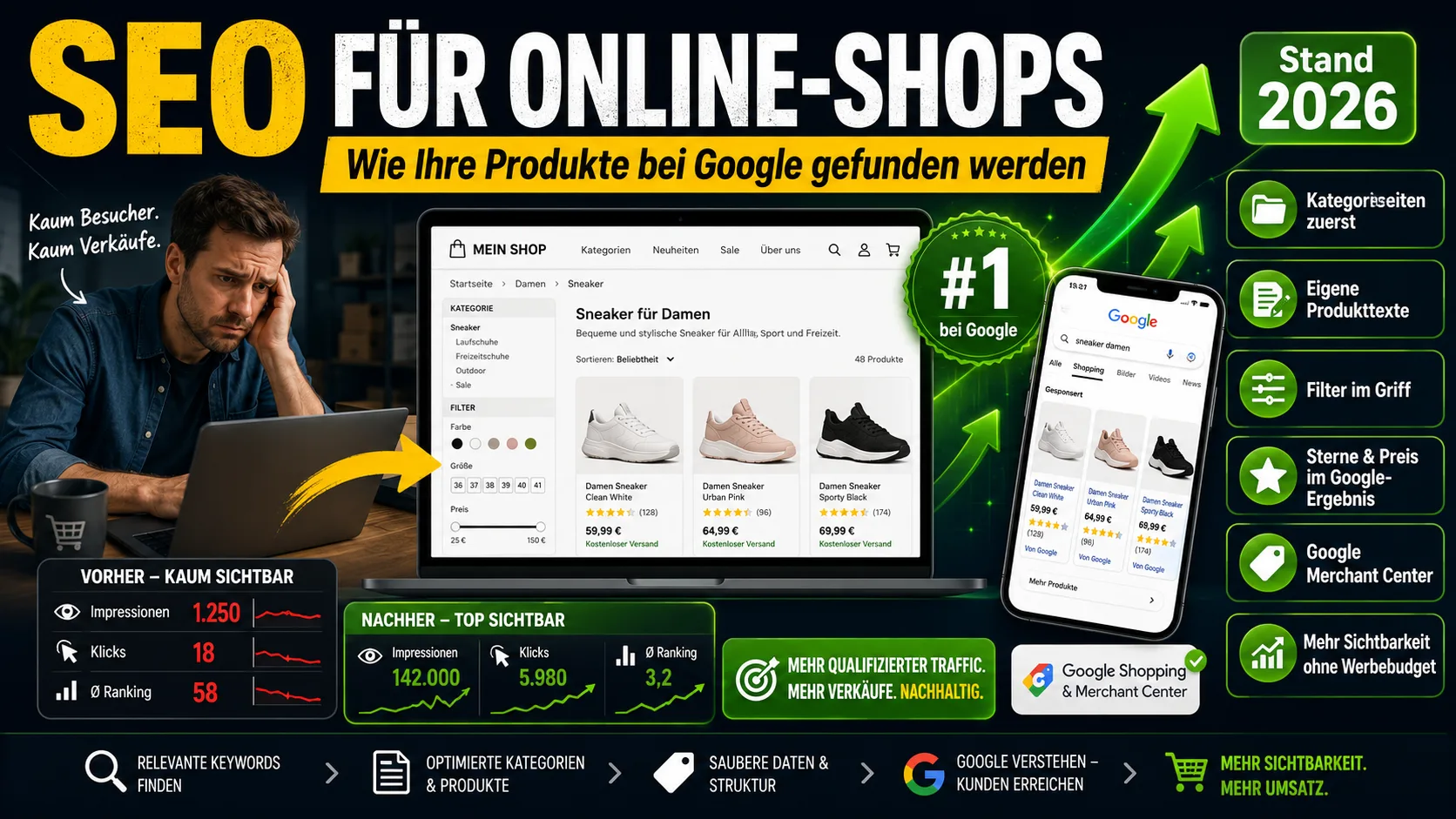
SEO for Online Shops: How Your Products Get Found on Google (2026)
Shop SEO works differently from ordinary website SEO. What really counts on category and product pages – without the technical jargon.
 Marketing & SEO
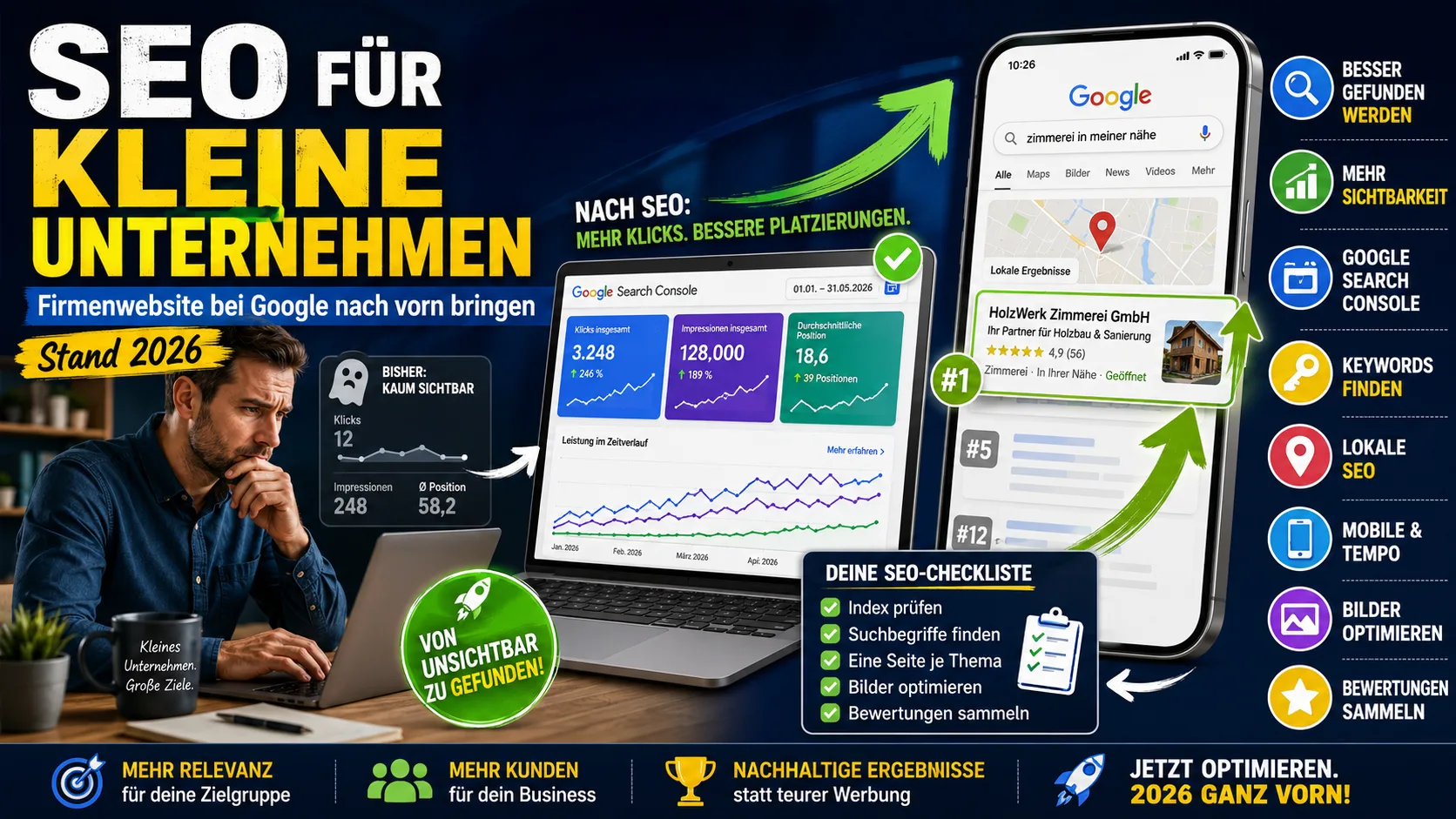
SEO for small businesses: getting your company website to the top of Google (as of 2026)
Starting from scratch: are you even on Google? Why you are not being found, what you can change yourself in three weeks – and what you can safely skip.
 Marketing & SEO
Getting a Website Built: Costs & Process for Freelancers and Small Businesses Like Tradespeople
What does it cost to have a website built? Real prices, what belongs on a 2026 site, and how the process works – for freelancers and small businesses like tradespeople.