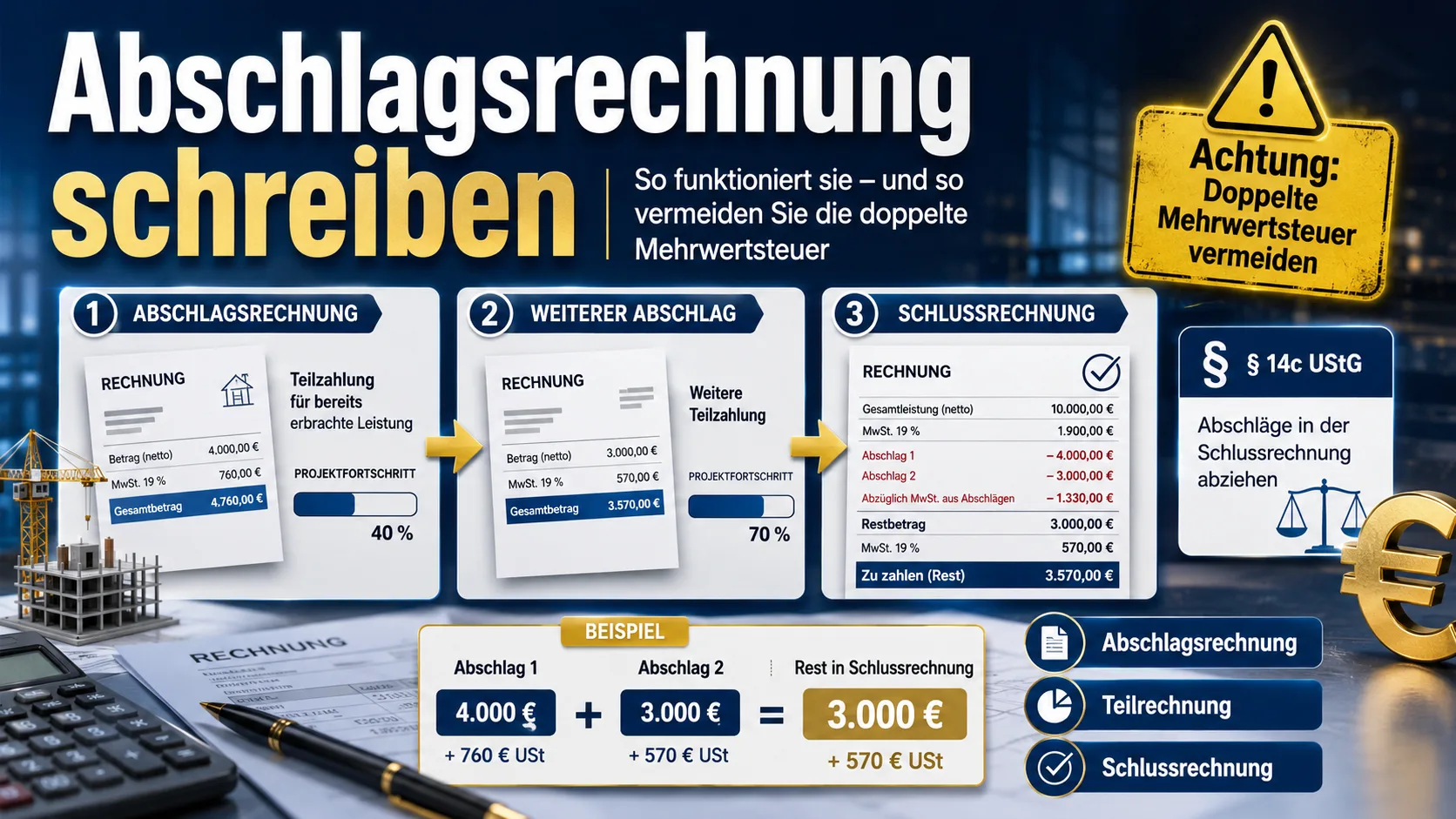
Writing a progress invoice: how it works – and how to avoid double VAT
If you work on a larger project for weeks or months, you don't want to see your money only at the very end. That's exactly what the progress invoice (German: Abschlagsrechnung) is for: you invoice partial amounts during the project and secure your cash flow. Sounds simple – and in daily practice it is. Only the final invoice (Schlussrechnung) hides an expensive trap that has landed many with double VAT. This article explains both: first the practice, then the legal background.
What a progress invoice is
A progress invoice is an interim invoice for parts already delivered of a service that isn't yet complete. Typical cases: a construction order over several months, an extensive web project, a larger consulting engagement. Instead of issuing one big invoice at the end, you request your money in stages.
The distinction matters:
- Progress invoice (Abschlagsrechnung): the overall service isn't finished yet. You request an advance on what has been delivered so far. Everything is reconciled at the end.
- Partial invoice (Teilrechnung): a clearly delimited, accepted part of the service is invoiced definitively.
- Final invoice (Schlussrechnung): at the end of the order. It bills the total service and deducts the advance payments already made.
Legally, as a contractor on works contracts you even have a right to advance payments for services already rendered (§ 632a of the German Civil Code, BGB) – so you don't have to carry the cost until everything is finished. If you want money before you even start, that is not a progress payment but an advance payment or prepayment – how to agree it and invoice it is explained in Advance payment invoice and prepayment.
If you want to write invoices with all mandatory details in a few minutes, you can try the invoicing software Easy Invoice free for 10 days.
An example in figures
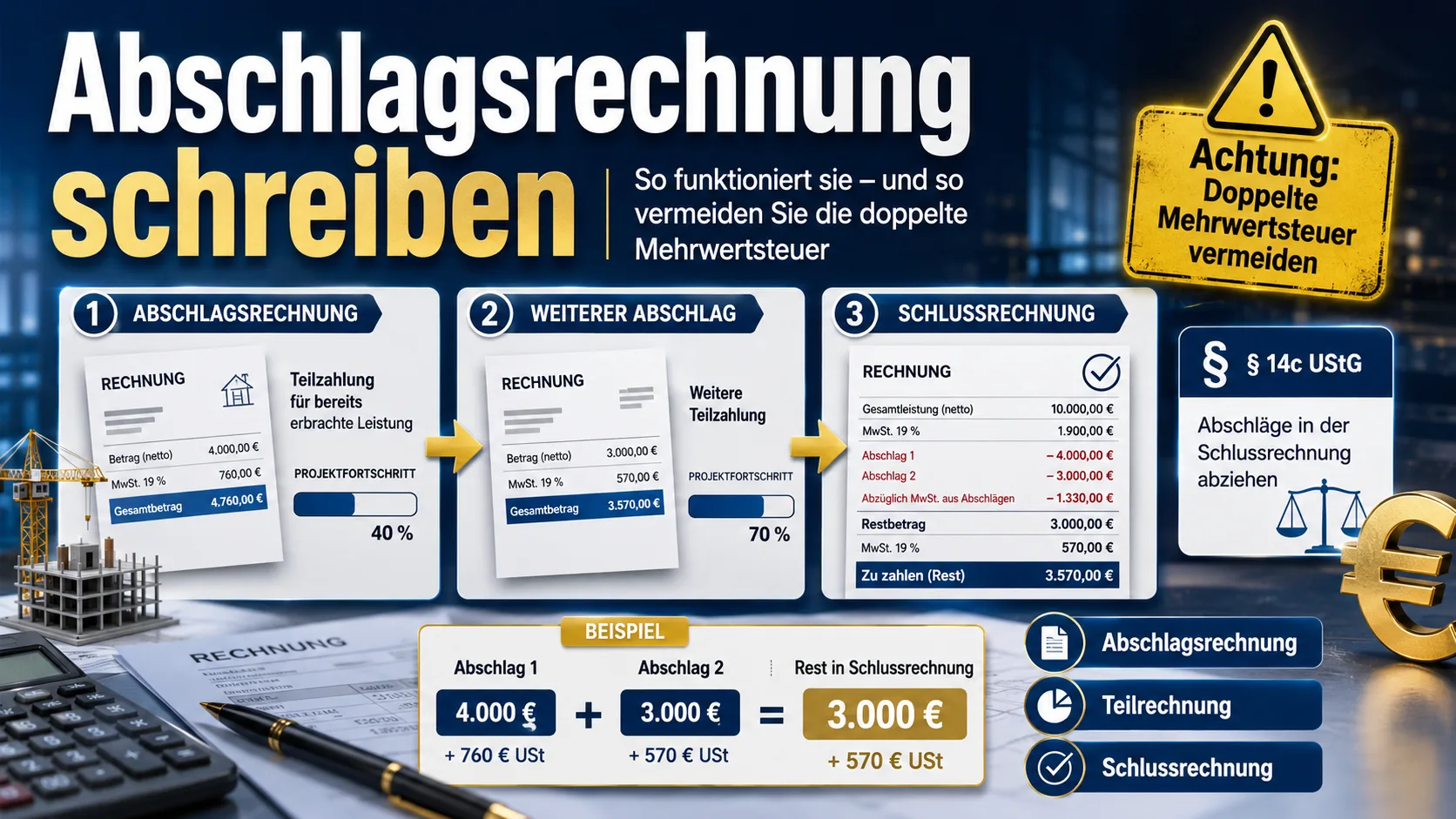
Suppose your order comes to 10,000 € net plus 19% VAT. During the project you issue two progress invoices, and the final invoice at the end:
- Progress invoice 1 (paid): 4,000 € net + 760 € VAT = 4,760 €
- Progress invoice 2 (paid): 3,000 € net + 570 € VAT = 3,570 €
Final invoice:
- Total service: 10,000 € net, 1,900 € VAT, 11,900 € gross
- less progress invoice 1: 4,000 € net / 760 € VAT
- less progress invoice 2: 3,000 € net / 570 € VAT
- Remaining amount: 3,000 € net + 570 € VAT = 3,570 €
At the end you only invoice the open remainder – you already paid the VAT on the advances when they were paid. Why the correct deduction matters so much, see below.
What belongs on the progress invoice
A progress invoice is a full invoice and needs all the usual mandatory details (see also our guide to writing an invoice). Two things are particularly important:
- Mark it clearly as a “progress invoice". If this note is missing, the tax office can treat the document as a normal invoice – with immediate, full VAT liability.
- Reference to the order and a description of the service delivered so far.
When the VAT becomes due
This is where the progress invoice differs from a normal invoice. For advances, the VAT only arises upon receipt of payment – not when the invoice is written (§ 13 (1) no. 1a sentence 4 of the German VAT Act, UStG). Concretely: only when the customer pays the advance do you have to remit the VAT on it in your next advance return. A progress invoice that has been written but not paid does not yet trigger any tax.
The final invoice – where the expensive mistakes happen
At the end of the order you issue the final invoice. It shows the entire service and deducts the advances already received. This deduction is exactly the tricky point.
The rule (§ 14 (5) UStG): in the final invoice the partial amounts collected in advance and the VAT attributable to them must be deducted, provided you issued invoices with VAT shown for the advances. So it's not enough to deduct only the net amounts – the VAT already remitted on the advances must also be visibly netted out.
The cleanest way is to list each individual progress invoice with date, invoice number, net amount and tax amount and deduct it (see the worked example above). That keeps it traceable for everyone – including a tax audit – that nothing was billed twice.
The double-VAT trap (§ 14c UStG)
The classic mistake: in the final invoice the VAT is shown again on the full amount, without deducting the VAT of the advances. Then you owe the tax office the VAT twice – once from the advances and once from the final invoice. The basis is § 14c UStG: anyone who shows VAT too high or twice also owes the excess amount until the invoice is corrected. For the customer, the input-VAT deduction may also be at risk.
Only the advances actually paid are deducted. If a progress invoice was issued but not paid, no VAT has arisen on it yet – the open amount is then automatically contained in the remaining amount of the final invoice.
Special case for small businesses: anyone who shows no VAT under § 19 UStG doesn't have this problem – no tax appears on the progress or final invoice, but the usual small-business note does.
How to avoid mistakes in daily practice
Reconciling by hand is error-prone – especially with several advances. Software that automatically offsets advances and the final invoice correctly takes exactly this calculation and the double-VAT risk off your hands. In Easy Invoice, the entire flow from progress invoice to final invoice is built in, including clean tax deduction. And to make sure the money actually arrives, consistent dunning helps.
Note: This article does not constitute tax or legal advice. For your individual case – especially with construction services, reverse charge or cash/accrual taxation – please consult a tax adviser. As of 20 June 2026.
Sources
- § 14 (5) UStG (gesetze-im-internet.de) — deduction of partial amounts and tax in the final invoice
- § 13 UStG (gesetze-im-internet.de) — when tax arises on advances upon receipt
- § 14c UStG (gesetze-im-internet.de) — incorrect and unauthorized VAT statement
- § 632a BGB (gesetze-im-internet.de) — right to advance payments
- Haufe: Showing VAT correctly in the final invoice — practice and double-taxation risk
Handle invoices more easily
Easy Invoice combines quotes, invoices and customer management in the cloud.
Try Easy InvoiceRead next
 Invoicing & Accounting
Showing a discount on an invoice in Germany: template, VAT, example
A discount is deducted from the net amount, and VAT is calculated afterwards. Here are two templates to copy, the rules for discount codes and vouchers, and what applies if you grant the reduction only after the invoice.
 Invoicing & Accounting
Freelancer invoices in Germany: template, required details, VAT
As a freelancer (Freiberufler) in Germany, you write invoices without registering a trade, but with the same mandatory details as any business. One question decides: do you add VAT or not? Here you find the answer for your case and a template for each of the three cases.
 Invoicing & Accounting
Retention periods 2026: invoices, receipts and what may go in 2027
Since 2025, eight instead of ten years have applied to invoices and other accounting vouchers (Buchungsbelege). The table shows all periods, when they start, when they run longer and which folders you may clear out at the start of 2027.