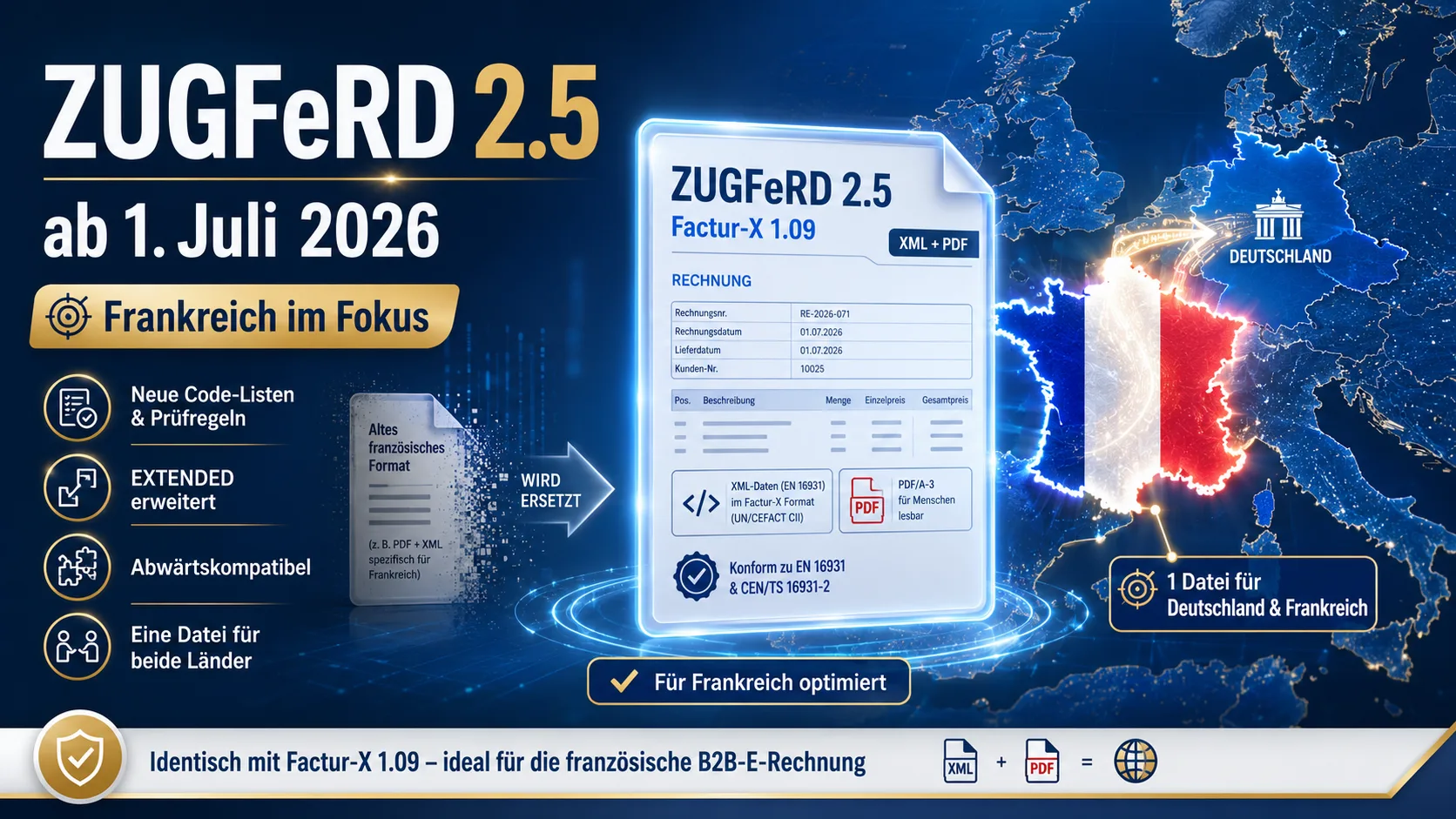
ZUGFeRD 2.5 is here. The new version of the e-invoice format has been available since 10 June 2026 (in France: Factur-X 1.09) and should be used from 1 July 2026. These are the changes:
- Updated code lists and validation rules. The lists (e.g. for countries, currencies, tax categories) have been raised to the current status of the EU standard EN 16931. This affects the technical check in the background, not your input.
- Extensions in the "EXTENDED" profile. Newly possible are, among other things, negative unit prices at line level, additional payment details and payments on behalf of third parties. Intended for more complex cases – standard invoices remain untouched.
- Better compatibility with the French B2B mandate. If you invoice to France, one single file is now enough (details below).
- Fully backwards compatible. Invoices in older profiles remain valid and readable.
- Gross invoices to follow later. This announced function will be added in a second step – relevant mainly for the book and publishing trade, not for the typical service or trade invoice.
In brief: what is ZUGFeRD anyway?
ZUGFeRD is a PDF invoice with an invisible "information leaflet". The PDF looks the same as always and can be opened and printed normally. Embedded inside it is an additional structured XML file with all the invoice data – amount, tax rate, line items, payment terms. The recipient's accounting software reads this data in automatically.
The advantage: your invoice is readable both by humans and by machines. That is exactly why ZUGFeRD (from the "EN 16931" profile onwards) meets the requirements of a genuine e-invoice. You can read why this is becoming increasingly important in our guide on the e-invoicing obligation for 2027 and 2028.
Do I now have to issue an e-invoice as a business?
It's worth keeping two things clearly apart here – because not everyone is affected in the same way.
The e-invoice only applies to B2B. The structured format only gradually becomes mandatory for invoices between domestic companies. Invoices to private customers (B2C) are not covered – here you can still send a normal PDF or paper invoice.
Small-business owners do not have to issue an e-invoice. Anyone who uses the small-business rule under Section 19 of the German VAT Act (§ 19 UStG) is permanently exempt from the obligation to issue and may continue to send a simple invoice. However: every business has had to be able to receive e-invoices since 2025 – an email address is enough for that. What exactly counts as a small-business owner and where the pitfalls lie is shown in our article on the small-business regulation 2026.
"Small business" is not a tax term. Don't confuse them: "small business" or "small company" says nothing about VAT. What matters is whether you are a small-business owner under § 19 UStG or subject to standard taxation. Only the latter will issue e-invoices in B2B in future.
And if I do have to issue e-invoices? Then ZUGFeRD 2.5 is still no extra work: well-maintained software builds and updates the format in the background. You write your invoice as always – the correct version is created automatically when the PDF is generated. Only two groups need to lend a hand: those who create ZUGFeRD files manually or via their own script, and those using outdated software that is no longer being developed. You'll find the basics on the invoice itself in our guide to writing an invoice.
To check an XRechnung or ZUGFeRD file, use the free e-invoice viewer by Office1, which displays the file readably without signing up.
For the technically minded: which fields were touched?
If you want to know exactly – here are the concrete nodes that are new or changed in ZUGFeRD 2.5 (the "EXTENDED" profile). You don't need to know this for day-to-day work; your software handles it.
| Level | New feature |
|---|---|
| Document | Tax exemption reasons (text and code) added for charges and allowances |
| Document | New payment details BT-215 / BT-216 (BIC and name of the payment service provider) |
| Document | New group BG-34 "Payments on behalf of third parties" (with BT-179, BT-180) |
| Line | BT-177 / BT-193 extended with the scheme identifier @ListID (code list 1153, except "VAT") |
| Line | Negative unit prices now permitted – with adapted business rules |
| Cardinality | BT-160 / BT-161 changed from mandatory to optional (0..1); allows either BT-161 or BT-X-12, not both |
| Validation | Schematron + XSD for all five profiles at EN 16931 level; based on UN/CEFACT CII D22B, backwards compatible with D16B |
What does "better for France" mean? France is introducing a mandatory B2B e-invoice; its national format is Factur-X – and ZUGFeRD 2.5 is technically identical to Factur-X 1.09. The new scheme identifiers (@ListID on the tax/ID fields) and the payment group BG-34 ensure that a German ZUGFeRD invoice is cleanly accepted by the French mandatory system. The practical benefit: anyone with customers in both Germany and France no longer needs a second format – one file works for both countries.
How office1.cloud handles this
In the invoicing software of the PepperTools Office Cloud you create ZUGFeRD and XRechnung files directly from the document – without worrying about format versions. We continuously roll out format updates such as ZUGFeRD 2.5 centrally, so that your e-invoices reflect the current status of EN 16931 – without you having to install or change anything.
Want to try it out? You can test the platform free for 10 days – no risk. Start straight away here: try office1.cloud for free. You can read more about the range of functions in our article Easy Invoice is live. How to produce a ZUGFeRD invoice step by step is explained in creating a ZUGFeRD invoice.
This article provides general information and does not replace tax or legal advice. For your specific case, please contact your tax adviser.
Handle invoices more easily
Easy Invoice combines quotes, invoices and customer management in the cloud.
Try Easy InvoiceRead next
 Invoicing & Accounting
Showing a discount on an invoice in Germany: template, VAT, example
A discount is deducted from the net amount, and VAT is calculated afterwards. Here are two templates to copy, the rules for discount codes and vouchers, and what applies if you grant the reduction only after the invoice.
 Invoicing & Accounting
Freelancer invoices in Germany: template, required details, VAT
As a freelancer (Freiberufler) in Germany, you write invoices without registering a trade, but with the same mandatory details as any business. One question decides: do you add VAT or not? Here you find the answer for your case and a template for each of the three cases.
 Invoicing & Accounting
Retention periods 2026: invoices, receipts and what may go in 2027
Since 2025, eight instead of ten years have applied to invoices and other accounting vouchers (Buchungsbelege). The table shows all periods, when they start, when they run longer and which folders you may clear out at the start of 2027.