
If you run an ordinary Kleingewerbe — a small trade business — you do not have to enter the commercial register. Not with two employees, not with 200,000 euros in turnover, not with an online shop. German law sets no turnover threshold that pulls you in automatically. The duty only starts once your business becomes so large and branched that it could no longer be run without commercial organisation — with stock, several locations, many contracts, a larger workforce (section 1 (2) HGB, the German Commercial Code).
You may still register voluntarily (section 2 HGB). Whether that pays off is an arithmetic problem with a clear answer: for small businesses the drawbacks outweigh the benefits. You pay 105 euros to the court once, plus a notary, you may lose your chamber of commerce fee exemption, you have to put four extra details on every invoice from then on — and you still have unlimited personal liability. The suffix „e.K." is not a limitation of liability. In return you get a protected business name that you can sell along with the business later on.
And if you have missed a duty? Your invoices and contracts remain valid. The register court will call on you to file, and can enforce that with a penalty payment — more on that below.
Contents
- When is the entry mandatory? There is no turnover threshold
- A client wants my commercial register number — what do I write?
- The 800,000 euros you may have heard about
- And if I should register but do not?
- With or without an entry? Side by side
- Registering voluntarily: when it is worth something
- What the entry costs
- Does it pay off? What the entry changes about your money for good
- What changes on your invoices after the entry
- Sole trader, GbR, freelancer: who belongs in which register?
- Trade number, register number, tax number: which number is which?
- Commercial register extract: where to get one
- Getting out of the register again
- Answered briefly
When is the entry mandatory? There is no turnover threshold
This is the question almost everyone asks — and the most disappointing answer in this whole text: German law names no figure. No turnover, no profit, no headcount.
Section 1 (1) HGB says: „A merchant within the meaning of this Code is anyone who operates a commercial business." And subsection 2 says what a commercial business is: „any trade business, unless the undertaking does not require a commercially organised business operation by nature or size."
That is clumsily worded, but it means something you can picture: has your business become so large and so tangled that you could no longer keep a grip on it without commercial organisation? That is, without orderly bookkeeping, without a stock overview, without someone in the office?
Whoever judges that looks in practice at a bundle of indicators:
- Turnover and profit — not as a fixed limit, but as an order of magnitude
- Number of employees
- Number and type of business transactions — 30 invoices a year is something different from 3,000
- Stock and inventory
- Loans, guarantees, ongoing contracts
- Several locations or branches
- Business abroad
None of these features decides on its own. The overall picture is what counts.
What to do with this: if you nod at one or two points at most, the matter is settled — you are not a merchant. If you nod at half of them, call your chamber of commerce or chamber of skilled crafts and describe the business in three sentences. The chambers work with their own reference values that are not in the statute and differ by region; the enquiry is free for members, and you are a member anyway. That is the only route that gives you a reliable answer for your business — every figure you find on the internet about this is guesswork.
If someone believes you have crossed the threshold, they usually get in touch by themselves: the register court is alerted to larger businesses via the chamber or the trade office and calls on you to file. Section 29 HGB obliges every merchant to file „his business name, the place and the domestic business address of his commercial establishment" for entry. Anyone who ignores that call risks a penalty payment.
For the vast majority of small trade businesses the answer stays no. A tradesman with two journeymen, an online shop with 400 orders a year, a photographer with a trade licence: none of these is a case for the commercial register.
Note: this article explains the legal position in general terms and does not replace legal advice. If you are unsure whether your business reaches the threshold, ask your chamber of commerce or chamber of skilled crafts — the enquiry is free for members — or your tax adviser.
Receipts, bank transactions and the export for your accountant are bundled in the Easy Invoice accounting software in one place.
A client wants my commercial register number — what do I write?
Most people arrive at this question for exactly this reason: a business client sends a supplier form, a marketplace wants to unlock the seller account, a bank is checking the business account — and somewhere there is a mandatory field marked „commercial register number". You do not have one. Now you are sitting in front of it wondering whether you have missed something.
Almost certainly you have not. A Kleingewerbe has no commercial register number because it is not in the commercial register. That is not a defect, it is the normal case.
What to do instead:
- Leave the field empty or write „not entered in the commercial register". That is a complete and correct answer.
- If the form insists on something, give your tax number — for business inside the EU, your VAT identification number. That is what the other side actually needs in nearly every case.
- Your trade registration serves as proof. The trade licence shows that you run a registered business. Many purchasing departments accept it for exactly that purpose.
- Do not let yourself be pushed. No client can demand that you register. If a marketplace makes a register entry a condition, that is its terms of business — not the law.
Only once orders repeatedly fall through because of it does a voluntary entry become a real calculation. What it gains you and what it costs is set out below.
The 800,000 euros you may have heard about
If you stumbled across the figures 800,000 euros turnover and 80,000 euros profit while searching: those belong to a different question.
They are in section 241a HGB and govern which registered sole trader does not have to keep double-entry books despite the entry. Anyone who stays below both values on two consecutive balance sheet dates may stay with the simple cash-basis income statement.
The difference matters:
| Question | Answer is in | Figure in the statute? |
|---|---|---|
| Must I enter the commercial register? | s. 1 (2) HGB | no |
| Must I prepare a balance sheet once registered? | s. 241a HGB | yes: 800,000 € / 80,000 € |
So the 800,000 euros are not an entry ticket to the register. They are a relief for people who are already in it.
And if I should register but do not?
This worry drives most people here, so here is the answer first: nothing you have done so far becomes invalid because of it.
- Your invoices stay valid. VAT follows the VAT Act, not the commercial register. Your documents keep their value with the tax office.
- Your contracts stay valid. Anyone who is obliged to register as a merchant but does not do so remains a merchant — they are simply not visible. Deals you have concluded hold.
- There is no back payment to the court for the years in which you were not registered.
What actually happens: the register court becomes aware of you — usually via the chamber of commerce or the trade office — and calls on you to file. If you do not comply, it imposes a penalty payment. Section 14 HGB caps the individual penalty payment at 5,000 euros. It is not a punishment but a means of pressure: as soon as you file, it is over.
The more unpleasant part is a different one. As a merchant you are measured against commercial law whether you are registered or not. The duty to give notice of defects when buying goods (section 377 HGB) then applies to you too — and in a dispute that can cost more than any penalty payment.
With or without an entry? Side by side
This is your decision basis at a glance. The details are in the sections below.
| without entry | with entry (e.K.) | |
|---|---|---|
| Your name in business dealings | your first and last name | free business name with the suffix „e.K." |
| Details on invoices | the usual mandatory details | plus business name, place, register court, register number (s. 37a HGB) |
| Liability | full, with your private assets | unchanged full, with your private assets |
| One-off costs | none | 105 € court + notary |
| Chamber of commerce fee | exemption up to 5,200 € trade income, founder relief for up to 4 years | these exemptions fall away (s. 3 (3) IHKG) |
| Trade tax | allowance of 24,500 € | allowance of 24,500 €, unchanged |
| Bookkeeping | cash-basis income statement | cash basis up to 800,000 € turnover / 80,000 € profit (s. 241a HGB) |
| Notice of defects when buying | ordinary deadlines | without delay, otherwise the goods count as approved (s. 377 HGB) |
| Name protection | only via trade mark and name law | protected in the district of the register court |
| Selling the business later | the name is not part of the package | the buyer may continue the business name (s. 22 HGB) |
| every later change | notification to the trade office | filing via the notary, with a fee again |
Registering voluntarily: when it is worth something
Section 2 HGB allows you the entry even when you do not have to. With the entry your business counts as a commercial business and you are a merchant — with all the rights and all the duties.
In favour:
- You get a business name. Without an entry you are called in business dealings whatever your identity card says. With an entry you may run a „Firma", a business name such as „Schuster Maler e.K." that does not have to be merely your surname.
- You look bigger. Some clients, landlords and banks read a register entry as a sign of permanence. That is not provable, but often noticeable.
- You can grant Prokura — a broad power of representation for an employee that is visible in the register.
- Your name is protected. In the district of the register court nobody else can register under the same business name.
Against:
- You are measured against commercial law. For example the duty to give notice of defects: a merchant buying goods must report defects without delay, otherwise the goods count as approved (section 377 HGB). As a non-merchant you have considerably more room.
- You are publicly visible. Your name, your business address and who may sign for the business can be looked up by anyone.
- Every change costs again. A move, a change of name, new partners: everything has to be filed, everything through the notary.
- Getting out takes an application — more on that below.
And one point that is often overlooked: under section 5 HGB, once you are registered you can no longer argue to a business partner that you do not operate a commercial business at all. The entry works in the other side's favour.
What the entry costs
Two items come together: the court fee and the notary's costs.
The court fee is fixed — it follows from the annex to the German commercial register fee regulation:
| First entry in division A | Fee number | Fee |
|---|---|---|
| Sole trader (e.K.) | 1100 | 105.00 € |
| OHG or KG with up to 3 partners | 1101 | 150.00 € |
| each further person beyond that | 1102 | + 60.00 € |
You have to see a notary in any case. Section 12 (1) HGB requires the filing to be submitted „electronically in publicly certified form". So you cannot hand the form in at the court yourself. For some years the certification has also been possible by video.
The notary's fee follows what is called a Geschäftswert, a transaction value. That is a pure calculation figure from the fees act — not the value of your business, and you obviously do not pay that sum. For the first filing of a sole trader it is 30,000 euros (section 105 (3) GNotKG), for an OHG or GbR with two partners 45,000 euros, plus 15,000 euros for each further partner. For orientation: a transaction value of 30,000 euros corresponds to a full fee of 125 euros in the GNotKG fee table, and 45,000 euros to 155 euros. What the notary charges is a legally fixed proportion of that — depending on whether they merely certify your signature or also draft the filing. Expenses and VAT come on top. The notary may not deviate from these rates, so haggling is pointless. Ask for a cost estimate when you make the appointment and the sum is settled in advance.
Does it pay off? What the entry changes about your money for good
The 105 euros are the smaller issue. What is more interesting is what the entry costs year after year — and there is one item that almost nobody has on their list.
The drawback: you lose your chamber of commerce exemptions
You are a compulsory member of the chamber of commerce as a trader anyway, registered or not. But the fee exemptions in the German chambers of commerce act are expressly tied to one thing: that you are not in the commercial register.
| Exemption under s. 3 (3) IHKG | Requirement | after the entry |
|---|---|---|
| no fee with trade income up to 5,200 € | natural person, not registered | falls away |
| founders, years 1 and 2: free of the basic fee and the levy | not registered, income up to 25,000 € | falls away |
| founders, years 3 and 4: free of the levy | not registered, income up to 25,000 € | falls away |
So anyone who registers voluntarily in the early years gives up a relief that would otherwise have run for four years. How high the fee is afterwards is set by each chamber itself — it is in your chamber's fee schedule.
What does not change
- Trade tax. The allowance of 24,500 euros applies to natural persons and partnerships (section 11 (1) no. 1 GewStG). A registered sole trader remains a natural person. The allowance stays with you.
- Your liability. This is the most important misconception here: an „e.K." still has unlimited liability with their entire private assets. The two letters look like a limitation of liability but are not one. Anyone who wants that needs a GmbH or UG — and thus an entirely different procedure.
- Your bookkeeping, as long as you stay below the limits of section 241a HGB.
- Your VAT. The small business rule and the register entry have nothing to do with each other.
The benefit comes at the end
There is one hard financial benefit, and it only shows when you stop: under section 22 HGB, a buyer of your business may continue the existing business name if you consent. An established name thereby becomes something transferable — part of the purchase price on a sale or a handover to the next generation. Without a register entry you sell tools, customer list and contracts; the name is not legally part of the package.
Everything else that speaks for the entry cannot be measured in euros: the better first impression with clients, the protected name, the option of Prokura.
The bottom line: anyone who stays small comes off cheaper without an entry. Anyone who is growing, wants to move into larger B2B contracts or intends to sell the business later buys something with the entry that only pays off later.
What changes on your invoices after the entry
This is the practical consequence you notice daily — and the point at which most people have to make corrections after the entry.
Your name gets a suffix. Section 19 HGB requires the business name of a sole trader to contain the designation „eingetragener Kaufmann", „eingetragene Kauffrau" or a generally understandable abbreviation — usually e.K., e.Kfm. or e.Kfr. For partnerships it is „offene Handelsgesellschaft" or „Kommanditgesellschaft" or their abbreviations accordingly.
Four details belong on every business letter. Section 37a HGB requires of merchants: the business name, the suffix under section 19, the place of the commercial establishment, the register court and the number under which the business name is entered. Order forms expressly count as business letters. Invoices and quotations fall under it too.
This is what the difference looks like on the letterhead:
| without entry | with entry |
|---|---|
| Maria Schuster<br>Malerbetrieb<br>Bahnhofstraße 4, 34117 Kassel | Schuster Maler e.K.<br>Bahnhofstraße 4, 34117 Kassel<br>Amtsgericht Kassel, HRA 12345 |
Anyone who omits these details can be pressed to supply them by the register court through a penalty payment (section 37a (4) HGB). That rarely happens on the court's own initiative. More often a missing register reference catches a competitor's eye, and then a lawyer's letter arrives.
If you write your invoices with software, this is a setting and not busywork: in Easy Invoice you store the business name, register court and register number once in the company profile, and the details then appear on every document. What else an invoice needs is in our guide to writing an invoice.
Bookkeeping, on the other hand, does not change at first. As a registered sole trader you stay with the cash-basis income statement under section 241a HGB as long as you are below 800,000 euros turnover and 80,000 euros profit. Exceed both values twice in a row and it becomes double-entry bookkeeping with a balance sheet — at which point the SKR03 or SKR04 chart of accounts becomes a topic and the BWA a monthly exercise.
What also does not change: your VAT. A register entry has nothing to do with the small business rule. You can be a registered merchant and a small business at the same time.
Sole trader, GbR, freelancer: who belongs in which register?
The commercial register is not the only register. Since 1 January 2024 the GbR, the German civil law partnership, has one of its own.
| Your situation | Register | Mandatory? |
|---|---|---|
| Sole trader, small business | Commercial register, division A | no, voluntary under s. 2 HGB |
| Sole trader, commercial business | Commercial register, division A | yes, s. 1 (2) HGB |
| GbR (two or more people, small business) | Company register, then „eGbR" | no — the partners „may" file (s. 707 (1) BGB) |
| GbR that wants to buy real estate | Company register | effectively yes: a right should only be registered for a GbR if it is in the company register (s. 47 (2) GBO) |
| OHG or KG | Commercial register, division A | yes |
| GmbH, UG, AG | Commercial register, division B | yes, they only come into existence on entry |
| Freelancers (doctor, lawyer, architect, journalist …) | none — freelancers do not run a trade business | no |
| Partnership of freelancers | Partnership register | yes |
Two things about this are new and often confused:
The eGbR is voluntary — but the way back is hard. Under section 707a (4) BGB, once entered, deletion takes place „only in accordance with the general provisions". In plain terms: you do not simply deregister, the partnership has to be dissolved for that. The name also carries the suffix „eingetragene Gesellschaft bürgerlichen Rechts" or „eGbR" from then on. So do not register out of pure caution.
Freelancers stay outside. Anyone working in a liberal profession does not run a trade business and therefore cannot be entered in the commercial register — even if the practice grows large. Whether you are a freelancer or a trader is sometimes surprisingly tricky; we have taken it apart in a separate article: freelancer or trade business?
Trade number, register number, tax number: which number is which?
This is the question that almost always follows the first one — at the latest with the next form. Many people search for their „Gewerbenummer", their trade number, and find nothing, because that number does not exist as an official term of its own. What is usually meant is one of these six:
| What you have in hand | What it looks like | Who issues it | What for |
|---|---|---|---|
| Number on the trade licence | file reference, differs by municipality | trade office | internal case number, not an identifier |
| Tax number | e.g. 12/345/67890 | your tax office | tax returns, invoices |
| VAT identification number | DE + 9 digits | Federal Central Tax Office | business inside the EU |
| Business identification number | DE + digits + a five-digit distinguishing feature (00001 for the first activity) | Federal Central Tax Office | permanent identifier of your business (s. 139c AO) |
| Employer number | 8 digits | Federal Employment Agency | only if you register employees |
| Commercial register number | HRA or HRB + number | register court | only on entry |
HRA or HRB? Division A holds sole traders and commercial partnerships, division B the corporations. So as a registered sole trader you are under HRA.
For your invoice you normally need the tax number or the VAT ID — not the number on the trade licence. What else belongs on every invoice is in the guide to writing an invoice.
Commercial register extract: where to get one
Through the joint register portal of the federal states at handelsregister.de you can inspect register data and documents — your own and those of your business partners. It is the same route a client uses to check that you really exist.
Two warnings about this:
Watch where you are searching. There are private sites that look like the official portal and charge money for the same information. The portal itself expressly warns about payment demands in connection with the use of online services.
Expect post after an entry. New register entries are public, and providers of private „directories" use this for official-looking forms and payment demands. The fee for your entry is invoiced to you by the court itself. Read everything else twice before you pay.
Getting out of the register again
Anyone who registered voluntarily can apply to have the business name deleted again — provided the business has not meanwhile grown so large that it meets the requirements of section 1 (2) HGB. That is in section 2 HGB as well.
Anyone who is under a duty to register only gets out if the business shrinks or ends.
The route is the same as the way in: filing through the notary, fee at the court.
Answered briefly
Does my Kleingewerbe have to be entered in the commercial register? As a rule, no. The duty only arises once your business requires a commercially organised operation by nature or size (s. 1 (2) HGB).
From what turnover do I have to register? The statute names no limit. The overall picture is assessed: turnover, employees, business transactions, stock, loans and locations.
What happens if I do not register although I should? Your invoices and contracts stay valid, and there is no back payment. The register court calls on you to file and can impose a penalty payment of at most 5,000 euros per case (s. 14 HGB).
What does the entry cost? 105 euros at the court for a sole trader, 150 euros for an OHG or KG with up to three partners. The notary's costs come on top, based on a transaction value of 30,000 or 45,000 euros respectively.
Can I register a Kleingewerbe without the commercial register? Yes. The trade registration at the trade office and the register entry are two separate things. How the registration works is in our article on registering a business and the tax registration questionnaire.
Is Kleingewerbe the same as Kleinunternehmer? No, and the two have nothing to do with each other. One describes the size of your business, the other is a rule in VAT law. We have taken the difference apart here: Kleingewerbe and Kleinunternehmer.
Does my GbR have to go into the company register? It does not have to. But as soon as the GbR wants to acquire real estate or hold shares, there is practically no way around it (s. 47 (2) GBO).
Does the entry change anything about my VAT? No. The small business rule and the register entry are independent of each other.
Do I pay more chamber of commerce fees after the entry? Possibly yes. The fee exemption up to 5,200 euros of trade income and the founder relief in the first four years apply only to natural persons who are not in the commercial register (s. 3 (3) IHKG).
Do I have less liability as an e.K.? No. A registered sole trader still has unlimited liability with their private assets. You only get limited liability through a GmbH or UG.
As at: August 2026. This article states the legal position in general terms and does not replace legal or tax advice. For your specific case, ask your chamber of commerce or chamber of skilled crafts, a notary or your tax adviser.
Handle invoices more easily
Easy Invoice combines quotes, invoices and customer management in the cloud.
Try Easy InvoiceRead next
 Taxes & Law
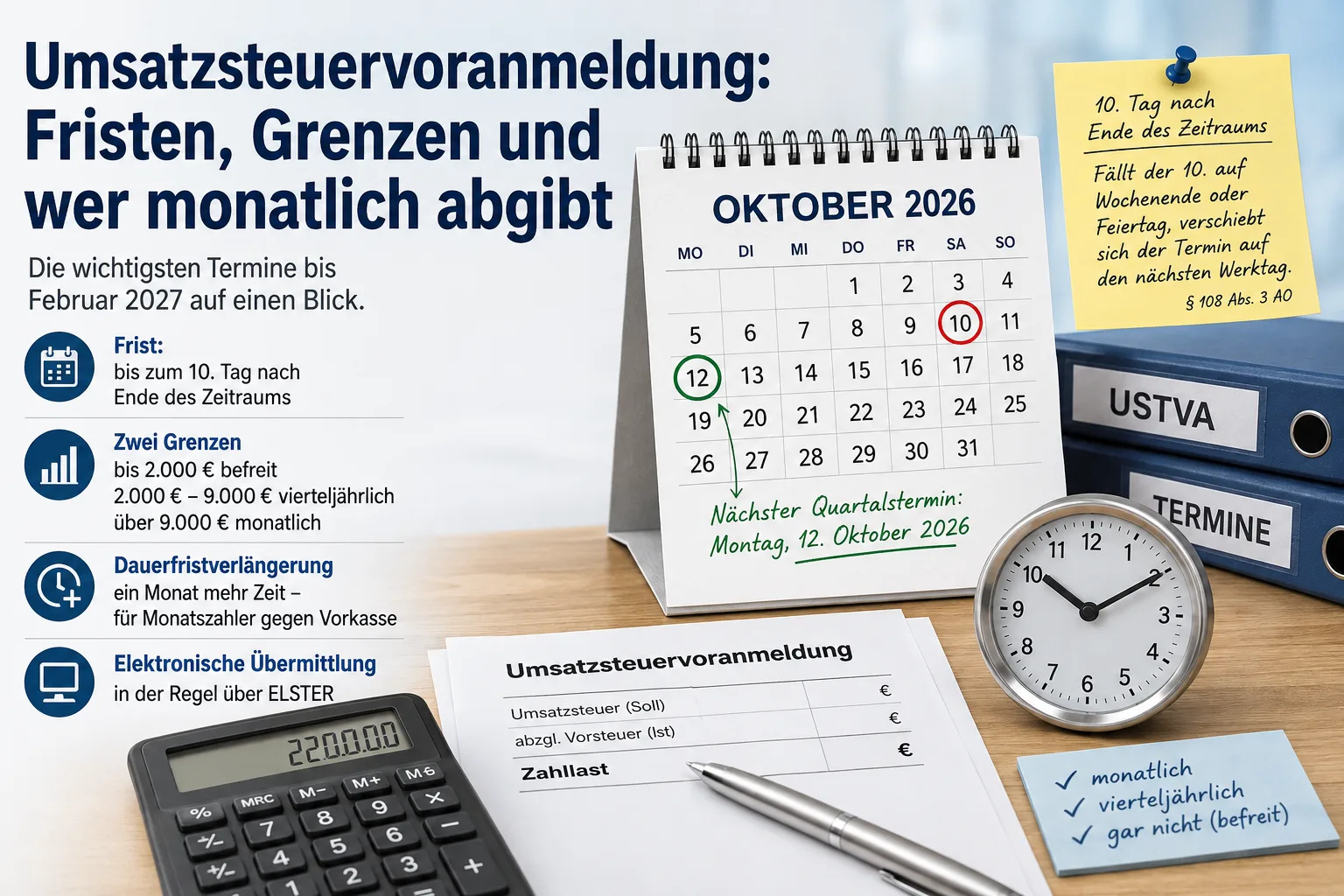
Advance VAT return in Germany: deadlines, thresholds, monthly or quarterly
If you run a business in Germany, you file an advance VAT return by the 10th day after each period. This article shows which cycle applies to you, when your next date falls and how to buy yourself an extra month.
 Taxes & Law
Which insurance do I need as a self-employed person in Germany? Mandatory, essential and skippable – costed out for three businesses
Health insurance is compulsory, pension insurance only for certain trades, and every business must register with its employers' liability association. Everything else is your call. What a roofer, a programmer and a café owner really need – and the order to buy in when money is tight.
 Taxes & Law
Bogus self-employment in Germany: when it applies – and why the back payment does not hit you
The fear of a huge back payment almost always targets the wrong person: your client owes the social security contributions, not you. What is really examined, what you actually risk – and how to get clarity without stirring things up.