
You have a steady job and an idea to earn money on the side – photographer at the weekend, a small online shop, copywriter or tutor. Three questions almost always come up first: Am I even allowed to do this alongside my employment? Do I have to register it somewhere? And will my health insurance now get more expensive? That is exactly what this article is about – in the order the questions usually arise.
Am I even allowed to be self-employed alongside my job?
In the vast majority of cases: yes. There is no general ban; your free time is yours. Still, check three points before you start:
A look at your employment contract. Many contracts contain a clause requiring you to report a secondary activity to your employer or to have it approved. Such a reporting duty is permissible. However, your employer may only forbid a side activity if they have a legitimate interest – for example because you work in the same industry and compete with them, or because the side activity impairs your actual work.
No competition with your own boss. During the existing employment relationship you may not cut into your employer's business. An employed electrician who takes on private electrical jobs in the evening is on thin ice. A different field, different customers – no problem.
Working hours and sick leave. Your side activity must not let your main job suffer. And while on sick leave you may not do anything in your side business that delays your recovery – someone off with a slipped disc should not be doing removals at the weekend.
The practical advice: if your contract contains a reporting duty, inform your employer briefly in writing before you start. It costs nothing but removes the risk of a warning should it come to light later.
Do I have to register it – and where?
Yes, every regular activity aimed at making a profit must be registered. There is no trivial or exemption threshold below which you could skip it. Where you register depends on what you do:
- Freelancers (e.g. journalist, programmer, lecturer, graphic designer, many consulting and artistic activities) register only with the tax office (Finanzamt). No trade office, no trade tax, no chamber fees.
- Traders (retail, crafts, most online shops, services involving the sale of goods) additionally register a business with the trade office (Gewerbeamt) – using form GewA1, costing roughly 20 to 60 euros depending on the municipality.
Whether you are a freelancer or a trader is not decided by your gut feeling but by the nature of the activity – and the line is blurry in cases of doubt. If you are unsure, the tax office clarifies the classification.
After the business registration, the office automatically notifies the tax office. From there you receive the tax registration questionnaire (Fragebogen zur steuerlichen Erfassung), which you fill in via ELSTER. In it you estimate your turnover and profit for the first year and state whether you want to use the small-business scheme (Kleinunternehmerregelung). This estimate is not a contract – it only helps the tax office decide whether and how often you have to submit advance VAT returns.
Does my health insurance stay the same – or get expensive?
For most people this is the actually important question, and the good news first: as long as your self-employment remains secondary (nebenberuflich), you pay no additional health insurance contributions on it. Your contribution continues to be based on your salary from your main job, and the employer covers half. The income from the side business remains contribution-free.
The catch lies in the word "secondary". Your health insurer classifies you as self-employed on a main-occupation basis if the self-employment outweighs your employment in terms of time and importance. As a rule of thumb, both apply together:
- You work fewer than 20 hours per week as self-employed, and
- you earn no more than 75% of the monthly reference figure (Bezugsgröße) with it – in 2026 that is around 2,966 euros per month (the reference figure is 3,955 euros).
If you also employ someone on more than a marginal basis, the insurers likewise assume a main occupation.
If you tip over these limits, you count as self-employed on a main-occupation basis – and then you must bear your health insurance entirely yourself, calculated on your total economic capacity. That can amount to several hundred euros a month. Hence the most important practical tip in this text: clarify the classification in writing with your health insurer in advance, before you grow strongly. Anyone who only notices afterwards that the insurer sees them retroactively as main-occupation gets an unpleasant back-claim.
Why there isn't one income limit, but several
This is where the most common misunderstanding arises. Various figures circulate online – 25,000, 24,500, around 2,966 a month – and many mix them up. But they measure completely different things and apply simultaneously alongside one another:
| Limit | Value 2026 | What it is about |
|---|---|---|
| Health insurance classification | ~2,966 €/month + under 20 hrs/week | Does the activity stay "secondary" (contribution-free)? |
| Small-business turnover limit | 25,000 € turnover in the founding year | Do you have to show VAT? |
| Trade tax allowance | 24,500 € profit | From here traders pay trade tax |
| Basic tax-free allowance | 12,348 € taxable income | From here income tax applies at all (on total income) |
The key is the difference between turnover (everything that comes in) and profit (turnover minus expenses). The small-business limit counts turnover, trade tax counts profit. And the basic allowance relates to your total taxable income – with a steady job it is usually long used up by your salary. So the first euro of profit from the side business is taxed at your personal rate, not tax-free.
Which taxes actually apply to me?
Three possible types of tax, but rarely all three:
Income tax you always pay – on the profit, not the turnover. You determine the profit via the simple income surplus statement (Einnahmen-Überschuss-Rechnung, EÜR): income minus business expenses. You enter the result in your annual tax return (Anlage S for freelancers, Anlage G for traders). Because your salary is already taxed, the side income raises your total income and is charged at your individual rate.
VAT you only have to show and pay if you do not use the small-business scheme. If you stay below it, you write invoices without VAT – simpler, but you also cannot deduct input tax from your purchases. Whether waiving the scheme is worthwhile depends on your initial investments and your customers; there is a detailed account in the article Invoice without VAT for small businesses.
Trade tax only affects traders – and even them only from 24,500 euros profit a year. As a freelancer you pay none at all, regardless of the amount. And even when trade tax does arise, for sole proprietors it is usually not a real double burden: it is credited against your income tax via the tax reduction under Section 35 of the Income Tax Act (§ 35 EStG), namely up to four times the trade tax base amount, at most up to the trade tax actually paid. In municipalities with an assessment rate up to 400%, the credit thus offsets the trade tax in full on paper; only at higher rates does a small remainder stick to you.
One point many overlook because it is unusually pleasant: if you make a loss in the starting year – for instance through purchases that exceed your first income – this loss can generally be offset against your salary and lowers your tax burden. Persistent losses without a recognizable intention to make a profit, however, are eventually no longer accepted by the tax office.
Pension insurance: compulsory for some professions
The normal case: through your main job you are covered by pension insurance, and nothing is added for the side activity. But there are occupational groups that are subject to compulsory pension insurance even on a secondary basis – and that surprises many. These include, among others, teachers and lecturers without their own employees, care workers, and certain craftspeople (the trades requiring a licence in the crafts register). Artists and publicists fall under the Artists' Social Insurance Fund (Künstlersozialkasse). If you belong to one of these groups, clarify it early with the German Pension Insurance (Deutsche Rentenversicherung), otherwise the contribution obligation comes later as a back-payment.
The four mistakes that cost the most later
From practice, the expensive pitfalls are easy to name:
- Not asking the employer although the contract requires it – a warning risk that a short email avoids.
- Not clarifying the health insurance classification and then being classified retroactively as main-occupation – the most common nasty surprise.
- Getting the small-business limit wrong in your head – anyone who breaks it mid-year becomes liable for VAT from then on and has to adjust invoices.
- Invoices without the mandatory details – if the name, tax number, sequential number or service date is missing, the customer has to reject the invoice, and for input tax deduction it becomes a problem for them.
The first invoice
Once the registration is in place, the moment it all leads up to arrives: you issue your first invoice. As a small business this is straightforward – you don't need to show VAT, but you must have all the mandatory details cleanly on it and keep the invoices afterwards. Anyone who doesn't want to juggle Word templates and a growing list of numbers in Excel uses a simple invoicing program for this; what to look out for is in the article Invoicing software for small businesses. With office1.cloud you write small-business invoices with correct mandatory details without having to worry about number ranges and formatting yourself.
Starting a business on the side is bureaucratically more manageable than it first appears: register, have the health insurer classify you, keep an overview of the four relevant limits – the rest follows with your first orders. This text does not replace tax or legal advice; for your specific classification – especially health and pension insurance – a short call to the respective office beforehand is worthwhile. So that your first tax return does not turn into a paper hunt, collect receipts and invoices in an accounting software from the start.
Handle invoices more easily
Easy Invoice combines quotes, invoices and customer management in the cloud.
Try Easy InvoiceRead next
 Taxes & Law
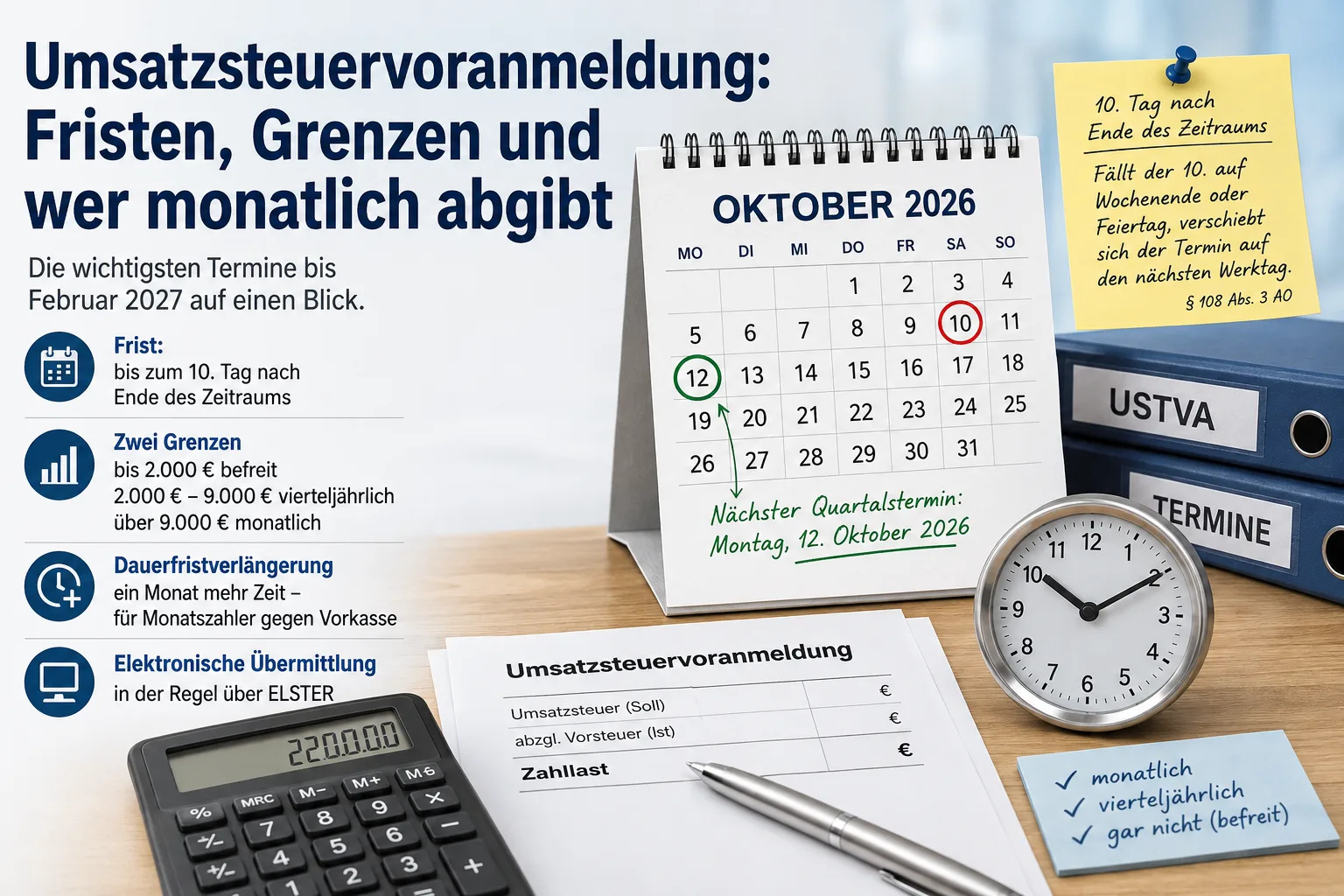
Advance VAT return in Germany: deadlines, thresholds, monthly or quarterly
If you run a business in Germany, you file an advance VAT return by the 10th day after each period. This article shows which cycle applies to you, when your next date falls and how to buy yourself an extra month.
 Taxes & Law
Which insurance do I need as a self-employed person in Germany? Mandatory, essential and skippable – costed out for three businesses
Health insurance is compulsory, pension insurance only for certain trades, and every business must register with its employers' liability association. Everything else is your call. What a roofer, a programmer and a café owner really need – and the order to buy in when money is tight.
 Taxes & Law
Bogus self-employment in Germany: when it applies – and why the back payment does not hit you
The fear of a huge back payment almost always targets the wrong person: your client owes the social security contributions, not you. What is really examined, what you actually risk – and how to get clarity without stirring things up.