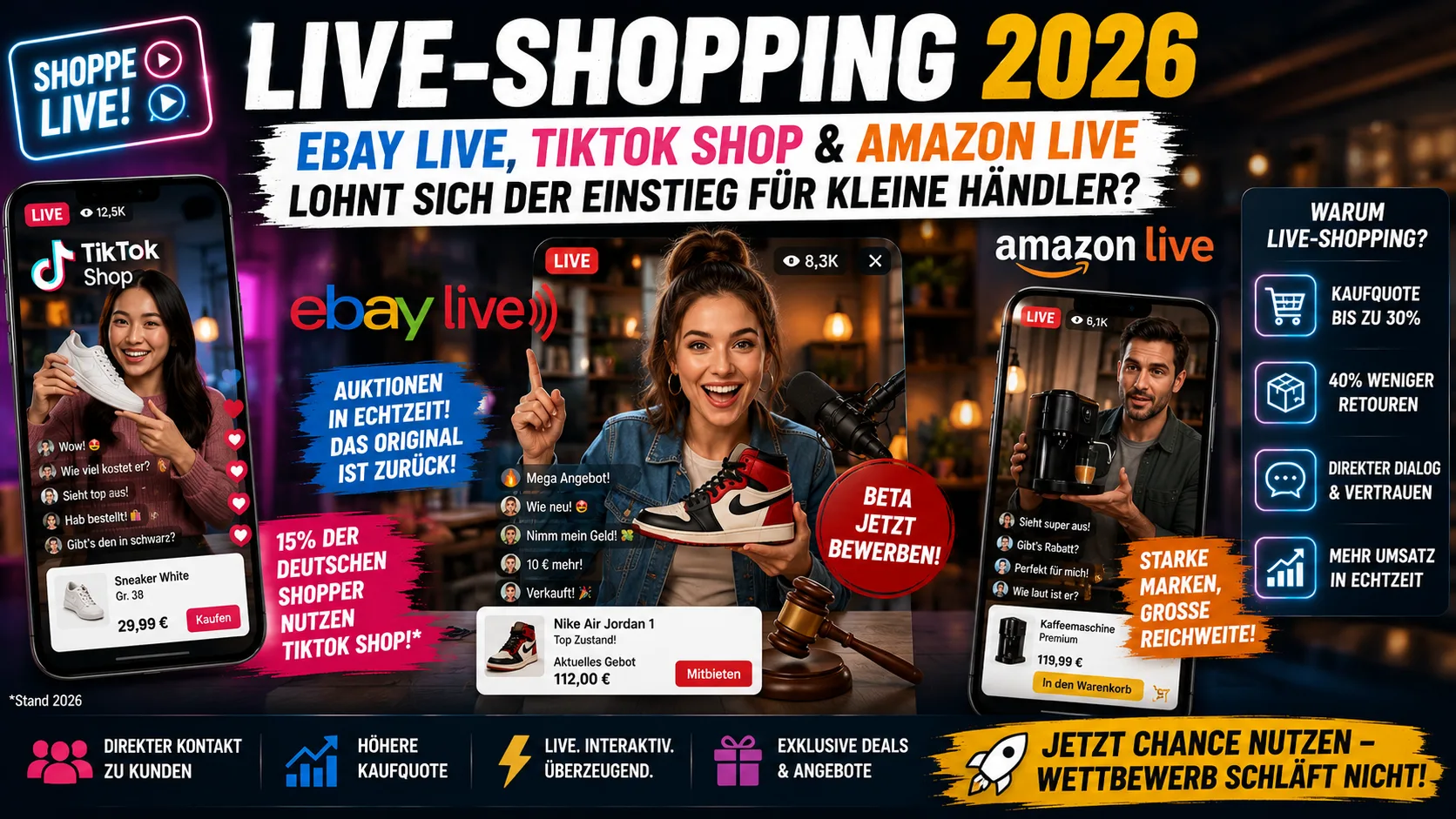
First it was known from China, then came TikTok Shop, Amazon followed with "Amazon Live" – and since eBay is rolling out the format too, selling by livestream has reached every major platform in 2026. If you sell yourself, you'll rightly ask: is this a real sales channel or just the next hype? And if so – is it something for small sellers, or only for brands with their own studio?
What live shopping actually is
Live shopping means: you show your products in a video livestream, talk directly to viewers, answer questions in the chat – and viewers buy with one or two taps without leaving the stream. At its core it's teleshopping, only interactive, on a smartphone and without a broadcast-slot contract. The appeal for buyers is the mix of entertainment, real-time advice and the feeling of being there for a time-limited offer.
For sellers, two numbers stand out:
- A purchase rate of 9 to 30 percent depending on the format – in a classic online shop it's usually 2 to 3 percent. Anyone watching a stream is much closer to a buying decision.
- Around 40 percent fewer returns, because buyers have seen the product live beforehand and had their questions answered immediately in the chat.
Together that makes a channel that measurably differs from a static product page – provided someone regularly stands in front of the camera.
The three platforms at a glance
TikTok Shop is the front-runner in Germany. After just one year the marketplace already ranks among the country's 15 largest online retailers, around 15 percent of all German online shoppers have already used it, and over 25,000 sellers are active. The average order value is just under 30 euros – so TikTok Shop lives on impulse buys and inexpensive items. For 2026 TikTok wants to triple the number of livestreams in Germany. The flip side: the sales commission was raised from 5 to 9 percent in early 2026 (details in our article on the TikTok Shop fees 2026).
eBay Live is the newcomer and brings back an eBay specialty: the auction feeling in real time. The format launched at the end of 2025, initially as a beta and limited to the "Collectibles" and "Clothing & Accessories" categories; more categories are being added over the course of 2026. Access currently still runs via an application on the eBay Live page, so the format is not yet open to all sellers. If you want to see it live: eBay is touring Germany in 2026 with "eBay on Tour" – after Berlin, Stuttgart and Dortmund, Hamburg follows on 26 August, and the big eBay Open takes place in Berlin on 15 October.
Amazon Live has existed for longer but plays a smaller role in Germany and is more geared toward established brands and Amazon's own events. For small sellers it's the hardest of the three channels to get into.
What you need for eBay Live – and how a stream works
Unlike on TikTok, not everyone can jump straight in on eBay Live. The format isn't open to all yet: you apply via the eBay Live page and get activated once you meet the requirements. These include:
- a commercial registration (EU business account) – as a purely private seller you won't get into the format,
- an eligible category (including collectibles, fashion, sneakers, luxury, electronics, home & garden, beauty),
- and a noticeable activity commitment: eBay generally expects 2 to 4 streams per week, each lasting at least around two hours.
That last point is honestly the biggest hurdle: eBay Live isn't a channel for a single trial stream, but for sellers who want to broadcast regularly.
Worth clearing up front, because it's often asked: eBay does not offer a dedicated streaming app. Broadcasting from your smartphone runs through the ordinary eBay app – there you open the eBay Live area and start your scheduled event. Events, however, are created and managed through two eBay-owned consoles, the "Live Studio" and the "Stream Manager". Both run in a browser on a desktop or laptop, not as an app: the Live Studio is not an extra program to install, but eBay's web interface for planning and managing your streams.
For the actual broadcast a current smartphone on a tripod is enough; if you want it more professional, use an external camera with a broadcast tool such as OBS. Recommended are a stable, ideally wired connection with around 10 Mbit/s upload, a simple ring light and a wireless microphone. Your stream is watched by buyers at ebay.com/eBayLive and in the eBay app.
The most common practical question – how do the buy links get into the stream? – is solved by eBay via the event itself: you attach up to 750 of your listings to your event in advance, either directly from your eBay store (by search) or via the item number or link. During the stream you then bring these items up one after another; viewers buy or bid with a tap without leaving the stream. So you don't post any links by hand – the products are already attached to the event and get "pulled up" live.
Finally, promotion is part of the routine: an event no one knows about has no viewers. eBay expects you to announce your date in advance – via your eBay store, social media and your newsletter. Live shopping is therefore a marketing and a time channel, not a self-runner.
You can read up and get started directly at eBay here: the overview of selling live with eBay Live with the requirements, the eBay Live questions & answers for details on the process, and the eBay Live page itself, where you can watch ongoing streams – alternatively in the eBay app via the "eBay Live" tile.
A realistic note on this: in Germany eBay Live is still in beta and limited to a few categories – so there may be little or nothing running at the moment. If you want a genuine impression of how it works beforehand (auction countdown, chat, items shown on screen), take a look at the more developed US page ebay.com/ebaylive, where streams run practically around the clock.
But this early phase is exactly the opportunity: as long as few sellers go live in Germany, the competition for viewers' attention is low. Anyone who starts now builds camera routine, grows a regular audience and – if the format catches on here – is visible from the very beginning, instead of chasing an established trend later. That's no guarantee, but a front-runner position that you won't be able to earn as easily in a year or two.
What you should settle before your first stream
As soon as you sell regularly, you are acting commercially – regardless of whether you sell in a shop, in a feed or in a livestream. That means: register a business, issue proper invoices and, depending on turnover, pay VAT. We've described in detail where the line between private and commercial runs in When do I count as commercial on eBay & co.?.
Two points that easily get overlooked in live selling:
VAT. As a small business under § 19 UStG you don't charge VAT – possible as long as your turnover doesn't exceed 25,000 euros in the previous year and 100,000 euros in the current year. Live shopping in particular can break that threshold faster than expected once a stream goes well. Whether the status pays off for you is covered in our article Small-business scheme – yes or no?.
The right of withdrawal – even for live auctions. There's a widespread misconception here: with a "publicly accessible auction" the right of withdrawal doesn't apply. But the German Federal Court of Justice ruled early on (judgment of 3 November 2004, ref. VIII ZR 375/03) that an online auction on eBay is not an auction in this sense. For you as a commercial seller that means: your buyers have the full 14-day right of withdrawal – even when the purchase came about in the live stream via an auction format. So you have to provide a correct withdrawal notice and may not refuse the withdrawal with "but it was an auction."
Don't forget: the marketplaces report your turnover to the tax office via DAC7 anyway – anyone who sells live shows up there just like in a classic shop.
When many orders pile up after the stream
A good stream produces many small individual orders in a short time – and often the same viewer buys several items one after another during the stream. Anyone who writes a separate invoice by hand for each of these orders immediately loses the time they gained.
That's exactly what Easy Invoice on office1.cloud has an eBay import interface for: your eBay orders are taken over automatically, without retyping. The real advantage for live selling, though, lies in the step after – in the shop interface you can, after the import, combine several orders from the same buyer into a single invoice. Five individual purchases by one viewer become one document: cleaner for your bookkeeping, clearer for the customer and one shipment instead of five.
Whether live shopping is the right channel for you depends less on the platform in the end than on your product and your willingness to step in front of the camera regularly. The lowest entry in 2026 is via TikTok Shop, the largest audience for collectors and niches is via eBay Live. Both can be tested with a single stream – the tax and withdrawal questions should be settled before, not after.
_This article provides a general overview and does not replace tax or legal advice. What matters is your specific individual case._
Handle invoices more easily
Easy Invoice combines quotes, invoices and customer management in the cloud.
Try Easy InvoiceRead next
 E-Commerce & Marketplaces
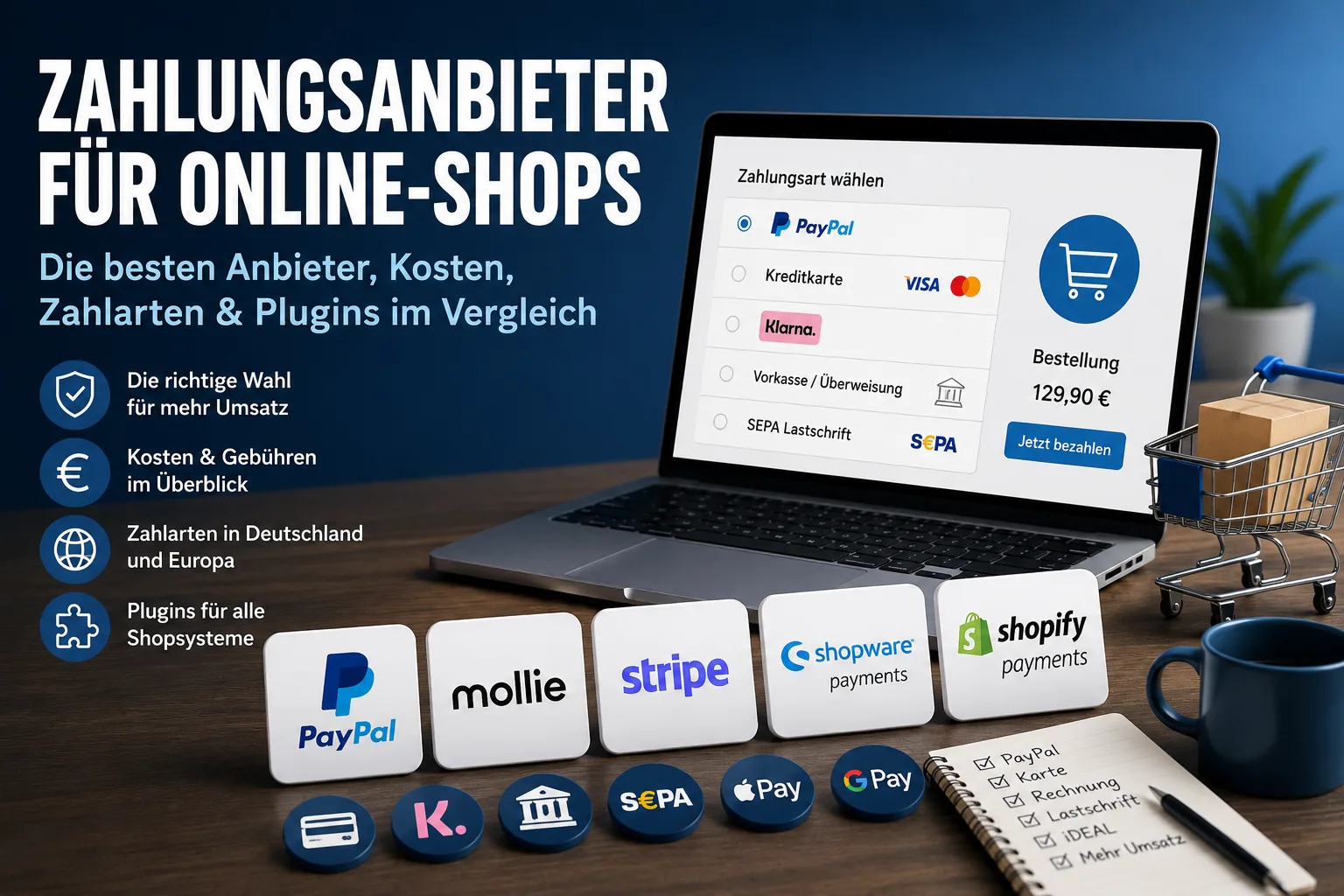
Payment providers for online shops: fees compared and which payment methods you need in 2026
PayPal plus one more provider is enough for most shops. Which payment methods you really need, what the providers cost – and why the fixed fee matters more than the percentage on small baskets.
 E-Commerce & Marketplaces
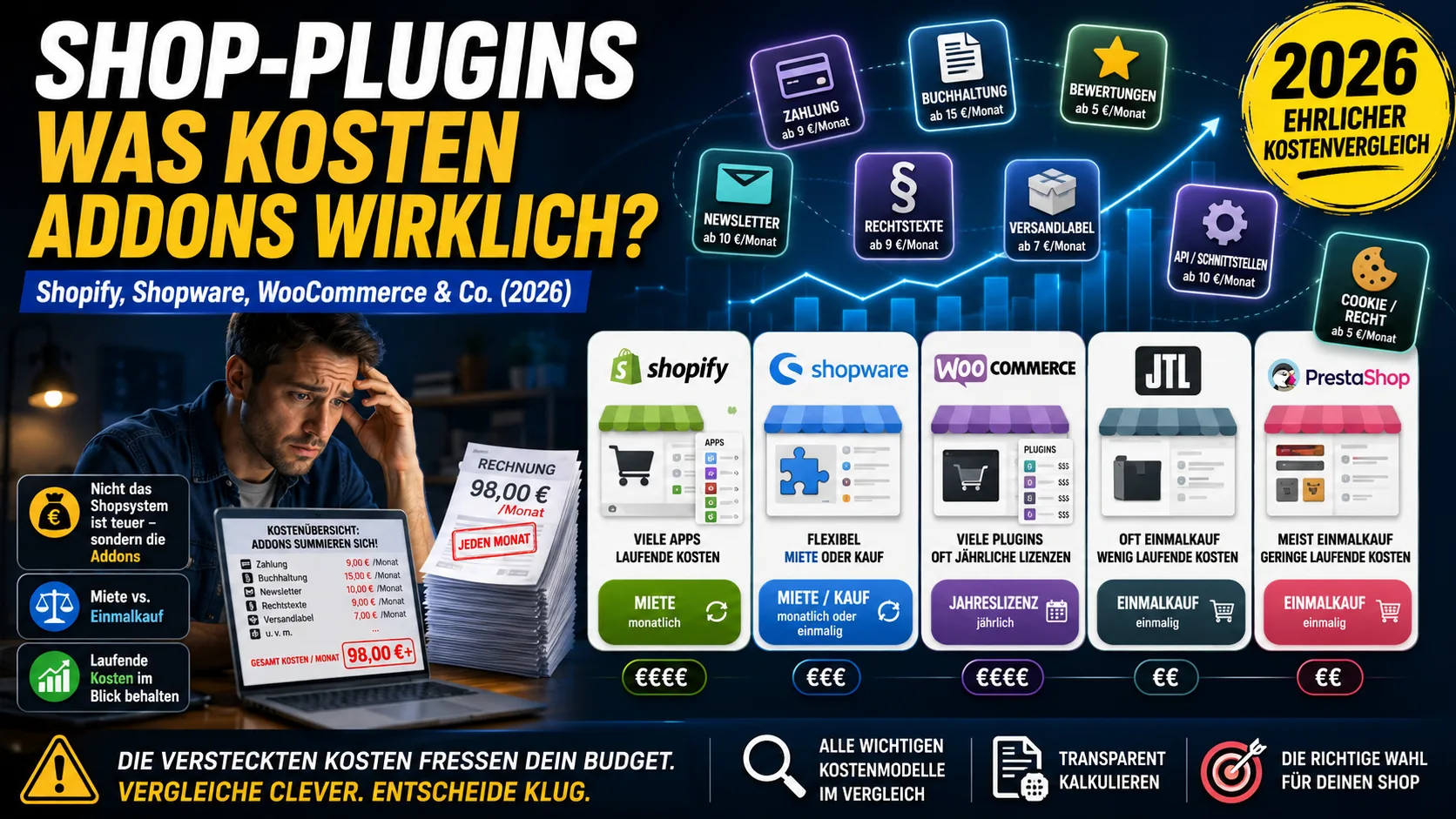
What Do Shop Plugins Cost? Add-on Prices for Shopify, Shopware, WooCommerce & Co. (2026)
It is not the shop system that is expensive, but the add-ons. Pricing models and typical costs in an honest comparison.
 E-Commerce & Marketplaces
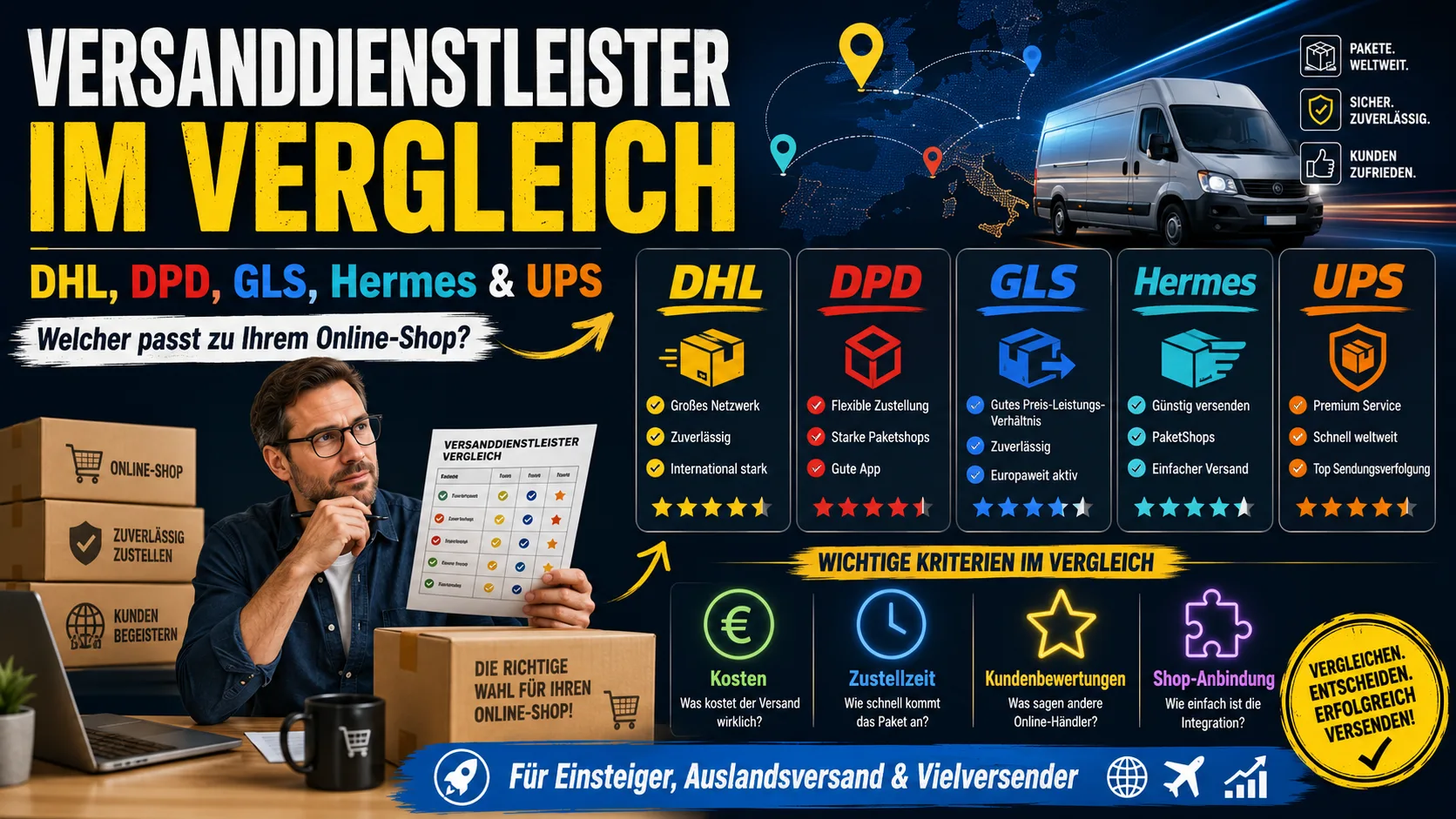
Shipping Providers Compared: Which One Fits Your Online Store?
DHL, DPD, GLS, Hermes or UPS? A comparison by cost, real delivery times, customer ratings and shop system integration — with recommendations for beginners, cross-border sellers and high-volume shippers.