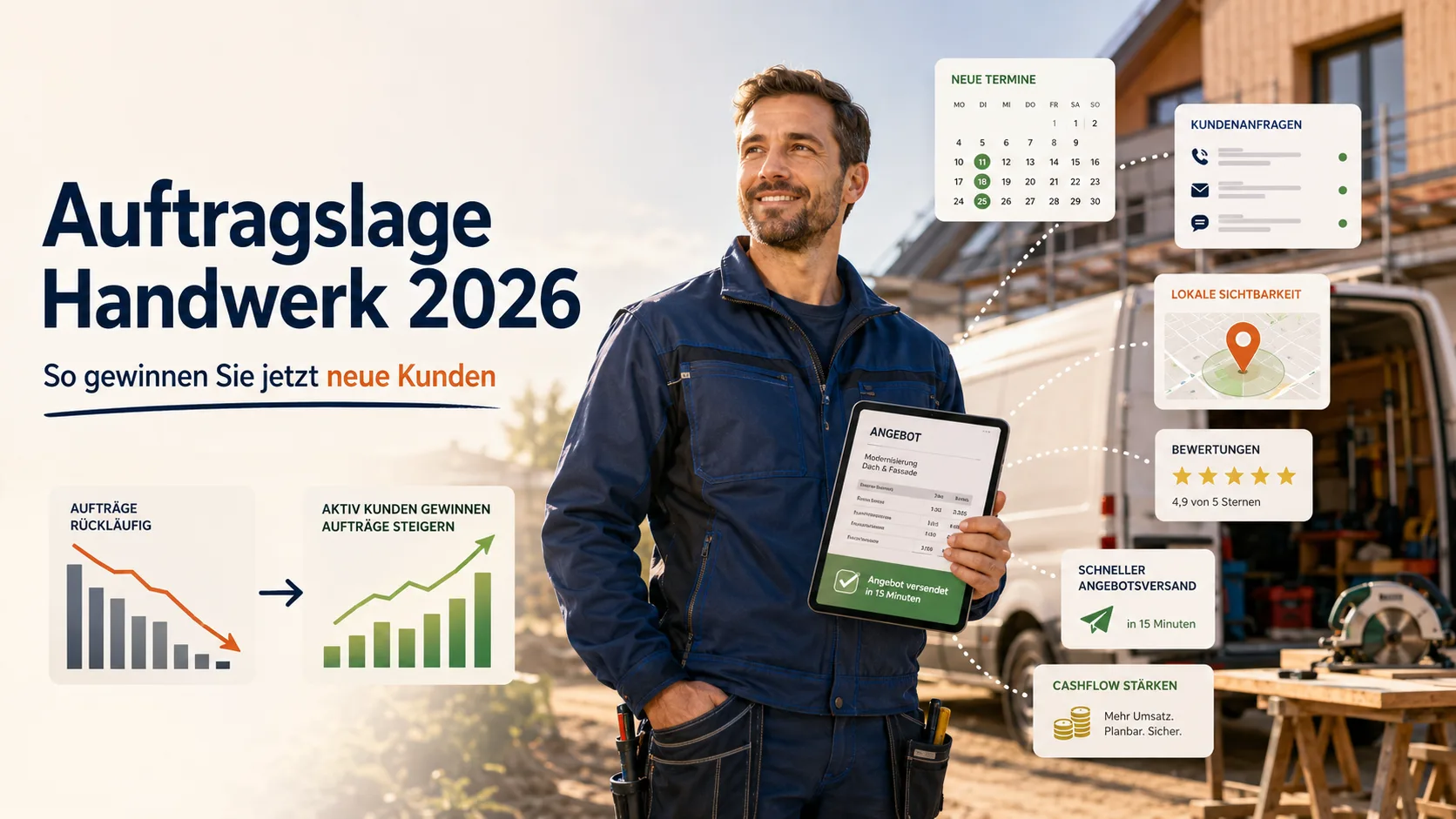
German Skilled Trades 2026: How to Win New Customers Now
Order backlogs in the German skilled trades are shrinking noticeably in 2026 – that is the finding of the latest economic report from the Central Association of German Skilled Crafts (ZDH), published in May 2026. When capacity utilisation drops, you do not have to sit and wait. A few targeted steps will fill your order books again and keep your cash flow stable.
Table of contents
- What the ZDH economic report actually says
- What does this mean for your business?
- Step 1: Reactivate existing customers
- Step 2: Become locally visible
- Step 3: Quote faster than the rest
- Step 4: Protect cash flow while business is good
- Frequently asked questions
- Conclusion
- Sources
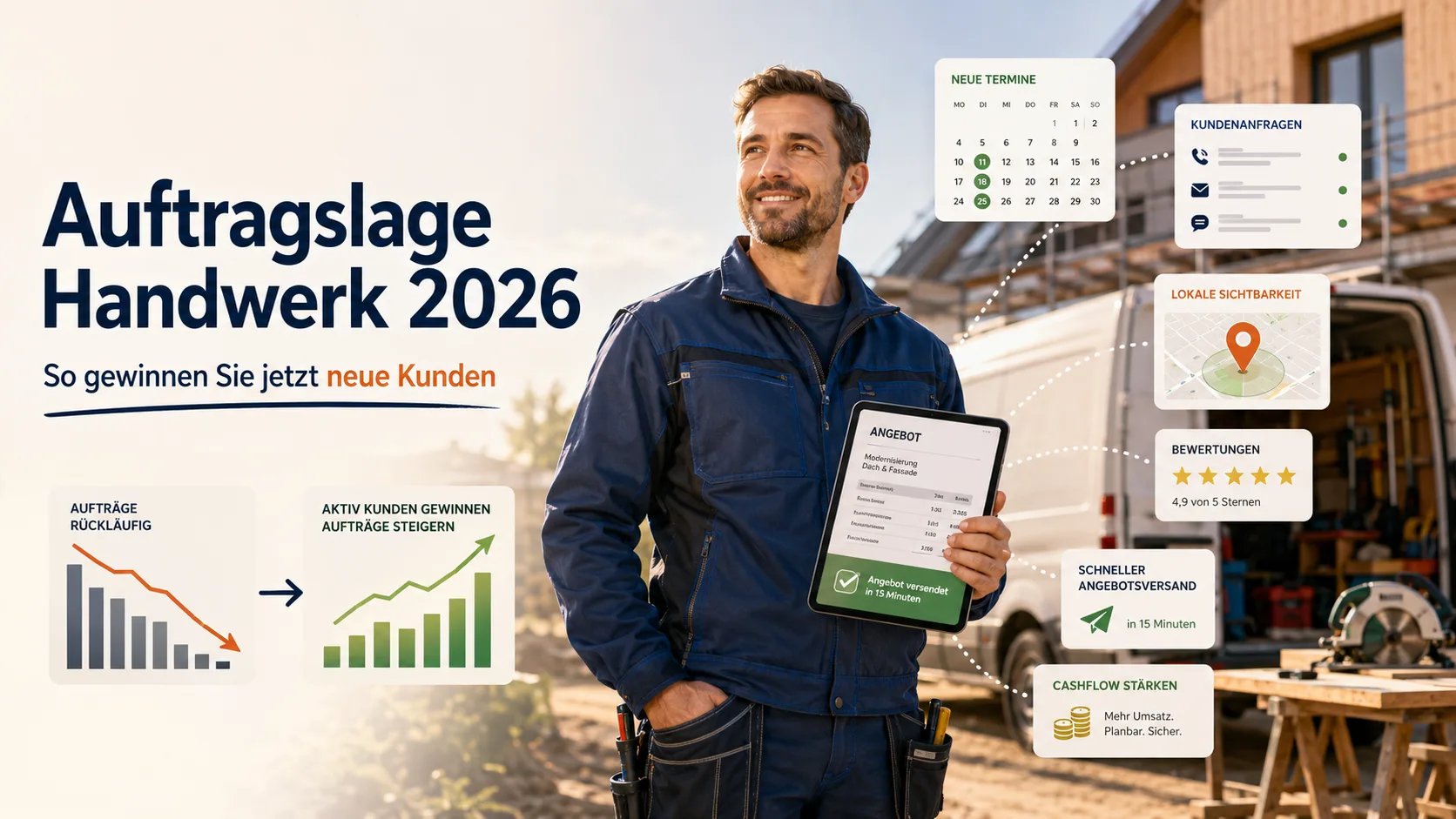
What the ZDH economic report actually says
Every quarter the ZDH surveys skilled-trade businesses across Germany. The report for the first quarter of 2026 is titled “Recovery postponed – recession risk rising”. The key figures in plain terms:
The business-situation indicator (how firms rate their current position) fell by 7 points to 13 points. Order backlogs are declining again – the order-volume indicator stands at minus 19 points. The average order reach – how long a business stays busy with the work it already has – is 8.9 weeks. Capacity utilisation dropped by 2 percentage points to 75 percent. Revenues are also falling further (revenue indicator: minus 25 points).
Among the causes, the ZDH names sharply higher energy prices and strained supply chains that make materials and inputs harder to obtain. In short: the hoped-for recovery has been postponed again.
What does this mean for your business?
A capacity-utilisation figure of 75 percent sounds abstract at first. Translated, it means that on average about a quarter of capacity sits idle – hours in which staff and machines cost money but earn none. An order reach of around nine weeks is solid, but it is not a cushion you can rest on. It is enough to plan calmly – not to let your sales efforts slide.
The good news: it is precisely in phases like this that it is decided which businesses stay ahead. Whoever is visible now, quotes quickly and looks after existing customers wins the jobs that others leave on the table. The following four steps cost little and can be implemented straight away.
Step 1: Reactivate existing customers
The cheapest order is the one from a customer who already knows you. An electrical business with two journeymen, for example, has served hundreds of private and commercial customers over the years – and never contacts most of them again. Yet that is where the fastest lever lies.
Go through your invoices from the past two to three years and sort by customers for whom a follow-up job is plausible: the heating system due for servicing, the second construction phase, the annual inspection. A short phone call or a personal email often works better than any advert. The only thing that matters is having an overview of who bought what and when – which saves the tedious search through filing cabinets.
What does this mean for you? Before spending money on advertising, collect the jobs that are already there.
Step 2: Become locally visible
Most skilled-trade jobs arise regionally – and the search for them now almost always starts online. A well-kept Google Business Profile is the foundation: current opening hours, photos of completed projects, fast responses to enquiries. Whoever ranks at the top gets the call.
A second lever is reviews. For many prospects they are the deciding signal before they pick up the phone. How to collect reviews systematically and in a legally compliant way is something we have described in detail elsewhere. And for businesses that need more enquiries at short notice, it can be worth looking at Google Local Services, because there you only pay for actual contact requests.
What does this mean for you? Make sure a potential customer can find you in two minutes, see that others were satisfied, and get in touch immediately.
Step 3: Quote faster than the rest
In a phase where fewer jobs are up for grabs, the winner is often not the cheapest but the fastest and clearest provider. Many prospects gather several quotes – and hire the one who puts a clear, professional quote on the table first.
Anyone still assembling quotes by hand loses days here. With templates for recurring services you create a clean quote in minutes and convert it directly into an invoice once it is accepted. A seamless workflow from quote to invoice gives you exactly the speed advantage that counts in the current situation.
Keep an eye on your costing as you do. Especially when utilisation drops, the temptation to compete on price is strong. Before you do, check your hourly rate – prices that are too low may fill the books in the short term but cost you substance at year-end.
What does this mean for you? Respond quickly, cost cleanly – and do not let yourself be drawn into a price war that eats your margin.
Step 4: Protect cash flow while business is good
Falling revenues are only half the problem. The other half is that a weaker economy tends to worsen your customers’ payment behaviour. When money gets tighter, people pay more slowly – and your business unwillingly finances other people’s liquidity gaps.
Three things help immediately: issue invoices right after completion, not collected at month-end. Agree on instalment payments for larger jobs so you are not in advance for weeks. And respond consistently when someone does not pay. A clear, friendly dunning process is not an affront but part of clean business – and with an automatic bank reconciliation you see at once which invoice is open and which is not.
What does this mean for you? In uncertain times, the money in your account matters more than the revenue on paper.
Frequently asked questions
How current are the figures in the ZDH economic report?
The report cited here is from May 2026 and covers the first quarter of 2026. The ZDH publishes such reports quarterly on its website.
Does the weak economy affect all trades equally?
No. The ZDH report shows an average across the entire skilled-trades sector. Depending on trade and region, the situation can be considerably better or worse. The customer-acquisition measures help regardless of trade, however.
Is advertising worth it when orders are declining?
Usually yes – but in a targeted way. Reactivated existing customers and a good local online profile tend to deliver results faster than broadly scattered ads. Start with the inexpensive levers before deploying larger budgets.
What can I do about late payments?
Issue invoices promptly, agree on instalment payments and follow up consistently. A clear overview of open items is the precondition for chasing them in good time.
Conclusion
The ZDH economic report 1/2026 is a wake-up call, not a reason to panic. Order books are not filled by waiting but by active customer acquisition and a watchful eye on cash flow. Whoever reactivates existing customers, stays locally visible, quotes quickly and invoices consistently comes through a weaker phase better. Tools such as a seamless quote-and-invoice workflow, automatic bank reconciliation and a structured dunning process take the routine work off your hands – so you can spend your time where it counts: with your customers.
Sources
- ZDH Economic Report 1/2026 — Official economic report of the Central Association of German Skilled Crafts (May 2026) with the cited indicators on business situation, order volume, utilisation and revenue.
- ZDH – Economic Reports (overview) — Quarterly economic reports of the German skilled trades to read and download.
Handle invoices more easily
Easy Invoice combines quotes, invoices and customer management in the cloud.
Try Easy InvoiceRead next
 Trades & Services
Timesheets in Germany: template, required entries and the seven-day rule
A German timesheet needs six entries, no more. For mini-jobbers and in eleven industries it must be filled in within seven days — and stay available for two years.
 Trades & Services
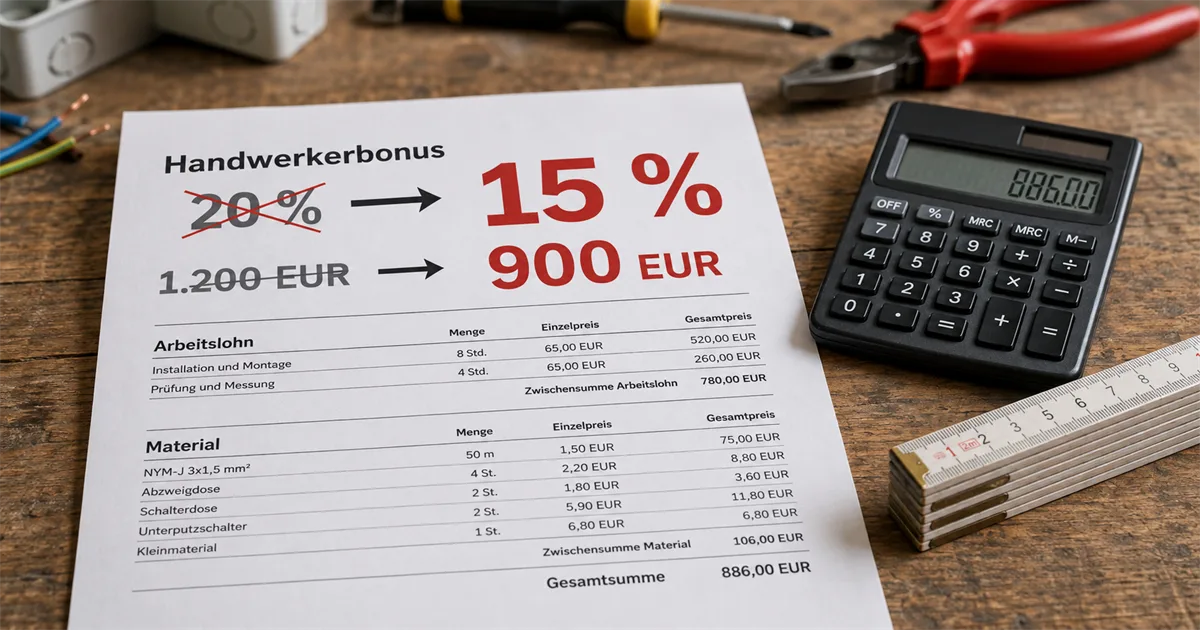
German trade tax credit set to drop to 15 percent: your customer loses up to 300 euros from 2027
In 2026, 20 percent and 1,200 euros still apply unchanged. The cut is planned for 2027 but not yet law – what your customers need to know now.
 Trades & Services
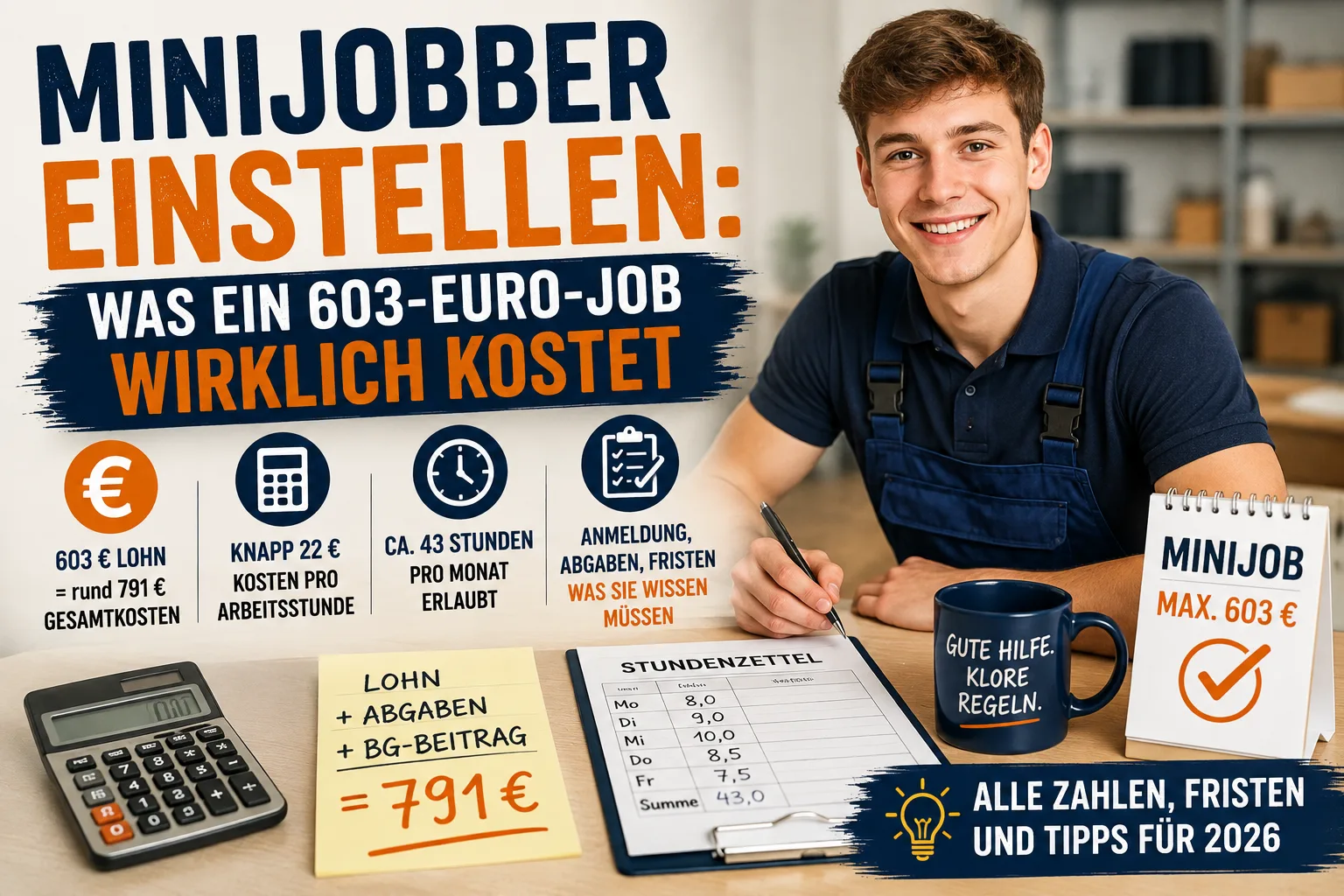
Hiring a minijob employee: what a 603-euro job really costs
A minijob employee costs more than their wages. What a 603-euro job costs per month and per hour in 2026, how many hours it covers, what the accident insurance fund charges and how you register the job.