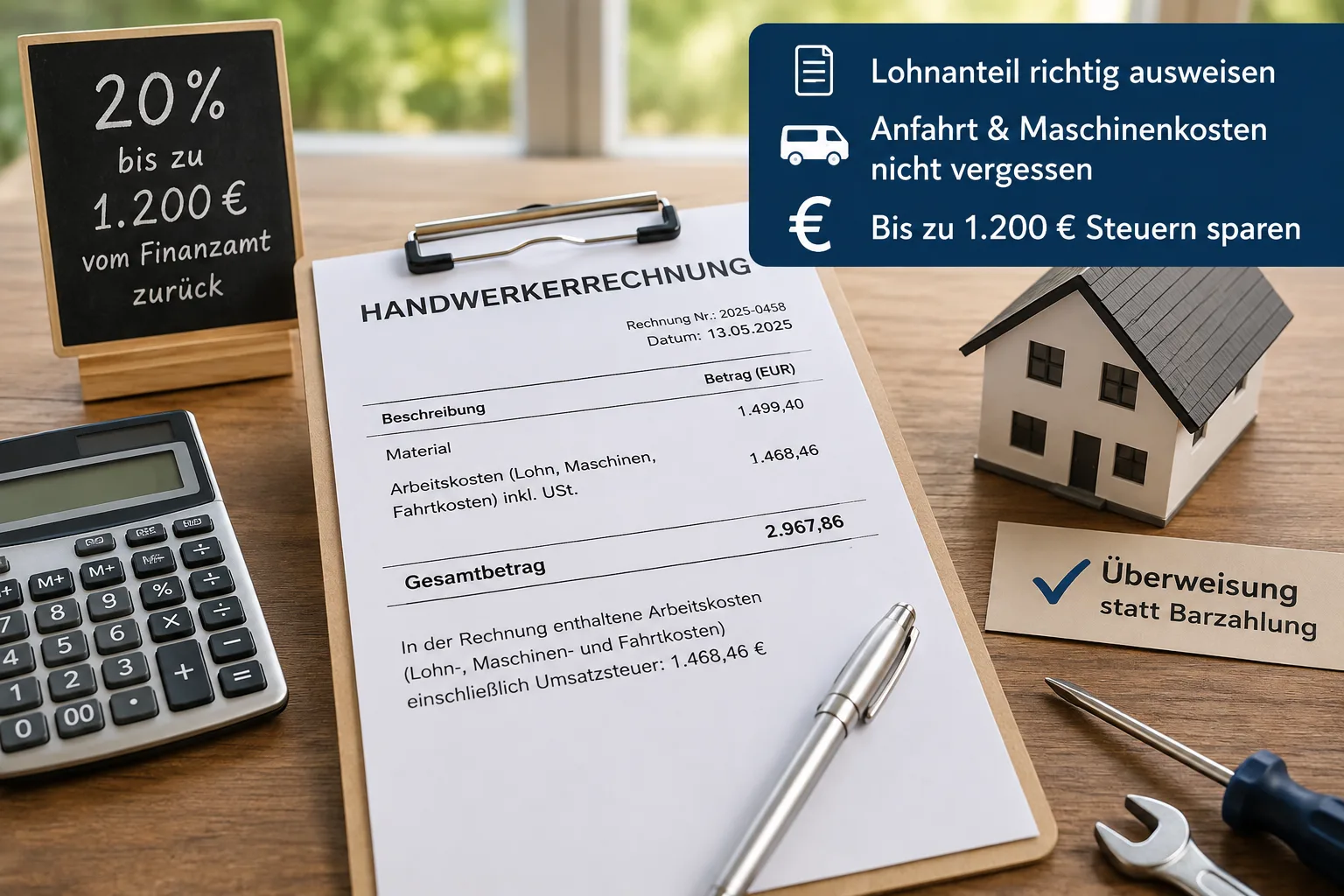
If you work for a private customer in Germany, your invoice decides whether they get money back from the tax office. They may deduct 20 percent of the labour cost directly from their tax bill, up to 1,200 euros a year (Section 35a (3) of the German Income Tax Act). The conditions: the labour cost is shown separately from the material on the invoice, and the customer paid by bank transfer rather than in cash. If your invoice shows only a total, they get nothing – and they will call you. Labour costs also include the travel you charge for and machine costs, not just the hours.
This article is general information and does not replace tax advice.
Table of contents
- What the customer gets – and what they lose
- How to put the labour cost on the invoice
- What counts as labour cost and what does not
- Template: tradesman's invoice to a private customer
- Why paying cash costs the tax relief
- The mandatory details – and the sentence almost everyone forgets
- By when does the invoice have to be written?
- When it does not work: new builds
- Invoice already sent and the labour cost is missing?
What the customer gets – and what they lose
The rule is called the tax reduction for tradesman services. What matters is the difference from everything else people call "deducting": the amount does not come off the income, it comes straight off the tax the customer has to pay. So 600 euros of relief means 600 euros less tax, not 600 euros less taxable income.
The calculation: 20 percent of the labour cost including the VAT on it, capped at 1,200 euros per year and household. The cap is reached at around 6,000 euros of labour cost – so for larger jobs, splitting the work across the turn of the year gives the customer more. That, by the way, is an argument that works in a sales conversation when a customer hesitates.
An example from a tiling invoice: 1,234 euros net of work and travel, plus VAT, makes 1,468.46 euros. Twenty percent of that is 293.69 euros less tax for the customer. If your invoice only says "bathroom tiling, 2,967.86 euros", it is zero. The tax office does not estimate and does not work it out for anyone – it needs the figure in black and white.
What follows for you is unspectacular, but it decides whether the phone rings: one more line on the invoice, and the call in February does not come.
If you want to write invoices with all mandatory details in a few minutes, you can try the invoicing software Easy Invoice free for 10 days.
How to put the labour cost on the invoice
There are two ways, and both are acceptable.
Way 1 – separate line items. You list material and work as separate lines. This is the cleanest version, because the customer immediately sees what was charged for what.
Way 2 – a closing line under the invoice. You invoice as usual and add one sentence below the gross amount:
Labour costs included in this invoice (wages, machine and travel costs) including VAT: 1,468.46 €
You can copy that sentence word for word. It states both things: the amount, and the fact that VAT is already included – which is exactly what the customer's tax office needs.
If you work with flat rates and have not calculated the labour share precisely, you may estimate it and split the amount by percentage. The split has to be plausible; an invented figure is not. In practice: someone who spent 30 hours on a job cannot declare 90 percent of the invoice as labour just because it helps the customer.
What counts as labour cost and what does not
This is where most tradespeople give something away – usually the travel, which they file under material or do not show separately at all.
| Counts as labour cost | Does not count |
|---|---|
| Wages and hourly charges | Material (tiles, paint, pipes, spare parts) |
| Travel to and from site, mileage | |
| Machine and equipment costs you charge for | |
| The VAT on all of these |
The rule of thumb: everything that costs your time, your journey and your machine can be claimed by the customer. Everything you bought at the wholesaler and passed on cannot. So the line does not run between "invoice" and "receipt", but between service and goods.
For a pure material delivery without installation, splitting the amounts gives the customer nothing, because there is no labour share. The other way round: if you only charge hours, the whole invoice counts – then one sentence stating that the invoice consists entirely of labour costs is enough.
For items that are neither one nor the other – disposal, scaffolding or consumables, for instance – it is worth a quick question to your tax adviser before you count them as labour. Tax offices assess such extras differently depending on whether they belong to the work or to the goods.
Template: tradesman's invoice to a private customer
The template contains everything that has to be there. The figures are invented, the structure you can take over:
Sander Tiling · Owner Michael Sander · Ringstrasse 12, 34567 Musterstadt
Tax number: 123/456/78901Mrs Anja Weber
Lindenweg 8, 34567 MusterstadtInvoice no. 2026-0184
Invoice date: 14 August 2026
Period of service: 3–7 August 2026
Your order confirmation: no. 2026-0151 of 22 July 2026| Item | Description | Qty | Unit price | Total |
|---|---|---|---|---|
| 1 | Wall tiles 30 × 60 cm, "Nova grey" range, bathroom | 30 m² | 42.00 € | 1,260.00 € |
| 2 | Tiling work incl. surface preparation and grouting | 22 hrs | 52.00 € | 1,144.00 € |
| 3 | Travel to and from site (5 days) | 1 | 90.00 € | 90.00 € |Net amount: 2,494.00 €
plus 19 % VAT: 473.86 €
Invoice total: 2,967.86 €Labour costs included in this invoice (wages, machine and travel costs) including VAT: 1,468.46 € (items 2 and 3).
Payable by 28 August 2026 without deduction to account DE00 0000 0000 0000 0000 00.
Please pay by bank transfer; cash payment cannot be taken into account.Note under Section 14 (4) no. 9 of the German VAT Act: you are required to keep this invoice for two years.
The note about the bank transfer is not compulsory, but it saves you the discussion on the doorstep. And the reference to the order confirmation means the customer can place the invoice without asking.
If you are a small business under the VAT exemption, the VAT line disappears and the labour cost sentence simply states the amount without VAT – how that looks is described in Invoice without VAT. The customer's tax relief still works, it is just smaller because no VAT is added.
How to calculate the hourly rate in item 2 is a subject of its own: Calculating a tradesperson's hourly rate.
Why paying cash costs the tax relief
The law requires the payment to reach your account (Section 35a (5) of the German Income Tax Act). Bank transfer, standing order, online banking – all fine. Cash is not, and it stays not fine even if you issue a proper receipt and the customer produces it. The reason behind the rule is well known: it is meant to make undeclared work unattractive. Accordingly there is little room for exceptions in practice.
For you this means: if a private customer wants to pay cash and you know they intend to claim the invoice, tell them beforehand. Otherwise they lose up to 1,200 euros, and the argument about it lands with you, not with the tax office.
With card payments the money also reaches your account; what matters is that the customer can prove the payment from their bank statement.
The mandatory details – and the sentence almost everyone forgets
Regardless of the tax relief, every invoice needs the details set out in Section 14 (4) of the German VAT Act: your name and address, the customer's name and address, your tax number or VAT identification number, the invoice date, a sequential invoice number, the quantity and type of service, the date of the service, and the net amount broken down by tax rate with the tax due on it. The full list with explanations is in Writing an invoice: the ultimate guide. Up to 250 euros gross, a small-amount invoice with fewer details is enough.
One mandatory detail is added for private customers and is missing from most tradesmen's invoices: the note about the retention obligation. If you work on a property – a flat, a house, land, a garden – the private customer has to keep the invoice for two years (Section 14b (1) sentence 5 of the German VAT Act), and you have to point that out in the invoice (Section 14 (4) no. 9). One sentence is enough, see the template above.
For the customer this is not a formality: failing to keep the document for two years is an administrative offence that can be fined up to 1,000 euros (Section 26a (2) no. 3 and (3) of the German VAT Act).
By when does the invoice have to be written?
Six months after the service was provided – and for construction work this deadline expressly applies to private customers too. The wording of the law refers to "a taxable supply of work or other service in connection with a plot of land" (Section 14 (2) sentence 2 no. 3 of the German VAT Act). That covers practically every building trade: painting, tiling, heating, electrics, roofing, windows, landscaping.
Anyone who lets the deadline slip risks a fine of up to 5,000 euros (Section 26a (2) no. 1 and (3)). In practice this rarely happens on purpose; usually the invoice is left lying because of a dispute over defects. The better route is to invoice anyway and settle the disputed points separately.
For large jobs running over months, work with progress payments instead of putting everything on one final invoice – how that works without VAT falling due twice is explained in Progress, partial and final invoice.
When it does not work: new builds
The tax relief only applies to an existing household. Everything that belongs to the construction of a building up to its completion falls outside it. Renovating a bathroom in a 30-year-old house counts; installing the same bathroom in a shell does not.
Tell that to a client building a house, calmly and in advance. Otherwise they will enter the figure in their tax return, have it struck out, and come back to you. Splitting labour and material does no harm anyway – by the first repair after moving in, it counts again.
A different case is the commercial customer: they claim the whole invoice as a business expense and do not need the split. And if you invoice construction work to another construction business, a completely different rule applies, namely the reverse charge – explained in Reverse charge on construction services.
Invoice already sent and the labour cost is missing?
No drama. You may correct an invoice, even months later. You do not cancel the old one; you issue a correction document that refers unambiguously to the original invoice number and adds the missing detail. The customer submits both together. What that looks like formally is described in Correcting an invoice.
The only thing that matters is the timing from the customer's point of view: they need the corrected invoice before they file their tax return – otherwise they have to get the assessment amended, which is work and does not always succeed.
If you mainly work for private households, put the labour cost line and the retention note into your invoice template once – in office1.cloud just as in a Word file. Then both are on every invoice and nobody has to remember them.
In the end it is one line of text that decides a few hundred euros for the customer – and whether they recommend you or call you in February because the tax office struck out their tradesman costs. An invoicing software writes invoices with every mandatory detail in minutes.
Handle invoices more easily
Easy Invoice combines quotes, invoices and customer management in the cloud.
Try Easy InvoiceRead next
 Trades & Services
Timesheets in Germany: template, required entries and the seven-day rule
A German timesheet needs six entries, no more. For mini-jobbers and in eleven industries it must be filled in within seven days — and stay available for two years.
 Trades & Services
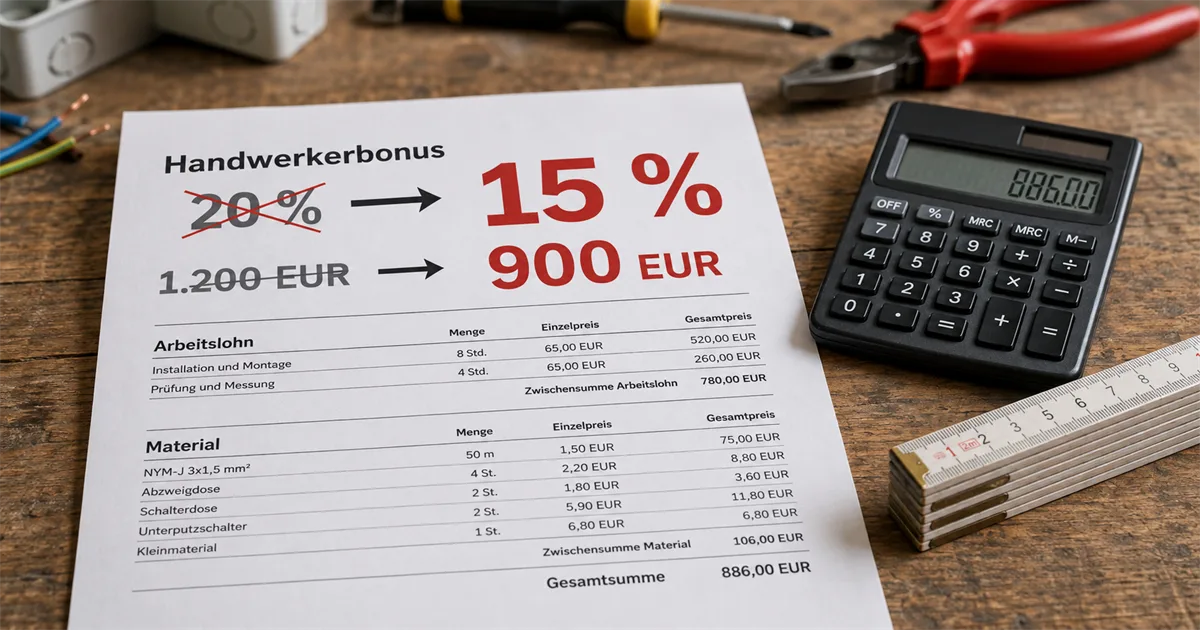
German trade tax credit set to drop to 15 percent: your customer loses up to 300 euros from 2027
In 2026, 20 percent and 1,200 euros still apply unchanged. The cut is planned for 2027 but not yet law – what your customers need to know now.
 Trades & Services
Hiring a minijob employee: what a 603-euro job really costs
A minijob employee costs more than their wages. What a 603-euro job costs per month and per hour in 2026, how many hours it covers, what the accident insurance fund charges and how you register the job.