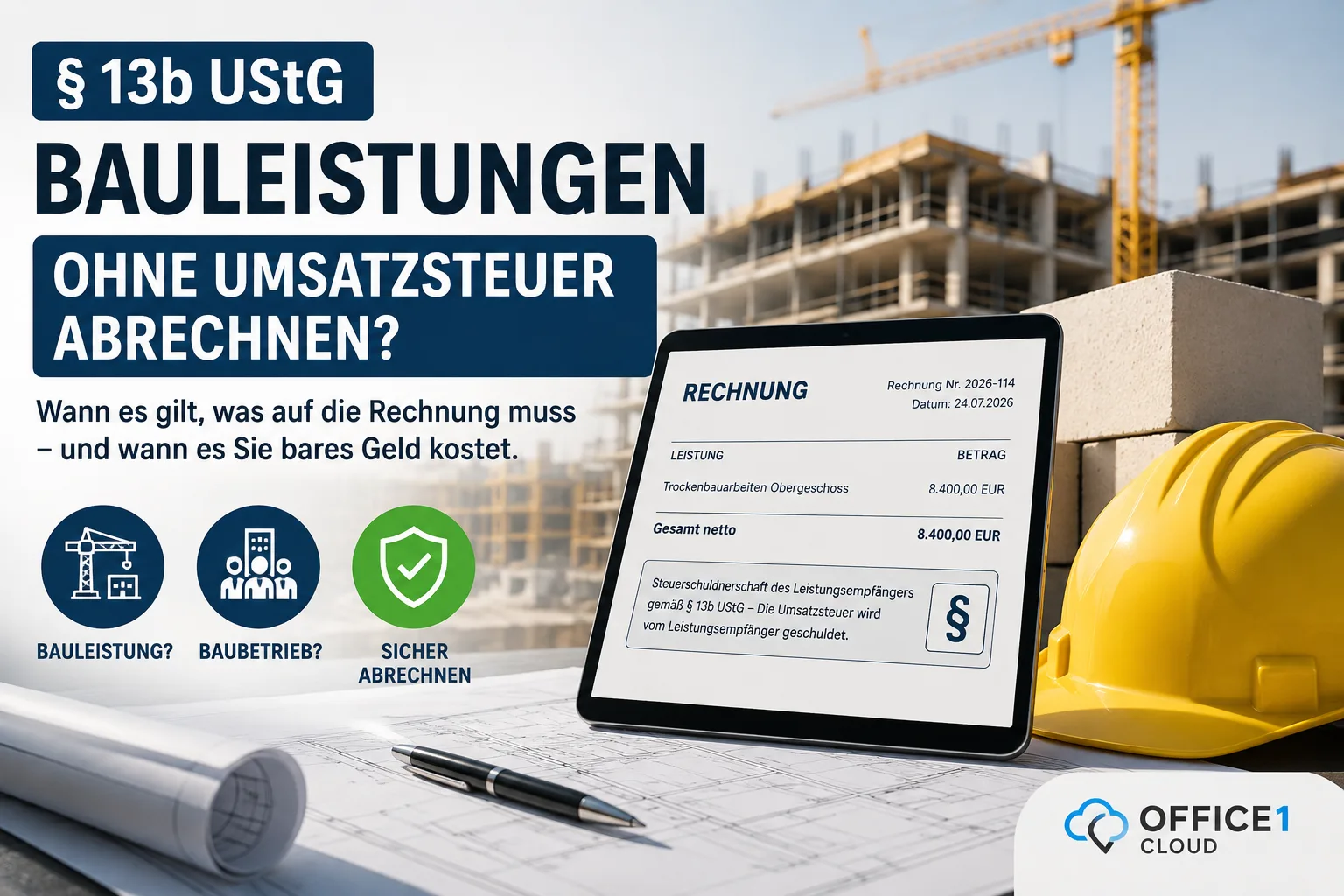
If a tradesperson provides a construction service for another building firm, the invoice is issued without VAT. The client reports the VAT to the tax office and pays it there. This is set out in Section 13b of the German VAT Act (UStG) and is called „reverse charge" or, in German, „Steuerschuldnerschaft des Leistungsempfängers". It only applies if two things are true at the same time: the work really is a construction service, and the client builds as well – regularly, not just once. For private customers, landlords, architects and every other non-construction business you invoice with VAT as normal. And if you are a small business under the German Kleinunternehmer rule: Section 13b does not change your own invoices – but if you receive such an invoice, it can cost you real money.
With the Easy Invoice Cloud you can issue a Section 13b invoice with the required notice and without a VAT amount. Try it free for 10 days – no payment details, the trial ends automatically.
Contents
- Why this rule exists at all
- Question 1: is it actually a construction service?
- Question 2: is your client a building firm?
- The 13b invoice: a sample to copy
- Small businesses: two cases – one of them costs
- What happens if you get it wrong
- Three questions that keep coming up
- The quick check before every invoice
Why this rule exists at all
Normally the tradesperson collects the VAT from the customer and passes it on to the tax office. In the construction industry a great deal of money went missing this way over the years: subcontractors issued invoices with VAT, the client reclaimed that VAT as input tax – and the subcontractor had disappeared before paying anything.
Section 13b therefore reverses who is responsible. The client owes the tax and reclaims it as input tax in the same breath. In effect, no VAT flows between the two businesses any more – there is nothing left to embezzle.
For you as the performing tradesperson this simply means: less money in your account that was never yours anyway. You receive the net amount, and that is it.
If you want to write invoices with all mandatory details in a few minutes, you can try the invoicing software Easy Invoice free for 10 days.
Question 1: is it actually a construction service?
A construction service is work that directly affects the substance of a structure – in other words, it creates, repairs, alters or removes something on the building or the land itself. „Structure" is meant broadly: house, hall, road, sewer, fence.
| Counts as one | Does not count |
|---|---|
| Erecting, repairing, converting or demolishing buildings | Pure supply of materials without installation |
| Installing permanently connected fittings and machinery | Planning and supervision: architects, structural engineers |
| Road, sewer and civil engineering work | Simply hiring out construction equipment |
| Fencing and surfacing work | Objects that merely hang on the wall or are fixed with nails |
In practice the difference almost always comes down to installation. Supplying windows is not a construction service. Supplying and fitting windows is. Anyone who only drops off the material and drives away is out.
One special case in passing: building cleaning has its own, very similar rule in the same section (Section 13b(2) no. 8 UStG). The test follows the same pattern but affects different businesses.
Question 2: is your client a building firm?
This question decides the case – and this is where most mistakes start. It is not enough that your client is a business. They must themselves provide construction services on a sustained basis.
„Sustained" is not a matter of opinion but a number: at least 10 per cent of their total turnover must come from construction services. This means the company's entire turnover, no matter which country it was generated in.
You cannot know this from the outside. That is what the USt 1 TG certificate is for: your client obtains it from their tax office and presents it to you. It is valid for a maximum of three years from issue. If they present it, you may rely on it and invoice without VAT. The form was last reissued by the Federal Ministry of Finance circular of 10 April 2026 – the changes are purely formal, among other things the field for the official seal has been dropped. An older certificate does not become invalid because of this.
Two points that are often missed:
- The certificate is proof, not a precondition. If the tax office has issued it, your client remains liable for the tax – even if they do not show it to you. And even if none was issued at all, they owe the tax as long as they genuinely reach the 10 per cent. It still matters to you: it is your evidence of why you invoiced without VAT.
- The purpose of the building project is irrelevant. If a construction business converts its own private house, the rule still applies.
Who typically has no certificate, so you invoice them with VAT as normal: private customers, landlords and property managers, doctors, retailers, restaurants, industrial firms – and property developers who sell finished buildings instead of building themselves.
If the client is a private individual, however, Section 13b does not apply: you invoice with VAT as usual. A different obligation comes into play there instead — the labour costs have to be shown separately from the material, otherwise the customer loses their tax relief. What that looks like is described in writing a tradesman's invoice to private customers.
The 13b invoice: a sample to copy
Two things are mandatory: no VAT amount shown, and the notice about the reversed tax liability. Otherwise the normal mandatory details apply.
Invoice no. 2026-114                    Service period: 06–24 July 2026
Project: new warehouse, Musterstrasse 7

Drywall work, upper floor, as measured           8,400.00 EUR
                                        ------------------------
Invoice total                                    8,400.00 EUR

Steuerschuldnerschaft des Leistungsempfaengers.
(Reverse charge: the recipient owes the VAT, Section 13b UStG.)

Payable by 14 August 2026 without deduction.
The German phrase „Steuerschuldnerschaft des Leistungsempfängers" has to appear exactly like that. And because this is an invoice between two businesses, the German e-invoicing rules apply as well – which format fits when is explained in XRechnung or ZUGFeRD?.
Small businesses: two cases – one of them costs
This is where two completely different situations get mixed up.
Case 1 – you issue the invoice. As a small business under Section 19 UStG you do not show VAT anyway. So there is nothing that could pass to the client: Section 13b does not apply. You write your invoice as always – with the note about the small business rule, not with the Section 13b sentence. What that invoice looks like is explained in Writing an invoice without VAT. An invoice to an EU business customer also goes out without VAT, but for a different reason. Mentioning your small business status helps the client, who would otherwise expect a Section 13b invoice.
Case 2 – you receive the invoice. This is the expensive one. If you, as a small business, hire a subcontractor and you yourself provide construction services on a sustained basis, then you owe the VAT from that invoice. The small business rule does not protect you from this.
And here comes the part that hurts: a normal business immediately reclaims that tax as input tax, so on balance it pays nothing. As a small business you have no right to deduct input tax. The tax stays with you – as a real payment to the tax office.
An example: a subcontractor invoices you 5,000 euros for drywall work, without VAT, with the Section 13b notice.
| Business with VAT | Small business | |
|---|---|---|
| Invoice amount | 5,000.00 € | 5,000.00 € |
| VAT owed (19 %) | 950.00 € | 950.00 € |
| reclaimed as input tax | −950.00 € | 0.00 € |
| actual cost | 5,000.00 € | 5,950.00 € |
On top of that comes an obligation you otherwise do not have: you must declare those 950 euros to the tax office – usually in a VAT return for the period, and in any case in the annual return. For small amounts the tax office can release you from the periodic return; ask there before you miss a deadline. Anyone running subcontractors as a small business should build this amount into their pricing from the start. It is not a pass-through item, it is a cost.
What happens if you get it wrong
You showed VAT although Section 13b applied. Then you owe that tax to the tax office – purely because it appears on paper. Your customer may not deduct it as input tax and additionally owes the tax on the net amount. They will send the invoice back. The only remedy is a corrected invoice.
The Section 13b notice is missing although the rule applied. Untidy, but not dramatic: the client owes the tax anyway. The missing notice does not release them. You should still correct the invoice.
Both parties thought it was a construction service, and it was not. There is a simplification for this: if both sides agreed and the tax authorities lost nothing because the recipient declared the tax correctly, it stands. The reverse does not work – if Section 13b should have been applied and nobody did, it gets corrected.
You were unsure whether the customer is a building firm. There is no simplification for that doubt. So: request the certificate and file it with the invoice.
Three questions that keep coming up
The client has no certificate – do I invoice with or without VAT? Request it in writing and invoice only afterwards. As long as it is unclear whether your customer is a construction business, you carry the risk in both directions: if you show VAT wrongly, you owe the amount purely because it is stated. If you wrongly leave it out, it is missing from your return. Unlike the question of whether a construction service exists, there is no simplification for doubts about the customer's status.
Do I have to keep the certificate? Yes, and with the invoices you used it for. It is your evidence of why there is no VAT on them. Check the expiry date: after three years at most you need a new one.
Does Section 13b also apply to progress invoices? Yes. A progress invoice also goes out without a VAT amount and with the notice. The client owes the tax in the period in which they make the payment – not only at the end of the project. Which type of invoice is the right one during a running job is explained in Progress invoice, partial invoice, final invoice: the difference.
The quick check before every invoice
- Does my work act directly on the structure – or am I only supplying material or planning?
- Is my client a business that regularly builds itself?
- Do I have their USt 1 TG certificate and is it still valid?
- Three times yes: invoice without a VAT amount, with the sentence „Steuerschuldnerschaft des Leistungsempfängers". Once no: normal invoice with VAT.
If the second question stays open, ask the client for the certificate. That is common practice in construction and nobody will hold it against you.
If you want to go deeper, or your tax adviser needs a reference: DATEV publishes the current position on the USt 1 TG certificate including the new form. It is written for tax advisers and is technical accordingly – but every detail this article deliberately leaves out is in there. An invoicing software writes invoices with every mandatory detail in minutes.
Sources: Section 13b UStG · Section 14a(5) UStG · Federal Ministry of Finance circular of 10 April 2026 on the USt 1 TG form · German VAT Application Decree 13b.2 and 13b.3 · Lower Saxony State Tax Office: reverse charge for construction services
_This article provides general information and does not replace tax advice._
Handle invoices more easily
Easy Invoice combines quotes, invoices and customer management in the cloud.
Try Easy InvoiceRead next
 Trades & Services
Timesheets in Germany: template, required entries and the seven-day rule
A German timesheet needs six entries, no more. For mini-jobbers and in eleven industries it must be filled in within seven days — and stay available for two years.
 Trades & Services
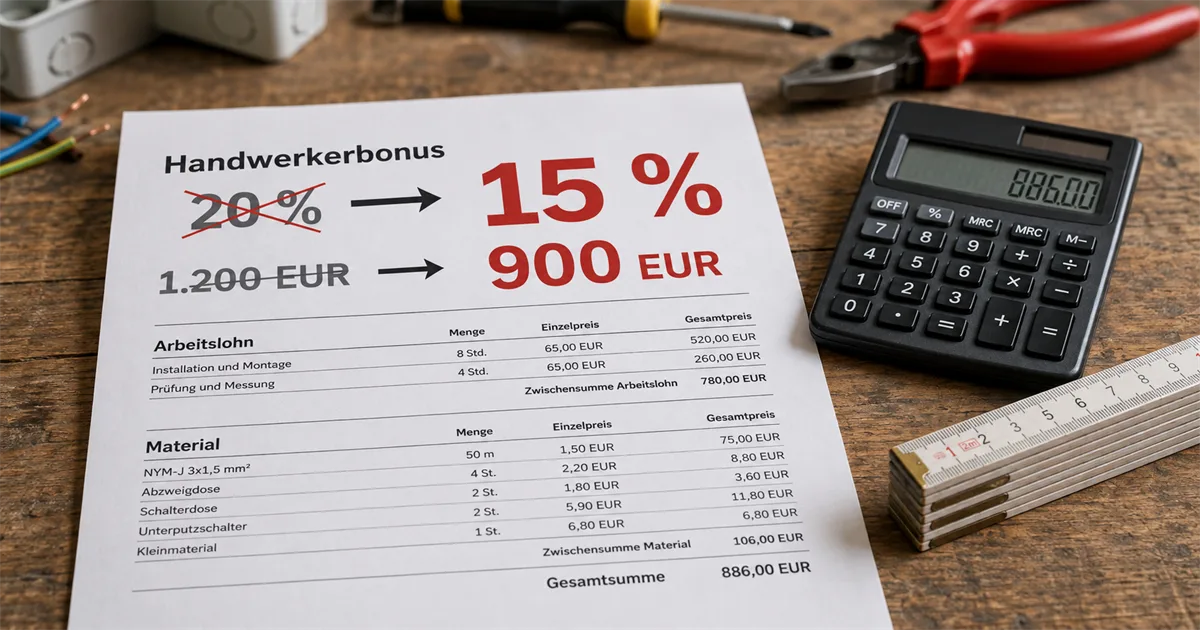
German trade tax credit set to drop to 15 percent: your customer loses up to 300 euros from 2027
In 2026, 20 percent and 1,200 euros still apply unchanged. The cut is planned for 2027 but not yet law – what your customers need to know now.
 Trades & Services
Hiring a minijob employee: what a 603-euro job really costs
A minijob employee costs more than their wages. What a 603-euro job costs per month and per hour in 2026, how many hours it covers, what the accident insurance fund charges and how you register the job.