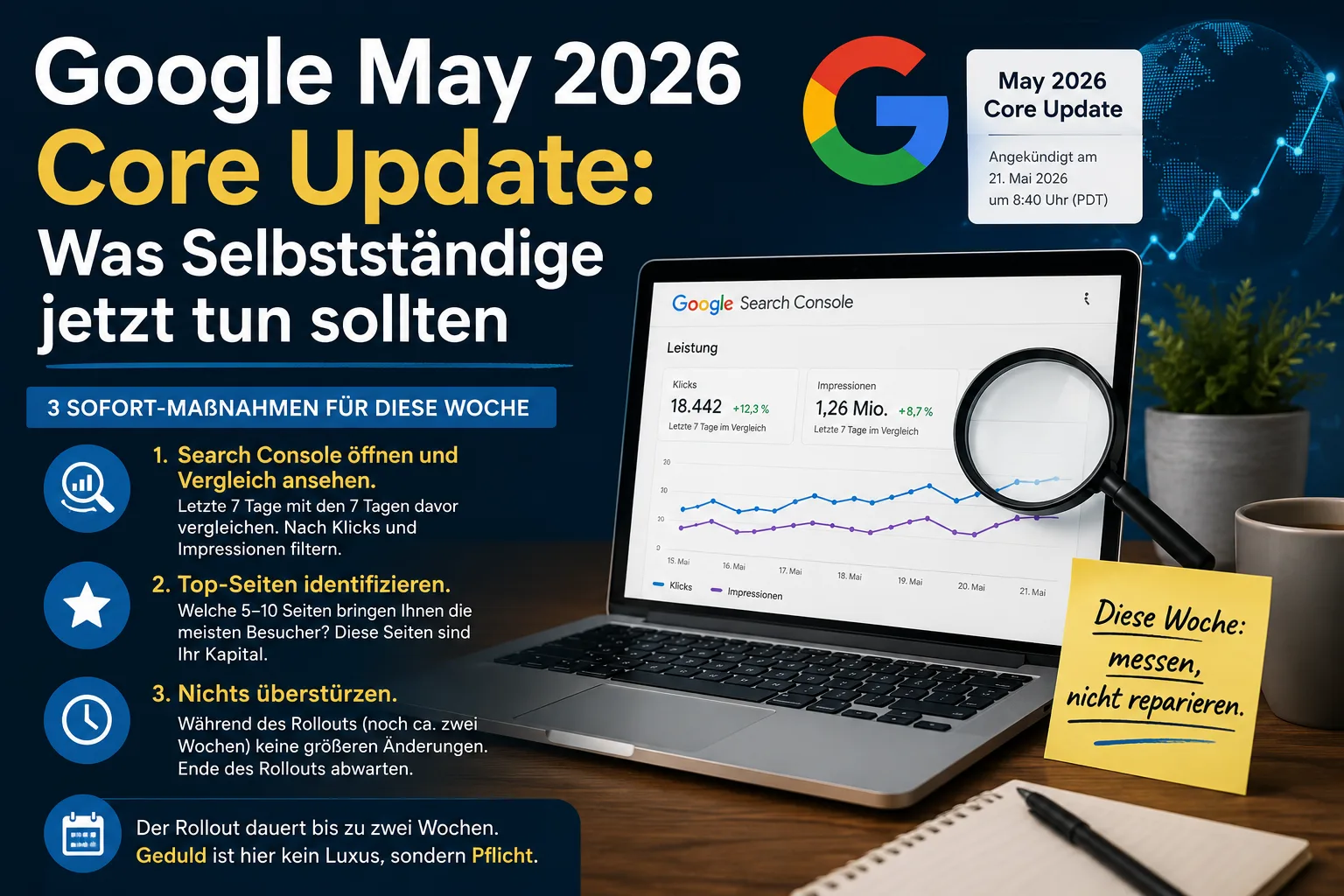
Google May 2026 Core Update: What Self-Employed Professionals and Small Online Shops Should Do Now
On 21 May 2026, Google started yet another Core Update. The rollout is still in progress through early June and also affects small websites, Etsy shops and tradesperson sites. Here's how to stay calm — and still do the right thing.
Table of Contents
- What happened?
- Who is most affected?
- Three immediate steps for this week
- Medium-term: what actually ranks again
- Practical example: an Etsy seller after the update
- Frequently Asked Questions
- Conclusion
- Sources
What happened?
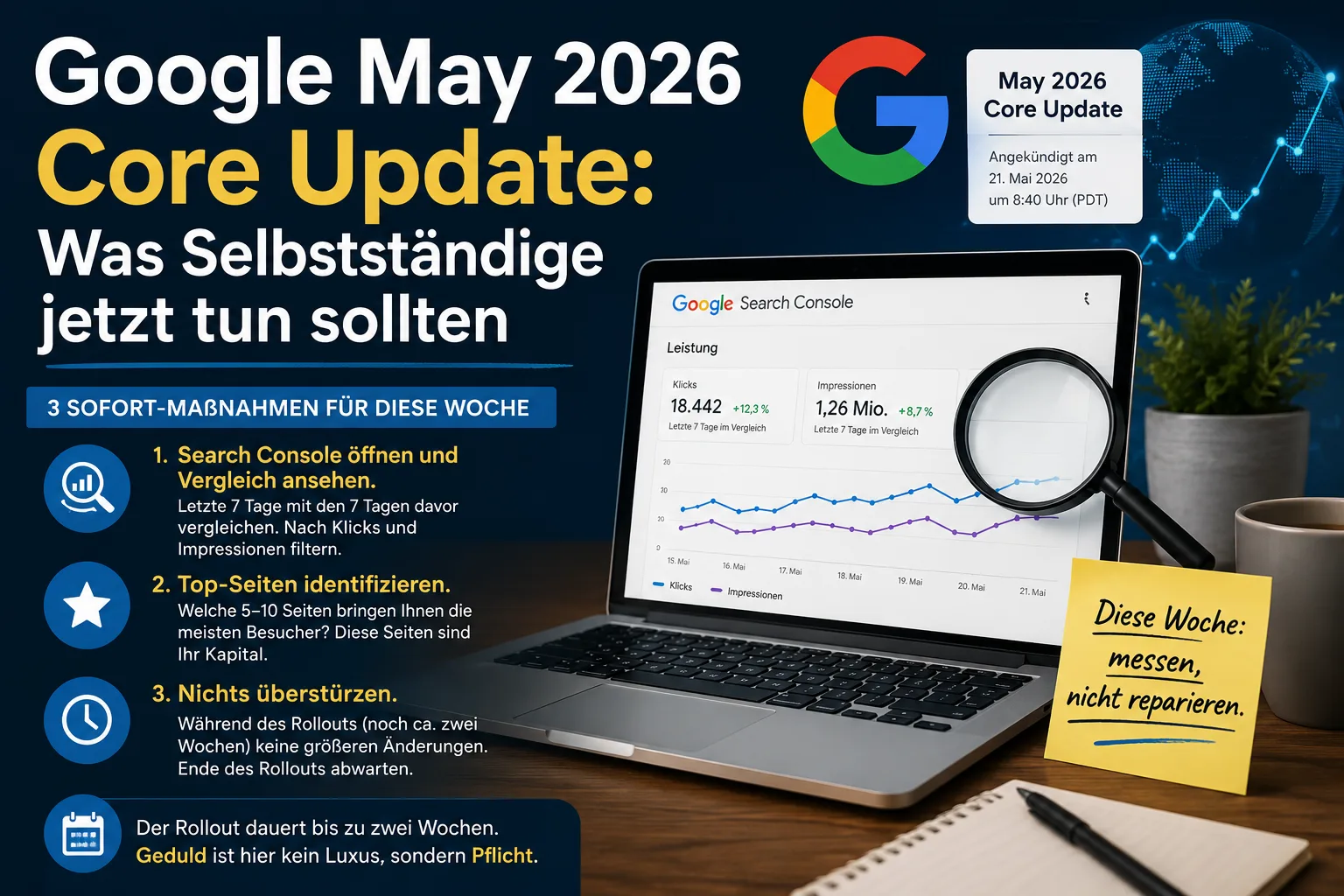
On 21 May 2026 at 8:40 a.m. PDT, Google announced the May 2026 Core Update via the official Search Status Dashboard. It is the second broad core update of the year and the fourth confirmed ranking update in 2026 — after the February Discover update, the March spam update and the March core update. The rollout takes up to two weeks.
Google itself describes the update soberly as a “regular update designed to better surface relevant, satisfying content for searchers from all types of sites". There is no topic list or blog post — confirmation came via X (formerly Twitter).
What does this mean for you? If you run a website, online shop or blog as a self-employed professional or small business, your Google visibility may fluctuate over the next few days — either up or down. Knee-jerk reactions are wrong now. First observe, then act.
Who is most affected?
Several independent trackers (SISTRIX, Semrush Sensor, AccuRanker etc.) have shown clear movement in search results since 21 May. Particularly volatile:
- YMYL topics (Your Money, Your Life — finance, health, legal): highest volatility here
- E-commerce sites: especially shops with thin product pages and no editorial content
- Info sites and aggregators: pages that compile third-party content without their own value-add
Small, regionally anchored providers with real expertise — typically the trades business, the photographer or the coach with clear positioning — have tended to be among the stable or winning sites in past core updates. Those who have published AI text en masse without editorial work tend to lose.
Three immediate steps for this week
Nothing needs to be rebuilt this week. But three things need doing now:
1. Open Search Console and check the comparison. Log in to Google Search Console and compare the last 7 days with the 7 days before. Filter by clicks and impressions. This shows you whether and where there was actual movement — rather than letting industry headlines panic you.
2. Identify top pages. Which 5–10 pages bring you the most visitors? These pages are your capital. If they are stable, the situation is reassuring. If something breaks there, the update has hit you noticeably — and you know where to optimise first.
3. Don't rush. During a rollout (still about two weeks to go), there is no point making major changes. Google itself recommends waiting for the rollout to complete before drawing conclusions. Patience here is not a luxury but a duty.
What does this mean for you? This week: measure, don't repair.
Medium-term: what actually ranks again
Once the rollout is complete (expected early June), it will be clearer where you stand. Four levers have proven the most important across several core updates in a row:
Make your own experience visible. The “E" in E-E-A-T (Experience, Expertise, Authoritativeness, Trustworthiness) has been the most important lever since 2023. Concretely: write first-hand. Show your own photos, your own measurements, your own customer cases. A painting business that brings a before-and-after picture from their last job beats a textbook text with stock photos.
Make authors visible. Anonymous content loses — even if it is solid in substance. A simple author byline with photo and short bio (“Master hairdresser in Cologne for 12 years") creates trust — with Google and with readers. This isn't an SEO trick, it's the simplest form of transparency.
Clean up thin content. If you have 80 old blog posts, 60 of which nobody reads and none of which contain anything original: remove or consolidate them. Fewer pages with more substance work better in core updates than many thin pages.
Use AI in moderation. Google doesn't punish AI texts categorically. But anyone publishing unchecked, interchangeable AI texts en masse is on the losing side. AI as a drafting aid — yes. AI as the sole author with no personal experience — no. How to use AI cleanly is shown in our piece on ChatGPT for product descriptions.
Practical example: an Etsy seller after the update
Imagine Maja, who sells handmade jewellery via Etsy and her own Shopify shop. So far, about a third of her shop visitors came directly from Google search. On 24 May she sees in Search Console: minus 18 percent clicks compared to the previous week, mainly on the category pages.
What Maja is doing right now:
- She waits a week before changing anything on the texts — the rollout is still running.
- She opens her three strongest category pages and notices: there's only a product list, no text, no story. She adds 3–4 paragraphs to each category: what makes the jewellery special, how it's made, who it fits — with her own photo from her workshop.
- She puts a short “About me" box with photo on every page — fifth-generation goldsmith, seven years on Etsy, over 1,200 reviews.
- She actively collects reviews and shows them on product pages. How to do this legally is covered in our piece on Collecting customer reviews 2026.
Result: even if rankings don't come back immediately — the pages get better for buyers. And that's exactly what Google has rewarded in every update since 2024.
Frequently Asked Questions
When is the May 2026 Core Update fully rolled out?
Google has announced that the rollout takes up to two weeks — so expected by early June 2026. Only then can the changes be finally evaluated.
Should I start working on my content immediately?
No, don't panic. As long as the rollout is running, rankings fluctuate. First measure (Search Console), then after the rollout, tackle in a targeted way — especially the pages that lost the most traffic.
Will my AI texts now be penalised?
Not categorically. Google evaluates whether a text brings real added value — whether it was written by a human or with AI assistance. Texts without your own insights, experience or data rank weakly — regardless of the tool.
How long does recovery take if I dropped?
Realistically two to six months for classic shops and service providers, in YMYL industries (finance, health) six to twelve months. Recovery typically only comes with the next core update.
Does the update also affect Google Business Profile / Maps?
No, core updates relate to organic web search. Your entry in Google Maps and the Business Profile is not directly affected. How to gain more customers there is in our Google Business Profile practical guide.
Conclusion
The Google May 2026 Core Update isn't drama — but a good occasion to honestly review your own online shopfront. Anyone who shows real experience, makes authors visible and cleans up thin content wins in the long run. And while Google sorts, sort your invoices and reminders best with PepperTools — so you can keep your head clear for the SEO work.
Sources
- Google Search Status Dashboard — May 2026 core update — official status and history page on the update.
- Google Search Central on X — confirmation 21 May 2026 — official rollout announcement.
- Google Search Central — How Core Updates work — Google's documentation on core updates and recommendations.
- Google Search Central — Creating helpful, reliable, people-first content — recommendations on E-E-A-T and people-first content.
- SISTRIX — Google Core Update March 2026: winners and losers — visibility analysis of the previous core update.
- SEO Südwest — Google rolls out the May 2026 Core Update — German-language reporting on the current update.
- OnlineMarketing.de — Google rolls out May 2026 Core Update — industry analysis and first data.
Handle invoices more easily
Easy Invoice combines quotes, invoices and customer management in the cloud.
Try Easy InvoiceRead next
 Marketing & SEO
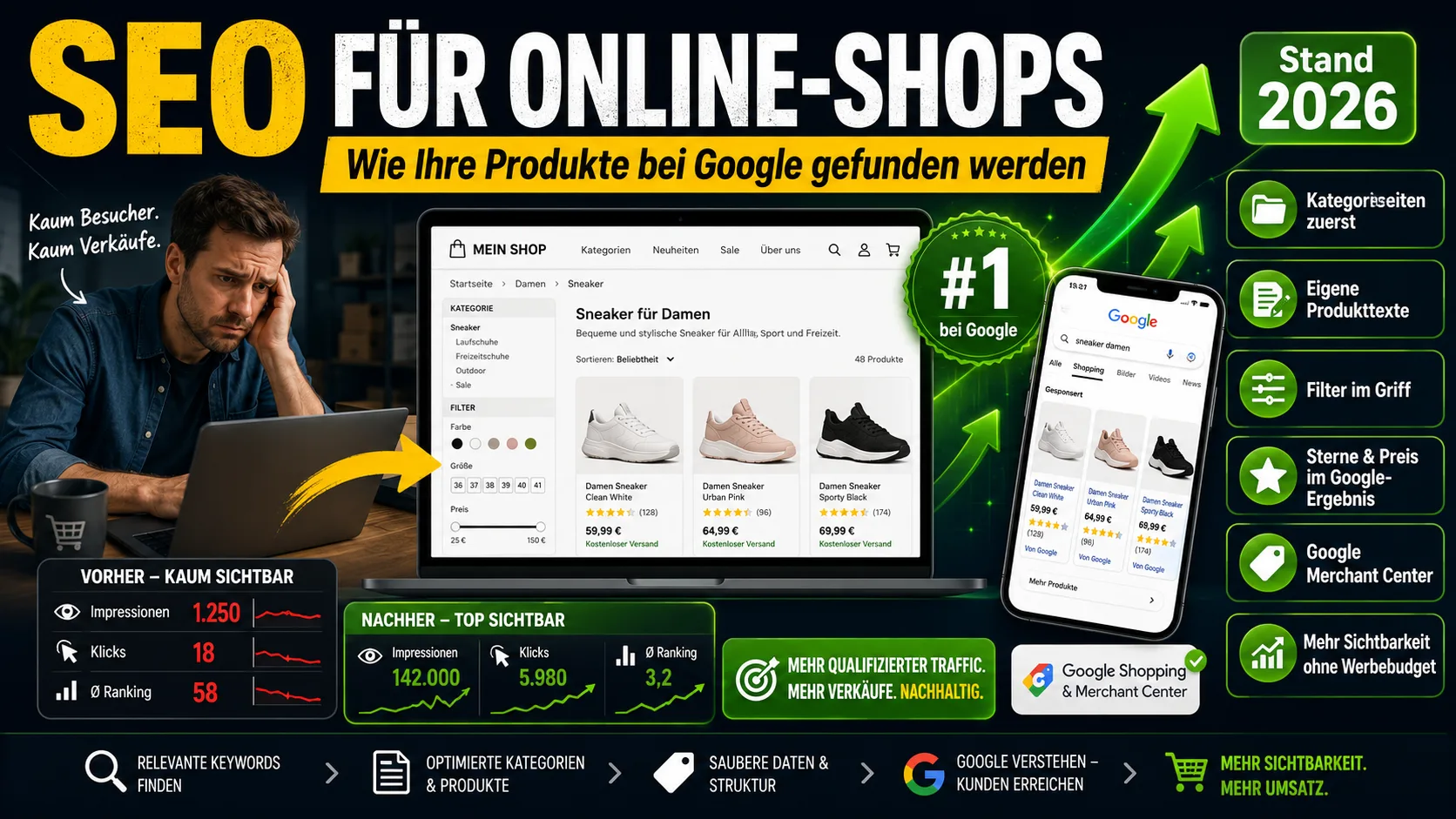
SEO for Online Shops: How Your Products Get Found on Google (2026)
Shop SEO works differently from ordinary website SEO. What really counts on category and product pages – without the technical jargon.
 Marketing & SEO
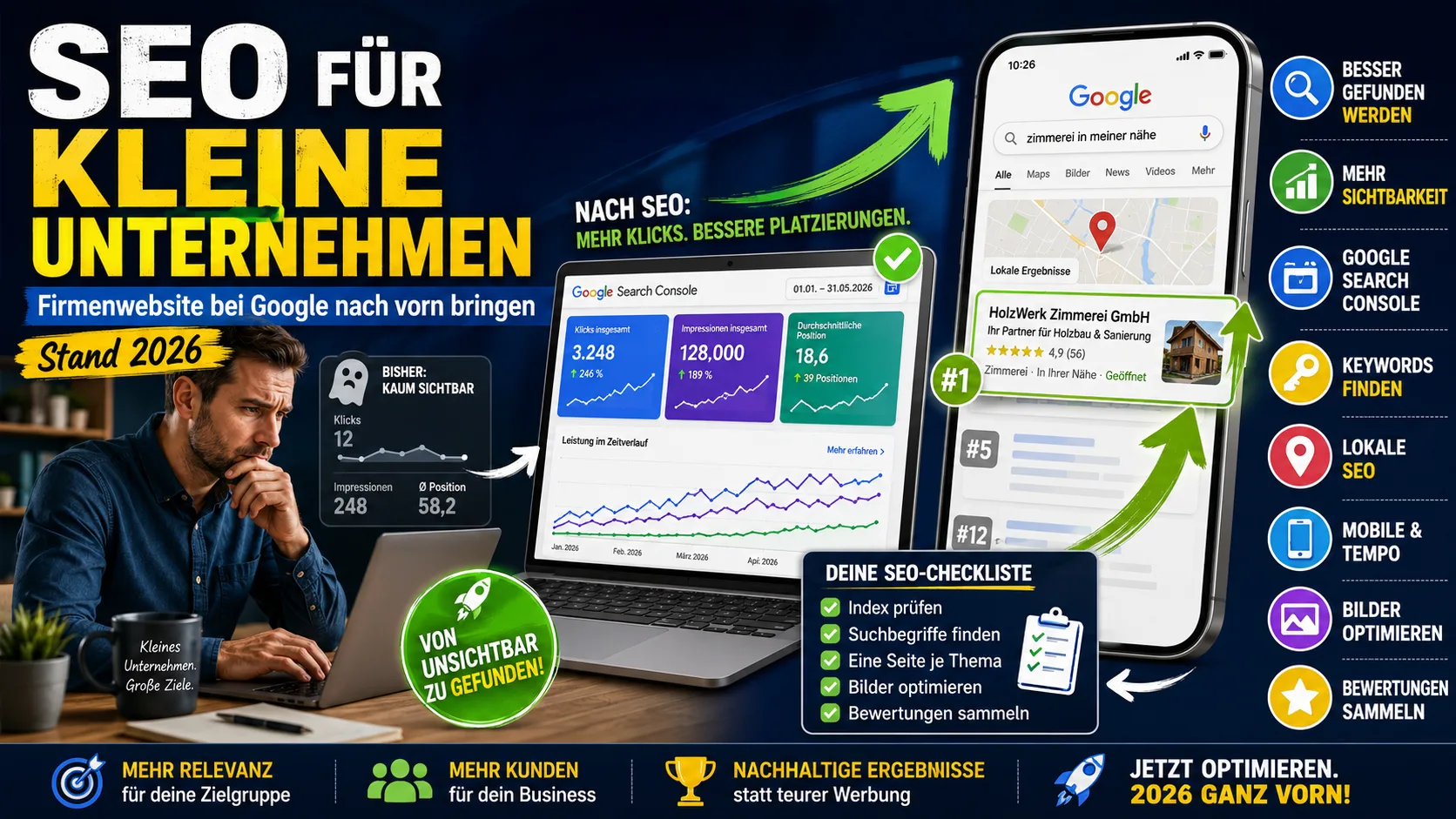
SEO for small businesses: getting your company website to the top of Google (as of 2026)
Starting from scratch: are you even on Google? Why you are not being found, what you can change yourself in three weeks – and what you can safely skip.
 Marketing & SEO
Getting a Website Built: Costs & Process for Freelancers and Small Businesses Like Tradespeople
What does it cost to have a website built? Real prices, what belongs on a 2026 site, and how the process works – for freelancers and small businesses like tradespeople.