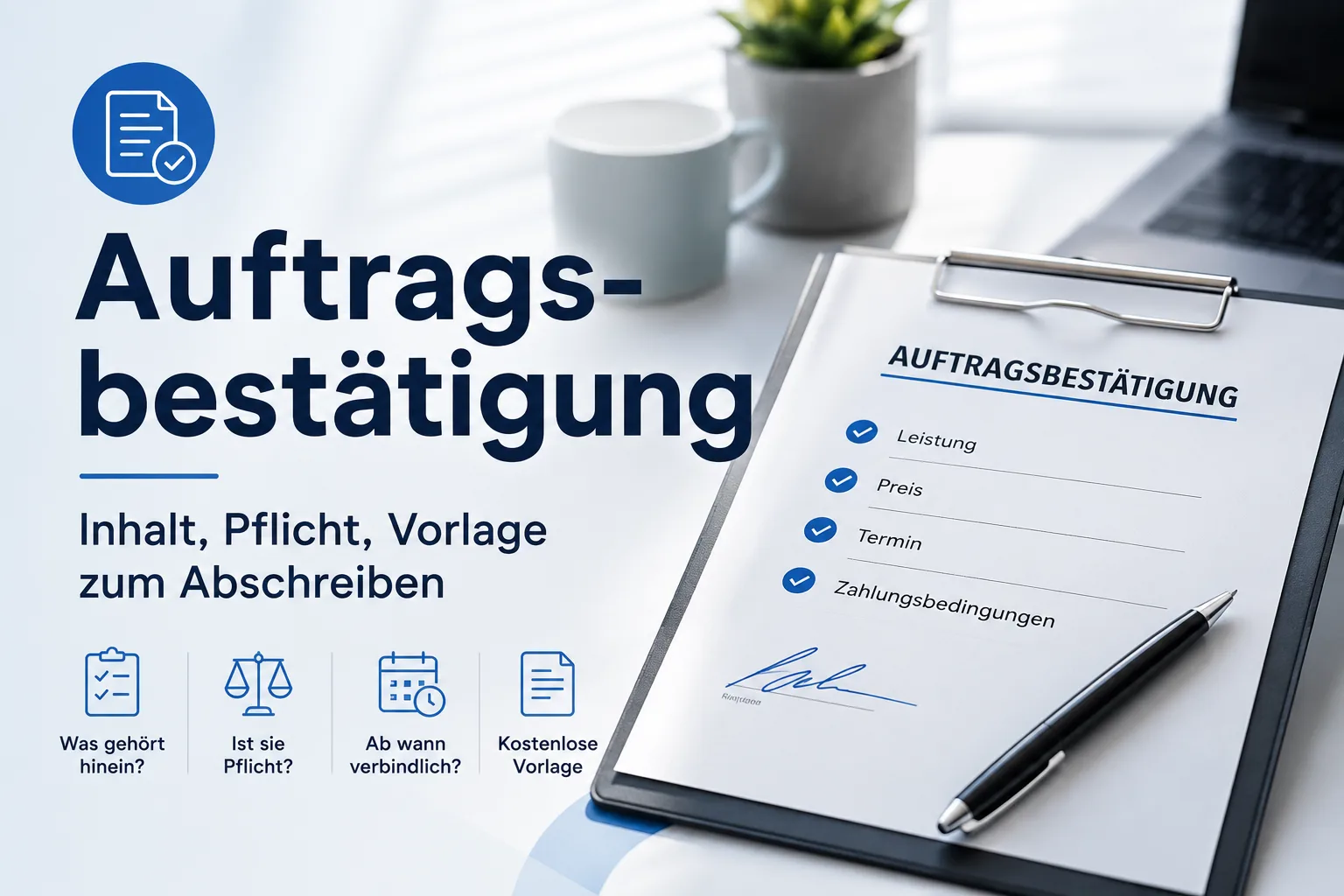
An order confirmation is a short document in which you confirm to a customer that you are accepting their order – and on what terms. It records what will be delivered, what it costs and when it will be ready. It is not mandatory: no law requires an order confirmation, and there are no compulsory details as there are for an invoice. It still has an effect, because in many cases it is the document that makes the order binding. And it sets what you are allowed to invoice in the end: whatever is not in here is hard to get paid for later.
A note first: this article describes the legal situation in Germany, provides general information and is not legal advice. In a dispute, the individual circumstances always matter.
Contents
- When do I need an order confirmation?
- What belongs in an order confirmation?
- Template to copy
- What does not belong in it
- From when is the order binding?
- Does the customer have to sign it?
- Order confirmation, quote, delivery note, invoice – the difference
- From order confirmation to invoice
- If the customer backs out afterwards
- How long do I have to keep it?
When do I need an order confirmation?
You can carry out any job without one. In four situations, however, it is more than paperwork:
- You negotiated verbally or by phone. Then nothing exists in writing. The confirmation is your only record of what was agreed.
- The customer ordered something different from your quote – for example only two of three items, or a different quantity.
- Your quote was marked „subject to change" or „without obligation". Such wording means you did not want to commit yourself yet. In that case the customer's order is not a completed contract; only your confirmation makes it firm. More on this in Is a quote binding?.
- Weeks or months lie between the order and delivery. By then both sides remember things differently.
From quote to invoice in one tool: the quote and invoice software Easy Invoice carries the line items over to the next document with one click.
What belongs in an order confirmation?
There are no compulsory details – an order confirmation is not a tax document. But it is only useful if nobody has to guess months later. These points should be included:
- The words „order confirmation" in the heading, so it is clear what the document is and what it is not.
- Both names and addresses, yours and the customer's.
- Date and your own reference number, so you can find the document again later.
- A reference to what came before: „regarding your order of 14 April" or „regarding our quote no. 2026-118". This prevents mix-ups when several jobs are running with the same customer.
- What you will deliver or do – specific enough for a stranger to understand. „Renovation work" is not enough; „living room and hallway, approx. 68 m², walls painted white twice, materials included" is. This line later decides who is right in an argument about scope.
- Quantity, unit prices, total price and whether VAT is added or already included.
- Date or period of execution.
- Payment terms: payment deadline, and any deposit or instalments.
Depending on your business, add: your terms and conditions, but only if they were already discussed. A retention of title for goods deliveries – meaning the goods remain yours until paid in full. And notes on what the customer has to provide, such as cleared rooms or a power supply. That last point is often forgotten and is the most common reason why appointments fall through.
Template to copy
Nothing more is needed. The text works as an email and as a PDF:
Order confirmation no. 2026-042
Date: 30 July 2026Dear Ms Berger,
thank you for your order of 28 July 2026. I hereby confirm as discussed:
Service: Living room and hallway (approx. 68 m²), walls painted twice, paint „pure white matt", materials included
Price: EUR 1,240.00 net plus 19 % VAT (EUR 235.60) = EUR 1,475.60 gross
Execution: 12–14 August 2026, starting 8:00 a.m.
Payment: 14 days after receipt of invoice, no deductionsPlease clear the rooms by the previous day so that the walls are accessible.
Kind regards
Malerbetrieb Kern · Thomas Kern, owner · Musterweg 4, 12345 Musterstadt
As a small business exempt from VAT, replace the price line with: „Price: EUR 1,240.00 · No VAT is included in this amount (small business scheme under section 19 of the German VAT Act)." How this looks on the later invoice is covered in Writing an invoice without VAT.
For deliveries of goods rather than craft services, swap „Execution" for „Delivery: expected calendar week 34, shipped by carrier, delivered free of charge".
Typing this in Word is fine for an order confirmation – for the invoice that follows it gets tricky, see Writing invoices with Word or Excel.
What does not belong in it
No request for payment. An order confirmation is not an invoice. It confirms the order; billing happens after the work. Do not accidentally call the document an „invoice" and do not word it like one. The reason is concrete: anyone who shows VAT in a document in a way that could pass as an invoice may owe the tax office exactly that amount – even if nothing has been delivered yet (section 14c of the German VAT Act).
No „if I hear nothing, I will assume you agree". The sentence sounds practical but usually does not hold. Why is explained in the section on signatures.
No silent changes. If you confirm something different from what was ordered, write it visibly, not in small print at the end. What happens otherwise is explained in the next section.
From when is the order binding?
A contract comes into being when two matching declarations exist: an offer and an acceptance (sections 145 ff. of the German Civil Code, BGB). Who gives which depends on the sequence of events:
| What happened before | When the order is firm | Role of your confirmation |
|---|---|---|
| You sent a binding quote, the customer orders unchanged | Already with the customer's order | Documentation only |
| The customer orders without a quote, or your quote was „subject to change" | Only with your confirmation | It is the acceptance and makes the order firm |
| You confirm something different from what was ordered | Not yet firm | Counts as a new offer – the customer must agree |
The third case is the most common trap. If you deviate, your confirmation counts under section 150 (2) BGB as a rejection combined with a new offer – so the ball is back with the customer. This also applies to changes that seem minor: a different delivery date, an added „plus travel costs", a reference to terms and conditions never mentioned before.
In practice this means: if you change something, get an answer before you spend money. One sentence is enough – „Please reply briefly with ‚that works' and I will reserve the date and buy the materials." Anyone who buys materials first and then receives a cancellation may have no contract at all to rely on.
Does the customer have to sign it?
No. An order confirmation is not a form that has to be countersigned. If the contract already exists (cases 1 and 2 in the table), a missing signature changes nothing – a customer is therefore not out of the job simply because they did not sign. Why most contracts are valid without a signature – and which few exceptions do require written form – is covered in signing contracts digitally.
For larger jobs a brief reply is still wise. Not for validity, but as evidence: an email saying „that works" is worth its weight in gold in a dispute.
Conversely: silence is generally not consent. Someone who does not react has not agreed. In commercial dealings between merchants there is an exception recognised by the courts, the commercial letter of confirmation – but it does not apply to most solo self-employed people. Freelance professionals are generally not merchants, a small trade without an entry in the commercial register usually is not either, and towards private customers the exception does not apply at all. So do not rely on it.
Order confirmation, quote, delivery note, invoice – the difference
| Document | Who writes it | Purpose | Demands payment? |
|---|---|---|---|
| Quote | You | You propose service and price | No |
| Order | The customer | They commission you | No |
| Order confirmation | You | You record what applies | No |
| Delivery note | You | What was actually delivered | No |
| Invoice | You | Billing after the work | Yes |
The content is always the same items, just with a different purpose. Anyone who retypes them each time eventually produces transposed digits – and those only surface when the customer compares the invoice with the confirmation. In office1.cloud the documents are linked: a quote becomes an order with confirmation at the click of a button, then a delivery note, then an invoice – items, prices and customer data carry over.
From order confirmation to invoice
The invoice lists the same things – but it is a tax document, so it has to say more. Four details are almost always missing from an order confirmation and are mandatory on an invoice (Section 14 (4) of the German VAT Act): your tax number or VAT identification number, a sequential invoice number, the date the service was provided (not the date of the confirmation) and the net amount broken down by tax rate. The full list is in Writing an invoice: the ultimate guide.
The number of the order confirmation is not one of the mandatory details. Put it on anyway. With business customers the invoice passes through an accounts department that has to match it to an order – without a reference it sits there, and you wait for your money without knowing why.
What happens if the invoice is higher than the confirmation?
The customer pays less. And usually they are entitled to, because what you can claim follows from the contract – not from what you write on the invoice. If you confirmed a fixed price, that fixed price applies, even if the work took longer than expected.
If it becomes clear during the job that it will cost more, there is exactly one right moment to raise it: immediately, not with the final invoice. Two situations need to be told apart:
- You confirmed a fixed price. You only get more if the customer agrees to the additional work. A short email with the extra amount and an "is that all right?" is enough – but before you carry out the work, not after.
- The basis was a cost estimate (an estimate without a price guarantee). Then the law actively requires you to speak up: if a substantial overrun is on the cards, you have to tell the customer without delay (Section 649 (2) of the German Civil Code). If you do not, you risk claims for damages. The customer may also cancel; in that case only the work done so far is billed. There is no fixed percentage in the law at which an overrun counts as "substantial" – that depends on the individual case. What a cost estimate means legally is explained in Is a quote binding?.
The same applies the other way round: if you delivered less than you confirmed, invoice less. An invoice that does not match the confirmation is the most common reason for queries – and every query costs you payment days.
Did you agree on a deposit?
If the order confirmation mentions a deposit or instalments, you need two invoices: one for the progress payment and a final invoice at the end in which the amounts already paid are deducted. VAT does not become due twice, but the structure of the final invoice is where things regularly go wrong – explained in Progress, partial and final invoice.
By when does the invoice have to be issued?
For many jobs there is a deadline of six months after the service was provided (Section 14 (2) of the German VAT Act). It covers services to other businesses and – tradespeople often overlook this – services to private customers where land or a building is involved: painting, heating installation, tiling, roofing, gardening. So anyone painting a wall for a private customer also has to invoice within six months. What else belongs on such an invoice so the customer keeps their tax relief is set out in writing a tradesman's invoice to private customers.
One last technical point: the e-invoicing obligation applies only to the invoice, not to the order confirmation. You can keep sending that as a PDF or an email – what changes for invoices to business customers is set out in E-invoicing obligation 2027 and 2028.
If the customer backs out afterwards
Briefly, because the question comes up regularly: for craft and manufacturing work the customer may cancel at any time, even without a reason – but not free of charge. You can claim the agreed fee and only have to deduct what you save through the cancellation. The law presumes 5 per cent of the fee for the part not yet performed as your entitlement (section 648 BGB), and this presumption can be adjusted upwards with documented costs. For private customers who concluded the contract solely by phone, email or online, an additional 14-day right of withdrawal may exist – that follows from the law, not from your order confirmation. Both depend on the individual case; where larger sums are involved, have it checked professionally. And if only the payment is missing at the end, see Customer is not paying – what now?.
How long do I have to keep it?
Business letters you send or receive generally have to be kept for six years (section 257 of the German Commercial Code, section 147 of the Fiscal Code) – emails count too, and an order confirmation usually falls into this category. The clock starts at the end of the calendar year in which the letter was sent: a confirmation from March 2026 may therefore be discarded at the earliest in early 2033. Invoices and other accounting documents have a longer period, eight instead of ten years since 1 January 2025. Whether an individual document counts as a business letter or an accounting document is best assessed by your tax adviser.
Incidentally, no particular form is prescribed. Email is valid, WhatsApp generally too – but a chat history is rarely findable years later, whereas a PDF with a date and number is.
The essentials in four sentences: confirm word for word what was agreed – then the order is firm. If you change something, it is a new offer, and you had better wait for the answer before spending money. The customer does not have to sign, and their silence is not a yes. And what you invoice in the end has to match what you confirmed – settle extra costs beforehand, not with the final invoice. From quote to invoice, a quote and invoice software handles it without typing anything twice.
Handle invoices more easily
Easy Invoice combines quotes, invoices and customer management in the cloud.
Try Easy InvoiceRead next
 Invoicing & Accounting
Booking private withdrawals in Germany: accounts, tax, contributions
A private withdrawal is not a salary and does not lower your profit. Which accounts apply, when VAT is due on goods and the car, and what goes into the Anlage EÜR.
 Invoicing & Accounting
Cost estimate in Germany (Kostenvoranschlag): template and what goes in
A German cost estimate (Kostenvoranschlag) is an estimate, not a fixed price. With a sample to copy: what goes in, which sentences protect you from disputes and when it may cost money.
 Invoicing & Accounting
Receipt lost? How to write an Eigenbeleg in Germany
No booking without a receipt – but there is a substitute. What belongs on a German Eigenbeleg, when the tax office accepts it, and why the VAT is gone anyway.