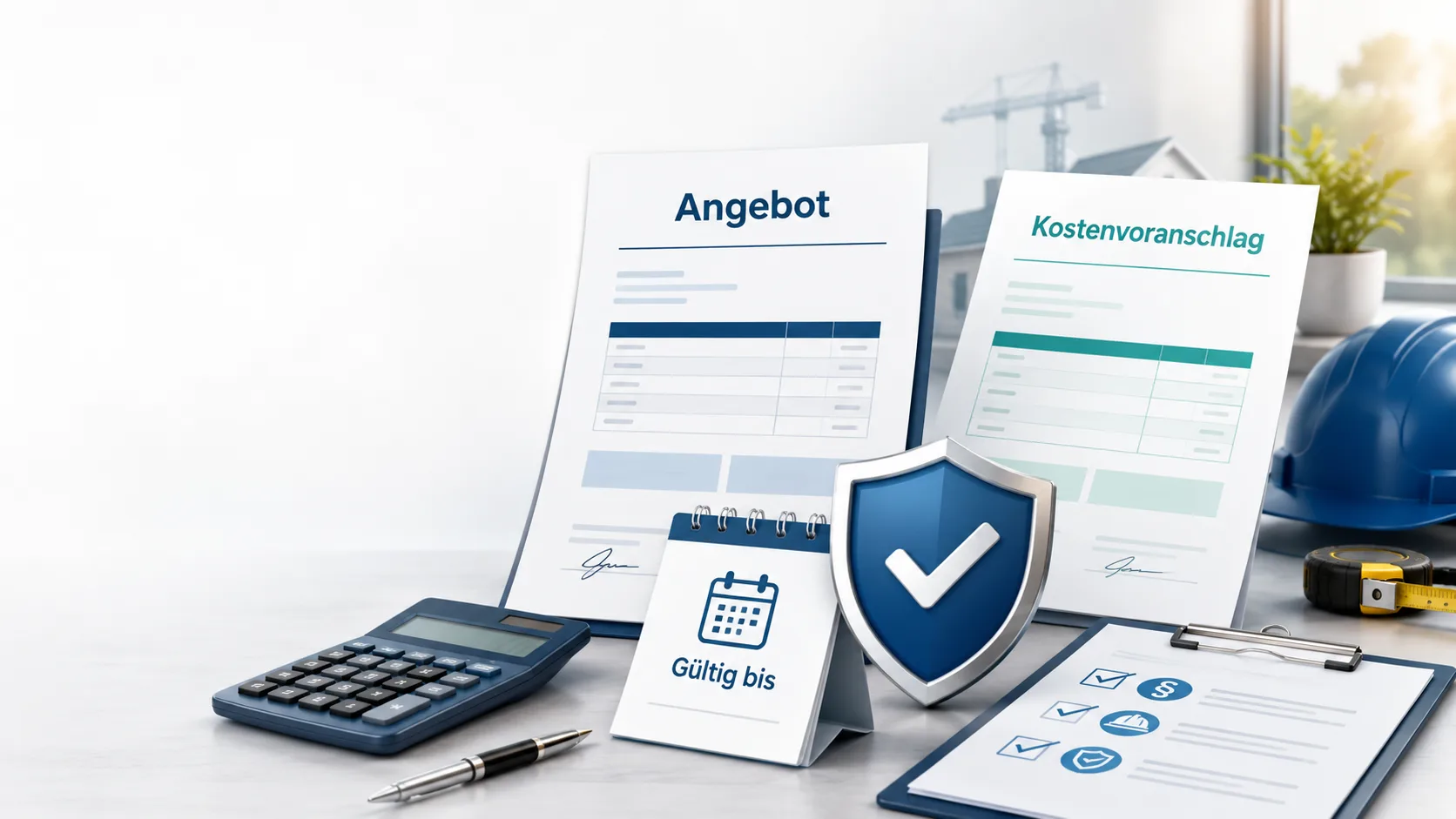
You sent out a quote – and then realise you miscalculated. Or a customer gets in touch three months later wanting to accept "that quote from back then". Or you wonder whether you may exceed your cost estimate because materials have become more expensive.
These are exactly the situations that keep coming up in forums and legal advice columns. This article answers the most common questions about the binding nature of quotes under German law – for self-employed professionals, tradespeople and small businesses that write quotes. Much of it also helps if you have received one.
One note up front: this article provides general information and is no substitute for legal advice. In a concrete dispute, the individual case is what counts.
Table of contents
- The short answer
- Is a quote legally binding?
- How long is a quote valid?
- Can I withdraw a quote?
- "Subject to change": how non-binding clauses work
- Miscalculated – and the customer has already accepted?
- The customer accepts but wants changes
- Quote or cost estimate – what is the difference?
- May a cost estimate be exceeded?
- May I charge for a quote or cost estimate?
- Checklist: how to protect yourself
The short answer
- A quote (Angebot) is generally binding: if the customer accepts it unchanged and in time, a contract is formed on exactly those terms.
- A cost estimate (Kostenvoranschlag), by contrast, is an estimate. It may be exceeded within limits – but if a substantial overrun becomes apparent, you must inform the customer without delay.
- With a validity period ("This quote is valid until …") and – where appropriate – a non-binding clause ("subject to change"), you stay in control of how long and how firmly you are bound.
Now for the details – and above all, the exceptions.
From quote to invoice in one tool: the quote and invoice software Easy Invoice carries the line items over to the next document with one click.
Is a quote legally binding?
Yes – as a rule, it is. Legally, a quote is an "offer" within the meaning of Section 145 of the German Civil Code (BGB): whoever offers to conclude a contract is bound by that offer. If the recipient accepts the quote unchanged and within the deadline, the contract is formed – without you having to agree again.
In concrete terms: the prices and services in your quote are not ballpark figures but the terms on which you must deliver or work if the customer says "yes". A quote "just as a rough guide" does not exist legally – unless you expressly label it as such (more on that below).
The form does not matter, by the way: a quote sent by e-mail or given verbally can also be binding. A written quote with date, description of services and validity note has one decisive advantage, though – in case of doubt you can prove exactly what you offered and on which terms. Where this freedom of form ends and only the qualified electronic signature counts is explained in signing contracts digitally.
How long is a quote valid?
This is where most misunderstandings happen in practice. There are two cases:
Case 1: You stated a validity period. For example: "This quote is valid until 15 August 2026." Then exactly this deadline applies (Section 148 BGB). Once it expires, the quote lapses – the customer can no longer accept it unilaterally. If they get in touch later, their "acceptance" is legally a new offer to you, which you may accept but do not have to.
Case 2: You did not state a deadline. Then Section 147 BGB applies – and it is stricter than many think:
- A quote made in person (including by phone) can only be accepted immediately.
- A quote made at a distance (letter, e-mail) can only be accepted for as long as you may expect a reply "under regular circumstances". For an e-mail that can be a very short period – depending on the case, a few days or even less.
At first glance that sounds like an advantage for the provider. In practice, the missing deadline is above all a source of disputes: the customer believes the quote from six weeks ago still stands – your purchase prices have changed in the meantime. Who wins depends on the individual case, and nobody wants to settle that in court.
Hence the simplest protection of all: put a validity period in every quote. Depending on the industry, 2 to 4 weeks is common. With strongly fluctuating material prices it may be shorter.
Can I withdraw a quote?
Only within a narrow window. A revocation is possible as long as the quote has not yet reached the recipient – or if the revocation arrives at the latest at the same time as the quote (Section 130 BGB).
With a letter that may still work. With an e-mail the window is practically zero: case law assumes that an e-mail arriving on the recipient's server during normal business hours is generally deemed received immediately. Sending "Stop, please ignore that e-mail!" a minute later usually no longer helps legally.
What remains afterwards:
- If the validity period has expired and the customer has not accepted, you are free.
- If you made the quote subject to change (next section), you are not bound anyway.
- Otherwise: quote submitted, customer accepts in time → contract. A "walk-back" is then no longer a question of quotation law but a breach of contract that can trigger damage claims.
"Subject to change": how non-binding clauses work
You can exclude the binding effect of your quote – with a so-called non-binding clause (Freizeichnungsklausel). Common wordings in Germany:
- "This quote is subject to change" (freibleibend).
- "Quote subject to change, subject to prior sale" (common in trade).
- "All prices subject to change."
The effect: your "quote" is legally no longer a binding offer but an invitation to the customer to make an offer themselves (lawyers call this invitatio ad offerendum). If the customer says "yes", the contract is only formed when you confirm – for example with an order confirmation.
But: a non-binding clause is not a cure-all.
- If you simply stay silent after a customer accepts a non-binding quote, you can still become bound under the principle of good faith – you must reject or confirm without delay if you do not want the order (or not on those terms).
- A quote that is "subject to change" throughout strikes some customers as non-committal in the bad sense – like a price you cannot rely on. In case of doubt, the clear validity period is the more customer-friendly instrument: the customer knows where they stand, and you are still only bound for a limited time.
Non-binding clauses are most useful selectively – for example for material items with strongly fluctuating purchase prices ("material prices subject to change, billed at daily rates") or limited stock ("while stocks last").
Miscalculated – and the customer has already accepted?
The most unpleasant scenario, and one of the most frequent questions of all: you made a mistake in the quote – forgot an item, priced something too low – and the customer has accepted.
The sobering basic rule: the contract stands. An internal calculation error – you calculated wrongly, but the quote says exactly what you (accidentally) meant to write – does not, according to established case law, generally entitle you to rescind. The calculation risk lies with the provider.
It can be different with a genuine declaration error: you meant to write €4,800, but a typo turned it into €480 in the quote. Such cases may justify rescission (Section 119 BGB) – but then the customer may be able to claim compensation for expenses made in reliance on the quote. And whether a court classifies the case as a declaration error or a calculation error is often exactly what the dispute is about.
In practice, a different route usually works best: the open conversation. Many customers are willing to talk when an obvious mistake has happened – especially when the alternative is a contractor working at a loss with correspondingly little motivation. Legally, however, you can generally not force the adjustment.
The better strategy is prevention: double-check the calculation before sending (especially with quotes copied from older templates), keep validity periods short, and use reservations or optional items for uncertain positions. How to calculate your hourly rate so the basis is right is covered in a separate article: calculating your hourly rate.
The customer accepts but wants changes
"I accept your quote – but give me another 5% discount", or "fine, but without item 3".
Legally, that is not an acceptance. An acceptance with extensions, restrictions or other changes counts as a rejection combined with a new offer – this time from the customer to you (Section 150(2) BGB). Your original quote is off the table; now you decide whether to accept on the changed terms.
Important: respond explicitly. If you simply start working after such an "acceptance with changes", you accept the changed offer by conduct – discount included.
The same applies to late acceptance: if the customer's "yes" arrives after the validity period has expired, it is likewise a new offer (Section 150(1) BGB). You may accept it – but you do not have to at the old prices.
Quote or cost estimate – what is the difference?
The two terms are constantly mixed up in everyday life, but legally they differ:
| Quote (Angebot) | Cost estimate (Kostenvoranschlag) | |
|---|---|---|
| Character | Binding offer to conclude a contract | Professional estimate of the expected costs |
| Price commitment | Stated prices apply upon acceptance | No guarantee – a guide value |
| Overrun | Not envisaged in principle | Permitted within limits (see next section) |
| Typical use | Work is clearly calculable | Effort hard to foresee (e.g. repairs, refurbishment) |
What matters, by the way, is not the heading on the document but its content: a detailed, itemised "non-binding quote" with fixed prices can be treated as a binding offer in a dispute – and a paper titled "quote" full of estimated items as a cost estimate. To be safe, name the document unambiguously and, for estimates, add that it is a non-binding estimate of costs.
May a cost estimate be exceeded?
Yes – but not without limits, and not silently. For contracts for work, Section 650 BGB governs this:
- An insubstantial overrun is permitted. Case law frequently uses a magnitude of roughly 10 to 20 percent as orientation – but that is no fixed statutory limit; it is assessed case by case.
- If a substantial overrun becomes apparent, you must inform the customer without delay – that is, as soon as it is foreseeable that things will get significantly more expensive, not only with the invoice.
- The customer may then terminate the contract. You must then be paid proportionately for the work performed up to that point (Section 650 in conjunction with Section 645 BGB).
For practice this means: if you notice the budget will not hold, contact the customer immediately – ideally in writing, with reasons and a new estimate. That is not only legally required, it also spares you the most unpleasant situation of all: an invoice 40 percent above the estimate that the customer then refuses to pay.
By the way: if everything stays within range, you bill the actual effort – the cost estimate is precisely not a fixed price. On larger projects you can bill interim stages with progress invoices.
May I charge for a quote or cost estimate?
Preparing one costs you time – sometimes hours, for instance when measurements or a site visit are needed. Still: a cost estimate is, in case of doubt, not to be remunerated (Section 632(3) BGB). "In case of doubt" means: without an express agreement, you cannot charge for it afterwards. An invoice for a cost estimate the customer knew nothing about is regularly unenforceable.
Charging is permissible if it was clearly agreed beforehand – for example: "We charge €80 for preparing the cost estimate including the on-site visit. If you place the order, this amount is credited." Exactly this model (a fee credited upon engagement) has become established in many trades: it filters out pure price-shoppers without putting off serious prospects.
Only the order matters: agree first, then prepare. And you should be able to prove the agreement in case of doubt – a short written confirmation is enough.
Checklist: how to protect yourself
Finally, the points that prevent the typical disputes from the outset:
- A validity period in every quote – "Valid until DD.MM.YYYY". Short enough that price changes do not hit you; long enough for the customer to decide (common: 2–4 weeks).
- Describe the work precisely – what is included, what expressly is not ("disposal not included", "painting by others"). Most quote disputes are in truth scope-description disputes.
- Flag uncertain items – label estimated or contingency items as such; make material prices subject to change where needed.
- Call a cost estimate what it is – including a note that it is a non-binding estimate of costs.
- Report foreseeable overruns immediately – in writing, with a new estimate.
- Never implement change requests silently – a changed or late acceptance is a new offer; confirm first, then work.
- Document your quotes – date, version, deadline. Upon acceptance the quote becomes part of the contract and belongs in your records.
If you create your quotes with invoicing software such as office1.cloud, numbering, date and validity note are on board automatically – and the accepted quote becomes the order and later the invoice without re-entering anything. That way quote and invoice match – one dispute fewer.
Handle invoices more easily
Easy Invoice combines quotes, invoices and customer management in the cloud.
Try Easy InvoiceRead next
 Taxes & Law
Entertainment receipt in Germany: what to write on it
A German entertainment receipt needs five details: place, day, guests, reason and amount. Miss one and the deduction is gone — and since 2025 new rules apply to the restaurant bill.
 Taxes & Law
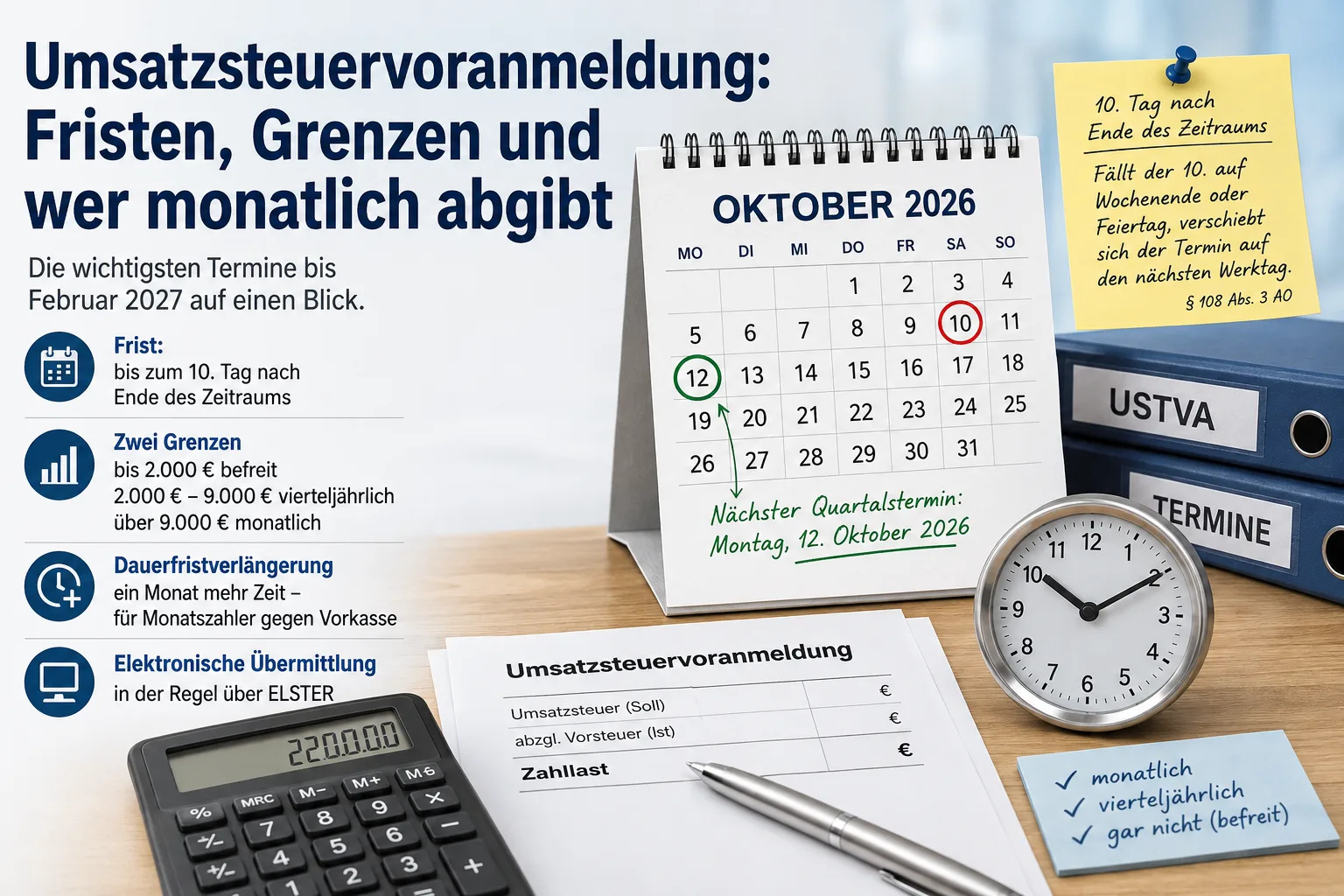
Advance VAT return in Germany: deadlines, thresholds, monthly or quarterly
If you run a business in Germany, you file an advance VAT return by the 10th day after each period. This article shows which cycle applies to you, when your next date falls and how to buy yourself an extra month.
 Taxes & Law
Which insurance do I need as a self-employed person in Germany? Mandatory, essential and skippable – costed out for three businesses
Health insurance is compulsory, pension insurance only for certain trades, and every business must register with its employers' liability association. Everything else is your call. What a roofer, a programmer and a café owner really need – and the order to buy in when money is tight.