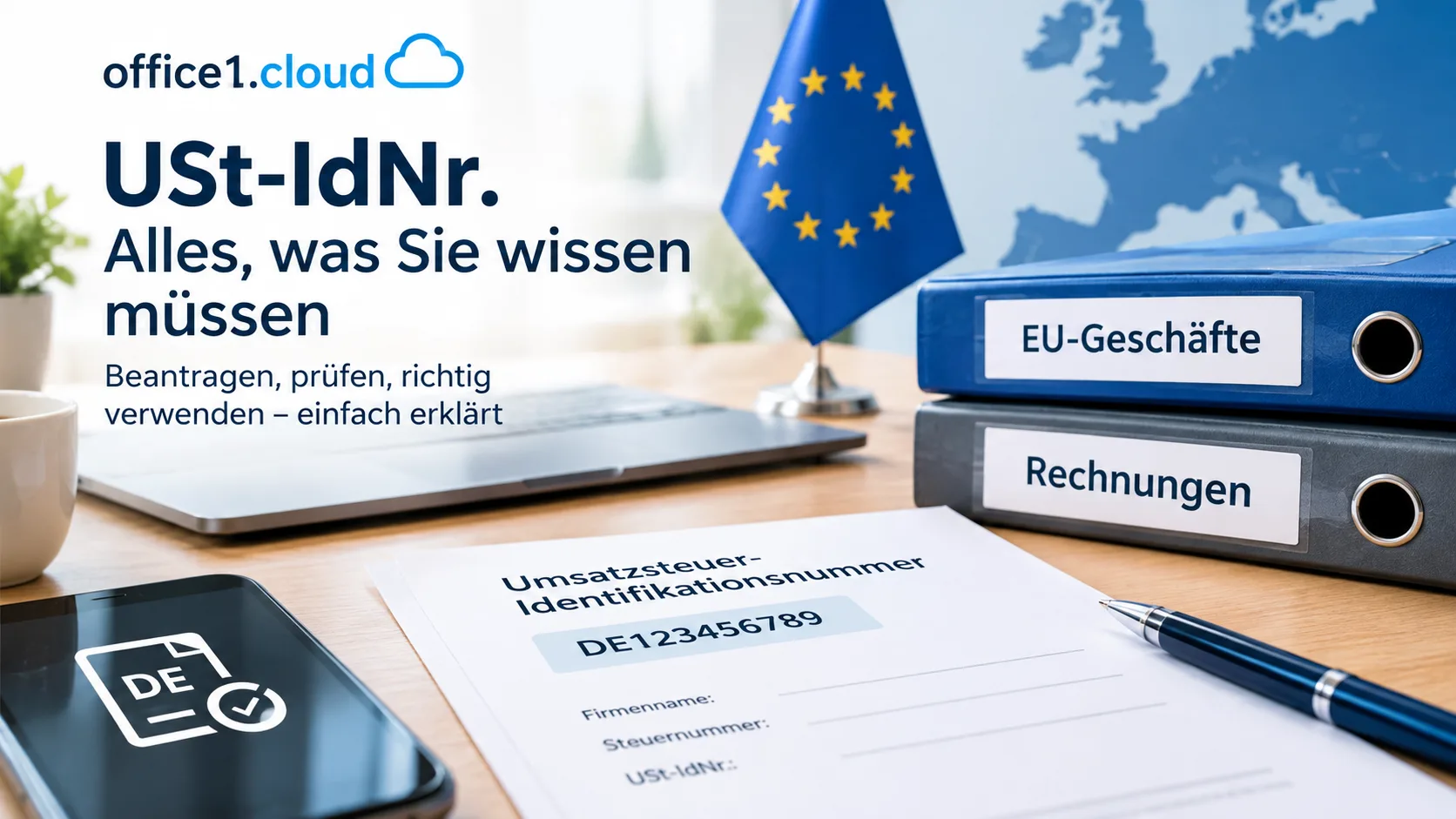
You need a USt-IdNr. (Umsatzsteuer-Identifikationsnummer, the German EU VAT identification number, VAT ID for short) as soon as you do business with companies in other EU countries, including when you buy from them. For business within Germany only, the Steuernummer (tax number issued by your tax office) is as a rule enough. You apply for the USt-IdNr. free of charge at the BZSt (Bundeszentralamt für Steuern, German Federal Central Tax Office), either online or right in the tax registration questionnaire (Fragebogen zur steuerlichen Erfassung); it is sent to you by post only. There you can also check, likewise free of charge, whether the number of a customer in another EU country is valid.
Contents
- Do you need a USt-IdNr.?
- Steuernummer, Steuer-ID, USt-IdNr.: which is which?
- Applying for a USt-IdNr.: step by step
- Forgot your own number: where can you find it?
- Checking a customer's USt-IdNr.
- Where must the USt-IdNr. appear?
- As a small business owner: do you need one?
- Frequently asked questions
Do you need a USt-IdNr.?
If you only sell to customers in Germany and only buy here, you can as a rule do without one. The BZSt names business in the EU single market as the purpose: companies need the number when they “work for companies in other EU countries or receive supplies / other services from them”.
| Your situation | USt-IdNr. needed? |
|---|---|
| You sell and buy only in Germany | as a rule no, the Steuernummer is enough for the invoice |
| You work for a company in another EU country | yes, according to the BZSt |
| You supply goods to a company in another EU country | yes, according to the BZSt |
| You buy goods from a company in another EU country | yes, according to the BZSt |
| You book services from a company in another EU country, such as advertising or software | yes, the BZSt names this case too |
| You sell via marketplaces such as Amazon or eBay | the marketplaces require it, reasons in the section As a small business owner |
| Your customers are private individuals in the EU | as a rule not for these invoices, private individuals have no USt-IdNr. |
The law does not set out an obligation to apply for the number as a precaution. The BZSt issues it “on application” (§ 27a Abs. 1 UStG, the German VAT Act). However, if your first order from another EU country is coming up, you are better off applying beforehand, because the letter takes some time.
In the office1.cloud invoicing software, you enter your own USt-IdNr. once in your company details and that of each business customer with the respective customer. You can also check the customer's number there directly; the software saves the result and shows the last check with its date and time.
Steuernummer, Steuer-ID, USt-IdNr.: which is which?
The USt-IdNr. does not replace any other number, it is added to them. The BZSt describes it as a “separate number that the BZSt issues to companies in addition to their company's tax number”.
| Number | How you recognise it | What for |
|---|---|---|
| Steuernummer (tax number) | from the tax office, without a country code | tax returns, invoices within Germany |
| Steuer-ID (steuerliche Identifikationsnummer, personal tax identification number) | 11 digits, no letters | you as a person, for life |
| USt-IdNr. | DE and nine digits | business with companies in other EU countries |
You have the Steuer-ID automatically, the USt-IdNr. only on application. Anyone searching for “apply for a Steuer-ID” usually means the personal number; that is not the subject here. An overview of all numbers, including the new business identification number (Wirtschafts-Identifikationsnummer), is given in the article Applying for a Steuernummer via ELSTER (ELSTER is the German tax authorities' online portal).
Applying for a USt-IdNr.: step by step
Before you apply, you need a Steuernummer. The BZSt only issues the USt-IdNr. once your tax office has registered you for VAT and passed the data on to the BZSt. Before that, the application fails.
There are two usual routes:
Route 1: You are just starting your business. In the tax registration questionnaire that you send to the tax office, you tick the box for the USt-IdNr. The tax office forwards the application to the BZSt. The BZSt writes: “From receipt at the tax office to automated forwarding to the BZSt, several weeks may pass.”
Route 2: You already have a Steuernummer. In that case, you apply for the number online at the BZSt:
- Open the BZSt online form for issuing the USt-IdNr..
- Enter the tax office and the Steuernummer under which your business is registered.
- Select the legal form. For a sole proprietorship, enter surname, first name and date of birth; for other legal forms, the company name, postcode and town.
- Submit the form. You immediately receive feedback on the result of the automatic check.
The BZSt compares your details with the data your tax office has transmitted. It therefore advises you to have your last tax assessment notice or the notification of your Steuernummer at hand and to write the address exactly as it appears there. If the data do not match, the tax office is the right point of contact, not the BZSt.
A written application is also possible, via the BZSt contact form or by letter to Bundeszentralamt für Steuern, Dienstsitz Saarlouis, 66738 Saarlouis. It needs your name and address, the responsible tax office and the Steuernummer.
| Question | Answer from the BZSt |
|---|---|
| What does it cost? | nothing, the BZSt charges no fees |
| How is the number delivered? | by post only, not by email, phone or chat |
| To which address? | to the address held by the tax office |
| From when is it valid? | from the date of the notice |
| How long does it take? | via the questionnaire, several weeks until forwarding; for the online application the BZSt does not state a duration |
You do not need paid intermediary services for this. The BZSt writes: “USt-IdNrs are issued exclusively by the Bundeszentralamt für Steuern.”
Forgot your own number: where can you find it?
If you already have a USt-IdNr., it is stated in the BZSt notice. If the letter is lost, fill in the same online form as for the application once more. The BZSt then sends you a copy of the original notice by post; the number stays the same.
The BZSt does not give out the number over the phone. If you have used it before, it may be on earlier invoices, in your legal notice (Impressum) or in your tax adviser's records.
If you run several trades, or a freelance activity alongside your trade, there is still only one number. The BZSt issues “only one USt-IdNr. for the entire business”.
Checking a customer's USt-IdNr.
Before you send a company in another EU country an invoice without German VAT, it helps to check its number with the BZSt. This tells you whether your customer is registered as a business at the time of the supply. Among other things, this determines whether the invoice without VAT is correct. The consequences of a wrong or missing number are explained in the article Invoicing customers in other EU countries.
The check runs via the BZSt interface. You can use our free VAT ID checker, which sends your request directly to the BZSt, or the official query on the BZSt website. The steps are the same:
- Open the VAT ID checker or the BZSt online query.
- Enter your own German USt-IdNr. It does not work without it; the BZSt states that “every holder of a German USt-IdNr.” is entitled to make queries.
- Enter your customer's number. This is the simple confirmation: it shows whether the number is valid today.
- Also enter the company name with its legal form, town, postcode and street. This is the qualified confirmation: it shows whether these details match the number.
- Keep the result, as a printout or as a screenshot.
The tax authorities explicitly name the last step. For an individual query over the internet, proof of the qualified confirmation is to be provided “by keeping the printout or by transferring the result transmitted by the BZSt into a commonly used format or as a screenshot” (Umsatzsteuer-Anwendungserlass, the German VAT application decree, section 18e.1). The BZSt does not send a letter with the confirmation. Our checker shows the BZSt result with the time of the query and the query ID and can be printed. If in doubt, your tax adviser can clarify which documents your tax office accepts as proof.
Three things that often come as a surprise during the check:
- Not retroactive. There is no confirmation for a past day. If you only check months later, you only know whether the number is valid today.
- “Does not match”. The BZSt does not tell you the correct data. Ask your customer under which name and address they are registered in their country. According to the BZSt, typing errors or special characters do not as a rule lead to this result.
- Only numbers from other EU countries. The BZSt confirms numbers issued by another member state (§ 18e UStG). A Swiss number cannot be checked there, and neither can a German one.
The European Commission offers its own query with VIES, which queries the authorities of the EU countries; Germany can also be selected there. For German numbers, VIES is therefore the way to go. For data protection reasons, many countries do not disclose names and addresses but only confirm whether the details entered match. The Commission recommends keeping proof of the check for a tax audit. The tax authorities describe the proof in the Umsatzsteuer-Anwendungserlass for the query at the BZSt.
Where must the USt-IdNr. appear?
Your invoices must show your Steuernummer or your USt-IdNr. This is set out in § 14 Abs. 4 Satz 1 Nr. 2 UStG. So you may also use the USt-IdNr. instead of the Steuernummer within Germany. The exception is small-amount invoices up to 250 euros, where the law requires neither number (§ 33 UStDV).
For an invoice without German VAT to a company in another EU country, the law additionally requires both numbers: your USt-IdNr. and your customer's (§ 14a Abs. 1 und Abs. 3 UStG). The USt-IdNr. must also be stated in the recapitulative statement (Zusammenfassende Meldung) to the BZSt, which as a rule follows such invoices. A sample invoice and the reporting process are shown in the article Invoicing customers in other EU countries. When and how to file this statement is explained in the article Zusammenfassende Meldung.
If you have a USt-IdNr., it belongs in the legal notice (Impressum) of your website and your shop. The Digital Services Act (Digitale-Dienste-Gesetz, DDG) requires it “in cases where they hold a VAT identification number ...” (§ 5 Abs. 1 Nr. 6 DDG). The same applies to the new business identification number as soon as you have one. If you have no USt-IdNr., the law does not require one there either, and according to the Händlerbund (a German retailers' association) the Steuernummer does not belong in the legal notice.
As a small business owner: do you need one?
Even as a small business owner (Kleinunternehmer), you receive a USt-IdNr. if you apply for one. The BZSt issues it to entrepreneurs within the meaning of § 2 UStG, and small business owners are among them. Whether you need one depends mainly on three cases:
- You sell via marketplaces. Under § 25e UStG, a marketplace is liable for VAT not paid by its sellers. It is released from this liability if the seller “has a valid VAT identification number issued to them by the Bundeszentralamt für Steuern under § 27a” (§ 25e Abs. 2 UStG). That is why Amazon, eBay and other marketplaces ask for it. The Händlerbund wrote in May 2021 that since then small business owners on marketplaces also need a valid number.
- You book services from companies in other EU countries. Advertising, software or platform fees come, for example, from companies based in Ireland. The BZSt explicitly names this case as a reason for a USt-IdNr. Under § 13b Abs. 5 UStG, the VAT on such services is owed by the recipient of the service if they are an entrepreneur; small business owners are entrepreneurs within the meaning of § 2 UStG. What this means for your advance VAT return (Voranmeldung) is explained in the article Small business scheme 2026: the pitfalls; in individual cases, your tax adviser will clarify it.
- You work for companies in other EU countries. In that case, too, the customer will as a rule ask for your number.
According to the wording of § 19 UStG, the small business scheme (Kleinunternehmerregelung) depends on turnover thresholds, not on the USt-IdNr. The provision even explicitly exempts small business owners from the obligation to put both USt-IdNrs on an invoice to an EU customer (§ 19 Abs. 1 Satz 2 UStG). What a small business owner's invoice otherwise looks like is shown in the article Writing an invoice without VAT.
Frequently asked questions
What is the format of a USt-IdNr.?
A German USt-IdNr. consists of the country code DE and nine digits, for example DE123456789. Other countries have their own formats; in Austria, for example, the number begins with ATU followed by eight digits. The BZSt lists all formats in an information sheet on the format of the USt-IdNr. (in German).
Is the USt-IdNr. the same as the Steuernummer?
No. The Steuernummer is issued by the tax office, the USt-IdNr. by the BZSt on application. An invoice within Germany needs one of the two; an invoice without VAT to an EU company needs the USt-IdNr.
Can I also use the USt-IdNr. privately?
No. The BZSt writes: “The USt-IdNr. applies exclusively to the business sphere.” Anyone who buys privately in another EU country pays the VAT charged there.
What do I do if my USt-IdNr. is invalid?
The number is valid as long as your tax office registers you as an entrepreneur for VAT. If it has become invalid, contact the tax office, not the BZSt. Afterwards, you can request a new confirmation by post using the online form.
What is a Euro address?
For sole proprietorships, the tax office often transmits the home address. If you present a different business address to EU business partners, problems may arise with their confirmation requests, according to the BZSt. For this purpose, you can have a Euro address (Euro-Adresse) registered with the BZSt in writing; it applies only to requests from other EU countries.
Try Easy Invoice free for 10 days — no payment details, the trial ends by itself.
Sources
- BZSt: Assignment and issuing of the USt-IdNr. (Vergabe und Erteilung der USt-IdNr.), in German
- BZSt: Questions and answers on the USt-IdNr. (Fragen und Antworten zur USt-IdNr.), in German
- BZSt: Confirmation of foreign VAT IDs (Bestätigung ausländischer USt-IdNrn.), in German
- § 27a UStG, VAT identification number (Umsatzsteuer-Identifikationsnummer), in German
- § 18e UStG, confirmation procedure (Bestätigungsverfahren), in German
- § 14 UStG, issuing invoices (Ausstellung von Rechnungen), in German
- § 14a UStG, additional obligations when issuing invoices in special cases (Zusätzliche Pflichten bei der Ausstellung von Rechnungen in besonderen Fällen), in German
- § 13b UStG, recipient of the service as the person liable for the tax (Leistungsempfänger als Steuerschuldner), in German
- § 19 UStG, taxation of small business owners (Besteuerung der Kleinunternehmer), in German
- § 25e UStG, liability for trading via an electronic interface (Haftung beim Handel über eine elektronische Schnittstelle), in German
- § 5 DDG, general information obligations (Allgemeine Informationspflichten), in German
- European Commission: Check a VAT number (VIES) (MwSt-Nummer prüfen), German-language page
Handle invoices more easily
Easy Invoice combines quotes, invoices and customer management in the cloud.
Try Easy InvoiceRead next
 Taxes & Law
Zusammenfassende Meldung (ZM): deadline, ELSTER and who must file
Anyone who supplies goods or invoices services without German VAT to business customers in other EU countries reports these sales to the German Federal Central Tax Office. Here you can find out who has to report, by when, what goes into the report and what happens if it is missing.
 Taxes & Law
Low-value assets in Germany (GWG) 2026: €800 limit, net or gross
The GWG limit in Germany is €800 net in 2026, also under the small business scheme. Which purchases you deduct at once, when the pooled item pays off and how to book it.
 Taxes & Law
Germany's 1% rule for company cars: how the self-employed pay tax
If you also drive your company car privately, you pay tax on 1 percent of the list price every month. What comes on top, what the calculation looks like with figures and when a mileage logbook saves money.