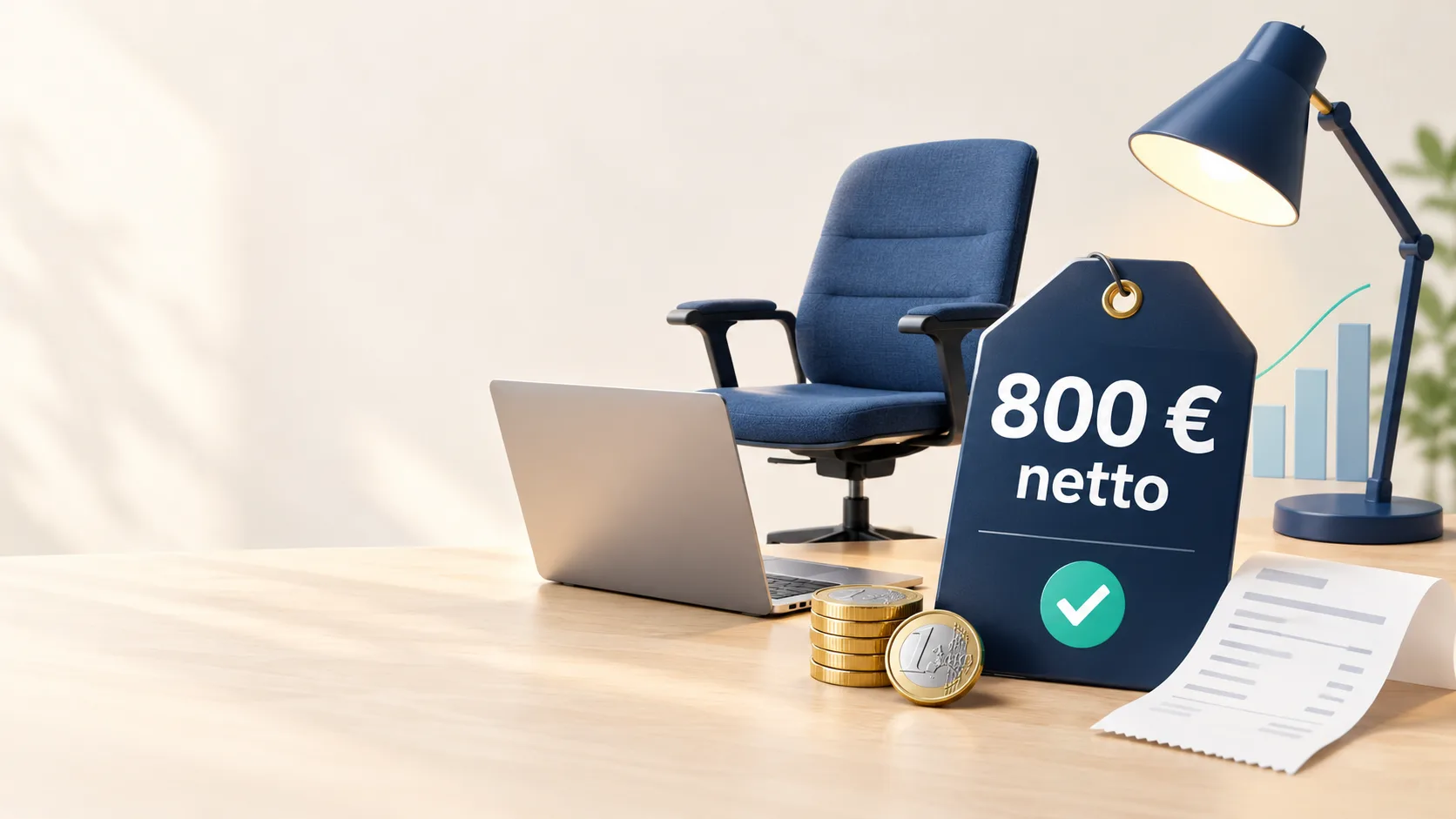
If a purchase for your business costs no more than €800 excluding VAT, you deduct the whole amount as a business expense in the year of purchase. That is a low-value asset, in German geringwertiges Wirtschaftsgut or GWG. The limit is unchanged for 2026 and is always checked against the net price, even if you use the German small business scheme (Kleinunternehmerregelung). If the item costs more than €250 net, it has to go into a register, unless the date and price are already in your bookkeeping anyway. For purchases between €250 and €1,000 there is the pooled item (Sammelposten) as an alternative. Laptops, printers and software you deduct in full in the year of purchase in any case, whatever they cost.
Contents
- The three figures for 2026
- Net or gross? Always net, even under the small business scheme
- What counts as a GWG and what does not
- Laptop, printer, software: here the limit does not matter
- Pooled item or deduct at once?
- GWG register: what has to go in
- Booking GWG: accounts and line in the Anlage EÜR
- Sale, private withdrawal, broken: what happens then
- Frequently asked questions
The three figures for 2026
For every purchase you only need the net price and this table. All amounts apply per item, not per invoice. The Anlage EÜR is the form for the cash-basis profit calculation (Einnahmen-Überschuss-Rechnung) in your German tax return.
| Net price | What you do | Where it goes |
|---|---|---|
| up to €250 | deduct in full in the year of purchase, no register needed | Anlage EÜR, line 37 |
| over €250 up to €800 | deduct in full in the year of purchase, entry in the GWG register | Anlage EÜR, line 37 |
| over €800 up to €1,000 | depreciate over the useful life or pooled item (five years) | Anlage EÜR, line 34 or 38 |
| over €1,000 | depreciate over the useful life | Anlage EÜR, line 34, Anlage AVEÜR |
The €800 have been in § 6 (2) EStG, the German Income Tax Act, since 2018 and apply unchanged for 2026. An increase to €1,000 was in the 2023 draft of the Wachstumschancengesetz (Growth Opportunities Act) and was struck out in the mediation committee. Anyone who tells you a different figure for 2026 is working from that old draft.
What could change from 2027: On 25 September 2026 the Bundesrat, the chamber of the federal states, proposed in its opinion on the Jahressteuergesetz 2026 (Annual Tax Act 2026) to raise the limit to €1,200 for purchases from 1 January 2027 and to abolish the pooled item. This is a proposal by the states that the Bundestag has not yet passed. For everything you buy in 2026, the limit stays at €800.
How you spread purchases over €800 across the years and which useful life applies to cars, furniture or machines is explained in the article Depreciation (AfA): table, useful life and what you deduct at once. This article stays with purchases up to €1,000.
Net or gross? Always net, even under the small business scheme
For the question of whether a purchase is below the limit, the price without VAT counts. This also applies if you use the small business scheme and get no input tax back. Under the small business scheme, you may still deduct the full gross amount.
Example: An office chair costs €890 gross. Net that is €747.90, so under €800. The chair is a GWG.
- With input tax deduction: You deduct €747.90 as a business expense. You get the €142.10 VAT back through the advance VAT return (Umsatzsteuer-Voranmeldung).
- Under the small business scheme: You check the limit with €747.90 and deduct the full €890.
This is set out in § 6 (2) EStG (acquisition costs "reduced by any input tax amount included") and in the Income Tax Guidelines (Einkommensteuer-Richtlinien), R 9b (2). Anyone who checks the limit with the gross price gives away money: the chair for €890 gross would then wrongly be depreciated over 13 years.
The net price also includes shipping, assembly and other incidental costs. You deduct discounts and early payment discounts (Skonto) (§ 255 (1) HGB, the German Commercial Code). A shelf for €780 net plus €40 delivery costs €820 and is no longer a GWG. If you used an investment deduction (Investitionsabzugsbetrag) for the purchase and reduced the acquisition costs with it, the reduced amount counts (§ 7g (2) sentence 3 EStG).
What counts as a GWG and what does not
Not every purchase under €800 is a GWG. The limit only applies to items that you use in the business for longer than a year, that wear out, that can be moved and that work on their own. If one of these four properties is missing, normal depreciation applies or it is not a fixed asset at all.
| Example | GWG? | Why |
|---|---|---|
| Office chair, desk lamp, tool case, coffee machine | yes | works on its own |
| Laptop, tablet, smartphone | yes | works on its own |
| Printer that can only print | no | only works together with a computer, is depreciated separately |
| Mouse that you buy for an existing PC | no | forms a unit with the computer, increases its acquisition costs |
| Goods that you resell | no | not a fixed asset but purchase of goods |
| Software | special case | see the section on laptops, printers, software |
The rule on accessories is in § 6 (2) sentences 2 and 3 EStG: an item cannot be used on its own if it can only be used together with other items of the business and is technically matched to them. The Federal Ministry of Finance (Bundesfinanzministerium, BMF) gives the example of a printer that can do nothing but print: it is not a GWG and is depreciated separately over its useful life. The mouse, on the other hand, belongs to the PC and increases its acquisition costs (BMF circular of 30 September 2010, margin number 11). In practice this has mattered less since 2021, because computers and accessories are fully deductible in the year of purchase anyway, see the next section.
You treat used items exactly like new ones. What counts is the price you paid. If you buy from a private person and get no invoice, record the purchase with a self-issued receipt. If you bring an item from your private assets into the business, the value at the time of the contribution counts (§ 6 (2) sentence 1 EStG).
Laptop, printer, software: here the limit does not matter
Computers, accessories and software you deduct in full in the year of purchase, even if they cost €2,000. The Federal Ministry of Finance allows a useful life of one year for computer hardware including peripheral devices and for operating and application software. The instructions for the Anlage EÜR 2026 say so explicitly for line 34.
The only difference from a GWG is in the form. A laptop for €700 net is a GWG and goes into line 37 as part of the total. A laptop for €1,500 net goes into line 34 as depreciation and additionally into the fixed asset register, the Anlage AVEÜR. The result is the same: both are fully deducted in the year of purchase.
This also applies to the printer from the table. It is not a GWG, but it falls under the one-year rule for peripheral devices and is therefore also fully deducted in the year of purchase.
Anything not on the ministry's list, for example a smartphone over €800, follows normal depreciation. The useful life for it is in the article Depreciation (AfA).
Pooled item or deduct at once?
For most small businesses, deducting at once is the better choice. The pooled item only pays off if you buy several things between €800 and €1,000 in one year and few below that.
This is how the pooled item works under § 6 (2a) EStG:
- All purchases of a year over €250 up to €1,000 net go into one pool.
- The pool is written off over five years at one fifth each year, starting in the year of purchase. The month of purchase does not matter.
- The decision applies to all purchases of that year. If you choose the pooled item, you may no longer deduct the office chair for €450 at once. Only things up to €250 remain immediately deductible.
- If you sell an item from the pool or it breaks, the pool continues unchanged.
Example: In May you buy a sewing machine for €950 net. Without the pooled item, you depreciate it over its useful life, which for sewing machines is a longer period. With the pooled item, it is €190 per year over five years. But if you also buy ten chairs for €120 each in the same year, they have to go into the pool too, instead of being an expense of €1,200 at once.
A complete worked example with both methods is in the article Depreciation (AfA) in the section on the pooled item.
GWG register: what has to go in
For every GWG over €250 net, you record the date of purchase and the price. The law requires nothing more. You only need a separate register if this information is not evident from your bookkeeping (§ 6 (2) sentences 4 and 5 EStG). For GWG up to €250, the booking entry is enough, no register is needed (BMF circular of 30 September 2010, margin number 3).
If you book GWG to a separate account and enter the date and description there, the register is taken care of. Anyone who prepares the Anlage EÜR without accounting software keeps a list:
| Date | Item | Net price | Receipt |
|---|---|---|---|
| 12 March 2026 | Office chair | €747.90 | Invoice 2026-0311 |
| 28 August 2026 | Tool case | €312.00 | Invoice 2026-0902 |
You keep the invoice itself like any other accounting record. Under § 147 (3) AO, the German Fiscal Code, that is eight years. You do not enter GWG in the fixed asset register, the Anlage AVEÜR.
The purchase invoice is the evidence for the deduction. If you file it in one place with your other incoming invoices, you have the date, price and receipt together for the next tax return.
Booking GWG: accounts and line in the Anlage EÜR
In the Anlage EÜR 2026, you enter the total of all GWG for the year in line 37. The write-off of a pooled item goes in line 38. In your accounting software, you book the net amount to the GWG account and the VAT to input tax.
| Transaction | SKR03 | SKR04 |
|---|---|---|
| Book GWG as an expense at once | 4855 Sofortabschreibung geringwertiger Wirtschaftsgüter (immediate write-off of low-value assets) | 6260 Sofortabschreibung geringwertiger Wirtschaftsgüter |
| Book GWG to an asset account first, then depreciate | 0480 Geringwertige Wirtschaftsgüter (low-value assets), depreciation via 4860 | 0670 Geringwertige Wirtschaftsgüter, depreciation via 6262 |
| Pooled item | 0485 Wirtschaftsgüter Sammelposten (pooled item), written off via 4862 | 0675 Wirtschaftsgüter Sammelposten, written off via 6264 |
The account numbers come from the DATEV charts of accounts for 2026. Other programs number differently, but the names are mostly the same. For the cash-basis profit calculation, no chart of accounts is prescribed.
Journal entry for the office chair from the example, with input tax deduction: €747.90 to 4855 (SKR03) or 6260 (SKR04), €142.10 to input tax 19 percent, €890 credited to bank. Under the small business scheme, you book the full €890 to the GWG account.
Sale, private withdrawal, broken: what happens then
If you sell a GWG, the proceeds are business income and go in line 18 of the Anlage EÜR. There is no residual value left, because you have already deducted the item in full. If you are subject to standard VAT, you charge VAT on the sale.
If you take a GWG permanently for private use, for example the laptop after two years, that counts as a withdrawal (Entnahme). You record the current value as business income (§ 6 (1) no. 4 EStG). If you deducted input tax on the purchase, VAT is due on the withdrawal (§ 3 (1b) UStG, the German VAT Act).
If a GWG breaks or goes missing, you book nothing further. It was already deducted. With the pooled item, the write-off continues unchanged in all three cases (§ 6 (2a) sentence 3 EStG).
Frequently asked questions
Has the GWG limit changed in 2026?
No. It remains at €800 net per item, unchanged since 2018. The limit for the register is €250, the upper limit for the pooled item is €1,000. For 2027 there is a proposal from the Bundesrat for €1,200, but it has not been passed.
Is the GWG limit gross or net under the small business scheme?
Net. You check the €800 against the price without VAT, even if you get no input tax back. What you then deduct is the full gross amount.
What do I do with a purchase for €801 net?
You depreciate it over its useful life or, up to €1,000, put it in the pooled item. For computers and software the question does not matter, they are fully deducted in the year of purchase anyway. Check first whether a discount brings the price below €800.
Do I have to deduct a GWG at once?
No. It is an option. You may also depreciate a GWG over the normal useful life, for example if your profit this year is low anyway and you would rather shift the expense to later years.
Ten chairs on one invoice for €1,200 in total: GWG or not?
GWG. The limit applies to the individual item, not to the invoice. Each chair costs €120 net and can be used on its own. You deduct the €1,200 in the year of purchase and, at €120 per chair, need no register.
Does the limit also apply to used items?
Yes. A used desk for €300 net is a GWG just like a new one. What counts is what you paid.
Sources
- § 6 EStG, valuation (subsection 2 low-value assets, subsection 2a pooled item)
- § 9b EStG, input tax deduction for VAT purposes
- § 7g EStG, investment deductions (subsection 2 sentence 3)
- § 255 HGB, acquisition costs
- § 147 AO, retention periods
- § 3 UStG, supply of goods and other services (subsection 1b, withdrawal)
- Bundesrat, opinion on the Annual Tax Act 2026 of 25 September 2026, printed paper 447/26 (resolution), number 4
- Bundestag, recommendation of the mediation committee on the Growth Opportunities Act, printed paper 20/10410
- DATEV chart of accounts SKR03 2026 and SKR04 2026
- Federal Ministry of Finance: Anlage EÜR 2026 with instructions, lines 18, 34, 37 and 38
- BMF circular of 30 September 2010, questions of doubt on low-value assets and pooled items, ref. IV C 6 - S 2180/09/10001, BStBl I p. 755
- BMF circular of 22 February 2022, useful life of computer hardware and software, ref. IV C 3 - S 2190/21/10002 :025
- Income Tax Guidelines (Einkommensteuer-Richtlinien), R 9b (2)
Try Easy Invoice free for 10 days — no payment details, the trial ends by itself.
Handle invoices more easily
Easy Invoice combines quotes, invoices and customer management in the cloud.
Try Easy InvoiceRead next
 Taxes & Law
Germany's 1% rule for company cars: how the self-employed pay tax
If you also drive your company car privately, you pay tax on 1 percent of the list price every month. What comes on top, what the calculation looks like with figures and when a mileage logbook saves money.
 Taxes & Law
Keeping a mileage logbook in Germany: template, required details
A German mileage logbook only counts if every trip is recorded promptly and without gaps. Which details are required, what a filled-in logbook looks like and why Excel is not enough.
 Taxes & Law
Travel expense report in Germany 2026: template, rates, receipts
A German travel expense report has four parts: travel, hotel, meals and incidentals. What you claim for each part, which receipts you need and how to re-invoice travel costs to clients.