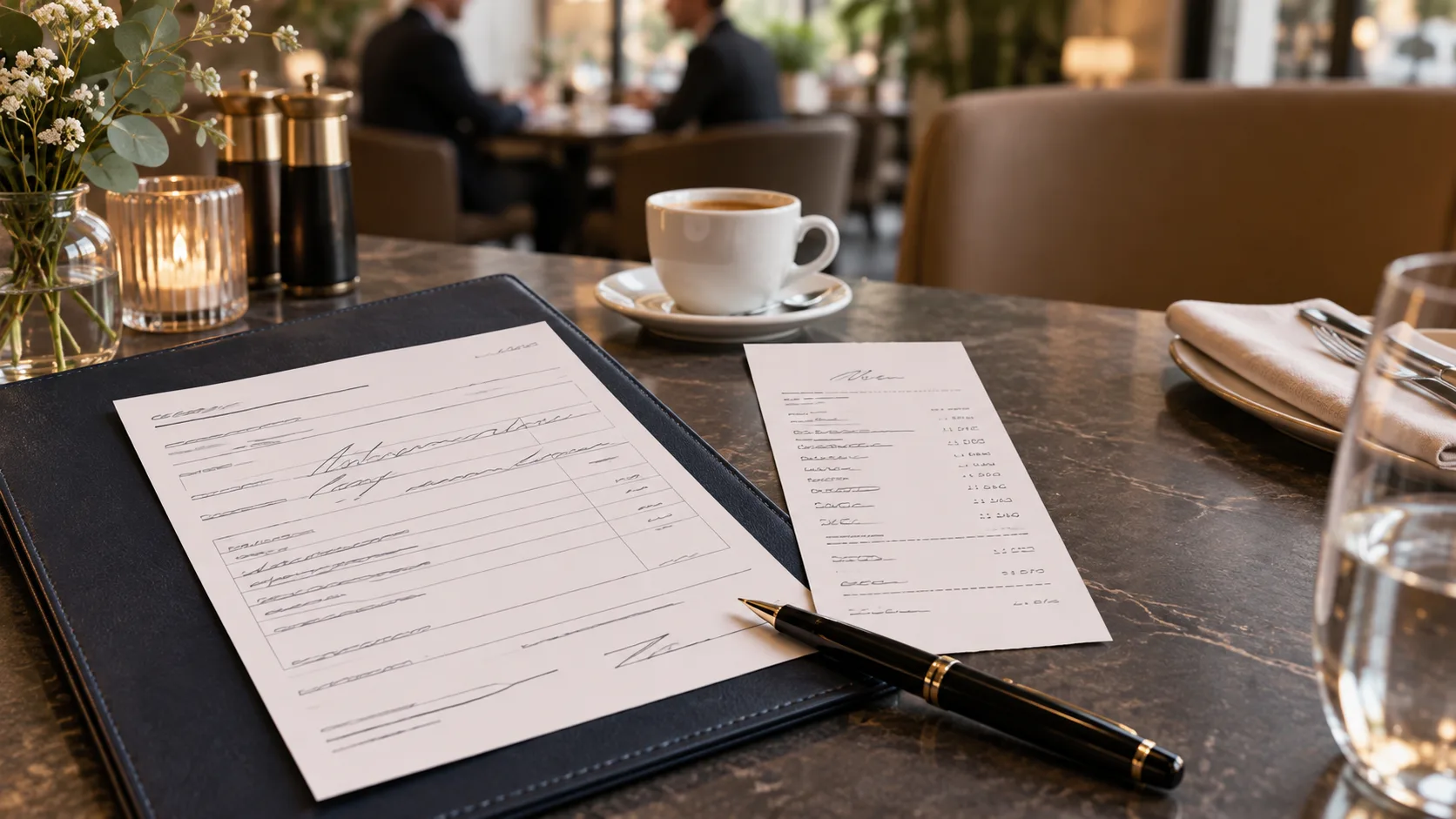
A German entertainment receipt needs five details: place, day, the people present, the business reason and the amount. If the meal took place in a restaurant, your own receipt only needs the reason and the names — you attach the restaurant's bill to it. You may deduct 70 percent as a business expense, but you reclaim the VAT in full. Write the receipt on the same day or the day after, and sign it.
Contents
- What belongs on the entertainment receipt
- Template to copy
- How much you can actually deduct
- Is the restaurant till receipt enough?
- Above 250 euros, three details are added
- Handwritten bills: where the deduction disappears entirely
- Proving the tip
- Your own staff: then it is 100 percent
- Filing the receipt digitally
- Meals abroad
- Frequently asked questions
- Sources
What belongs on the entertainment receipt
If one of the five details is missing, the tax office strikes the deduction — even if the restaurant bill is flawless. The law requires written proof of the place, the day, the people present and the business reason, plus the amount spent (Section 4 paragraph 5 sentence 1 number 2 sentence 2 of the German Income Tax Act, EStG).
| Detail | What goes in | Common mistake |
|---|---|---|
| Place | name and address of the restaurant | „the Italian place downtown" |
| Day | date of the meal | date of the invoice instead of the meal |
| People present | everyone by name, including yourself | forgetting your own name |
| Reason | the specific business purpose | „business lunch", „customer meeting" |
| Amount | the bill, separate from the tip | tip hidden in the total |
The reason causes the most disputes. „Customer meeting" says nothing. Write down what it was about instead: „Coordination on online shop relaunch, quote dated 12 September." The reason has to show that this was about your business and not a pleasant evening.
For a meal in a restaurant, your own receipt only needs the reason and the names, because place, day and amount are already on the bill. The bill then has to be attached (Section 4 paragraph 5 sentence 1 number 2 sentence 3 EStG). If you collect receipts and incoming invoices digitally anyway, you can link the entertainment receipt directly to the restaurant bill — the section on digital filing below explains how. Invoicing software such as Easy Invoice helps you keep receipts and incoming invoices in one place.
Two things are often overlooked: the receipt has to be written promptly, meaning on the day of the meal or shortly after, and you have to sign it. The Federal Fiscal Court decided both points, and the Federal Ministry of Finance refers to them explicitly in its letter of 19 November 2025.
Template to copy
You do not need a purchased form. A plain sheet of paper is enough as long as the five details are on it. Printed forms, PDF templates and Word files are convenient, but none of them is required.
Entertainment receipt

Day of the meal:    16.09.2026
Place:              Ristorante Molinari, Hauptstrasse 8, 40213 Duesseldorf
People present:     Yusuf Demir (Mailand Media GmbH),
                    Anja Kowalczyk (Mailand Media GmbH),
                    Charles Imilkowski (host)
Reason:             Coordination on online shop relaunch, quote of 12.09.2026
Cost of the meal:   142.80 euros (see attached bill)
Tip:                10.00 euros
Total:              152.80 euros

Date, signature:    16.09.2026, ______________________
Write the names as they appear in people's identity documents, and do not forget yourself. If you host a closed group and do not know every name, note the group and its size — for example „sales team of company X, 8 people" — and explain in the reason field why a list of names was not possible.
How much you can actually deduct
Seventy percent of the bill remains as a business expense, while you reclaim the VAT in full. That sounds contradictory but is exactly how it is meant: income tax law cuts the deduction to 70 percent (Section 4 paragraph 5 sentence 1 number 2 EStG), while VAT law explicitly exempts entertainment from the input tax exclusion (Section 15 paragraph 1a sentence 2 of the German VAT Act, UStG).
An example with 142.80 euros gross and 19 percent VAT:
| Step | Amount |
|---|---|
| Bill, gross | 142.80 euros |
| of which VAT | 22.80 euros |
| Net | 120.00 euros |
| Input VAT, fully deductible | 22.80 euros |
| Business expense: 70 percent of 120.00 euros | 84.00 euros |
| Not deductible: 30 percent of 120.00 euros | 36.00 euros |
If you are a small business under Section 19 UStG, you calculate differently. You do not reclaim input VAT, so the VAT is part of your cost. You take 70 percent of the gross amount: 70 percent of 142.80 euros is 99.96 euros as a business expense.
You treat the tip the same way: 70 percent of it is a business expense. It is not included in the example above because it is listed separately on the receipt.
The 30 percent are not a flaw in the system but deliberate. The legislator assumes that part of a business meal is private enjoyment. The cut applies even if you did not eat anything yourself. In your income statement you enter both parts separately.
Only what is reasonable is deductible. There is no fixed ceiling; the tax authorities look at what is normal in your industry. A menu costing 80 euros per person means something different at an investor meeting than on a 300-euro job.
Is the restaurant till receipt enough?
Yes, if it carries the right details — and those have been set out more clearly since the Federal Ministry of Finance letter of 19 November 2025. Up to a total of 250 euros the receipt counts as a small-amount invoice and has to contain four things:
- Name and address of the restaurant, in full.
- Date of issue.
- What you ate and drank, itemised. „Food and drinks" with a total is not enough. „Menu 1", „dish of the day 2" or „lunch buffet" are fine.
- The day of the meal. If the bill says „service date equals invoice date", that is sufficient. A handwritten addition or a date stamp is not.
The third point is where most till receipts fail. Check it while you are still in the restaurant and can ask the waiter. You will rarely get an itemised bill afterwards.
Above 250 euros, three details are added
If the bill exceeds 250 euros, it needs three further details on top of the four above. If one is missing, the deduction is at risk:
| Additional detail | Where it comes from |
|---|---|
| Tax number or VAT identification number of the restaurant | on a proper invoice, not on a simple till receipt |
| Sequential invoice number | issued by the restaurant |
| Your name as the host | you have to ask for it to be put on the bill |
The third point is the one most often forgotten. Say so in the restaurant before they settle the bill: above 250 euros your name or your company's name has to appear on it. Writing it in yourself afterwards does not help.
Handwritten bills: where the deduction disappears entirely
If the restaurant uses an electronic till but hands you a handwritten receipt, the entire amount is not deductible — not reduced, but struck completely. This is the strictest rule in the whole subject, and it is set out in the ministry letter of 19 November 2025 (margin number 13).
The background: businesses with an electronic till system are required to produce their receipts by machine and secure them with a certified technical security device (Section 146a of the German Fiscal Code, Cash Register Security Ordinance). A receipt in any other form then fails the proof requirements.
How to recognise a proper receipt: it carries a transaction number and the serial number of the till or of the security module, often printed as a QR code. If it does, you may rely on everything being in order — even if something turns out to be wrong at the restaurant later.
There are two reliefs:
- Till failure: if the security device fails and this is evident from the receipt, for instance through a missing transaction number or a corresponding note, the deduction remains possible in principle.
- Later settlement without cash: if a closed event is settled later and paid by transfer, or if the business only accepts cashless payment, you do not need a till receipt. You then attach the payment record if the method of payment is not stated on the bill.
Proving the tip
A tip is deductible, but you have to be able to prove it — and the burden of proof is on you. The simplest route is to have the restaurant include the amount on the machine-produced bill. Ask before you pay.
If the tip is not on the bill, a confirmation from the recipient helps: the waiter writes the amount on the bill and signs it. Your own note saying „10 euros tip" without a countersignature is weak — the tax office does not have to accept it.
The same cut applies to the tip as to the meal: 70 percent as a business expense.
If nobody signs for the tip, all that remains is a receipt you write yourself. What it has to contain is explained in Writing an Eigenbeleg.
Your own staff: then it is 100 percent
If you invite only your own people, you may deduct the cost in full. The 30 percent cut only applies to a business occasion, meaning when business partners, customers or applicants are present. Entertaining your own employees counts as purely operational (R 4.10 paragraph 7 of the German Income Tax Guidelines).
The line is sharp: if one outside person sits at the table, the whole bill becomes business entertainment and is cut to 70 percent. That includes the share for your own staff.
Coffee, tea and biscuits during a meeting are not entertainment at all but courtesies. They are fully deductible and need no entertainment receipt.
Gifts to customers and employees follow their own rules and their own thresholds. There is a separate article on booking gifts to customers and employees.
Filing the receipt digitally
You may keep the entertainment receipt entirely digital, and since 2025 the requirements are spelled out. The trigger for the new rules was the electronic invoice: since 1 January 2025 invoices between domestic businesses may arrive as e-invoices, and the old 2021 letter no longer fitted. When you have to issue e-invoices yourself is covered in the article on the e-invoicing obligation in 2027 and 2028.
You have to meet four points:
- You create the receipt digitally or scan it and add the required details promptly.
- You authorise it — sign it electronically or approve it in your software. Later changes have to be documented.
- The time of creation and of approval is recorded electronically.
- Receipt and restaurant bill are linked and kept together. A clear reference is enough, for instance an index, a barcode or a link in a document management system.
If a bill cannot be matched to an entertainment receipt, the deduction is gone. The same principles of record keeping apply here as to any other document — what the tax office actually checks is covered in the article on the GoBD-compliant invoice. Separate filing is allowed as long as the match stays unambiguous. If you keep the paper receipt and only file the bill digitally, you have to ensure the same clear match.
If you have been collecting receipts in a shoebox, moving to digital filing is the point where the effort pays off. You can try Easy Invoice for free.
Meals abroad
The same rules apply to meals abroad — the law makes no distinction. A dinner in Vienna or Barcelona also needs a machine-produced, electronically recorded bill with all the details.
There is one exception: if you can credibly show that such a bill was not available there, a bill that does not fully meet the requirements is accepted by way of exception. If all you have is a handwritten foreign bill, you have to show credibly that the country in question does not require machine-produced receipts. In such cases, note straight away why nothing else was possible.
Frequently asked questions
Do I have to write my own name on the receipt?
Yes. You take part in the meal and belong on the list. For bills above 250 euros your name also has to appear on the restaurant's bill.
What do I do if I have lost the receipt?
Ask the restaurant for a duplicate while the transaction can still be traced. A self-written replacement without the restaurant bill is not enough for a restaurant meal, because the law explicitly requires the bill.
Does a business meal count if I did not eat anything?
Yes, you do not have to eat. The cut to 70 percent still applies to the whole amount.
Which account do I book entertainment costs to?
You map the 70/30 split across two accounts. In the standard German chart of accounts SKR03 and SKR04 these are accounts 4650 and 4654 (SKR03) and 6640 and 6644 (SKR04): the first for the deductible part, the second for the non-deductible part. In both cases you reclaim the input VAT in full. If your chart of accounts differs, ask your tax adviser for the right accounts.
How long do I have to keep the entertainment receipt?
Like any other accounting document. Keep the receipt and the bill together, digitally or on paper — what matters is that the match is preserved.
Sources
Handle invoices more easily
Easy Invoice combines quotes, invoices and customer management in the cloud.
Try Easy InvoiceRead next
 Taxes & Law
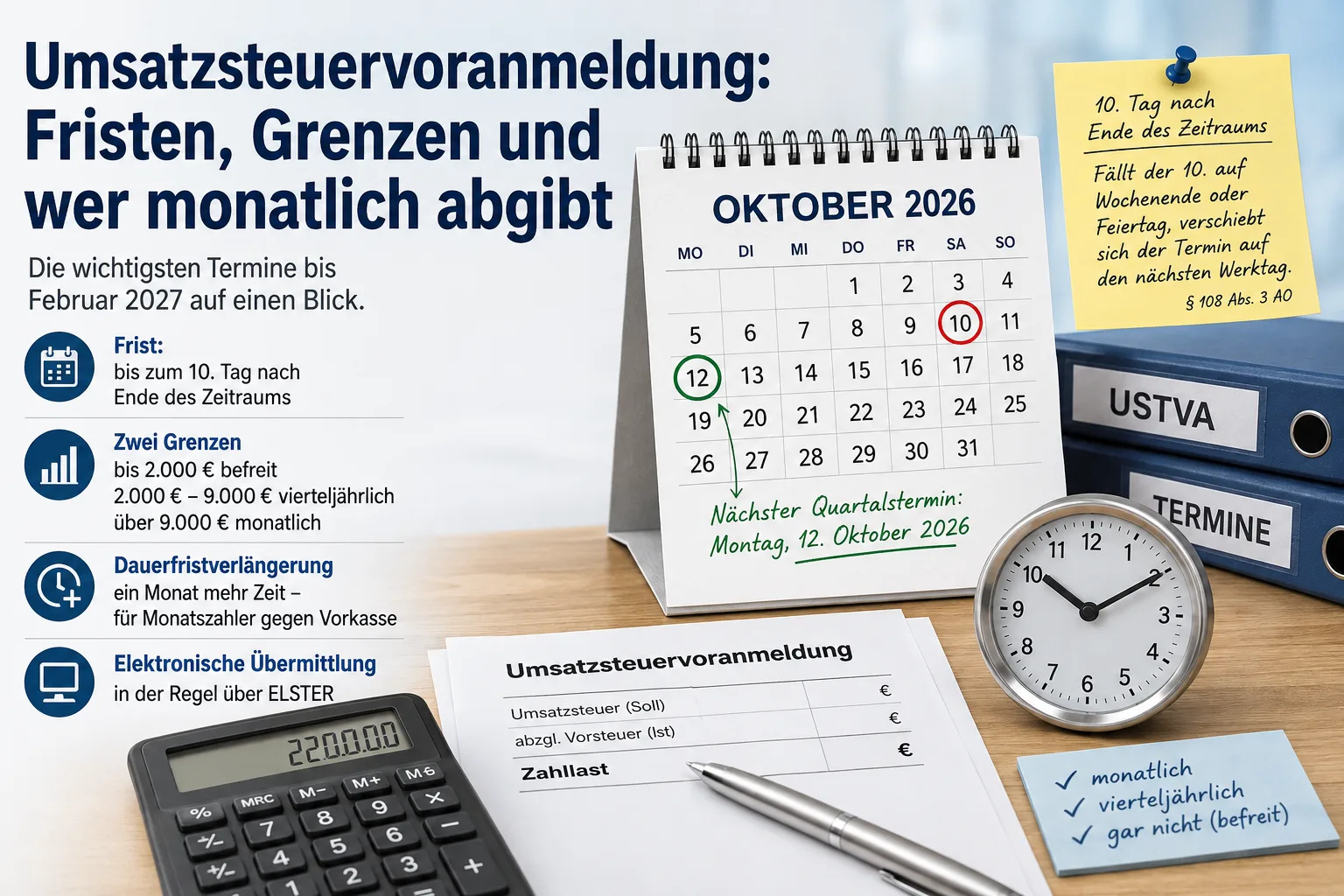
Advance VAT return in Germany: deadlines, thresholds, monthly or quarterly
If you run a business in Germany, you file an advance VAT return by the 10th day after each period. This article shows which cycle applies to you, when your next date falls and how to buy yourself an extra month.
 Taxes & Law
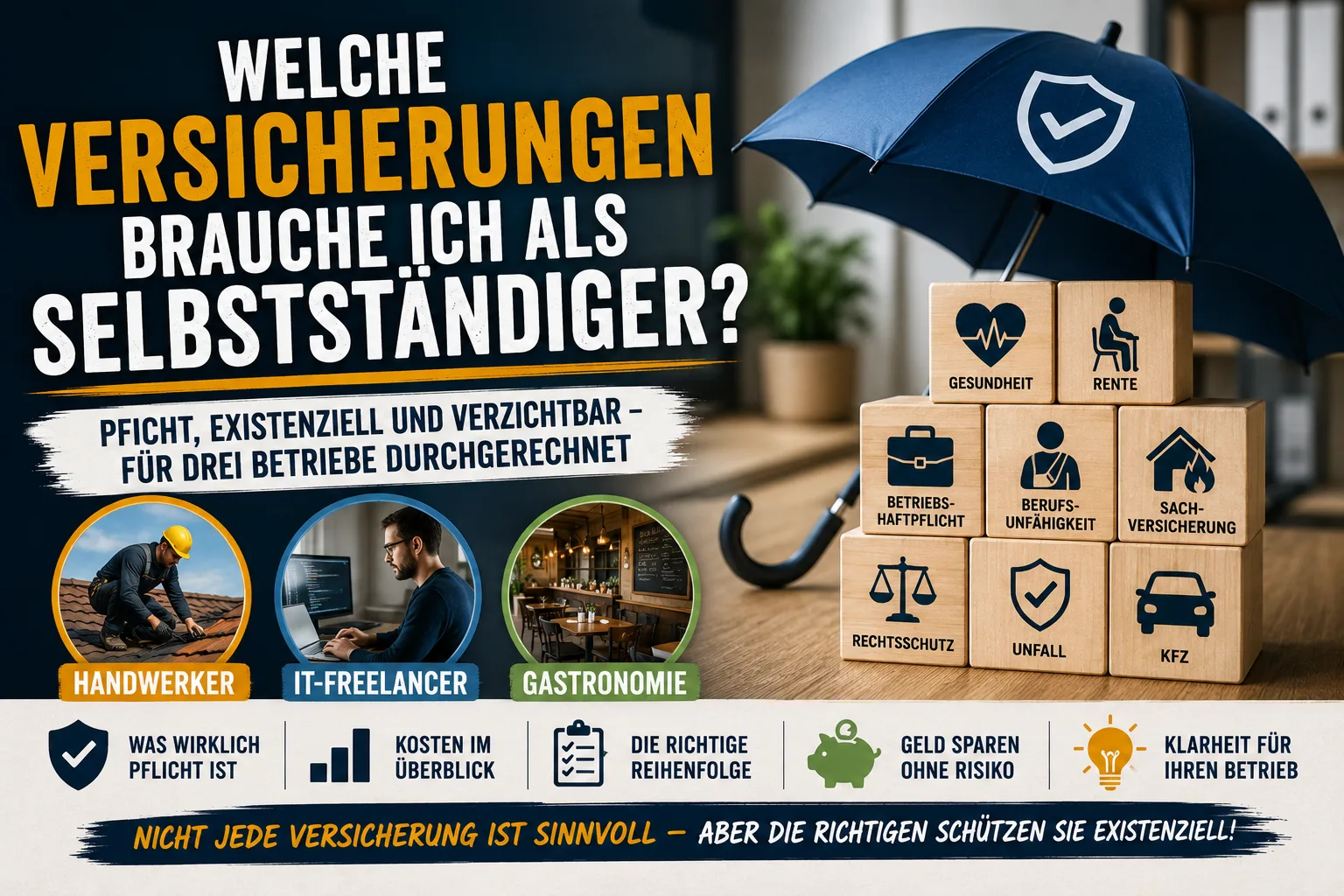
Which insurance do I need as a self-employed person in Germany? Mandatory, essential and skippable – costed out for three businesses
Health insurance is compulsory, pension insurance only for certain trades, and every business must register with its employers' liability association. Everything else is your call. What a roofer, a programmer and a café owner really need – and the order to buy in when money is tight.
 Taxes & Law
Bogus self-employment in Germany: when it applies – and why the back payment does not hit you
The fear of a huge back payment almost always targets the wrong person: your client owes the social security contributions, not you. What is really examined, what you actually risk – and how to get clarity without stirring things up.