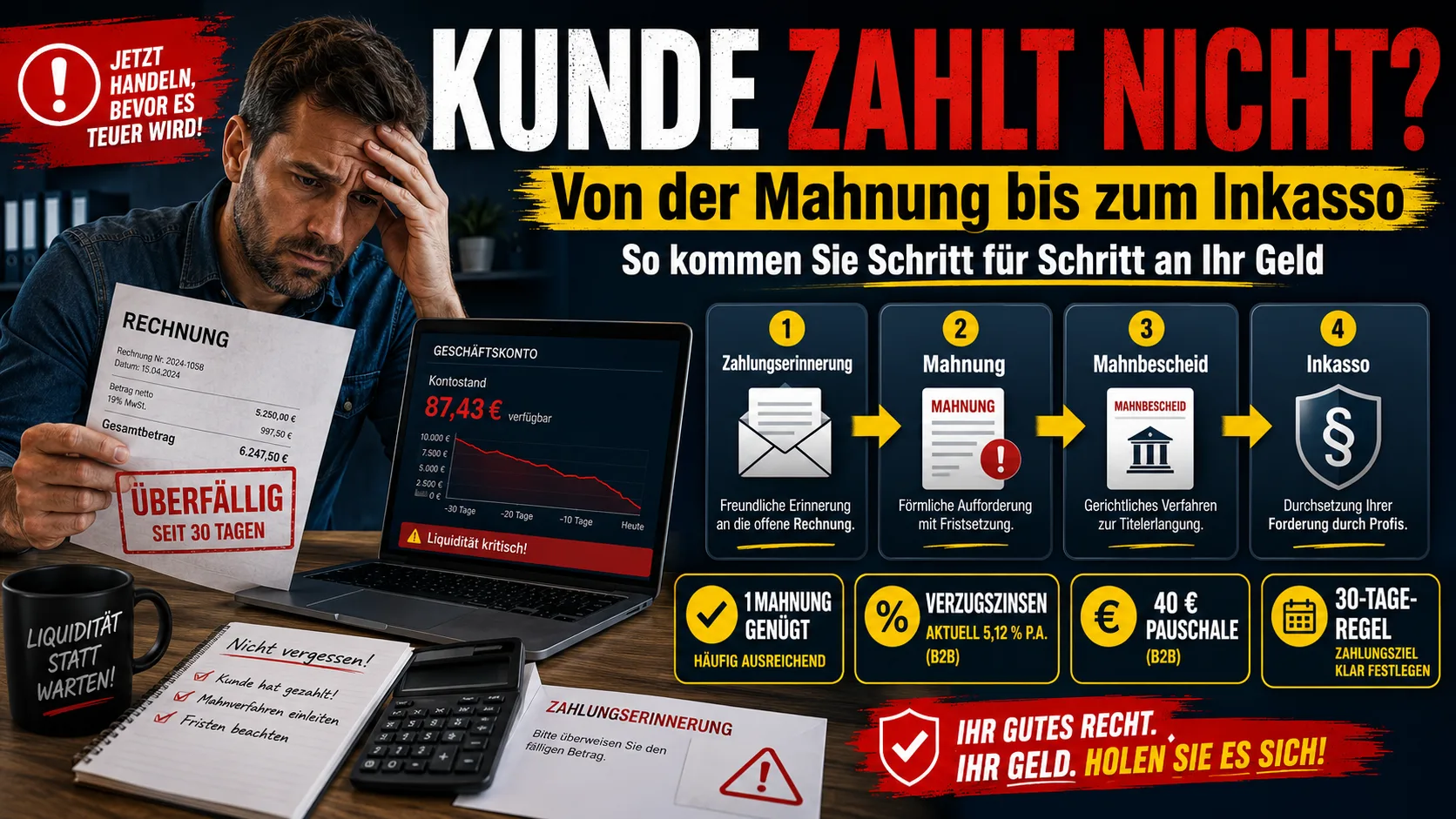
The invoice went out long ago, the payment deadline has passed, and nothing is happening in your account. For freelancers and small businesses, that is more than just annoying: a single unpaid invoice worth a few thousand euros can push the whole month into the red. The good news: you have clear tools to get your money. It all comes down to the right order of steps, and to not throwing away a single deadline.
First things first: is your customer actually "in default" yet?
Before you can charge interest or reminder fees, the customer has to be legally in default. Only once default has occurred do the claims arise that let you apply pressure. Default (Verzug) sets in in three typical cases:
- A fixed payment date was agreed. If you agreed a payment deadline set by the calendar ("payable by the 15th of the month"), the customer is automatically in default the very next day, with no reminder needed. What matters here and how to word the payment term correctly is covered in Payment terms on an invoice.
- You sent a reminder. Once the invoice is due, a single reminder (Mahnung) is enough to trigger default.
- The 30-day rule applies. At the latest, the customer is in default 30 days after the invoice falls due and has been received (Section 286 (3) of the German Civil Code, BGB). Important for private customers: for consumers, this automatic 30-day period only applies if you expressly pointed it out on the invoice. For business customers, no such notice is required.
The distinction between private and business customers runs through this whole topic, so keep it in mind: it will shortly determine the rate of interest and the flat fees you can claim.
The myth of the "three reminders"
You do not have to send three reminders before you are allowed to take further steps. This is a widespread misconception. Legally, a single reminder after the due date is enough, or even none at all if default has already occurred through a fixed date or the 30-day period.
Even so, a step-by-step approach has proven its worth in practice, because a missed payment is often nothing more than carelessness: a mislaid invoice, a transposed digit, a holiday.
- Ask briefly, ideally by phone. A friendly call resolves the most common cause, simple forgetfulness, in two minutes, costs nothing, and protects the business relationship. Afterwards, confirm any payment commitment in a short email.
- If that does not help, send a written payment reminder with a short grace period (for example 7 days).
- If that goes unanswered too, send the formal reminder (Mahnung) with a clear, final deadline and a note that you will otherwise take further steps. From this point on, you may state default interest and reminder costs.
Keep the wording factual and free of threats. State the invoice number, the outstanding amount and a specific date, not a vague "immediately".
What else you can claim: interest, flat fee, reminder costs
Once default has set in, you are entitled to more than just the invoice amount:
- Default interest. The rate is based on the base rate (Basiszinssatz) set by the German central bank, the Deutsche Bundesbank (as of 1 July 2026: 1.52%). For private customers, the default interest rate is 5 percentage points above that, currently 6.52%. For business customers, it is 9 percentage points, currently 10.52% (Section 288 BGB). The base rate changes on 1 January and 1 July; you can find the current figure at the Bundesbank.
- 40-euro flat fee for business customers. If a business customer pays a monetary claim late, you may additionally demand a flat fee of 40 euros (Section 288 (5) BGB). You cannot claim this flat fee from private customers.
- Reminder costs. You may charge your actual expenses (postage, materials). Usual amounts are a few euros per reminder; excessive "reminder fees" of 15 or 20 euros, on the other hand, are open to challenge.
The customer still isn't paying: three routes to your money
If even the formal reminder goes nowhere, you have three options. Which one fits depends above all on a single question: is the claim undisputed, or is the customer objecting on the merits?
1. The court order for payment procedure: do it yourself, cheaply
For clear, undisputed claims, the court order for payment procedure (gerichtliches Mahnverfahren) is the fastest and cheapest route to an enforceable title. You do not need a lawyer, and you file the application online through the official portal of the German justice system: online-mahnantrag.de.
Here is how it works:
- You complete the application online and file it with the competent court. Court fees start at 38 euros (half the fee based on the amount in dispute); the court adds these to the debtor's liability, so if they pay, you get the fees back.
- The court serves the debtor with a court order for payment (Mahnbescheid). From the date of service, the debtor has 14 days to lodge an objection.
- If no objection comes and the debtor still does not pay, you apply for the enforcement order (Vollstreckungsbescheid), with no further court fee. This gives you a title you can enforce for 30 years, for example through a court bailiff.
The catch: if the customer lodges an objection, the matter moves into ordinary court proceedings. For disputed claims, the court order for payment is therefore often only an intermediate step.
2. A debt collection service collects for you
If you would rather not deal with it yourself, a debt collection service (Inkasso-Dienst) takes over the whole receivables process, from the reminder through to enforcement. This pays off above all when you lack the time or the patience, or when the debtor persistently plays dead.
On the costs: for justified claims where default has occurred, the debtor in principle bears the debt collection costs. Since the reform of German debt collection law, the recoverable fees are capped (as a rule a 1.3 times business fee plus no more than 20 euros in expenses). In the ideal case, then, debt collection is cost-neutral for you. If the debtor turns out to be insolvent, however, part of the costs may end up with you depending on the contract model, which is why it pays to read the fine print.
How to spot a reputable provider:
- They are entered in the official legal services register (Rechtsdienstleistungsregister), which is mandatory for every debt collection company.
- They are a member of the German Federal Association of Debt Collection Companies (BDIU); at inkasso.de you will find members and a provider search.
- They disclose the costs transparently and do not push you towards unnecessary extra services.
There is a provider for every profile: classic, broadly positioned firms such as Creditreform (with an integrated credit check), purely digital, success-based providers such as PAIR Finance, and younger fintechs such as Debtist, which specialise in e-commerce, software and the self-employed. Compare the fee model and whether they even take on individual claims at all, because not every service will handle the single unpaid invoice of a solo freelancer.
One variant is selling the receivable: some providers buy your outstanding invoice from you (factoring). You get money straight away and hand off the default risk, but you only receive part of the sum, and this tends to be worthwhile for ongoing receivables rather than for a single, possibly disputed invoice.
3. Lawyer and lawsuit
As soon as the customer disputes the claim on the merits, for instance by alleging defects, the court order for payment is usually just a detour, because an objection is a foregone conclusion. In that case, the more direct route is a lawyer's demand for payment and, if necessary, a lawsuit. This costs more up front, but it settles the disputed question in a binding way. Here too, if the claim is justified, the debtor ultimately bears the lawyer's costs.
A quick guide to choosing: undisputed claim, you do it yourself → court order for payment. Undisputed, but no time or inclination → debt collection. The customer is objecting on the merits, or a lot of money is at stake → lawyer.
Special case: "the customer is claiming there are defects"
If the customer refuses to pay by pointing to alleged defects, the claim is disputed, and your evidence becomes important. Document the work performed and the acceptance, and secure emails and photos. A court order for payment achieves little here, because the customer will simply object. It makes more sense to examine the defect objection on its merits (if it is justified, subsequent performance follows; if it is a pretext, the matter heads towards a lawyer). Incidentally, you should not simply "cancel" an invoice in this dispute: a cancellation invoice changes nothing about the obligation to pay, only your bookkeeping. You can read about when a correction is really necessary in the article Correcting an invoice: cancellation and correction invoices.
Trade special case: taking materials back?
In the trades in particular, the question comes up of whether you may remove installed materials again or reclaim goods you delivered when payment fails to arrive. This depends on the retention of title (Eigentumsvorbehalt): only if you validly agreed it do the goods remain your property until payment is made in full. But do not act on your own here: removing firmly installed materials without authorisation can quickly amount to criminal damage or trespass. If in doubt, have any existing retention of title checked legally before you take action.
When there is nothing left to recover from the customer
Sometimes payment fails not because of unwillingness but because the account is empty. In that case neither a court order for payment nor debt collection will help, and it becomes purely a matter of limiting the damage.
If the customer is insolvent, you can no longer collect the claim directly. Once insolvency proceedings have been opened, you instead register the outstanding sum with the insolvency administrator for the schedule of creditors, not with the court. The registration deadline is stated in the opening order (usually between two weeks and three months), and you attach the invoice and the order as proof. You can check free of charge whether proceedings are running against a company at insolvenzbekanntmachungen.de. To be honest: often only a small quota flows in the end, but without registering you are certain to come away empty-handed.
If it is definitively established that you will not get your money, write off the claim as a loss. Many people overlook one detail here: if you have already paid the VAT from the invoice to the tax office (accrual-basis taxation), you can reclaim it. As soon as the claim is "irrecoverable", for which it is enough that you cannot enforce it for the foreseeable future, for example in the event of insolvency or unsuccessful enforcement, you correct the VAT in your next advance VAT return (Section 17 of the German VAT Act, UStG). That way you at least get back the tax you fronted for an invoice that was never paid. If the customer does pay after all, against expectations, you pay it over again accordingly. This does not affect small businesses (Kleinunternehmer), because they do not show VAT; if in doubt, your tax adviser will clarify the exact timing, since the correction can only be made up for to a limited extent.
Don't sleep through the limitation period
Your claim generally becomes time-barred after three years, counted from the end of the year in which the invoice arose. An invoice from 2026 therefore becomes time-barred at the end of 31 December 2029. A court order for payment applied for in good time suspends the limitation period. Anyone who lets outstanding items sit for too long risks ending up empty-handed, so keep an eye on the calendar.
Best of all: don't let it get that far
Most payment defaults can be defused before they even arise: clear payment deadlines on the invoice; for larger jobs a progress invoice, so you are not exposed for the full amount; and a look at your outstanding items that does not wait until weeks have passed. For new customers and larger jobs, a quick credit check beforehand is worthwhile, as a poor payment history often shows up before the first job even gets going. An invoicing program like office1.cloud shows you due invoices at a glance and sends multi-stage reminder runs (payment reminder, formal reminders with reminder fees) automatically, so no payment default sits unnoticed, and the first stage is out before you even have to think about a court order for payment. To stop it getting that far, an automatic dunning process helps by flagging deadlines before a claim grows old.
If the customer is willing to pay but cannot do so in one go, an instalment agreement often gets you paid faster than a court order for payment – including a template and the rules that apply.
_This article provides general information and is no substitute for legal advice. For disputed or larger claims, you should seek advice from a lawyer._
Handle invoices more easily
Easy Invoice combines quotes, invoices and customer management in the cloud.
Try Easy InvoiceRead next
 Invoicing & Accounting
Instalment agreement with customers: template and rules
Your customer asks whether they can pay the invoice in three instalments. Before you agree, two things matter: the tax office will not wait, and your favour legally becomes a loan.
 Invoicing & Accounting
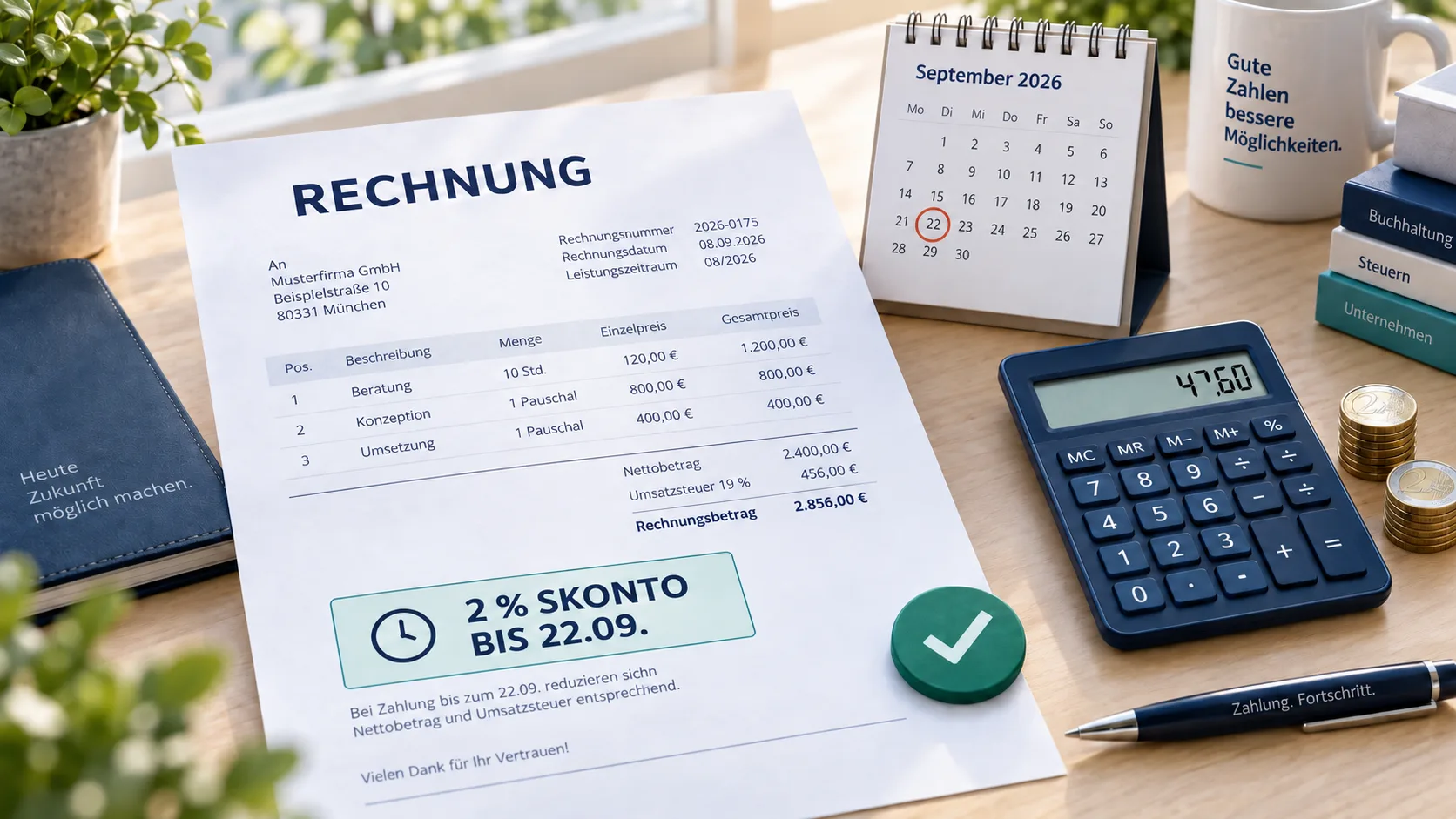
Cash Discount on an Invoice: Wording, Deadline and VAT
A client deducts a cash discount even though they paid far too late – and looking at your invoice, you realise your wording never settled the point.
 Invoicing & Accounting
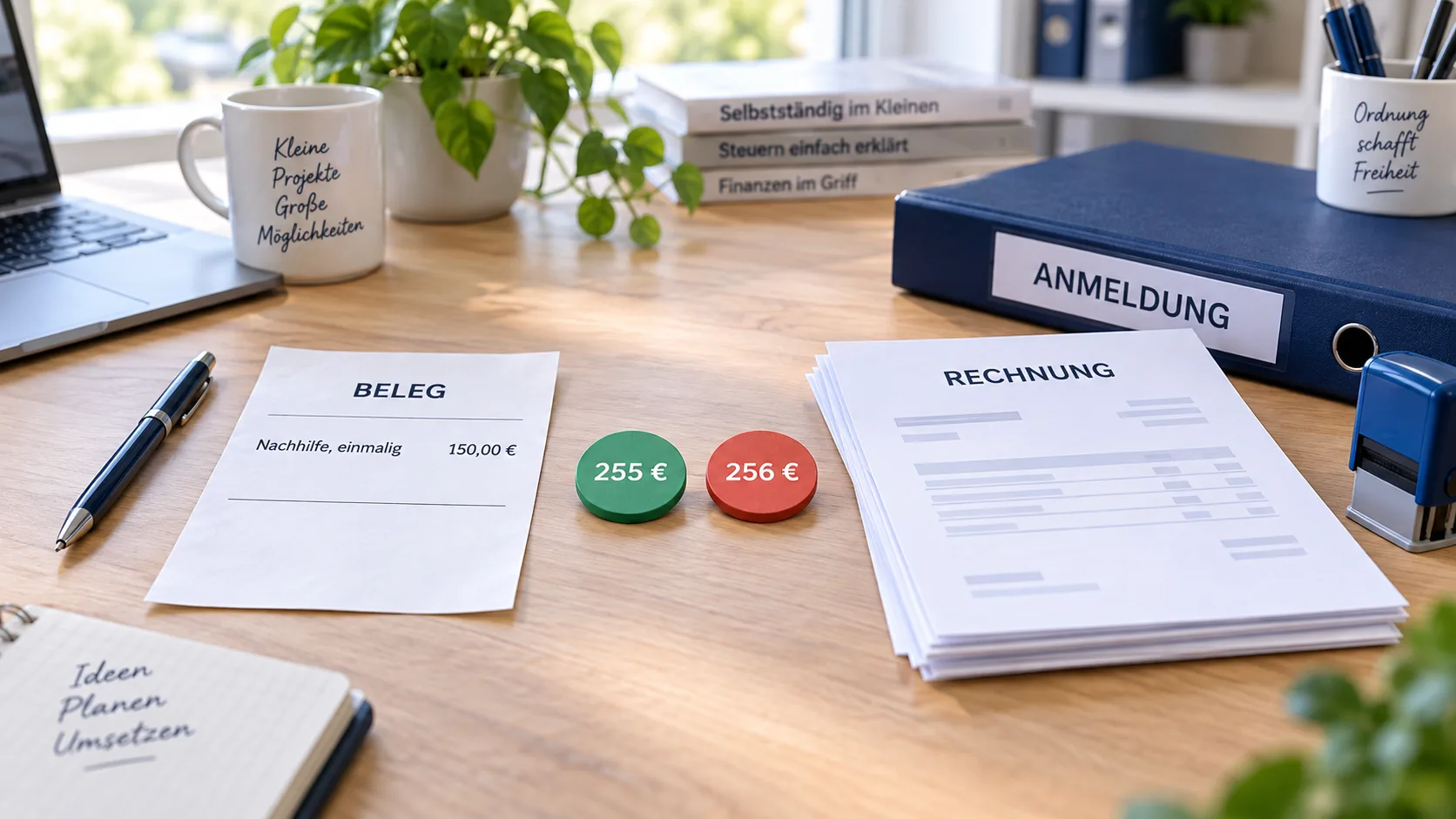
Invoicing Without a Trade License in Germany: Allowed, With a Limit
A client wants an invoice, but you haven't registered a trade. You may still write one – the real question is when a favor turns into an obligation.