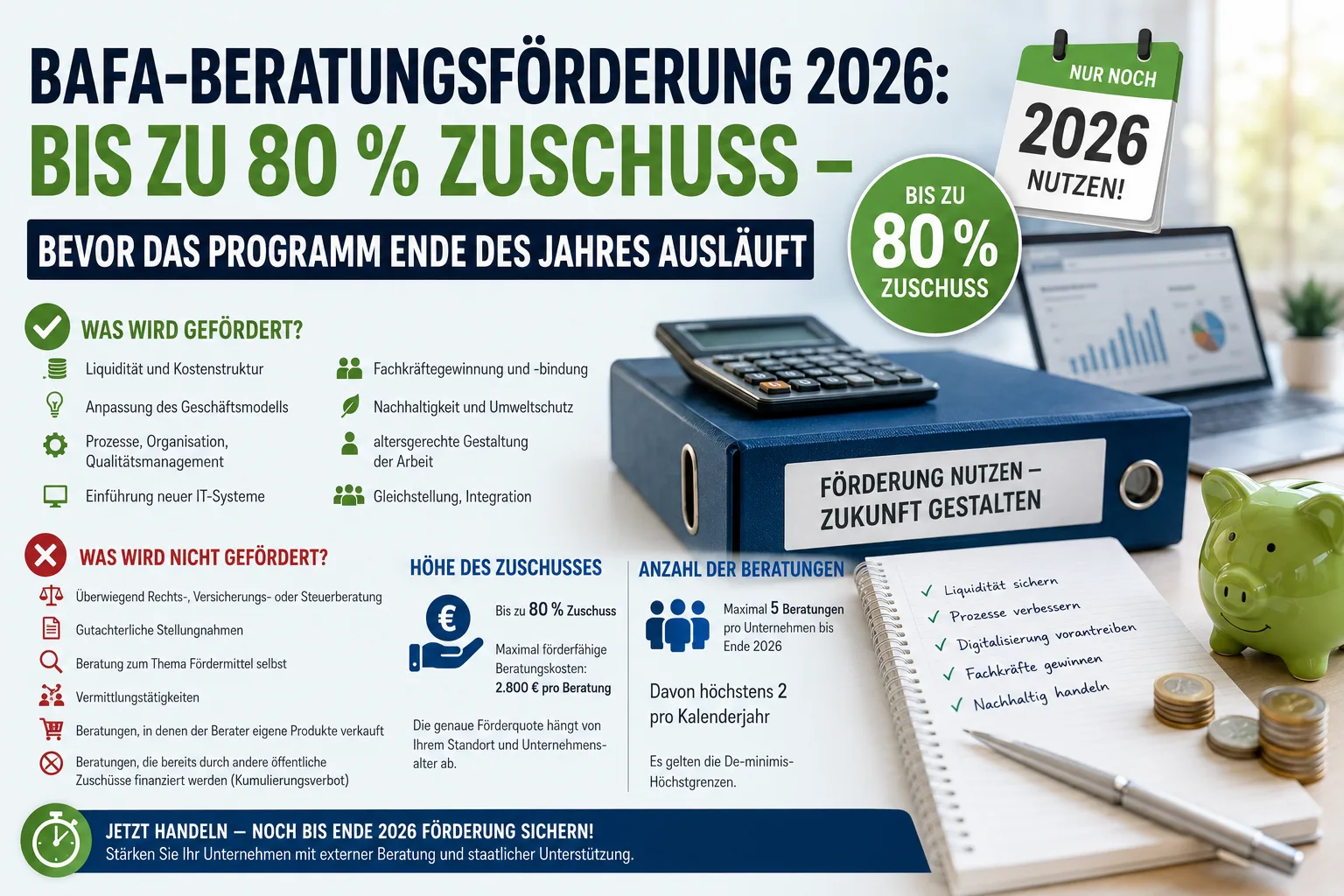
BAFA Consulting Grant 2026: Up to 80 % Subsidy Before the Programme Ends
The German BAFA programme co-finances external business consulting for small firms, freelancers and solo self-employed — with grants of up to 80 % of consulting costs. The programme expires on 31 December 2026. If you want to use the subsidy, you need to know the key steps for 2026 — and above all, do not sign too early.
Table of contents
- What is the BAFA consulting grant?
- Who can apply?
- What is funded — and what is not
- Amount of the subsidy and number of consultations
- Application process: the critical sequence
- Practical example: a painter's business with a cash-flow problem
- Frequently asked questions
- Conclusion
- Sources
What is the BAFA consulting grant?
The "Funding of business consulting for SMEs" is a German federal grant programme run by the Ministry for Economic Affairs and Climate Action (BMWK) and administered by the Federal Office for Economic Affairs and Export Control (BAFA). The programme subsidises external consulting on business management topics — from liquidity issues and process optimisation through to sustainability and the introduction of digital systems.
The key point for 2026: the current funding directive is limited until 31 December 2026. What comes next is open. If you are considering a consultation, you should tackle it this year.
What this means for you: you can get the federal government to pay a large share of a professional consultation — without a loan or complicated set-up.
Who can apply?
Eligible are small and medium-sized enterprises (SMEs) in the commercial sector as well as members of the liberal professions. The EU SME definition applies:
- up to 249 employees
- maximum 50 million € annual turnover or 43 million € balance sheet total
Your business seat or a branch must be located in Germany. This explicitly includes solo self-employed, freelancers and micro-enterprises — from the hairdresser through the photographer to the part-time online seller with a registered trade.
What this means for you: if you run a registered business or are a freelancer in Germany, you very probably belong in the target group.
What is funded — and what is not
The following conceptual individual consultations are funded:
- liquidity and cost structure
- adaptation of the business model
- processes, organisation, quality management
- introduction of new IT systems
- recruiting and retaining skilled workers
- sustainability and environmental protection
- age-appropriate work design, equal opportunities, integration
Important: it must be a real consultation — analysis of your situation, identification of weaknesses, and concrete recommendations. Seminars, workshops and group formats are not eligible.
Not funded, according to the federal funding database, includes:
- predominantly legal, insurance or tax advice
- expert opinions
- consulting on funding programmes themselves
- brokerage activities
- consultations where the consultant subsequently sells you their own products
- consultations already financed by other public grants (no cumulation)
What this means for you: if you want someone to pay for a lawyer or tax advisor, you are in the wrong place. But if you need a strategic outside view of your business — on cash flow, processes, digitisation — you are in the right place.
Amount of the subsidy and number of consultations
The official federal funding database describes the level as follows: the grant is up to 80 % of eligible costs depending on region, with the maximum eligible consulting cost set at 2,800 € per consultation. The exact funding rate depends on location and company age — the responsible lead office (Leitstelle) sets the details in the information letter.
Per company, a maximum of five self-contained consultations is possible within the programme period (i.e. by the end of 2026), with no more than two per calendar year. The de minimis ceilings must be respected, but for most solo and small enterprises this is not a hurdle.
What this means for you: a consultation spread over several days may not exceed five consulting days in total (report writing and travel time do not count). If you need more, you can apply for several consultations in sequence.
Application process: the critical sequence
This is where the most expensive mistake happens — please follow this order exactly:
- Choose a consultant. The consultant must be listed in the BAFA consultant directory and provide proof of a recognised quality management system (e.g. DIN ISO 9001 or a BAFA-compliant QM handbook).
- Apply — before the consultation starts. Submit the application online via the BAFA application platform. A "Leitstelle" (lead office, e.g. DIHK lead offices, the ZDH counterpart for crafts, or the RKW network) is in charge.
- Wait for the information letter. The lead office checks the application and sends an information letter. Only after receiving this letter may the consulting contract be signed.
- Conduct the consultation. Typically across several appointments, totalling no more than five days.
- Submit proof of use. After the consultation ends, submit the consulting report, invoice and proof of payment via the BAFA portal.
- Receive the subsidy. After a positive review, BAFA transfers the grant.
Warning — the classic mistake that voids the funding: if you sign the consulting contract or start the consultation before the information letter arrives, you lose the entitlement. Retrospective funding is excluded by the directive.
What this means for you: apply first, wait for the letter, then sign. In that order.
Practical example: a painter's business with a cash-flow problem
A painting contractor in Saxony with three employees notices at year-end that the orders are there but the account is regularly tight at month-end. Materials and wages are due early, customers pay late. He is looking for advice on liquidity planning and dunning.
How it actually plays out:
- He searches the BAFA consultant directory for an SME-finance consultant in his region.
- Before the first meeting, he submits the online application to his responsible lead office.
- After the information letter arrives, he signs the consulting contract.
- The consultation runs over three days, spread across four weeks: situation analysis, building a rolling 13-week liquidity plan, defining a clear dunning schedule.
- The consulting report and invoice go to BAFA, and the subsidy is paid out.
The exact subsidy amount depends on the funding rate the lead office determines for his region and company phase. Concrete euro amounts can vary case by case — the individual figure is stated in the information letter.
To put the consulting results into practice, the right tools help: anyone who wants to get a clean grip on open invoices and dunning can start with our article Dunning 2026 for the self-employed. For revisiting calculations, see Calculating tradespeople's hourly rates 2026. And for a different funding line aimed at training, see KOMPASS 2026: 4,500 euros training subsidy for solo self-employed.
Frequently asked questions
Can I get the grant as a part-time self-employed person?
Yes, provided you run a registered business or independent freelance activity and meet the SME definition. The funding directive does not distinguish between main and part-time activity.
How long does the whole process take?
Realistically, expect several weeks — from application through the information letter and the multi-day consultation to the proof of use. Payment follows a positive final check.
Can I combine the grant with other funding?
No. There is a no-cumulation rule: if the same consultation is already financed by other public grants, the BAFA funding is excluded. Other programmes for different content (e.g. training) are not affected.
What happens if I get the order wrong?
If you start the consultation or sign the contract before the lead office's information letter arrives, you lose the funding. You will then have to pay the full cost yourself.
Which topics are expressly not funded?
Pure legal, tax or insurance advice, expert opinions, advice on funding programmes themselves and brokerage activities are excluded. Consultations where the consultant subsequently sells you their own products are also not eligible.
Conclusion
The BAFA consulting grant is one of the few funding instruments that directly benefits solo self-employed and micro-enterprises — and it ends in its current form at the end of 2026. If you need an honest outside view on liquidity, processes or digitisation, apply this year. The sequence is critical: choose consultant, apply, wait for the letter, only then sign.
To put the recommendations into practice afterwards, PepperTools' everyday tools help — from structured dunning to automated bank import for a reliable liquidity overview.
Sources
- Funding of business consulting for SMEs — Federal funding database (BMWK) — official programme description with funding rate, eligible costs and programme end on 31 Dec 2026.
- BAFA — Business consulting — contact point of the Federal Office with application portal, consultant directory and detailed leaflets.
- BAFA — Consultants — requirements for consultants, quality management and consultant directory.
- Funding directive (BAnz AT 23.12.2022 B1) — legal basis published in the Federal Gazette.
- Amendment of the funding directive of 12 Dec 2024 (BAnz AT 23.12.2024 B1) — latest amendment to the funding directive.
- BAFA SME consulting — German Confederation of Skilled Crafts (ZDH) — lead office for the skilled crafts.
- BAFA programme — IHK Munich — Chamber of Commerce information.
- BAFA funding programme — leitstelle.org — overview of responsible lead offices.
Note: This article does not constitute tax or legal advice. For your individual situation, please consult a tax advisor or lawyer.
Handle invoices more easily
Easy Invoice combines quotes, invoices and customer management in the cloud.
Try Easy InvoiceRead next
 Funding & Finance
Gründungszuschuss and Einstiegsgeld: Which German start-up grant you get when you found a business while unemployed
Starting a business while unemployed in Germany: which grant applies depends on whether you receive Arbeitslosengeld or Grundsicherungsgeld. Both routes side by side — with amounts, steps and the points most people miss.
 Funding & Finance
Top-Up Benefits for the Self-Employed: What Germany's New Grundsicherung Pays from July 2026 – and Why the Jobcenter Gets a Say in Your Business After One Year
Self-employed people can claim top-up benefits without deregistering their business. But the calculation is not based on your taxable profit – only on money that actually moves. And since July 2026 the Jobcenter must review after one year whether employment is reasonable for you.
 Funding & Finance
Funding for Small Businesses 2026: The Most Important Grants and Loans at a Glance
Grants you don't repay, low-interest development loans and tax breaks – sorted by type and each with a link to the official body. So you can see what really fits your business.