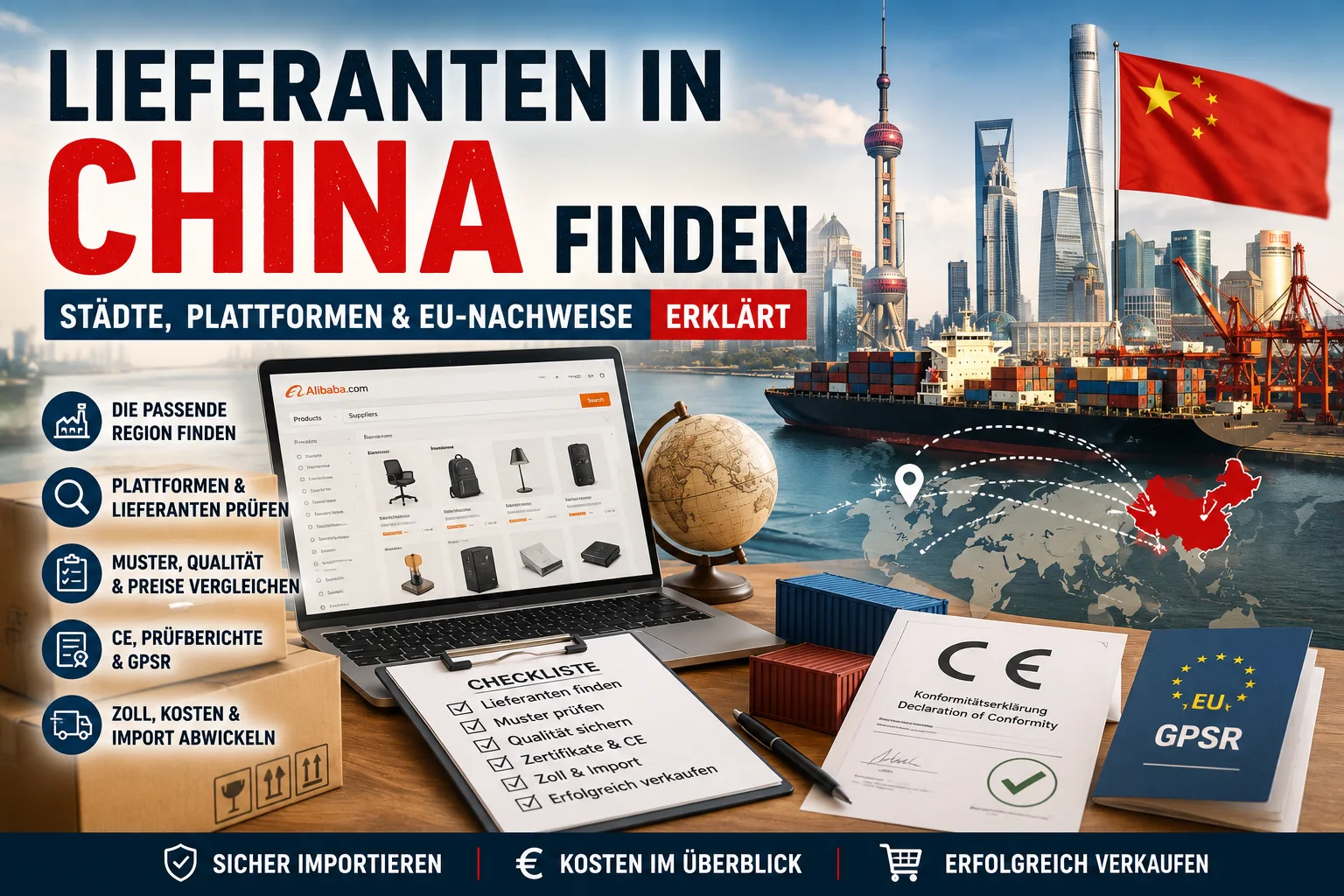
The best approach in short: First describe the desired product, the target market and any quality and safety requirements. Then search for several suppliers in the appropriate Chinese industrial region and on a suitable B2B platform, have comparable offers and samples sent to you and check the business license, manufacturer role and documents for the European market. Only when a close-to-production sample, the technical evidence and the total costs are correct, will a small test order be placed with written product specifications and quality control before shipping. In the case of 1688, multiple factories or difficult communication, a transparent purchasing agency can help - but it does not automatically relieve the German importer of responsibility.
How do you find suppliers in China? The seven steps in short:
- Write a one-page product specification: function, materials, target market, required standards.
- Pick the industrial region that makes your product – Shenzhen for electronics, Yiwu for small consumer goods, Foshan for furniture, and so on (see the city table below).
- Search on a B2B platform that suits your order size: Alibaba for international purchasing, 1688 only with Chinese-language support, Made-in-China and Global Sources for manufacturer-oriented searches.
- Contact five to ten suppliers in plain English with the same request, so that offers are comparable.
- Check business licence, manufacturer role and factory location before you pay for samples.
- Order samples, then a small test order with written specifications and a pre-shipment inspection.
- Collect the EU evidence for exactly this product and model: CE or GPSR documents, test reports, registrations (packaging, electrical equipment, batteries).
Table of contents
- Why AliExpress and Temu are only good for initial orientation
- What you should decide before searching for suppliers
- Which Chinese city matches which product?
- Alibaba, 1688, Yiwugo or trade fair: Where should you look?
- How do you find a manufacturer instead of just a middleman?
- How do you write to Chinese suppliers in English?
- When is a purchasing agency in China worthwhile?
- How do you check samples, minimum quantity and series quality?
- What proof do products need for Germany and the EU?
- How do you obtain test reports, CE documents and registrations?
- How much does it really cost to import?
- The first test order in ten steps
- Frequently Asked Questions About Purchasing in China
This article is current as of July 2026 and provides general guidance. Which regulations and evidence actually apply depends on the specific product, its design and its use; The contribution does not replace individual legal, customs or product advice.
Why AliExpress and Temu are only good for initial orientation
AliExpress and Temu are useful for monitoring product ideas, variants, sales prices and customer reviews. Negative reviews are particularly informative: They show which sizes are missing, which materials seem cheap, which parts often break or which instructions buyers do not understand. This can result in a better product description for later supplier searches.
However, both platforms are only suitable to a limited extent as a permanent source of procurement for a commercial shop. AliExpress describes itself as a global retail platform, Temu also targets consumers. You will therefore not necessarily find the factory there, you will not automatically receive complete technical documentation and you will often only be able to negotiate conditions for packaging, materials, branding or series production to a limited extent.
There is also a point that is neglected in many instructions: a product may not be sold in your shop simply because it is already offered on Temu or AliExpress. Trademark rights, designs, product images and operating instructions may be protected. You also have to check product safety for the European market yourself. An existing offer and a CE illustration in a product photo are not reliable evidence.
Consumer platforms are therefore useful for initial market observation. International B2B platforms, trade fairs, regional wholesale markets or directly researched manufacturers are usually more suitable for building a supply chain.
You record purchase orders and goods receipts with purchase orders in Easy Invoice, linked directly to your products.
What you should determine before searching for suppliers
Anyone who simply asks for a “drink bottle”, “mobile phone case” or “LED lamp” will receive offers that can hardly be compared. One provider calculates thin material and neutral packaging, the other a stronger version with a logo. Both mention a unit price, but mean different products.
Therefore, create a short product sheet before your first inquiry. It should contain at least:
- intended use and target group,
- Dimensions, weight and permissible deviations,
- material, material thickness and surface,
- Colors with an exact reference, for example Pantone instead of “dark blue”,
- Functions, voltage, plug or radio technology, if available,
- desired packaging and labeling,
- Logo, printing process and position of the print,
- planned quantities for samples, test orders and subsequent orders,
- Target market Germany or the European Union,
- required operating instructions and warnings in German,
- Already known EU regulations, standards and test reports.
The last point in particular belongs at the beginning. For example, if a product is considered a toy, electrical appliance, cosmetic product or food contact material, this affects more than just the documentation. It may change material, construction, packaging, testing cost and minimum order quantity. If you only ask this question after production, in the worst case scenario you will have goods that cannot be sold.
Which Chinese city goes with which product?
The assumption is correct: many regional industrial clusters have formed in China. Manufacturers, suppliers, tool makers, packaging companies and wholesalers in the same industry are located close to each other there. This makes product searches, adjustments and price comparisons easier.
The assignment is still not a guarantee. Some places are primarily commercial centers, while the factory is in a neighboring town. Even a provider from the “right” region must be checked individually.
| region | Typical focal points | Important classification |
|---|---|---|
| Yiwu | Gift items, jewelry accessories, stationery, household items, socks and many small consumer goods | Huge trading and procurement space. Not every product offered there is made in Yiwu. |
| Shenzhen and Huaqiangbei | Electronics, components, circuit boards, accessories and prototypes | Strong development and trading environment. Parts of the production are located in the surrounding Pearl River Delta, for example in Dongguan. |
| Guangzhou | Clothing, textiles and wholesale | Suitable for fashion, fabrics and accessories; different districts and neighboring cities have their own specializations. |
| Shiling in Huadu District | Bags, leather goods, fittings and accessories | Complete supply chain from material to finished bag. |
| Foshan | Furniture, ceramics, sanitary products and household appliances | Interesting for home and furnishing products, often with high transport costs. |
| Guzhen in Zhongshan | Lights and lighting technology | Good supplier density, but check electrical safety and technical documentation early. |
| Chenghai in Shantou | Toys | Wide selection and complete supply chain; Toys are also one of the more demanding import categories. |
| Keqiao in Shaoxing | Fabrics, textile materials, dyeing and finishing | Makes sense when material and fabric development are more important than a finished standard garment. |
| Yongkang | Tools, metalware, insulated cups and security doors | Broad metal and hardware cluster with numerous specialized suppliers. |
| Xuchang | Wigs and hair products | Specialized location for synthetic and human hair products. |
For a simple giveaway, the large market in Yiwu may be a better address. On the other hand, anyone who wants to develop their own electronic assembly will find the more suitable environment in Shenzhen. For fabrics, it's worth looking in Keqiao, and for ready-made fashion in Guangzhou and the specialized clothing clusters of the Pearl River Delta.
The benefit of regional search is not just the price. A specialized manufacturer understands typical materials, manufacturing steps and quality issues more quickly than a retailer that also offers kitchen items, toys and electronics.
Alibaba, 1688, Yiwugo or trade fair: Where should you look?
The best platform depends on whether you are looking for an existing product in small quantities, a private label or a completely new version.
| Search path | Suitable for | Boundaries |
|---|---|---|
| Alibaba.com | International B2B purchasing, English communication, samples, OEM and export | Many trading companies; platform badges do not replace your own verification. |
| 1688 | Chinese domestic wholesale, local suppliers and product search | Often Chinese communication, local payment, domestic delivery and no export support. |
| Made-in-China | Manufacturer and industry oriented search | Even tested profiles must be checked on a product-related basis. |
| Yiwugo | Online access to Yiwu Market stalls and small consumer goods | Yiwu is partly a trading center; Manufacturer and place of production may vary. |
| Canton Fair | Personal contact, wide product selection and comparison of many providers | travel and time expenditure; A trade fair stand is not yet proof of the factory. |
| Trade fairs in an industry | Specialized manufacturers, new products and technical discussions | Less suitable if the product idea is still completely open. |
For beginners, Alibaba is usually the easiest place to start. The platform is aimed at international B2B trade and offers supplier profiles, inquiries and transaction protection for suitable orders. According to Alibaba, “Verified Supplier” status means that an external audit has taken place and a report may be available. Check this report anyway: Was the production really investigated? For which product groups? At which location?
When ordering from the platform for the first time, use the intended order and payment method if possible and write the product specification, delivery date and quality requirements in the protected order. Alibaba describes Trade Assurance as protecting payment, agreed delivery and the requirements set out in the order. However, the service does not automatically check whether your product complies with all EU regulations. If a different company or even private account is suddenly named after the agreement, the change should be checked using already verified contact details.
1688 can be interesting if you have a Chinese-speaking employee or purchasing agency. However, the unit price shown there is not automatically your purchase price in Germany. Translation, Chinese domestic delivery, agent fee, warehousing, multiple shipment consolidation, export and international freight are additional.
A common misconception is: “At 1688 I always find the real factory and at Alibaba I only find middlemen.” It's not that simple. There are manufacturers and trading companies on both platforms. A good dealer can even make more sense than a factory for small quantities, several product variants or complicated export processing. It is crucial that you know who you are working with and what service is included in the price.
Which platform shows compliance evidence?
A frequent question from importers who need material declarations or safety documentation: which marketplace is best for finding suppliers that can prove compliance? The honest answer is that no platform checks EU conformity for you. What they offer differs:
| Platform | Supplier verification | Compliance documents |
|---|---|---|
| Alibaba.com | "Verified Supplier" after an external audit; Trade Assurance for the order | Suppliers can upload certificates to their profile; always request the report for your exact model. |
| Made-in-China | "Audited Supplier" reports by third-party firms | Certificates shown per product; check issuer, model number and date. |
| Global Sources | "Verified Supplier" programme, strong on electronics | Test reports on request; useful for CE-relevant products. |
| 1688 | Chinese domestic platform, licence data in Chinese | Rarely any EU-specific documents – you or your agency commission the tests. |
| Trade fairs (Canton Fair, industry fairs) | Personal contact, factory visits possible | Bring your checklist; documents still have to be verified afterwards. |
Whichever platform you use, the steps in the section on EU evidence remain your job as the importer.
How do you find a manufacturer instead of just a middleman?
First, request the Chinese business license. The registered Chinese company name is decisive. The EU SME Centre points out that English company names have no corresponding legal significance in China. Company name, address, bank account, invoice, contract and platform profile should match.
The IHK Düsseldorf also recommends checking your business license, company stamp, bank details and the authority of the contact person. Payments to a private account or to a company with a completely different name require a coherent, verifiable explanation. If in doubt, no deposit should be made.
The role of the provider can be further narrowed down with these questions:
- Are you a manufacturer or trading company?
- Which work steps do you carry out yourself?
- What parts are supplied by other factories?
- What is the exact address of the production facility?
- Can you offer a video call from ongoing production?
- Which machines and testing devices are used for our product?
- What is the monthly capacity for exactly this model?
- What other products are manufactured at this location?
- Who owns molds, print data and technical drawings after payment?
- To which EU countries has this specific model already been delivered?
A provider who only shows catalog images, avoids questions about production or offers completely different product ranges can be a trading company. This is not an automatic reason for exclusion. But it becomes problematic if it pretends to be a factory, hides the actual supply chain or has no control over production.
Compare at least three, preferably five, serious candidates using the same specification. The lowest price is only one criterion. Quality of response, technical queries, complete documents, realistic delivery times and how we deal with errors often say more about the later collaboration.
How do you write to Chinese suppliers in English?
Export-oriented vendors on Alibaba and international trade fairs often have English-speaking sales representatives. You shouldn't assume this for 1688 and smaller factories. Even good everyday English does not prevent misunderstandings regarding materials, tolerances or testing requirements.
Write short sentences and use measurements, drawings, photos and tables. Approvals should not be given only during a phone call or be scattered across WeChat messages. Record the final product specification, packaging, quality limits, delivery time and payment terms in the purchase order or contract.
This template can be customized for the first request:
Subject: RFQ for [exact product] for the German and EU market

Hello,

we are a German online retailer looking for a long-term supplier for
[exact product]. The attached specification is part of our request.

Please quote the following quantities:
- 300 pieces
- 1,000 pieces
- 3,000 pieces

Please include:
- unit price for each quantity
- MOQ
- sample price and sample lead time
- production lead time
- EXW and FOB price
- packaging dimensions, gross weight and units per carton
- cost and MOQ for our logo and custom packaging
- payment terms

Please also confirm:
1. Are you the manufacturer or a trading company?
2. Which production steps are completed in your own factory?
3. What is the factory address?
4. Which EU rules and standards were applied to this exact model?
5. Can you provide the complete EU Declaration of Conformity and full
   test reports for the exact model before we order?
6. Can an independent inspector check the goods before shipment?
7. Which HS code do you normally use for this product?

The destination market is Germany and the European Union. Instructions,
warnings and labels must be available in German where required.

Best regards
[name and company]
The customs tariff number suggested by the supplier is only an indication. The importer remains responsible for the correct classification. The same applies to statements such as “EU approved”, “CE certified” or “all certificates available”. Always ask for the specific document for the specific model.
When is a purchasing agency in China worthwhile?
A purchasing agency is not its own marketplace. She looks for suppliers on your behalf, communicates in Chinese, negotiates, orders samples or collects goods. Depending on the contract, additional services may be added.
An agency is particularly helpful if you:
- want to search primarily on 1688 or local markets,
- want to purchase from multiple suppliers and combine shipments,
- develop your own packaging or product variant,
- have no one in the company who speaks Chinese,
- would like to have factories or goods inspected on site,
- have to coordinate a lot of small orders.
Distinguish between four roles:
- Purchasing agent: looks for suppliers, asks for prices and negotiates.
- Procurement agency: additionally coordinates samples, ordering, packaging and suppliers.
- Testing company: carries out factory audits or goods inspections according to specified criteria.
- Shipping company: organizes collection, consolidation, transport and, if necessary, customs clearance.
A company can take on multiple roles. Then the price and area of responsibility for each service should still be visible separately. For an important order, an independent final inspection makes more sense than an inspection carried out exclusively by the supplier's agent.
There is no generally applicable agent commission. Some service providers charge a fixed amount, others a percentage of the purchase, a markup on the goods, their own exchange rates or a combination of these. Therefore, please have a sample invoice shown with the original price of the goods, agent services, Chinese domestic delivery, storage, control, export and freight. A low commission rate means little if other markups are not visible.
Ask a possible agency:
- What is the registered company and which company account is paid into?
- In which regions and product categories does she regularly work?
- Does it charge a fixed price, a commission, an exchange rate markup or a goods markup?
- Does she receive additional money from the supplier?
- Do you get the name, license and original quotation of the actual factory?
- Who owns molds, patterns, drawings and print data?
- How are samples, shortages and complaints documented?
- What exactly does quality control include?
- Who is the contractual partner for goods, testing and transport?
- Are there verifiable references from your industry?
An agency can save time and solve communication problems. However, it does not turn an untested product into a permitted EU product. An offer “including DDP and certificates” should therefore be broken down into individual services and documents.
How do you check samples, minimum quantity and series quality?
Don't immediately order the minimum quantity just because the unit price looks attractive. A sample shows material, workmanship, function and packaging. However, it does not yet show whether a factory can produce 1,000 pieces with consistent quality.
If there are several candidates, it is worth ordering samples in parallel. Then document:
- weight and dimensions,
- material and material thickness,
- color and surface,
- function and resilience,
- smell, sharp edges or loose parts,
- Print image and position of the logo,
- packaging and protection during transport,
- Completeness of labeling, instructions and warnings.
The approved production sample is often referred to as the “Golden Sample”. Keep it and clearly link it to the written specification. A photo alone is not enough when it comes to material, feel or color.
The minimum order quantity - MOQ for Minimum Order Quantity - can be reduced if you accept standard materials, existing colors and neutral packaging. A small test series can be more expensive per unit, but is often cheaper than a warehouse full of unsaleable or unauthorized goods.
Before production begins, agree:
- which deviations are permissible,
- how many randomly selected pieces are checked,
- which errors are critical, significant or minor,
- what happens if the test is not passed,
- when the remaining amount is due,
- whether rework or a new inspection is possible.
The final inspection should take place after completion, but before shipping and, if possible, before the last large payment. It checks not only the visible product, but also the number of pieces, boxes, shipping markings, accessories and documents.
What evidence do products need for Germany and the EU?
There is no general “EU certificate” that releases every imported product for sale. The necessary evidence depends on the product, material, target group, function and country of distribution. Some products require a CE marking, others are not allowed to bear a CE mark. Still others need registration, labeling or security assessment, but not a classic certificate.
As an importer, you are not just a reseller. According to EU requirements for importers, before selling, you must check that the manufacturer has taken the necessary steps, the documentation is available and the product has been correctly labeled. If you have a product manufactured under your own name or brand, you can legally be considered a manufacturer and assume additional obligations.
This overview shows typical cases. It is deliberately not exhaustive because even small product changes can trigger other regulations.
| Product type | Typical checks and documents to obtain |
|---|---|
| Simple household, decorative or office items without electricity | General product safety according to GPSR, risk analysis, technical product documentation, material requirements such as REACH, traceability, manufacturer and importer data as well as necessary warnings. Usually no CE marking. |
| Clothing and other textiles | GPSR, textile fiber labeling, chemical requirements, traceability and, if applicable, care or warning instructions. Normal clothing usually does not carry CE. |
| Toys | Safety assessment, technical documentation, relevant toy standards such as parts of the EN-71 series, EU declaration of conformity, CE marking and age and warning information. The new EU toy regulation with a digital product passport essentially applies from August 1, 2030; Until then, the previous rules largely apply. |
| Electrical devices without radio | Depending on the product, among other things, low voltage and EMC requirements, RoHS, technical documents, test reports, EU declaration of conformity and CE. Additionally WEEE/ElektroG obligations and registration. |
| Devices with WLAN, Bluetooth or other wireless technology | Requirements of the Radio Equipment Directive RED, including safety, electromagnetic compatibility and radio use; additional cybersecurity requirements, if applicable. In addition, EU declaration of conformity, technical documents, test reports and CE. |
| Batteries or products with batteries | Requirements of the EU Battery Regulation, labels, manufacturer registration and take-back obligations; Regularly suitable transport evidence such as the UN 38.3 test summary for the transport of lithium batteries. There are additional obligations for electrical appliances. |
| Drinking bottles, tableware and other food contact materials | EU rules for food contact materials, information on intended use and, depending on the material, declaration of conformity, material data and migration tests. Plastic, ceramic, paper and metal may be subject to different rules. |
| Cosmetics | EU responsible person, safety report, product information file, correct ingredient and product labeling, manufacturing in accordance with relevant specifications and reporting on the CPNP portal. Cosmetics do not receive a CE mark. |
| Personal protective equipment, medical devices or certain machines | Often complex compliance procedures and, depending on the risk class, the involvement of a notified body. Particularly demanding for a first import without specialist knowledge. |
CE is not a certificate that an authority sells
The EU expressly states that there is no central body that issues a general CE approval. The manufacturer determines the applicable regulations, carries out the required conformity procedure, prepares the technical documentation and then signs the EU declaration of conformity. Only then is the CE mark affixed if it is required for this product group.
For some products, a properly documented assessment by the manufacturer is sufficient according to the relevant regulations. For others, a notified body must be involved. A voluntary certificate with a CE logo is not automatically a legally required proof of conformity.
GPSR also applies to products without CE
The EU Product Safety Regulation GPSR has been in effect for many consumer products since December 13, 2024, unless more specific rules already cover the respective safety aspect. There must be a responsible economic operator in the EU for each affected product. Manufacturers and importers need, among other things, traceability, safety information and appropriate technical documentation.
For online offers, according to Article 19 of the GPSR, among other things, the manufacturer's information must appear clearly, and in the case of a manufacturer outside the EU, the responsible person in the EU, product identification and necessary warning and safety information must also appear. This information therefore does not belong on the box, but must be taken into account when designing the product page.
Registrations are not product certificates - but are still a requirement
Before commercial import, an EORI number is regularly required for customs clearance. Registration in the LUCID packaging register and participation in the system may be required for packaging. The Central Packaging Register Office focuses on who bears legal responsibility for the packaged goods when crossing the border.
Anyone who imports electrical devices or batteries and offers them in Germany for the first time can be considered a manufacturer under German law. The stiftung ear explains the registration obligations for importers. An existing CE marking does not replace this registration.
For cosmetics, a responsible person in the EU, a safety report and notification in the free Cosmetic Products Notification Portal are required. This is also not a CE certification.
How do you get test reports, CE documents and registrations?
The right time is before the deposit for series production. Do this in this order:
1. Classify the product legally
First, clarify what the product is legally and how it will be used. A decorative figure can be a normal decorative item or, based on design and advertising, a toy. A simple lamp can also contain radio technology. A drinking bottle is a food contact material, a bottle with a filter or health advertising claims can raise further questions.
The EU trade assistant Access2Markets provides initial information on customs duties, import formalities and product-related requirements. For national technical regulations, the Product Information Points of the EU Member States can help. For toys, electronics, cosmetics, protective products or other sensitive categories, it makes sense to get expert product or legal advice before ordering.
2. Request documents for the exact model
Do not ask for “all certificates” across the board. Depending on the product, request specifically:
- complete EU declaration of conformity,
- complete test reports instead of just a cover sheet or certificate photo,
- exact model, article and version numbers,
- List of applied EU regulations and standards,
- risk analysis and other technical documentation,
- Material and parts lists for safety-relevant components,
- drawings and product description,
- Designs of nameplates, packaging and labels,
- German instructions as well as safety and warning information,
- for food contact materials, the required declaration of conformity and migration data,
- for cosmetics, recipe information, safety documents and information for the product information file,
- for lithium batteries, the UN 38.3 test summary belonging to the specific battery type.
According to the EU, the technical documentation must, among other things, bring together the product description, applicable regulations, standards used, risk analysis, relevant test reports, labeling and instructions in a comprehensible manner.
3. Check whether the document and the goods belong together
A real lab report may apply to a different model. Therefore compare:
- manufacturer name and address,
- model number and photos,
- electrical data and components,
- material and dimensions,
- applied standard with year of issue,
- Date and scope of the test,
- name and contact details of the laboratory,
- Number of pages and completeness of the report.
If you have a certificate from a notified body, also check whether the body is named in the European NANDO database for exactly this regulation and product group. NANDO is not the general list for every testing laboratory. A notified body is only required if the specific conformity procedure provides for it.
4. Commission any missing tests yourself
If documents are missing, outdated or do not match the planned design, have a near-production sample evaluated by an independent testing laboratory. Tell the lab the target market, use, audience, all variants and planned labeling. The laboratory can suggest the necessary scope of testing; The legal classification and completeness of the entire conformity procedure should still be clarified.
The test should be carried out on the same construction and with the same safety-related materials and components that will be produced later. If the factory then replaces the power supply, radio module, plastic or coating, previous results may lose their significance.
5. Complete documentation, labeling and product page
Before the sale, the product, packaging, accompanying documents and online offer must match. These can include:
- model, type, batch or serial number,
- name and contact address of the manufacturer,
- Name and contact address of the importer or responsible EU economic actor,
- CE mark, but only if required,
- WEEE symbol, battery or other legal markings,
- ingredients, materials or fiber composition,
- Age information and warnings,
- German instructions and safety information,
- GPSR information directly in the online offer.
The EU declaration of conformity is signed by the manufacturer or his authorized representative. If you sell a product made specifically for you under your brand, you are often considered the manufacturer yourself and must assume the corresponding responsibility. A testing laboratory does not “give” you this responsibility; it provides results for your documentation.
6. Complete necessary registrations before the start of sales
Depending on the product and sales model, EORI, LUCID and system participation, electric or battery registration, CPNP or other national reports follow. Do not plan these steps for the day the goods arrive. Some registrations must be completed before they are first offered or placed on the market.
How much does importing really cost?
The unit price from the chat is not the price at which the product is in your warehouse. Calculate at least:
Goods price + samples + tooling and printing data + packaging + Chinese domestic costs + quality control + international freight + insurance + customs + customs clearance + tests and documentation + registrations + storage + expected defects and returns
A simplified example shows the difference: 500 items at 3 euros each initially cost 1,500 euros. For example, individual packaging and setup costs 250 euros, 250 euros for inspection, 650 euros for freight and insurance, 200 euros for customs clearance and other import costs and 800 euros for necessary product tests. This means that the cost is already 3,650 euros or 7.30 euros per salable item, before shipping within Germany, storage costs and import sales tax. This is not a tariff calculation, but shows why the factory price alone says little.
The duty rate depends on the correct customs tariff number and the origin of the goods. The import sales tax is often not a final cost block for companies entitled to deduct input tax, but it initially burdens liquidity and must be proven correctly. Have the calculation checked by a shipping company, customs agency or tax advisor when you import the goods for the first time.
The delivery condition – the Incoterm – also changes the offer:
- EXW: You take over the organization and many costs practically from the factory.
- FOB: The supplier brings the goods to the agreed port of shipment and on board; From there you continue to organize.
- CIF: Main freight and certain insurance to the destination port are included, but the costs and tasks thereafter are not complete.
- DDP: The seller promises delivery including import processing and duties to the named location.
DDP sounds the easiest for beginners. Nevertheless, clarify who appears as the importer in the customs declaration, what value of goods and tariff number are stated and whether you receive complete import documents. DDP does not automatically transfer your product safety, labeling, packaging or manufacturer registration responsibilities to the Chinese seller.
If goods from multiple suppliers are to be included in one shipment, an agency or shipping company can consolidate them in a Chinese warehouse. This doesn't always save money: additional domestic transport, storage, testing and repackaging costs have to be taken into account against the saved international freight.
The first test order in ten steps
- Determine the product and target group. Describe the function, material, dimensions, packaging and desired quantity.
- Pre-check EU requirements. Clarify whether CE, GPSR, food contact, cosmetics, electrical, battery or other rules are affected.
- Choose the appropriate region and search methods. Use industry clusters, B2B platforms, trade fairs and, if necessary, an agency.
- Ask multiple suppliers identically. Compare not only the unit price, but also MOQ, documents, packaging, delivery time and Incoterm.
- Check companies and contact persons. Business license, Chinese company name, place of production, bank account and contractual partner must be consistent.
- Order samples from two or three candidates. Check and document product, packaging, communication and delivery time.
- Check evidence or order tests. Do this before ordering a series and with a sample that is close to series production.
- Order a small test series in writing. Product specification, Golden Sample, defect limits, delivery date and payment plan become part of the order.
- Check goods before shipping. The final inspection takes place after completion and before shipping or final payment.
- Complete customs, registrations and sales documents. Only when import, labeling, German instructions and online information have been clarified does the product belong in the shop.
Frequently asked questions about purchasing in China
Do Chinese suppliers speak English?
Often yes on international B2B platforms and export trade fairs. Not reliable on 1688 and smaller local factories. However, technical misunderstandings still arise even if you have a good knowledge of English. Therefore, use drawings, tables, clear units and a written approved product specification.
As a German company, can I order directly from 1688?
Some providers and payment methods allow this, but the process is geared towards the Chinese domestic market. International payment, export processing, English communication or international shipping are often missing. Small German companies therefore often need a purchasing agent or their own partner in China.
Is a middleman fundamentally worse than a factory?
No. A trader can better bundle smaller quantities, multiple product types and export formalities. A factory, on the other hand, often offers more influence on materials, construction and long-term series prices. It is not the retailer itself that is problematic, but rather a misrepresentation of its role or an opaque supply chain.
How do I know if a supplier is trustworthy?
There is no single seal that guarantees this. Combine business license and company verification, video or site audit, technical queries, appropriate documents, samples, secure payment methods and a small first order. Platform badges are a filter, not the end of your verification.
Is an EORI number sufficient for commercial imports?
No. The EORI number serves as identification for customs. Depending on the product, you may also need product safety documentation, labels, registrations and correct sales information. LUCID, electrical or battery registration as well as CE or GPSR obligations are not replaced by the EORI number.
Is the supplier's CE certificate sufficient?
Not automatically. First check whether the product is even subject to CE requirements. The declaration of conformity, technical documentation and test reports must then match the exact model, manufacturer and current product. A general certificate, a CE logo or a report for another variant is not enough.
Does DDP mean I don't have to worry about anything anymore?
No. DDP primarily regulates the agreed delivery, costs and customs clearance between buyer and seller. It does not automatically eliminate your role as an importer, private label manufacturer or obligated party under product and packaging law. Have the customs declaration and import documents shown and clarify the roles before ordering.
Can an agency ship goods from multiple suppliers together?
Yes. Consolidation is one of the services frequently offered by purchasing agencies and shipping companies. Ask in advance about domestic transportation, storage time, inspection, repacking, export documents and the allocation of risks of loss or damage.
Do I have to travel to China myself for my first purchase?
No. Video calls, external company audits, samples and independent goods controls also enable a sensible entry from Germany. If tool costs are high, development is complex or order values are large, a personal visit or factory audit can still make economic sense.
Which products are particularly difficult for beginners?
Electronics, radios, toys, cosmetics, personal protective equipment, medical devices, food and products with lithium batteries often involve higher testing, documentation and registration requirements. A technically simple item without electricity, physical contact, food contact or child reference is usually easier to assess, but is still subject to product safety and possible material regulations.
The crucial step when shopping in China is therefore not finding the cheapest item. It is the translation of a product idea into a testable specification, a traceable supplier and complete documentation for the target market. Anyone who does this work before ordering a series can realistically assess prices and opportunities - and can recognize early on if a supposed bargain becomes too expensive due to tests, freight or risks. Orders and supplier documents belong in the same place — that is what purchase orders are for.
Handle invoices more easily
Easy Invoice combines quotes, invoices and customer management in the cloud.
Try Easy InvoiceRead next
 E-Commerce & Marketplaces
New eBay Terms of Service from 15 September 2026: What Sellers Should Check Now
New eBay terms apply from 15 September. Four things change, and one of them can cost you your account.
 E-Commerce & Marketplaces
Creating invoices for Shopify
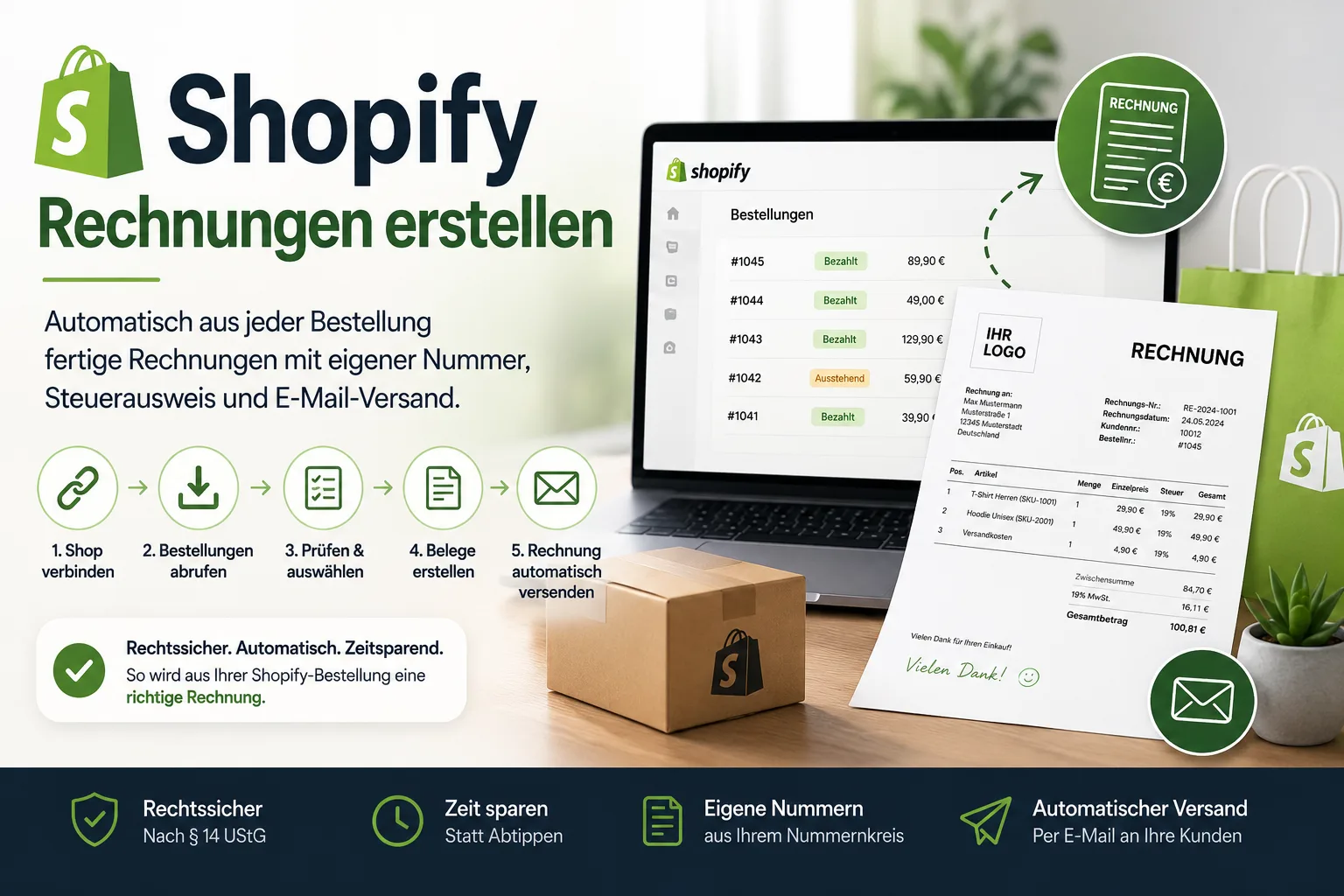
Shopify sends order confirmations – not invoices. How to get from a Shopify order to a finished invoice in five steps, with your own number, correct tax details and automatic sending.
 E-Commerce & Marketplaces
eBay vehicle parts: free returns mandatory since 28 September – what it costs you
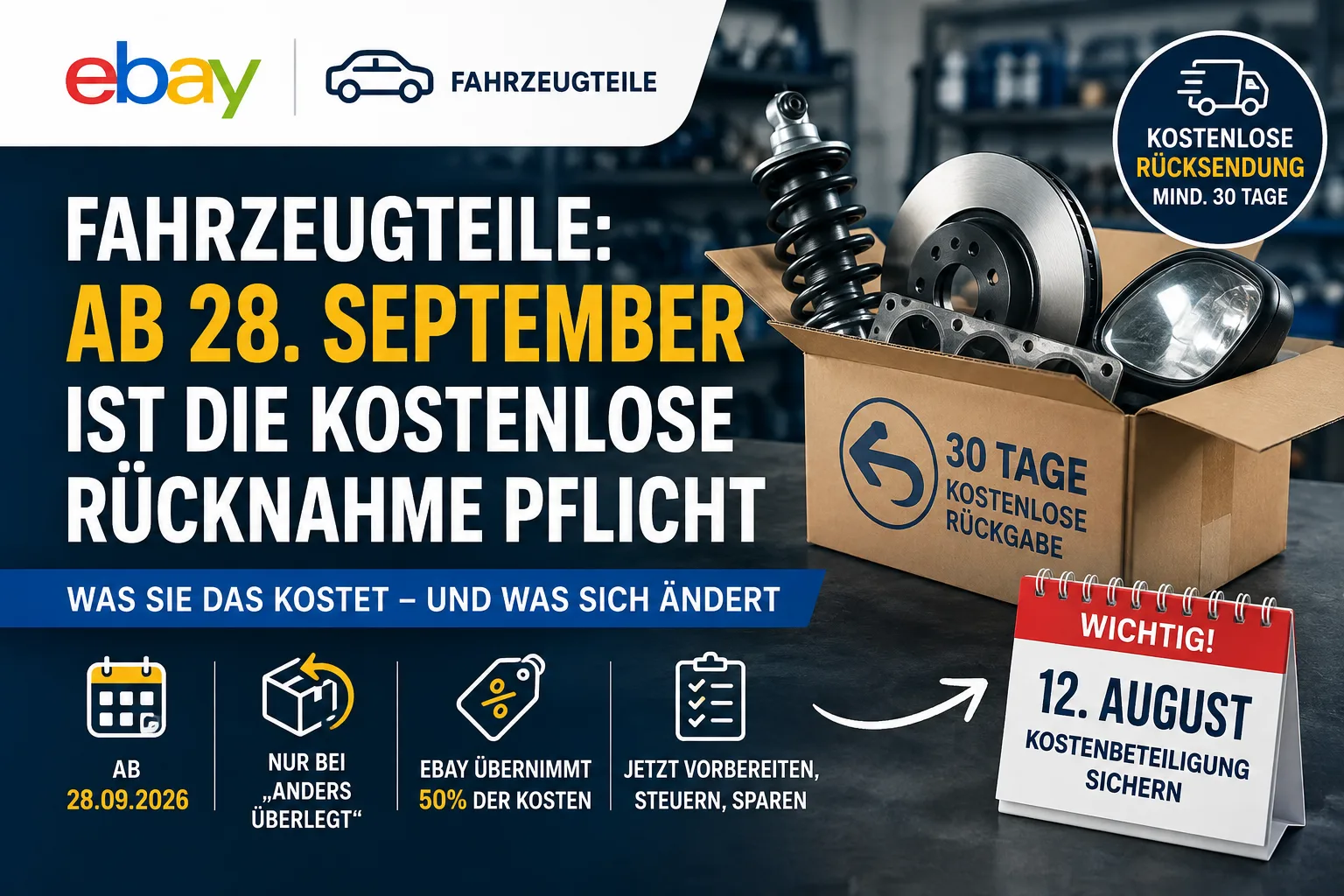
New parts over 10 euros at a fixed price: since 28 September you have to take them back free of charge for 30 days and adjust your withdrawal policy. Which returns are not covered, what the rule costs and what to check now.