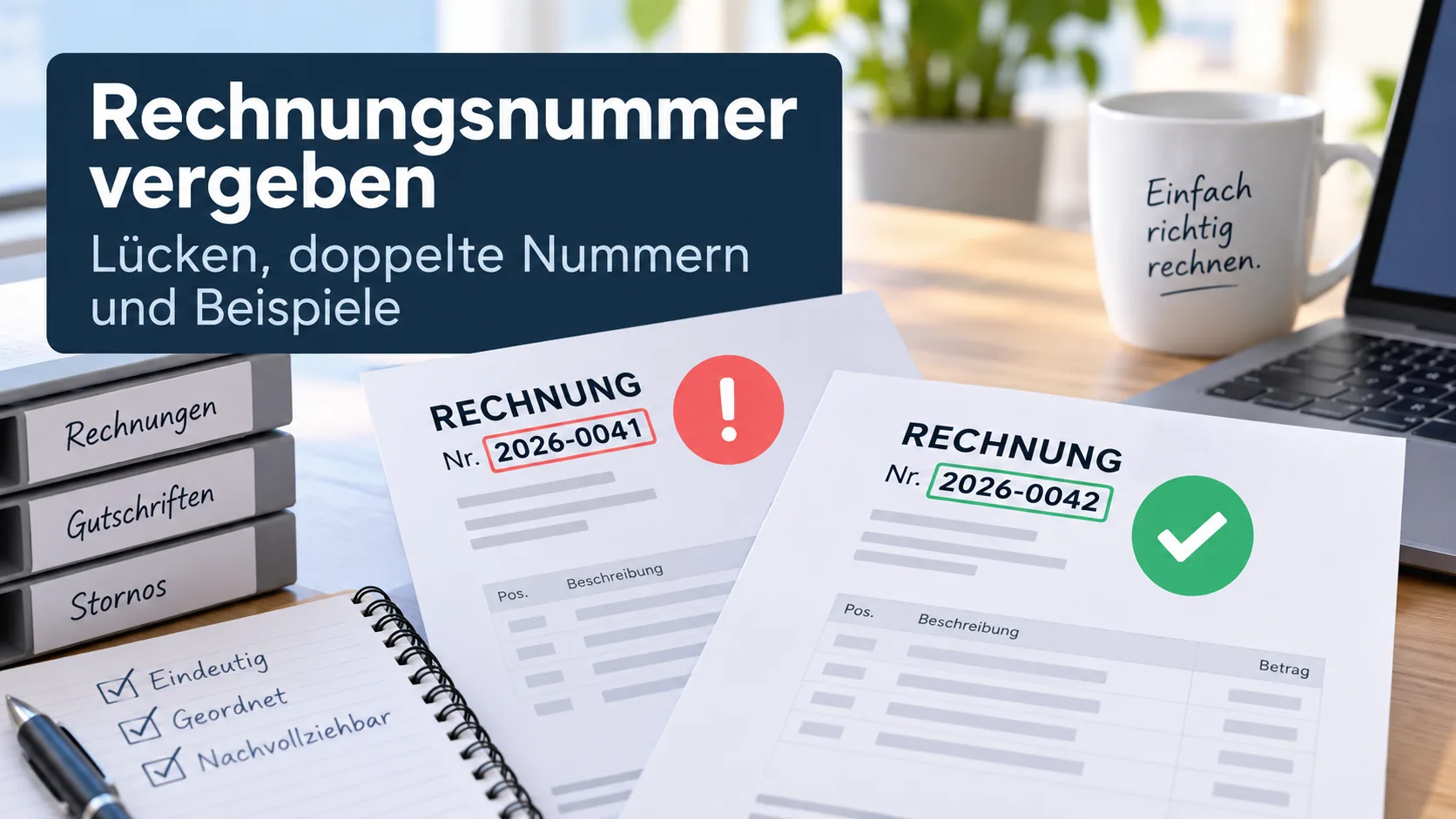
If you have issued the same invoice number twice, that is a formal error and no reason to panic. You correct it with a correction document that refers unambiguously to the invoice concerned. That correction takes effect retroactively to the date of the original invoice, so your customer keeps the input VAT deduction.
On gaps, the answer has two halves. German VAT law does not require an unbroken sequence (section 14.5(10) of the VAT Application Decree, UStAE). The principles of proper bookkeeping (GoBD) do require orderly allocation and use gaps as a test criterion – every gap must be explainable by a document. Issuing numbers at random is not a VAT problem but a bookkeeping problem.
This article provides general information and does not replace tax advice.
Contents
- Number issued twice: what happens now
- How to repair a duplicate number
- Do invoice numbers have to be gapless?
- What the law requires – and what it does not
- Examples and multiple number ranges
- When VAT law requires no number
- Frequently asked questions
Number issued twice: what happens now
Two invoices carrying the same number breach section 14(4) sentence 1 no. 4 UStG. The provision requires a number issued once only to identify the invoice. If two invoices are numbered alike, the number no longer identifies anything.
The consequences sort themselves by who is affected:
| Who it affects | What happens |
|---|---|
| Your customer | Their invoice is formally not in order. The input VAT deduction is open to challenge until it is corrected |
| You | A formal defect in your records. You owe your VAT unchanged; section 14c UStG does not apply |
| Your bookkeeping as a whole | It is not rejected because of this. For that the tax office needs grounds to object to the substantive accuracy (section 158(2) no. 1 of the German Fiscal Code, AO) |
The last point is the one that causes the most fear. An estimate under section 162 AO presupposes that the records cannot be used as the basis for taxation. A single duplicate number that can be explained and corrected does not meet that bar. It looks different if numbers are systematically duplicated or omitted and the link between documents and turnover breaks down.
How a tax audit actually proceeds here is covered in the article on the GoBD-compliant invoice. An invoicing program for the self-employed issues the numbers itself and rules the error out – doing it by hand in Word makes it practically unavoidable as soon as more than one person writes invoices.
How to repair a duplicate number
The decisive point first: you do not change the invoice you sent. You write a document that corrects the incorrect detail and refers specifically and unambiguously to the original invoice (section 31(5) UStDV).
Proceed like this:
- Decide which of the two invoices keeps the number. Usually the one sent first.
- Write a correction document for the second one. It states which invoice is meant – with the old number and the invoice date – and which number applies from now on.
- Send it to the customer. Returning the original invoice is not required.
- File both together. The original invoice and the correction belong in the same place.
A separate number range for the correction document is not needed; it does not even need an invoice number of its own, as long as it names the number of the original invoice (section 14.11(1) UStAE).
The good news on timing: the correction takes effect retroactively to the day the invoice was first issued. The condition is that the original document contained five core details: issuer, recipient, description of the service, consideration and separately stated VAT. The invoice number expressly does not belong to those five. If they are present, the correction always has retroactive effect (section 15.2a(7) UStAE). Your customer therefore keeps the input VAT deduction in the original period.
A full cancellation with a new invoice is also possible and can have retroactive effect. How that works is covered in the article on correcting an invoice.
Do you have to report this to the tax office? No. A duty to notify arises only when a filed tax return is incorrect or incomplete and tax could be understated as a result (section 153(1) AO). If you declared both transactions in full, the duplicate number changes nothing about that. You correct it, file both and produce them if asked.
And if you only notice years later? Correct it anyway. An invoice can be corrected and submitted up to the close of the final oral hearing before the tax court (section 15.2a(7) UStAE). For everyday purposes that means a correction made during an ongoing audit is not too late.
Do invoice numbers have to be gapless?
Two sets of rules apply side by side here, and anyone who knows only one of them draws the wrong conclusion.
VAT law does not require gaplessness. The VAT Application Decree states literally: „An unbroken sequence of the invoice numbers issued is not mandatory" (section 14.5(10)). What is required is that each number is issued only once and can be assigned unambiguously to its number range.
The GoBD – the principles for the proper keeping and retention of books – look at it from the other side. They require every business transaction to be recorded individually, completely and in an orderly manner (section 146(1) AO), and they expressly name gap analysis on document numbers as a control for completeness (GoBD margin no. 40). The unique document number is described there as a „criterion for completeness control" (margin no. 77). A tax auditor works exactly that way: they ask for the sequence of numbers and enquire about the missing document at every gap.
Taken together this means:
- A gap is not a breach as long as you can evidence it. A cancellation with a visible cancellation document, a discarded draft your program logged, a new number range at the turn of the year – all of that is explainable and fine.
- A gap without an explanation is a completeness problem. The auditor then assumes an invoice is missing and turnover went unrecorded. That is the route to an additional estimate – not because of the number, but because of the turnover presumed missing.
- Issuing numbers at will is not permissible. The GoBD require orderly allocation. A system has to be recognisable, otherwise no completeness control is possible, and that is precisely a breach of section 146 AO.
The practical advice is therefore narrower than the VAT Application Decree sounds: issue the numbers sequentially and make sure every gap has a document behind it. An invoicing program that issues the number only when the invoice goes out, and keeps cancellations as their own documents, produces no unexplained gaps of its own accord.
What the law requires – and what it does not
Section 14(4) sentence 1 no. 4 UStG requires „a sequential number with one or more series of numbers, issued once only by the invoice issuer to identify the invoice". Nothing more is stated there. In concrete terms:
| Allowed | Not allowed |
|---|---|
plain number series: 2026-0041 | issuing the same number twice |
letter series and combinations: RE-2026-B-0041 | overwriting a number afterwards in an invoice already sent |
| several separate number ranges side by side | a number that cannot be assigned to any range |
| gaps in the sequence, where a document explains them | gaps without a document – a completeness problem under the GoBD |
| the date as part of the number |
There is no requirement as to length, separator, or that the number must begin with the year. Anyone selling you a particular scheme as mandatory is mistaken.
Two clarifications on scope. First, the number is a genuine mandatory detail – an invoice without one is not in order. Two special cases carry relief, see the section When VAT law requires no number. Second, the provision applies only to invoices. Quotations, order confirmations and delivery notes need no sequential number under VAT law. In practice they are numbered anyway, otherwise nothing can be found later.
Practice does draw one line: nobody should be able to deduce from the number how few invoices you write. Anyone at 2026-0007 in November gives that away to their customer. Many therefore start at a higher figure – which is permissible, because the number merely has to be unique.
Examples and multiple number ranges
Four schemes that have proven themselves in practice:
| Scheme | Example | Suits |
|---|---|---|
| Year plus running number | 2026-0041 | most small businesses |
| Year, month, running number | 2026-09-041 | anyone billing monthly |
| Prefix per document type | RE-2026-0041, GS-2026-0007 | anyone separating invoices and credit notes |
| Prefix per location or division | HH-2026-0041, B-2026-0018 | several branches or permanent establishments |
How many number ranges you run is up to you. Ranges for areas delimited by time, geography or organisation are permissible – periods, branches, permanent establishments (section 14.5(11) UStAE). The only condition is that each invoice can be assigned easily and unambiguously to its range and that the number is unique within it. That is exactly what a prefix is for.
Two special cases with their own rule:
- Credit notes. If your customer invoices for your service, they issue the sequential number from their range, not you (section 14.5(13) UStAE). More on this in the article on creating a credit note.
- Continuing obligations as an e-invoice. Here a unique number contained in the contract is sufficient, for instance a property or tenant number. The individual payment documents need no sequential number of their own (paragraph 12).
When VAT law requires no number
Two types of invoice do not carry the sequential number as a mandatory VAT detail (section 14.5(14) UStAE):
- Small-amount invoices up to 250 euros gross (§ 33 UStDV). The hardware store receipt is the standard example.
- Transport tickets (§ 34 UStDV).
These reliefs concern the VAT side alone. For your own records a number remains sensible: without one, an individual document is hard to place as soon as two transactions with the same date and the same amount sit next to each other.
Note for small businesses
On 1 January 2025 § 34a UStDV came into force, a dedicated provision for invoices issued by small businesses under section 19 UStG. It lists the details such an invoice must contain and departs from the requirements of section 14 UStG. Until the end of 2024 this special rule did not exist.
Whether and how anything changes for your invoice numbers as a result depends on how § 34a UStDV interacts with the recording and retention duties of the Fiscal Code. That question cannot be answered across the board, because it depends on your method of profit determination and your other recording duties. Clarify it with your tax adviser before changing your existing numbering practice. Anyone who has numbered sequentially so far does nothing wrong by keeping that practice.
What else belongs on a small business invoice is covered in the article on the invoice without VAT.
Frequently asked questions
Invoice number issued twice – what should I do? Write a correction document naming the invoice concerned with its old number and date, and stating the new number. The invoice you sent stays unchanged. The correction takes effect retroactively to the original date.
What are the consequences of a duplicate invoice number with the tax office? It is a formal defect. It costs neither you your bookkeeping nor your customer their input VAT deduction permanently, as long as you correct it. For an estimate the tax office would have to be able to object to the substantive accuracy.
Do invoice numbers have to be gapless? Not under VAT law – the VAT Application Decree says expressly that an unbroken sequence is not mandatory. For bookkeeping the rule is: every gap must be explainable by a document, because the GoBD use gap analysis as a completeness control. An unexplained gap is treated as missing turnover.
What does a good invoice number look like? For example 2026-0041. Digits, letters and combinations are permissible; there are no requirements as to length or structure. All that matters is that the number is unique.
May I run several number ranges? Yes, as many as you like – per year, per branch or per document type. Each invoice must be assignable unambiguously to its range.
Do I have to start at 1 again in the new year? No, you do not have to. You may, because a number range per period is permissible. If you include the year in the number, it stays unique anyway.
What applies to small businesses? Since 1 January 2025, § 34a UStDV governs the details on invoices issued by small businesses independently. How that affects numbering depends on your other recording duties and belongs in a conversation with your tax adviser. Anyone numbering sequentially is on the safe side.
Do I have to report a duplicate number to the tax office? No. The duty to notify under section 153 AO applies where a tax return is incorrect and tax could be understated. If both transactions are declared, that is not the case here.
Do quotations and delivery notes need sequential numbers too? Not under VAT law, the provision applies only to invoices. For your own order, numbering them is sensible nonetheless.
May the invoice number contain the date? Yes. A combination of digits and letters is permissible; the date is merely a special case of that.
Numbers you do not have to think about
Duplicate numbers almost never arise from ignorance but from manual work: a copied Word file, a second employee, a template carrying last month's number. In office1.cloud the program issues the number when the invoice goes out, sequentially and separated by document type. Issuing a number twice is thereby technically ruled out.
If something does need correcting, the correction document is created straight from the existing invoice, with a reference to the original. Try Easy Invoice for free.
Sources
- Section 14 German VAT Act – issuing invoices
- Section 31 UStDV – details in the invoice
- Section 33 UStDV – small-amount invoices
- Section 34a UStDV – invoices issued by small businesses
- Section 146 German Fiscal Code – rules for keeping books
- GoBD – principles for the proper keeping and retention of books, BMF letter of 28 November 2019, margin nos. 30 to 41 and 61 to 77 (AO Handbook, Annex 64)
- Section 158 German Fiscal Code – evidential value of bookkeeping
- Section 162 German Fiscal Code – estimation of tax bases
- German VAT Application Decree, sections 14.5, 14.11 and 15.2a (Federal Ministry of Finance) An invoicing software writes invoices with every mandatory detail in minutes.
Handle invoices more easily
Easy Invoice combines quotes, invoices and customer management in the cloud.
Try Easy InvoiceRead next
 Invoicing & Accounting
Instalment agreement with customers: template and rules
Your customer asks whether they can pay the invoice in three instalments. Before you agree, two things matter: the tax office will not wait, and your favour legally becomes a loan.
 Invoicing & Accounting
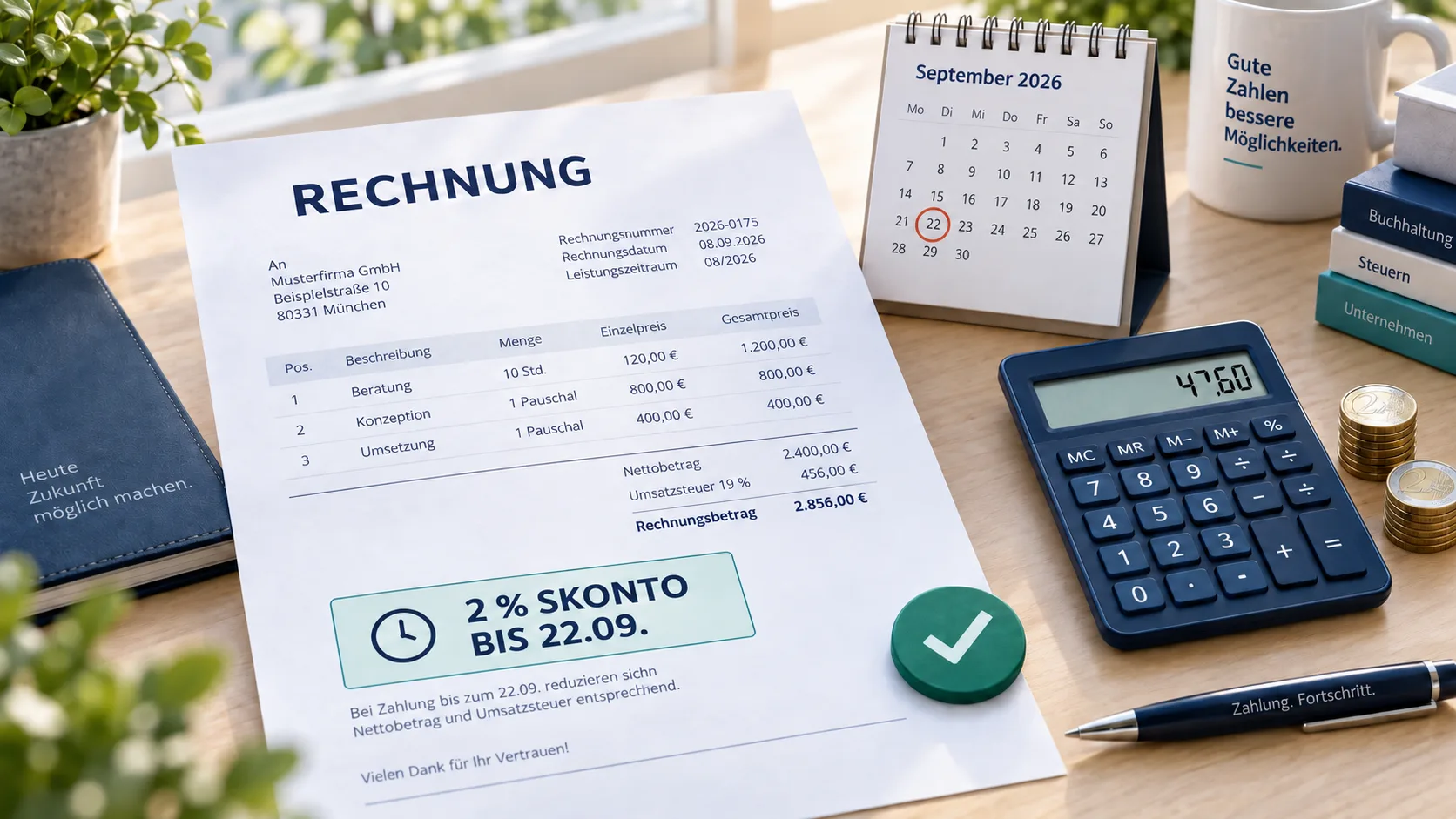
Cash Discount on an Invoice: Wording, Deadline and VAT
A client deducts a cash discount even though they paid far too late – and looking at your invoice, you realise your wording never settled the point.
 Invoicing & Accounting
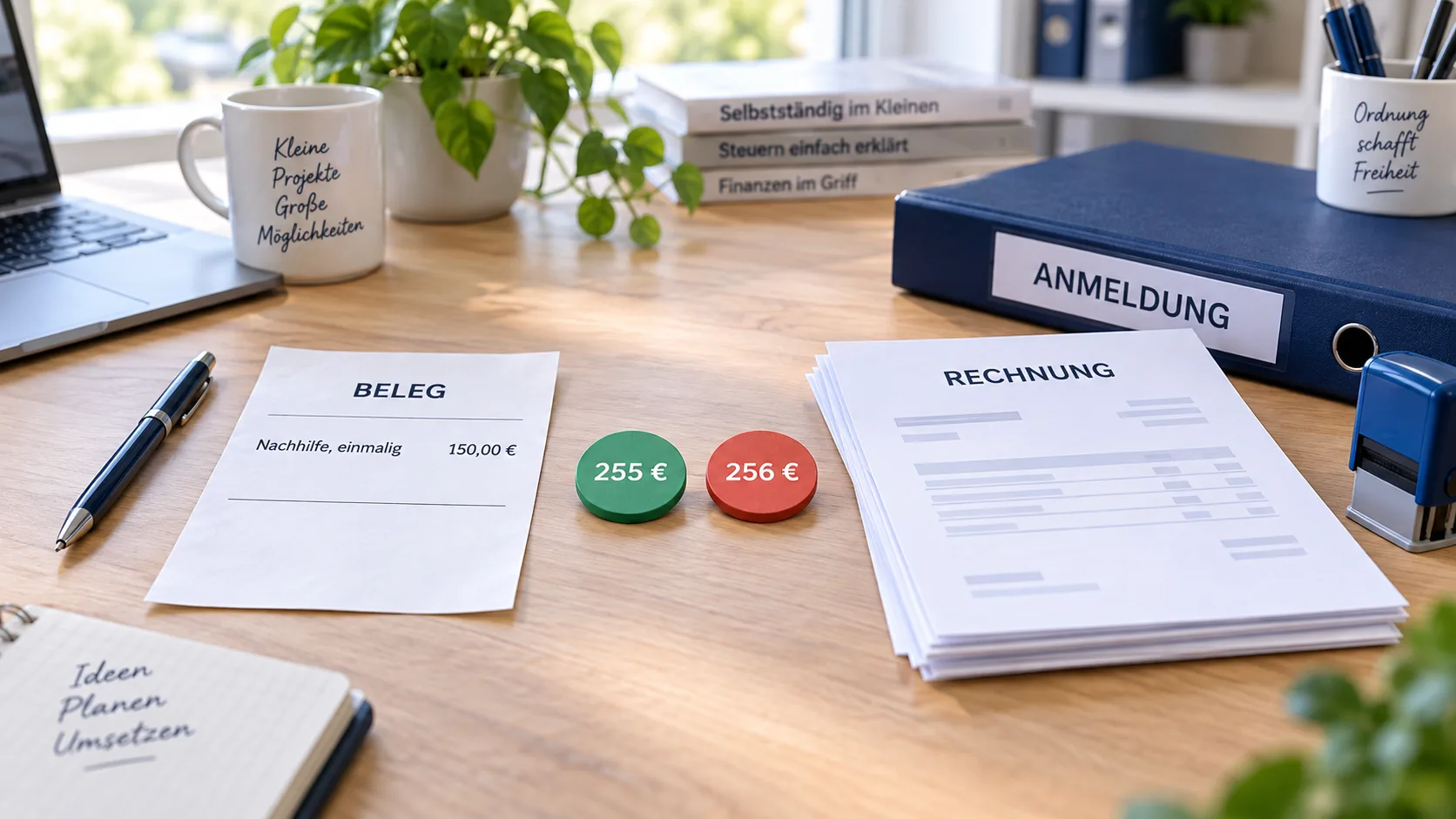
Invoicing Without a Trade License in Germany: Allowed, With a Limit
A client wants an invoice, but you haven't registered a trade. You may still write one – the real question is when a favor turns into an obligation.