
An instalment agreement needs three details: the total amount, the number and size of the instalments, and each due date written out as a calendar date. A template you can copy is further down. You may offer a customer instalments, but you never have to – and if you agree, expect German VAT to fall due in full straight away, as soon as you have delivered the goods or performed the service. With a private customer, interest-free instalments count legally as a deferral of payment, and that carries a right of withdrawal. From 20 November 2026 this situation is regulated far more strictly.
This article gives general information and does not replace legal or tax advice. If you are unsure about your own case, ask your tax adviser or a lawyer.
Contents
- Do I have to offer instalments?
- One invoice or several?
- Template for the instalment agreement
- The expensive part: VAT does not wait
- With private customers, instalments are credit
- What changes on 20 November 2026
- The customer stops paying: what you may do
- Business customers: a shorter leash
- Klarna, PayPal and others: handing over the risk
- Frequently asked questions
Do I have to offer instalments?
No. No law forces you to. Your customer owes the invoice amount by the agreed payment term, and that stands unless you agree otherwise. Instalments are a later change to the contract, and both sides have to consent to it.
So you are not saying „no" to a right your customer holds. You are turning down an offer, and you may do that without giving reasons.
Many businesses still agree, usually for one of two reasons. Either the job is large enough that it would otherwise not happen at all – a fitted kitchen, a roof, a photo series, a coaching package. Or the customer is already in payment difficulties, and instalments are the only way to see any money at all. These two cases look identical in the contract but differ sharply in risk. In the first you are choosing freely; in the second you already have a problem.
The middle path few people think of: a deposit plus a short payment term for the rest. You get money early, the customer gets breathing space, and you stay out of the credit rules described in With private customers, instalments are credit – provided everything is paid within 50 days of delivery.
One invoice or several?
One. You write a single invoice for the full amount and settle the instalments alongside it, either in the invoice itself or in a separate agreement.
The most common mistake is writing three invoices for a third each. That tells the tax office you performed three services. You did not: you fitted one kitchen, and the customer pays it off in three steps.
The exception is called a partial service (Teilleistung) and its conditions are narrow. It exists where the fee for specific parts of an economically divisible service has been separately agreed (§ 13 (1) no. 1 (a) UStG, the German VAT Act). An example: you were commissioned separately to tile the bathroom first and then the kitchen, each with its own price. Those are two partial services, and each may have its own invoice. A kitchen paid off in three monthly instalments is not a partial service.
| What you are doing | How many invoices | Why |
|---|---|---|
| Customer pays off one service in instalments | one invoice for the total | There is only one service. The instalments are a payment arrangement |
| Separately commissioned parts, each with its own price | one invoice per partial service | Partial service under § 13 (1) no. 1 (a) UStG |
| Customer pays before you deliver | interim invoice, final invoice later | With advance payments the tax arises when the money arrives |
If you would rather not retype payment terms and due dates on every invoice, store them once in your invoicing software; the due date then appears on the document as a specific date.
Template for the instalment agreement
For small amounts a paragraph on the invoice is enough. From around 1,000 euros use a separate sheet that both parties sign. The reason is simple: without a signature you cannot prove in a dispute that the customer agreed to the instalments.
You can copy both texts below into Word or your invoicing software. Replace the square brackets and the example figures with your own.
What belongs in every template – eight points:
| Point | Why it must not be missing |
|---|---|
| Both names with full addresses | Without clearly identified parties the agreement is worthless in a dispute |
| Reference to the invoice with number and date | Otherwise it is unclear which claim is being deferred |
| Total amount in euros | The basis for the 10 per cent threshold in case of default |
| Number and size of the instalments | The most common gap in free templates |
| Every due date as a specific calendar date | „monthly" is not enough. Without a date there is no default without a reminder |
| A sentence on freedom from interest and fees | Keeps you out of German consumer credit law |
| A rule for a missed instalment | See the warning just below |
| Place, date, both signatures | Proof that the customer agreed |
A warning about ready-made templates from the internet: many PDF and Word templates contain the sentence „If one instalment is in default, the entire remaining balance falls due immediately." Against a private customer that sentence does not help you, because § 498 BGB sets stricter conditions. Check every downloaded template at this point before you use it.
Short form for the invoice:
Payment terms: the invoice amount of EUR 3,600.00 is payable in three equal instalments of EUR 1,200.00 each, due on 1 October 2026, 1 November 2026 and 1 December 2026. The instalment arrangement is free of interest and fees.
Separate agreement, in full:
Instalment agreement
between [your company name, address] – hereinafter the creditor –
and [customer name, address] – hereinafter the debtor –1. The debtor owes the creditor EUR 3,600.00 arising from invoice no. 2026-0148 dated 15 September 2026.
2. The parties agree on payment in three instalments of EUR 1,200.00 each, due on 1 October 2026, 1 November 2026 and 1 December 2026 respectively.
3. The instalment arrangement is free of interest and fees. No additional costs arise.
4. If the debtor fails to pay an instalment in full or at all, the statutory rules apply. The creditor may demand the entire remaining balance only once the conditions of § 498 BGB are met and the period provided for there has expired without payment.
5. The goods delivered remain the property of the creditor until payment in full.Place, date – signature of creditor – signature of debtor
Three notes on this template:
- Point 3 is not decoration. The moment you charge interest, a handling fee or a surcharge, the deferral becomes a paid financing facility (§ 506 BGB). Against consumers the full consumer credit regime then applies, with written form, mandatory disclosures and an annual percentage rate. If mandatory disclosures are missing, the transaction is initially void (§ 507 (2) BGB). For most trade businesses the interest-free route is the only practical one.
- Point 4 looks weak and is not. The widespread clause „If one instalment is in default, the total amount falls due immediately" gets you nowhere against a consumer, because § 498 BGB sets stricter conditions. The section The customer stops paying explains them.
- Point 5 applies only to movable goods (§ 449 BGB). With a fitted kitchen or a service, retention of title has nothing to attach to. And even with movable goods you may only demand the item back once you have withdrawn from the contract (§ 449 (2) BGB).
The expensive part: VAT does not wait
This is the point that surprises most businesses: your VAT liability does not follow the instalments.
If you account for VAT on agreed consideration – the standard case in Germany, known as Sollversteuerung – you owe the tax at the end of the reporting period in which the service was performed (§ 13 (1) no. 1 (a) UStG). Not when the money arrives.
An example using the figures from the template: EUR 3,600 gross, of which EUR 574.79 is VAT. You fit the kitchen in September. You declare the EUR 574.79 in the September return and transfer it. At that point you have seen nothing from the customer – the first instalment arrives on 1 October. So you are financing the tax yourself, with three instalments for roughly two months.
How to avoid this: with cash accounting under § 20 UStG. The tax then arises only when the money arrives, so instalment by instalment. The tax office may permit it on application, among other cases where your total turnover in the previous year did not exceed EUR 800,000, and also for members of the liberal professions under § 18 (1) no. 1 EStG and for those exempt from bookkeeping obligations. It is an application, not a choice you simply make.
| Your situation | When you owe the VAT |
|---|---|
| Accrual accounting (standard case) | in full in the month or quarter of the service, regardless of the instalments |
| Cash accounting under § 20 UStG (on application) | with every incoming payment, so per instalment |
| Advance payment before the service | when the money arrives, even under accrual accounting |
| Small business under § 19 UStG | not at all, because you do not show VAT |
Income tax is a separate question and depends on whether you prepare a balance sheet or a cash-basis profit statement. Under the cash-basis statement, the moment of receipt counts, so each individual instalment. How to prepare it is covered in the article Filing your tax return as a self-employed person.
With private customers, instalments are credit
Your private customer may withdraw from the instalment agreement within 14 days, and you have to inform them of this beforehand. That applies even if you charge nothing at all for the instalments.
The reason: legally you are granting time that the contract does not give them. The law calls this a deferral of payment and treats it like a loan.
For the interest-free case this follows from § 515 BGB: where a business grants a consumer a deferral of payment free of charge, § 514 BGB applies accordingly. And § 514 (2) BGB gives the consumer a right of withdrawal under § 355 BGB. You must inform them before they make their contractual declaration; the law provides a model text for this in Annex 9 to the EGBGB.
The period is 14 days and starts when the contract is concluded (§ 355 (2) BGB).
Two points that ease the burden:
- The right of withdrawal does not apply if the customer already has one under § 312g (1) BGB – for instance because you concluded the contract at a distance or away from your business premises.
- What is withdrawn is the instalment agreement, not your original order. The customer then owes the invoice amount in one go again.
If you do charge interest or a fee, § 506 BGB applies and with it almost the entire consumer credit regime: pre-contractual information, written form, mandatory disclosures, annual percentage rate. For a business that grants a few instalments on the side, this is barely achievable.
None of this applies to business customers. Under § 13 BGB, a consumer is only someone who concludes the contract for private purposes.
What changes on 20 November 2026
In short: if your private customer needs more than 50 days to pay, from 20 November 2026 you will be treated legally like a credit provider. You will then have to check before agreeing whether they can repay at all, hand them prescribed documents and inform them of their right of withdrawal. If everything is paid within 50 days, nothing changes for you.
Three monthly instalments cross that line. Two instalments within seven weeks do not.
Now the explanation behind it.
On 20 November 2026 the German act implementing the EU Consumer Credit Directive (EU) 2023/2225 takes effect. It has been passed and was published in the Federal Law Gazette on 18 May 2026 (BGBl. 2026 I no. 139).
Until now, small, interest-free and short-term credit largely fell outside consumer credit law. That ends. According to the Federal Government, „small loans up to 200 euros, interest- and fee-free credit, credit with a term of up to three months and so-called ‚buy now, pay later' models" are being brought within the consumer protection rules for credit agreements. Those three corners are exactly where the typical instalment arrangement of a trade or service business sits.
The 50 days come from the directive itself. Under Article 2(2)(h), a deferral of payment stays outside the scope where no third party offers credit, the deferral is free of interest and charges, and „the payment is to be made in full within 50 days of the delivery of the goods or the provision of the services". For larger distance providers that are not small or medium-sized enterprises, the period shortens to 14 days.
Your three cases at a glance:
| Your arrangement | Until 19 Nov 2026 | From 20 Nov 2026 |
|---|---|---|
| Everything paid within 50 days, interest-free | right of withdrawal under § 515 in conjunction with § 514 (2) BGB | stays outside consumer credit law |
| Three monthly instalments, interest-free | right of withdrawal under § 515 in conjunction with § 514 (2) BGB | falls within the extended scope |
| With interest or a fee | § 506 BGB, consumer credit law | unchanged and strict |
The obligations coming to commercial credit providers extend as far as assessing the customer's creditworthiness. How far they reach a small business that grants instalments twice a year has not yet been settled by the courts. If you regularly offer instalments running longer than 50 days, clarify your position well before 20 November 2026 – either with a lawyer or by switching to a payment service, see Klarna, PayPal and others. Existing agreements are not affected by the new rules.
The customer stops paying: what you may do
With a consumer you may not simply demand the entire remaining balance after the first missed instalment. § 498 BGB, which applies to interest-free instalments via § 514 and § 515 BGB, requires three things at the same time:
- The customer is in default on at least two consecutive instalments, in full or in part.
- They are in default on at least 10 per cent of the total amount – for terms longer than three years, 5 per cent is enough.
- You have set them a two-week deadline to pay the arrears, without success, and stated that you will otherwise demand the entire remaining balance.
The law also provides that you should offer them a conversation about an amicable solution, at the latest when you set the deadline.
These hurdles do not apply where the amount is below EUR 200 (§ 514 (1) sentence 2 in conjunction with § 491 (2) sentence 2 no. 1 BGB). Nor do they apply to business customers.
You may charge default interest from each missed instalment: against consumers, five percentage points above the base rate (§ 288 (1) BGB). What happens when the deadline passes as well is covered in the article The customer is not paying – what now?.
A practical side effect of the instalment agreement that many overlook: once the customer pays the first instalment, they generally acknowledge the debt. That works in your favour if there is later a dispute about the invoice itself.
Business customers: a shorter leash
If your customer is a business, the whole consumer credit regime falls away. You agree the instalments freely, you may charge interest, and you may include a clause making the remaining balance fall due immediately on a missed instalment.
Two points that stand better for you in a B2B case:
- Default interest: nine percentage points above the base rate instead of five (§ 288 (2) BGB).
- A flat EUR 40: where a non-consumer is in default, you are additionally entitled to a flat EUR 40. § 288 (5) sentence 2 BGB makes clear that this also applies „where the payment claim is an instalment or other part payment". So with three missed instalments, three times.
The VAT question from the section VAT does not wait is unaffected. It depends on your accounting method, not on the type of customer.
If you want to keep track of instalment dates, what you mainly need is an overview of which documents are outstanding on a given day. Try Easy Invoice for free – open items appear there as at your chosen date, and reminder stages run to your own settings.
Klarna, PayPal and others: handing over the risk
If you settle through a payment service, it is no longer you granting the credit but the provider. That changes your position fundamentally: you receive the full amount immediately, and the default risk sits with the service. The obligations under consumer credit law then fall on the provider, not on you.
For its instalment product in Germany, PayPal states 3, 6, 12 or 24 instalments on purchases between EUR 99 and EUR 10,000, and says on risk: „Once you have completed the transaction, you receive the full amount. So there is no additional risk for you if customers do not pay on time." Klarna works on the same basic model.
You pay for this with a fee per sale that is higher than a card rate. Providers negotiate terms individually and do not publish them consistently for instalment products; ask them for a quote based on your turnover.
| You grant the instalments yourself | Payment service | |
|---|---|---|
| When you see money | gradually, over months | immediately after the sale |
| Default risk | with you | with the provider |
| Cost | no direct cost, but administration and chasing | fee per sale |
| Legal obligations | with you, stricter from 20 Nov 2026 | with the provider |
| Suits | one-off cases, regulars, workshop trade | when instalments come up regularly |
The point that usually decides it: a single instalment agreement a year does not justify a contract with a payment service. If you are asked every month, however, the fee buys you not only security but, from 20 November 2026, freedom from the obligations as well.
Frequently asked questions
How do I word the fact that a customer may pay in instalments?
With three details: the total amount, the number and size of the instalments, and each due date as a specific calendar date. Plus the sentence that the arrangement is free of interest and fees. A template is in the section Template for the instalment agreement.
May I charge interest or a handling fee?
Against business customers, yes. Against private customers this turns the arrangement into a paid financing facility under § 506 BGB, which brings the consumer credit regime with written form and mandatory disclosures. If those disclosures are missing, the instalment transaction is initially void under § 507 (2) BGB.
Do I need a licence to offer instalments?
Not for an interest-free deferral granted to individual customers. Anyone granting credit commercially does need a licence. If instalments become part of your business model, have your position checked legally before 20 November 2026.
Do I pay the VAT per instalment or all at once?
In the standard case all at once, in the reporting period of the service (§ 13 (1) no. 1 (a) UStG). Instalment by instalment only if the tax office has granted you cash accounting under § 20 UStG.
What do I do if the customer stops after the second instalment?
With a private customer, set a two-week deadline for the arrears and state that you will otherwise demand the entire remaining balance. Only once two consecutive instalments are outstanding as well, amounting to at least 10 per cent of the total, can you accelerate the balance (§ 498 BGB). These hurdles do not apply to business customers.
Does the customer have to sign the agreement?
For interest-free instalments the law prescribes no particular form; an arrangement by email is valid. You need the signature not for validity but as evidence. As soon as you charge interest or fees, the written form required by consumer credit law applies instead.
How long do I have to keep the instalment agreement?
Under § 147 (3) AO, accounting vouchers must be kept for eight years and other documents relevant for taxation for six. The simplest approach is to file the agreement with the invoice and treat both alike.
Does this also apply to customers abroad?
For consumers elsewhere in the EU, protection generally follows the law of their country of residence. The Consumer Credit Directive applies across the EU, but its implementation differs in detail. Clarify the individual case before you agree.
Sources
- § 13 UStG – When the tax arises
- § 20 UStG – Calculating tax on payments received
- § 506 BGB – Deferral of payment, other financing facilities
- § 507 BGB – Instalment transactions
- § 514 BGB – Free-of-charge loan agreements
- § 515 BGB – Free-of-charge financing facilities
- § 498 BGB – Acceleration of instalment loans
- § 491 BGB – Consumer credit agreement
- § 449 BGB – Retention of title
- § 288 BGB – Default interest and other damage
- § 355 BGB – Right of withdrawal in consumer contracts
- § 147 AO – Rules on retaining documents
- Directive (EU) 2023/2225 on consumer credit agreements
- Federal Ministry of Justice: act implementing Directive (EU) 2023/2225
- Federal Government: better protection in credit agreements
- PayPal: instalment payments for merchants
Handle invoices more easily
Easy Invoice combines quotes, invoices and customer management in the cloud.
Try Easy InvoiceRead next
 Invoicing & Accounting
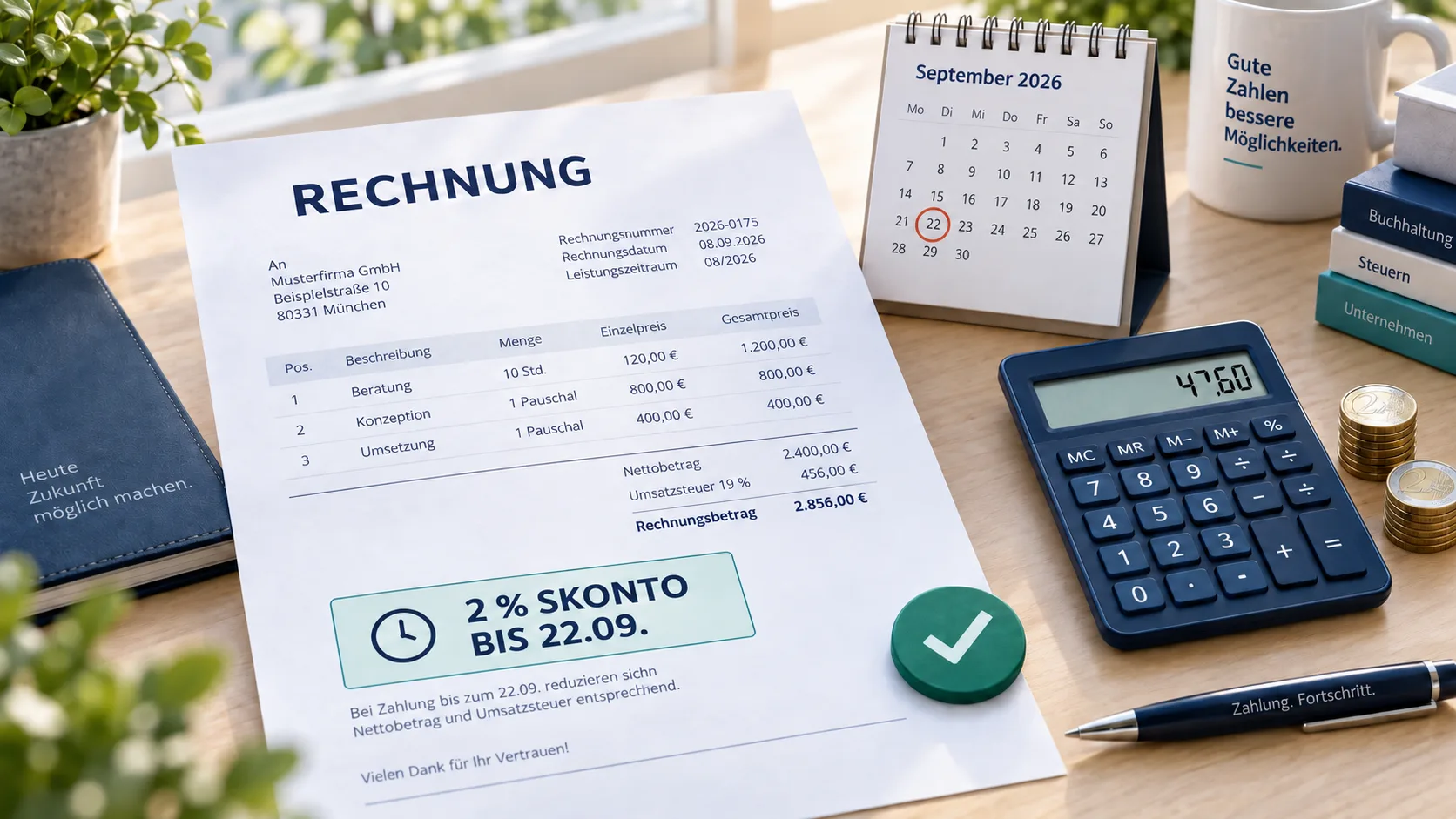
Cash Discount on an Invoice: Wording, Deadline and VAT
A client deducts a cash discount even though they paid far too late – and looking at your invoice, you realise your wording never settled the point.
 Invoicing & Accounting
Invoicing Without a Trade License in Germany: Allowed, With a Limit
A client wants an invoice, but you haven't registered a trade. You may still write one – the real question is when a favor turns into an obligation.
 Invoicing & Accounting
Payment terms on an invoice: wording, deadlines, default
How long may your customer take, what do you put on the invoice, and when may you send a reminder? The answers, with wording you can copy.